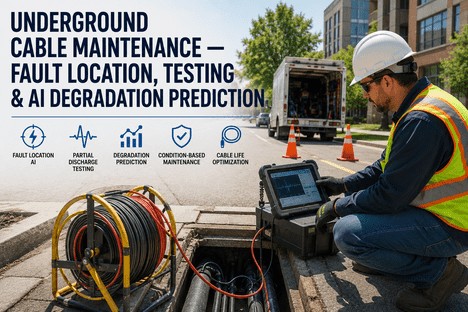
Every utility network runs on underground cables. Yet most maintenance managers will tell you the same truth: they do not know what condition their cables are in until one of them fails. The cable fault locator market was valued at $827.5 million in 2025 and is projected to reach $1.8 billion by 2035 at 8.5% CAGR. Cable maintenance services are forecast to climb from $13.5 billion in 2026 to $24.6 billion by 2036. The industry is investing heavily in keeping underground infrastructure operational. But the dominant approach remains reactive — wait for a fault, locate it, dig it up, repair it, repeat. The organisations that are changing this pattern are shifting from reactive fault response to AI-driven condition prediction, and they are cutting outage-related costs by up to 40% in the process. iFactory's Cable Intelligence module was purpose-built to make this shift possible at network scale.
Stop Finding Faults After They Happen. iFactory Predicts Them Before They Cost You Downtime.
iFactory's Cable Intelligence module gives utility maintenance managers real-time visibility into underground cable condition across every substation and every feeder — with AI-powered fault location, online partial discharge monitoring, and insulation degradation prediction that tells you which cables to replace and when.
Projected cable fault locator market by 2035 at 8.5% CAGR — utilities investing in AI-powered diagnostics will capture disproportionate reliability gains
67%
Of medium and high voltage cable failures traced to installation workmanship defects — detectable years before failure with partial discharge testing
40%
Potential reduction in outage-related costs when moving from reactive fault response to AI-driven condition-based cable maintenance
23+ yrs
Average age of underground cable assets in major urban networks — aging infrastructure demands predictive analytics, not calendar-based replacement schedules
The Real Problem With Underground Cable Maintenance Is Not the Cable Age — It Is the Blindness
Most utilities know their cable assets are aging. What they do not know is which cables are deteriorating fastest, where the next failure will occur, and whether today's maintenance budget is being spent on the right feeders. The operational challenge of managing underground cable networks is not that cables fail — it is that the first indication of trouble is usually the failure itself. And in a network where cable diagnostics data is scattered across disconnected test sets, spreadsheets, and individual engineer memories, the inability to see degradation before it becomes an outage is not a technology problem — it is a data integration problem that iFactory was designed to solve.
How Reactive Cable Maintenance Fails — and What the Pattern Looks Like
The Visibility Gap
Substations see alarms. Control rooms see outages. Nobody sees the degradation happening between them.
Without continuous cable condition monitoring, the first sign of insulation degradation is a customer outage. Partial discharge begins years before failure — producing measurable electrical signals that reveal exactly where insulation is weakening. But without the sensors and analytics to capture those signals, the degradation remains invisible until the cable fails catastrophically. The cost of this visibility gap includes emergency repairs at premium labour rates, regulatory penalties for unplanned outages, and the customer trust erosion that follows each preventable blackout.
Unplanned Outage Cost + Regulatory Risk
The Calendar Trap
Replacing cables by installation date means replacing good cables while failing ones stay in the ground.
The conventional approach to cable replacement is age-based: replace feeders once they cross a threshold installation age. This ignores the reality that cables of the same vintage in different environments degrade at fundamentally different rates. A feeder in dry, stable soil may operate reliably for 45 years. A parallel feeder installed the same year in a high-moisture, load-cycled corridor may fail at year 22. Calendar-based replacement spends capital on cables that do not need replacement and misses cables that do — producing both wasted investment and preventable failures in the same programme.
Capital Waste + Preventable Failures
The Diagnostics Fragmentation Problem
Different teams test cables with different tools and methods — and no central data repository connects them.
In a typical multi-substation utility, cable testing is performed by different field teams using a mix of VLF test sets, tan delta analysers, partial discharge detectors, and insulation resistance testers — each generating data in a different format, stored in a different spreadsheet, reviewed by a different engineer. Year-over-year trending of cable condition across the network becomes impossible. The data exists, but it cannot be compared, combined, or converted into a prioritised replacement plan. The network condition assessment is a stack of PDFs rather than a queryable database that management can act on.
No Historical Trending + Siloed Data
The Workforce Knowledge Drain
The engineer who remembers which feeders have a history of PD activity is retiring — and taking that knowledge with them.
Underground cable networks accumulate institutional knowledge over decades. The senior engineer who knows that Feeder 7 on the north side has had recurring partial discharge for three years, or that the termination on Feeder 12 was repaired after a dig-in in 2019, carries memory that no database captures. When that engineer retires, the knowledge leaves with them. A centralised cable intelligence platform captures this history as structured, accessible data — ensuring that the condition history of every feeder survives personnel changes and becomes the algorithmic foundation for replacement prioritisation.
Managing Each Feeder Separately Is Not Cable Asset Management. It Is a Collection of Blind Spots. iFactory Gives You the Network View.
A single platform view of every cable's condition score, partial discharge trend, fault history, and predicted remaining life — updated with every test result, without manual data compilation, without the spreadsheet consolidation that takes your engineers days every quarter.
What iFactory's Cable Intelligence Module Actually Does
iFactory is not a reporting layer bolted on top of disconnected test equipment. It is a unified cable asset intelligence platform where every feeder, every test result, and every fault event is registered, tracked, and analysed in a single data environment — with role-based access that gives network managers the cross-substation visibility they need and gives field engineers the diagnostic tools that match their testing workflow.
Capability 01
AI-Powered Fault Location — Find Underground Cable Faults in Minutes, Not Days
Precision Fault Detection
iFactory integrates with time-domain reflectometers, acoustic fault locators, and cable diagnostic systems to create a centralised fault location platform. When a fault occurs, the system correlates electrical signature data with GIS-integrated cable route maps to pinpoint fault location within metres — not the approximate kilometre-range typical of manual fault location methods. The AI engine learns from past fault signatures to accelerate future location by recognising pattern matches between present waveforms and historical fault types. For networks managing hundreds of kilometres of underground cable across multiple substations, the time saved per fault event translates directly into reduced outage duration and lower restoration cost. The system also maintains a searchable fault history database, enabling engineers to identify repeat offenders — specific cable sections or joint locations that fail multiple times — and prioritise them for root cause analysis or replacement.
Sub-metre fault precision
Multi-technology integration
AI-assisted signature recognition
Capability 02
Online and Offline Partial Discharge Testing — Detect Insulation Weakness Before It Becomes a Failure
Insulation Intelligence
iFactory supports both online PD monitoring — using high-frequency current transformers on cable grounding leads and capacitive couplers at terminations — and offline PD testing using VLF energisation with simultaneous PD measurement. The platform aggregates PD data from both sources into a single trending database, enabling engineers to track PD activity levels, phase-resolved patterns, and trend direction over time. When PD activity crosses a configurable threshold, the system alerts the responsible engineer with the specific feeder identification, PD magnitude in picocoulombs, and location along the cable length — enabling targeted intervention before the defect progresses to failure. The online monitoring mode operates continuously without service interruption, while offline testing provides baseline data for newly installed cables or periodic network-wide assessments. Together, they give maintenance teams a complete picture of insulation health across every voltage class in the network.
Online continuous monitoring
Offline VLF-enabled PD testing
Threshold-based PD alerting
Capability 03
AI-Driven Insulation Degradation Prediction — Replace Cables Based on Condition, Not Calendar Age
Predictive Analytics
iFactory's degradation prediction engine combines partial discharge trends, tan delta measurements, insulation resistance history, and operational data — load profiles, thermal history, soil moisture correlation — to produce a per-feeder condition score and remaining life estimate. Instead of relying on a single diagnostic measurement, the AI model fuses multiple data streams to identify accelerating degradation patterns that no single test can reveal in isolation. The output is a prioritised cable replacement list sorted by predicted failure probability, enabling maintenance managers to allocate capital replacement budgets to the feeders that need it most, regardless of installation age. The model improves over time as more data is collected, and it can be recalibrated as new cable types, installation methods, or environmental conditions are introduced to the network.
Multi-variate condition scoring
Remaining life estimation
Risk-prioritised replacement lists
Capability 04
Network-Wide Cable Asset Dashboard — Every Feeder, Every Substation, One Unified View
Unified Visibility
iFactory aggregates cable asset data from every substation in the network into a single geospatial dashboard. Every feeder is displayed with its current condition score, last test date, PD trend graph, fault history timeline, and predicted remaining life. Network managers can filter by condition severity, cable type, installation decade, or geographic zone to identify patterns that would be invisible in substation-by-substation reporting. The dashboard supports what-if analysis for replacement planning — modelling the impact of replacing specific feeders on network reliability metrics and budget requirements over five and ten year horizons. This turns the annual cable replacement planning process from a subjective discussion based on engineer judgement into an objective, data-driven decision framework that can be defended to regulators and financial stakeholders.
Geospatial cable condition map
Cross-substation trend analysis
Replacement scenario modelling
Managing a Mixed Cable Network — Why Different Cable Types Require Different Diagnostic Approaches in the Same Platform
One of the underappreciated challenges of underground cable network management is that different cable types do not just require different maintenance schedules — they require fundamentally different diagnostic approaches and degradation models. A network with PILC cables installed in the 1970s alongside XLPE cables from the 1990s and recent EPR installations cannot be managed with a one-size-fits-all testing protocol. Each insulation type has distinct failure mechanisms, different diagnostic test sensitivity, and different remaining life prediction models. Managing all of them in a single analytics environment requires a platform that can apply cable-type-specific logic without forcing a common denominator approach on all assets.
How iFactory Handles Cable-Type Diagnostic Differences Within a Single Multi-Feeder Network
Cable Type
Primary Degradation Mode
How iFactory Configures Diagnostics for This Type
MV PILC
Moisture ingress, lead sheath corrosion, dielectric loss acceleration
Tan delta slope tracking for moisture content estimation, DC insulation resistance trending, lead sheath condition logging with corrosion risk scoring, dielectric loss factor trending over time
MV XLPE
Water treeing, void formation, termination and joint defects
VLF tan delta with voltage dependence analysis for water tree detection, offline PD mapping per feeder, online HFCT PD monitoring for service-aged cables, trend-based condition indexing
HV XLPE
Electrical treeing, sheath damage, joint and termination defects
Online continuous PD monitoring with sub-metre location accuracy via synchronised sensors, sheath current monitoring for outer sheath integrity, joint condition tracking with temperature correlation
Thermal age calculation based on historical load profiling, moisture content correlation through dielectric response analysis, multi-voltage tan delta response characterisation for ageing assessment
"
We were managing over 400 kilometres of underground cable across twelve substations with a combination of spreadsheets, individual test set outputs, and the collective memory of our senior engineers. Every quarter, we spent a week consolidating test data from five different diagnostic sources into a condition report that was already obsolete by the time it was reviewed. The first month on iFactory, we identified three feeders with accelerating PD trends that our previous siloed review process had missed entirely. One of them was predicted to fail within six months. We scheduled replacement before the outage occurred. That single intervention justified the platform investment.
— Manager of Underground Cable Asset Management, Regional Utility — 22 Years Power Distribution
Conclusion
The cable fault locator market is heading toward $1.8 billion by 2035 at 8.5% CAGR, cable maintenance services are projected to reach $24.6 billion by 2036, and the average age of underground cable assets continues to climb across every major urban network. The underground facilities maintenance market — valued at approximately $66 billion in 2025 — reflects the scale of the infrastructure challenge that utilities face globally. The defining test for underground cable maintenance in this decade is not whether cables will degrade. It is whether your organisation will know which cables are degrading fastest and act before they fail.
The utilities that solve this challenge with AI-driven condition prediction and centralised cable intelligence will outperform those running reactive, calendar-based programmes on every metric that matters: outage frequency, restoration time, maintenance cost per feeder, capital replacement efficiency, and the network reliability that determines regulatory outcomes and customer satisfaction. The diagnostic data already exists at every substation. What has been missing is the management layer that connects it into a single, actionable view of network-wide cable health.
iFactory's Cable Intelligence module connects every diagnostic data source, every feeder, and every substation into a single real-time network view — with AI-powered fault location, online partial discharge monitoring, degradation prediction analytics, and the network dashboard that gives maintenance managers the information they need to replace the right cables at the right time, regardless of installation age. Book a Demo to see how the platform maps to your network's specific cable types and substation configuration, or talk to an expert to begin your cable intelligence configuration and get your first network condition dashboard live within thirty days.
Frequently Asked Questions
iFactory supports integration with a wide range of cable diagnostic instruments, including VLF test sets, tan delta analysers, partial discharge detectors, time-domain reflectometers, and insulation resistance testers from major manufacturers. Data can be imported through automated file parsing, direct instrument connectivity, or API-based integration for compatible systems. In the initial deployment phase, iFactory can operate alongside your existing testing workflow — field teams continue using their current instruments, and test results are uploaded to the platform for centralised analysis and trending. The full condition-based replacement workflow becomes available as historical data accumulates in the platform. Talk to an expert to review your current instrument inventory and integration requirements.
Yes. iFactory's cable intelligence architecture supports heterogeneous testing environments where different substations or regions within the same utility apply different testing protocols, at different frequencies, using different equipment. The platform normalises data from all sources into a consistent condition assessment framework, so a feeder tested quarterly with online PD monitoring and a feeder tested annually with offline VLF and tan delta both produce comparable condition scores and trend data. The system tracks which methodology was used for each data point, so engineers can evaluate whether changes in condition scores reflect actual degradation or methodology differences. Book a Demo to walk through the multi-substation configuration for your specific network structure and testing protocols.
iFactory's AI prediction engine uses cable-type-specific degradation models that are calibrated to the known failure mechanisms of each insulation system — PILC, XLPE, EPR, and others. The model accepts contextual parameters including installation year, soil type, average load current, historical fault exposure, and environmental moisture conditions as input features. This means the same AI engine applies a fundamentally different degradation model to a 1970s PILC feeder in coastal clay soil than to a 2010s XLPE feeder in arid inland conditions, producing condition scores and remaining life estimates that reflect each feeder's specific risk profile. As more inspection and test data is collected from each feeder, the model calibrates its predictions to the observed degradation rate of that specific asset. Talk to an expert to discuss how the prediction model would be configured for your specific cable inventory and environmental conditions.
For a utility network managing multiple substations with mixed cable types, iFactory's standard implementation sequence covers: weeks one to two for network architecture configuration and cable asset register population from existing GIS and CMMS data; weeks three to five for diagnostic instrument integration and data import pipeline setup; weeks six to eight for condition score calibration and AI model initialisation using available historical test data; and weeks nine to twelve for dashboard configuration, threshold setting, and engineering team training. The first network-wide cable condition dashboard is typically available for management review within the first thirty days, with the AI degradation prediction engine producing prioritised replacement recommendations once a minimum of two test cycles have been recorded in the platform. Book a Demo to build the implementation plan specific to your network's substation count, cable types, and current testing programme.
Finding Faults After Failure Is Not Cable Management. Predicting Them Before They Happen Is.
iFactory's Cable Intelligence module — AI fault location, online PD monitoring, degradation prediction, network-wide condition dashboard. The single platform your underground cable network has been missing.