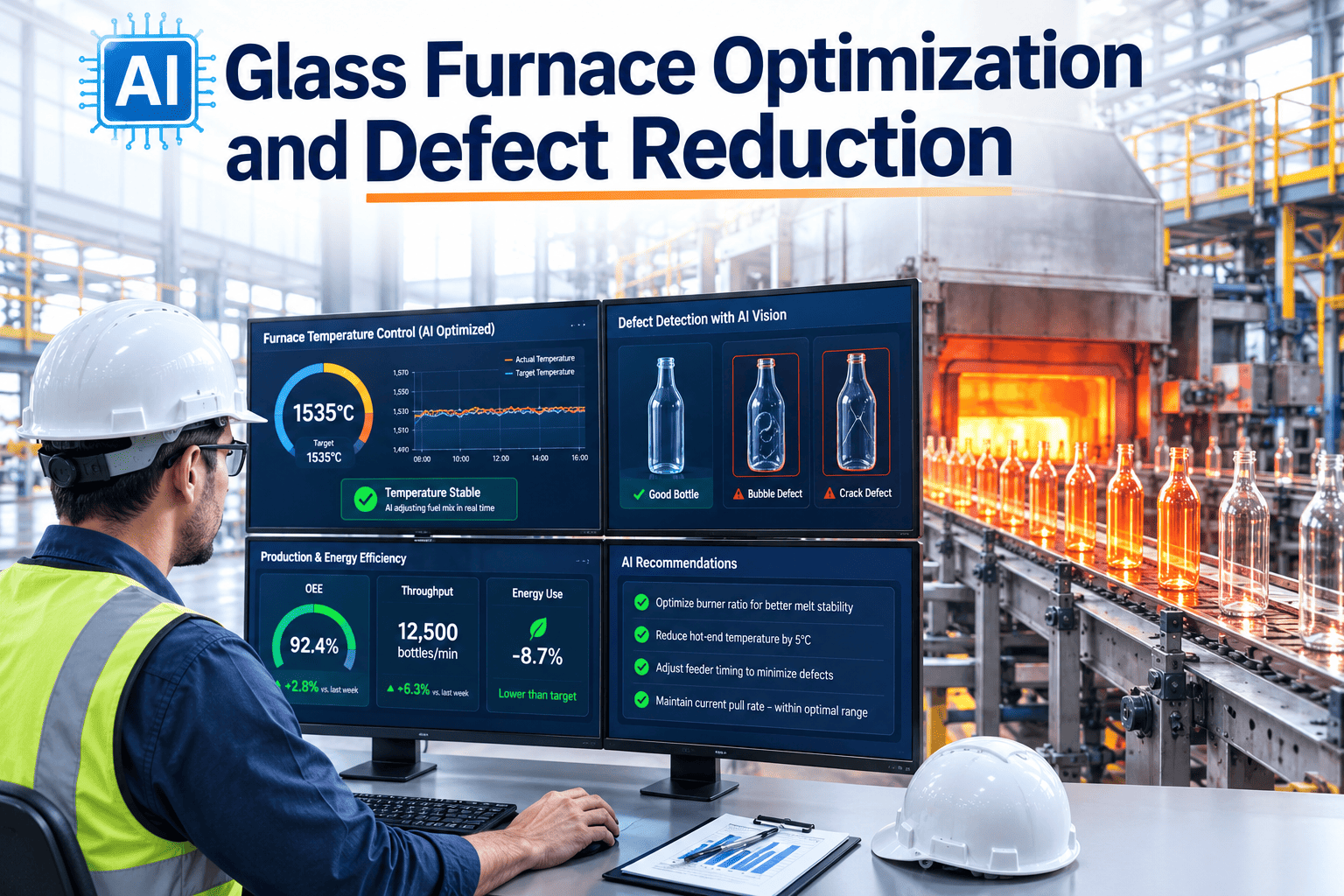
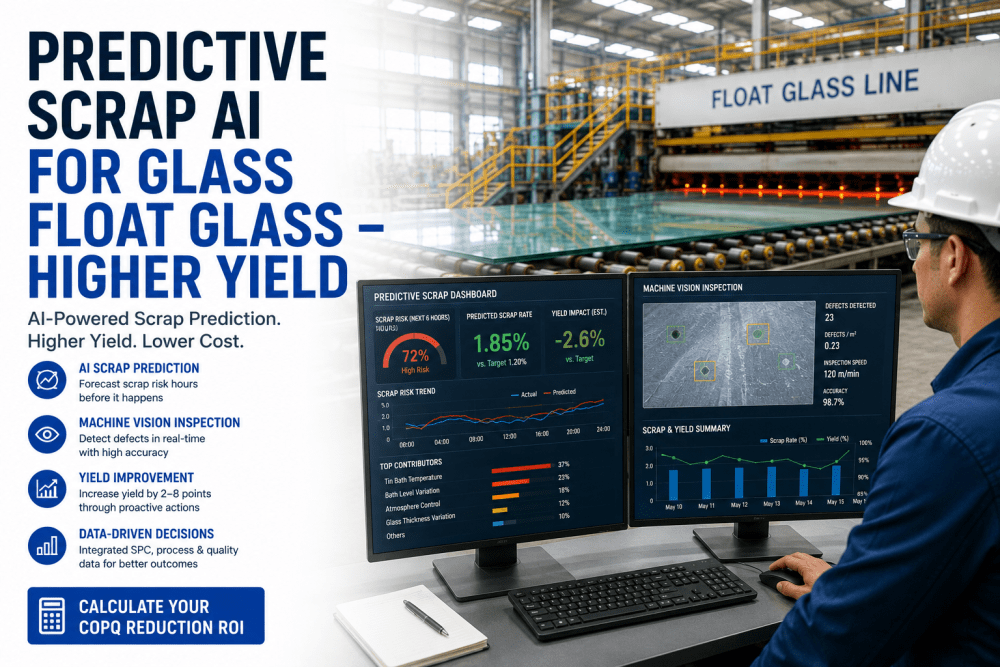
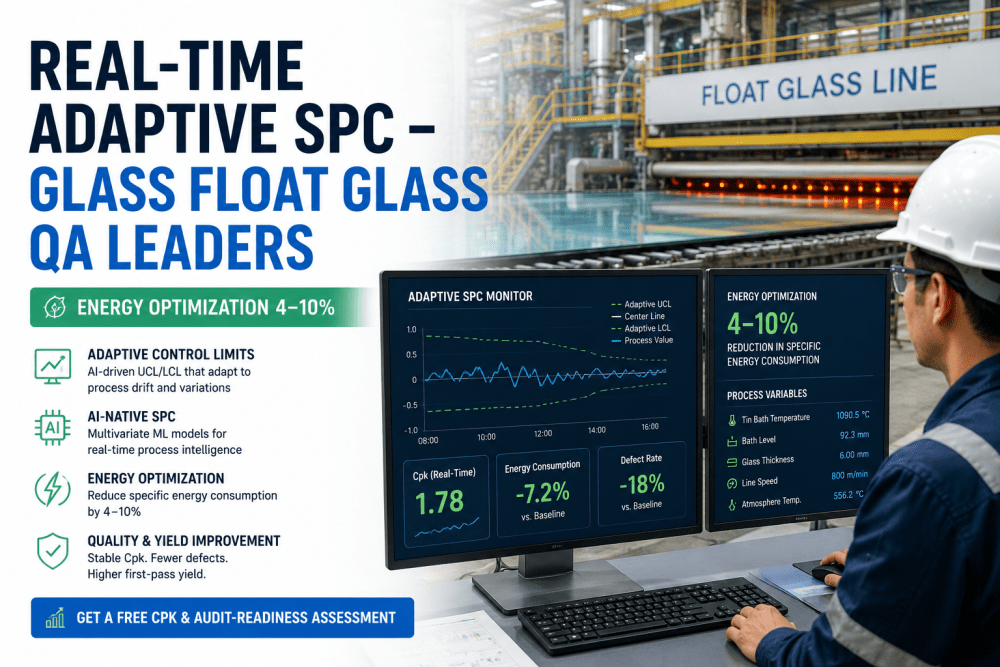
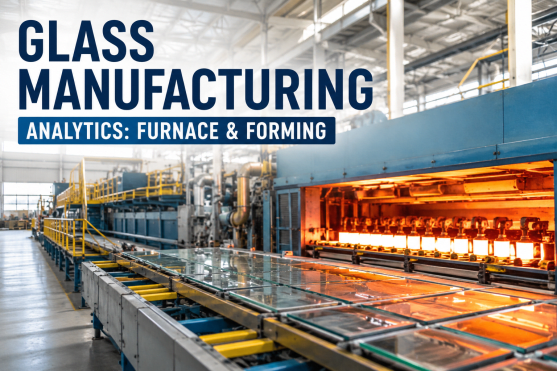
A glass furnace runs at more than 1,500 degrees Celsius for fifteen years without stopping, and it accounts for up to three-quarters of everything a glass plant spends on energy. Every batch of raw material, every shift in cullet ratio, and every fluctuation in fuel quality pushes the melt slightly off its ideal profile, and a furnace tuned by fixed setpoints and operator experience alone cannot chase those shifts fast enough to catch them before they show up as scrap on the cold end. That is the gap AI-based thermal control closes — not by replacing the combustion engineer, but by watching the melt continuously and adjusting before drift becomes a defect, as our team can walk through in a live furnace data session.
Furnace & Forming Intelligence
The Furnace Is Your Biggest Cost Center — And Your Least Controlled Variable
Fixed combustion setpoints can't track the raw material, cullet, and fuel variability that hits your furnace every shift. AI reads the melt in real time and adjusts before quality and energy both drift.
75%
Of plant energy spent at the furnace
Why the Melt Is So Hard to Control
Furnace management looks simple from the control room — set the fuel-air ratio, hold the crown temperature, watch the pull rate. In practice, four things are moving underneath those setpoints at once, and none of them hold still for long. A combustion engineer working from fixed thresholds is effectively steering a fifteen-year process with a dashboard built for a single moment in time, checking readings on a schedule while the melt itself keeps drifting between checks.
The result is a control loop that is always a step behind. By the time a temperature deviation is large enough for an operator to notice on a trend chart, the melt has already been running slightly off-profile for hours, and that lag is exactly where the fuel waste and quality variability documented across the industry tends to originate. Continuous monitoring closes that lag by design rather than by adding more manual checks to an already busy shift.
Raw Material Composition
Sand, soda ash, and limestone shipments vary batch to batch, shifting the melt chemistry the furnace has to compensate for without warning.
Cullet Ratio
Recycled glass content changes energy demand and melt behavior, and cullet quality itself varies by source and contamination level.
Fuel Quality
Calorific value fluctuations in natural gas or fuel oil change the actual heat delivered for a given fuel-air setpoint.
Refractory Condition
Slow degradation of furnace refractory changes heat transfer and insulation characteristics gradually enough to go unnoticed until failure.
From Combustion to Cold End: Where AI Reads the Process
A glass furnace does not operate in isolation — thermal conditions at the melt propagate through forming, annealing, and final inspection, so a small improvement upstream compounds into a larger yield gain downstream. AI-based process control reads signals at each of these stages and treats them as one connected system rather than four separately managed processes.
1
Melting
Model predictive control adjusts fuel-air ratio and boosting power against real-time temperature and composition data to hold the melt profile steady despite input variability.
2
Refining & Conditioning
Forehearth temperature zones are tuned automatically to deliver glass to the forming machine at consistent viscosity, the single biggest driver of forming defects.
3
Forming
Closed-loop vision and sensor feedback on IS machines or the float bath adjusts forming parameters in response to upstream melt conditions rather than reacting after defects appear.
4
Annealing & Inspection
Lehr temperature profile and final AI vision inspection close the loop, feeding defect data back to the furnace model so tomorrow's melt starts from today's lessons.
What Changes in the Numbers
The economics of furnace optimization are unusually direct for a process this complex: because the furnace consumes the majority of plant energy and even minor melt inconsistency shows up immediately as forming or quality loss, small percentage improvements translate into large absolute figures on a facility running hundreds of tons per day.
Furnace Energy Reduction
Achieved through AI-driven combustion optimization and continuous thermal profile analytics rather than periodic manual tuning.
Forming Defect Reduction
Closed-loop forming adjustments driven by upstream melt data cut the defect rate that traditionally required a manual quality catch downstream.
NOx Emission Reduction
Dynamic combustion adjustment in response to real-time conditions lowers emissions without the fuel-consumption penalty that blunt setpoint changes often carry.
A 1-2% improvement in furnace thermal efficiency can be worth millions annually on its own — and a 2% reduction in forming defect rate at a float glass facility can recover $200,000 to $500,000 in yield value in the same year. See what your furnace's actual thermal profile is costing you.
Book a 30-minute demo with your recent furnace data.
Traditional Control vs. AI-Based Furnace Control
Fixed-setpoint control was never designed to track continuous variability — it was designed to hold a stable target and rely on periodic operator adjustment when conditions drifted far enough to notice. AI-based control was built for exactly the opposite assumption: that the inputs are always shifting, and the control system's job is to keep adjusting rather than to hold still.
| Dimension | Fixed Setpoint Control | AI-Based Control |
| Response to raw material shift |
Manual adjustment after drift is noticed |
Continuous automatic compensation |
| Refractory degradation |
Detected at scheduled inspection |
Predicted from thermal trend data |
| Cullet ratio changes |
Fixed fuel-air ratio regardless of ratio |
Fuel-air ratio adjusts to actual energy demand |
| Defect feedback loop |
Quality data reviewed separately from furnace ops |
Defect data feeds back into melt model |
| Emission control |
Static NOx abatement settings |
Dynamic adjustment tuned to combustion state |
Built for Every Furnace Type
Glass manufacturing spans container, float, and fiberglass production, and each furnace type has a different relationship between thermal conditions and downstream quality. AI-based furnace optimization is trained on the specific geometry, pull rate, and forming process of each plant rather than applied as a generic model.
Container Glass
IS machines running at high speed need consistent gob weight and viscosity from the forehearth, making conditioning-zone stability a direct yield driver.
Float Glass
Architectural-quality sheet demands tight thickness and optical consistency across the tin bath, where even small melt variation shows up as a saleable-grade loss.
Fiberglass
Bushings drawing filament at high speed are especially sensitive to viscosity consistency, where AI-stabilized melt conditions reduce filament breaks.
Specialty & Tableware
Lower-volume, higher-value production benefits from defect reduction on individual pieces where scrap cost per unit is highest.
Getting From Data to Closed-Loop Control
Furnace optimization projects fail most often when a plant tries to jump straight to full closed-loop automation before the model has proven itself against real operating conditions. A staged rollout builds trust between the combustion team and the AI system one validated adjustment at a time, which is also why the plants that see the fastest sustained gains tend to be the ones that resist the urge to automate everything on day one.
Stage 1: Baseline
Historical and live furnace data is ingested and the model learns your specific furnace's normal operating envelope across a full range of raw material and fuel variability.
Stage 2: Advisory Mode
The model recommends fuel-air and boosting adjustments to the combustion team, who review and approve each change while accuracy is validated against outcomes.
Stage 3: Selective Closed Loop
High-confidence parameters move to automatic control first, typically fuel-air ratio trimming, while higher-risk adjustments stay advisory longer.
Stage 4: Full Integration
Forming and quality data feed back into the furnace model, closing the loop from melt to inspection and continuously refining the control strategy.
What Furnace Instability Actually Costs
Furnace inefficiency rarely announces itself as a single event — it shows up as a slightly higher fuel bill every month, a defect rate that never quite hits target, and a refractory campaign that ends a year or two earlier than budgeted. Individually, each of these looks like a cost of doing business. Added together across a full furnace campaign, they represent one of the largest controllable expense categories in a glass plant's operating budget.
75%
Share of total plant energy consumed at the furnace, making even small efficiency losses expensive at scale
$200K-$500K
Typical annual yield value recovered from a 2% forming defect reduction at a float glass facility
1-2%
Thermal efficiency improvement that can translate into millions of dollars in annual fuel savings at scale
30%
Downtime reduction reported from predictive maintenance informed by continuous thermal trend data
Reading Refractory Health Before It Becomes a Shutdown
A furnace rebuild is one of the largest planned capital expenses a glass plant absorbs, and the difference between a rebuild scheduled during a planned outage window and one forced by unplanned refractory failure is measured in weeks of lost production, not just repair cost. Refractory doesn't fail suddenly — it degrades gradually, and that gradual shift leaves a signature in the relationship between fuel input and achieved temperature long before it becomes visible as a control problem an operator would notice on a trend chart.
Fuel-to-Temperature Drift
More fuel is required to hold the same crown temperature as insulating refractory properties degrade, a trend visible in data well before an operator would notice it manually.
Localized Hot Spots
Thermal imaging and embedded sensors detect uneven heat distribution patterns that often precede visible refractory wear at specific furnace zones.
Glass Quality Correlation
Certain defect patterns at forming correlate with specific refractory degradation modes, giving the model an additional early-warning signal beyond temperature alone.
Campaign Trend Modeling
Comparing current degradation trends against the historical pattern from previous furnace campaigns sharpens the remaining-life estimate over time.
Frequently Asked Questions
Can AI control actually be trusted on a furnace that runs continuously for fifteen years?
AI-based control is deployed as an advisory and closed-loop layer on top of your existing combustion and process control system, not as a replacement for the safety interlocks and operator oversight already governing the furnace. Most facilities begin in advisory mode, where the model recommends adjustments that an operator reviews and approves, and move to closed-loop control only for the specific parameters where confidence has been established through months of validated performance. The underlying furnace protection systems remain untouched throughout.
Discuss a phased rollout plan for your furnace.
What data do you need from our furnace to get started?
The starting dataset typically includes historical temperature readings from crown and bottom thermocouples, fuel and air flow rates, cullet ratio and batch composition logs, pull rate, and whatever quality or defect data is currently captured at forming and inspection. Most glass plants already generate this data through existing DCS and quality systems; the work is in connecting and structuring it rather than installing new instrumentation. Where a specific gap exists — commonly NIR furnace imaging or forming-stage vision — we recommend targeted additions rather than a full sensor overhaul.
Ask our team what data your current systems already provide.
How long before we see measurable energy or defect improvement?
Initial thermal profile modeling and baseline establishment typically take four to six weeks, since the model needs to observe the furnace across enough raw material and fuel variability to learn normal versus abnormal behavior. Measurable energy reduction usually begins appearing within the following quarter as combustion adjustments are validated and expanded, while defect rate improvement tends to follow forming-stage integration, which is often the second phase of a rollout after furnace-side control is established.
Does tighter furnace control mean we can push higher pull rates safely?
In many cases, yes — a furnace with a tightly controlled thermal profile has more margin to safely increase pull rate than one operating with wide, undetected temperature swings, because the risk of pushing pull rate on an unstable furnace is exactly the quality and refractory stress that AI control is designed to prevent. Facilities that stabilize their thermal profile first are generally better positioned to evaluate a pull rate increase with confidence, though any such change should still go through your normal engineering review process.
Can this help predict when refractory will need replacement?
Yes — refractory degradation produces a gradual, measurable shift in the relationship between fuel input and achieved temperature that is difficult for a human to track shift to shift but clear in a trended model. AI-based thermal analytics can flag this drift well before it becomes visible as a temperature control problem, giving maintenance planning teams a longer runway to schedule a rebuild during a planned outage window instead of reacting to an unplanned refractory failure.
Ask about refractory trend monitoring in your demo.
Your Furnace Is Talking — Most Plants Just Aren't Listening
See What AI Reads in Your Furnace's Thermal Data
Bring recent temperature, fuel, and quality data from any furnace. We'll show you where the melt is drifting, what it's costing in energy and yield, and how closed-loop control changes both.