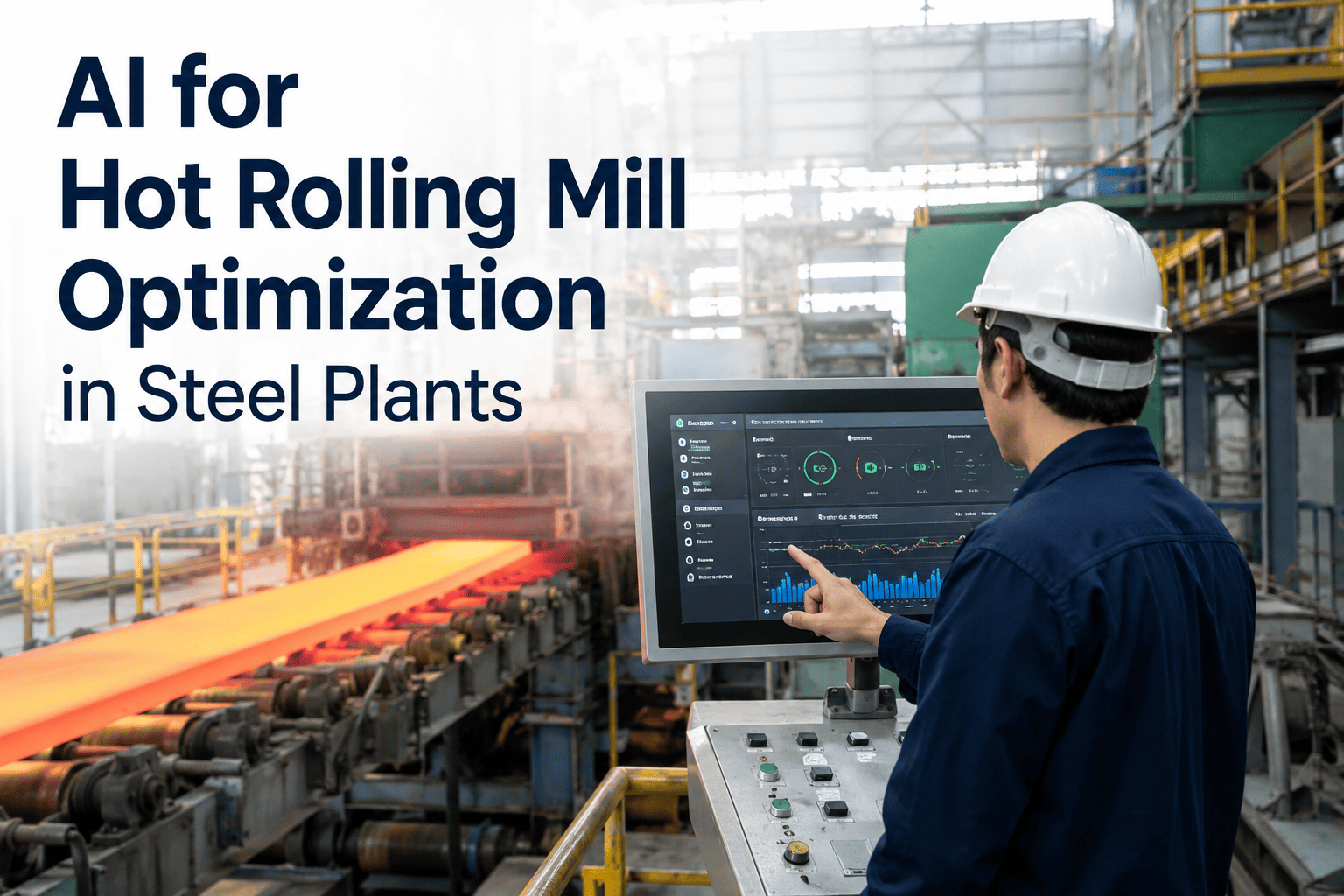
Every grade change on a hot strip mill starts the same way: the crew rolls three to five trial coils while operators nudge roll gap, speed, and tension by feel, watching the pyrometer and hoping the strip comes out flat. Those trial coils rarely meet spec, so they get sold as secondary material at a steep discount, and the mill loses throughput hours it can never get back. A modern finishing mill runs a static setup model calibrated during the last roll campaign, which means it has no idea that the work rolls have worn 0.3mm since Tuesday or that the backup roll bearing is running two degrees warmer than baseline. AI-driven pass schedule optimization replaces that static model with one that relearns itself every coil, and plant managers who want to see it working on their own width and grade mix can book a demo.
Hot Strip Mill Intelligence
Your Finishing Mill Is Still Guessing. Your AI Model Doesn't Have To.
Real-time pass schedule, interstand tension, and coiling temperature optimization that turns every grade change from a scrap event into a routine transition.
0
Trial coils needed per grade change, down from 3-5
40-60%
Reduction in grade change scrap generation
5-12%
Increase in mill throughput
±5μm
Strip profile held across 95% of coil length
Why Static Setup Models Cost You Coils Before the First One Ships
A hot strip mill setup model is only as good as the day it was calibrated. Roll campaigns run for weeks, and across that campaign the work rolls develop thermal camber, lose diameter to wear, and change how they grip the strip on every single pass. Backup roll condition drifts too, and none of it is captured by a model built from last month's averages. Operators compensate the only way they can, by running conservative speed profiles and accepting trial coils as the cost of doing business. The problem is that this cost is not small. Across a mill running dozens of grade and width changes a week, the accumulated scrap, downtime, and quality inconsistency adds up to millions of dollars a year that never shows up as a single line item, so it never gets fixed.
What Drifts Between Roll Changes
Work roll thermal camber
Shifts continuously as rolls heat unevenly across the barrel, altering crown transfer to the strip.
Work roll wear progression
Diameter loss changes roll gap geometry, requiring compensation the static model cannot see.
Backup roll condition
Bearing wear and surface degradation alter stand stiffness and force distribution.
Incoming slab temperature
Furnace discharge variability changes rolling force needed for the same reduction target.
What It Costs You Per Grade Change
Trial coils
3-5 coils rolled to secondary spec while the crew converges manually on the right settings.
Conservative speed profile
Operators hold back line speed to protect against flatness defects, sacrificing throughput on every coil.
Inconsistent strip profile
Crown and flatness vary along coil length, creating downstream complaints at the customer's press line.
Operator fatigue decisions
Manual convergence depends on who is on shift, producing inconsistent results between crews.
What an AI Pass Schedule Model Actually Controls
Replacing a static setup table with a continuously learning model means the AI is not guessing once at the start of a coil, it is adjusting in real time as the strip moves through the stand. The model fuses pyrometer readings, width gauge data, profile meter output, and roll force sensors at sub-second intervals, catching tension deviations before they ever become a center-buckle or edge-wave defect that shows up on the customer's incoming inspection.
01
Pass Schedule and Roll Gap
Predicts optimal reduction, roll gap, and speed profile for every stand based on current roll condition and historical coil data for that exact grade and width combination.
02
Interstand Tension
Adjusts looper height and stand speed differentials within the control window the instant tension drifts, before flatness defects can form.
03
Laminar Cooling Pattern
Modulates header banks along the run-out table to hit target coiling temperature uniformly across the full coil length, not just at the head end.
04
Coiling Temperature
Coordinates with cooling control to hold mechanical property targets consistent from coil head to coil tail, cutting property-related customer claims.
Trial Coils Are a Choice, Not a Rolling Constant. See What Your Mill Looks Like Without Them.
Static Model vs Continuously Learning AI Model
| Parameter | Static Setup Model | AI Continuous Model |
|---|
| Roll wear compensation | Recalibrated during roll campaigns only | Adjusted continuously, coil by coil |
| Trial coils per grade change | 3-5 coils to secondary spec | Zero, first coil is on spec |
| Tension response time | Manual correction after defect appears | Sub-second correction before defect forms |
| Strip profile consistency | Varies with roll condition and shift | Held within ±5 microns across 95% of length |
| Throughput | Conservative speed to protect quality | 5-12% higher, speed set by real conditions |
| Scrap on grade transitions | Baseline scrap rate every change | 40-60% lower grade change scrap |
The Reheating Furnace Feeds the Same Problem Upstream
A reheating furnace ahead of a hot strip mill burns $8 million to $15 million in natural gas a year, and most of that fuel is spent protecting against the visible cost of an under-heated slab rather than the invisible cost of over-heating. Operators run zones hotter than necessary because a cobble or quality reject is obvious immediately, while excess fuel and scale loss are not. That single bias costs 3 to 8% in excess fuel consumption and 15 to 30% in additional scale formation, and it compounds directly into rolling mill performance because scaled, unevenly heated slabs are exactly what forces conservative pass schedules downstream.
50-70%
Reduction in slab temperature non-uniformity at discharge
$300K-$800K
Annual material savings from reduced scale yield loss
20-40%
Of excess furnace energy tied to mill delay lag alone
10-30 Min
Manual control lag when mill speed or product mix changes
Cobble Prediction: Stopping a Failure Before the Strip Ever Tangles
A cobble at the mill entry does not just cost the coil in progress, it can take the line down for hours while crews clear tangled strip from the stand and inspect for roll damage. The drive current signature that precedes a cobble is detectable well before the physical failure occurs, and edge-deployed anomaly detection models are now fast enough to flag that signature with sub-200 millisecond latency, processed at the asset rather than routed through a cloud inference cycle that would arrive too late to matter. This is the same real-time discipline that makes pass schedule optimization work: the model has to be watching continuously, not sampling periodically, because a mill running at line speed does not give you a second chance to react.
Digital twins extend this protection upstream of the decision itself. Rather than committing a grade change sequence to the schedule and finding out its throughput impact after the fact, a digital twin simulates that impact first, so scheduling and operations can weigh a width transition's real cost against alternatives before it ever touches the mill. The same twin can model the energy cost of an upcoming hot mill campaign and adjust roll change timing and speed profiles accordingly, closing the loop between production planning and the physical constraints of the equipment doing the rolling.
Cobble Prediction
Sub-200ms anomaly detection on drive current signatures at mill entry, flagging developing faults before the strip tangles.
Grade Change Simulation
Digital twin models the throughput impact of a sequence before it is committed to the production schedule.
Campaign Energy Forecasting
Predicts the energy cost of an upcoming hot mill campaign and adjusts roll change timing and speed profiles in advance.
Built to Sit on Top of Your Existing Automation Stack
None of this requires ripping out your current Level 1 and Level 2 control systems. The optimization platform connects to existing pyrometer, width gauge, profile meter, and roll force instrumentation through standard industrial protocols, and it operates as a supervisory layer that issues setpoints to your existing drive and actuator systems rather than replacing them. This matters for two reasons: it keeps the deployment timeline short because there is no hardware swap-out on the critical path, and it keeps your existing safety interlocks and operator overrides fully intact, since the AI model is proposing and later executing setpoints within the same control envelope your crew already trusts. Plants integrating SCADA, MES, and ERP layers into one real-time data flow are the ones best positioned to get full value from this kind of model, because the AI is only as good as the breadth of data it can see across scheduling, maintenance, and quality systems simultaneously.
Deployment Path: From Static Tables to Closed-Loop Control
Rolling mill AI deployment does not require shutting the line down. Leading producers phase the rollout so the model earns operator trust before it takes any autonomous action, starting in shadow mode and moving toward closed-loop control only once its recommendations consistently outperform the existing setup tables.
Phase 1
Data Connection and Baseline
Connect pyrometer, width gauge, profile meter, and roll force sensors to the platform. Establish baseline scrap, throughput, and profile variance for the mill's current grade mix.
Phase 2
Shadow Mode Recommendations
The model runs alongside the existing setup table, generating pass schedule and tension recommendations that operators can compare against actual outcomes without acting on them yet.
Phase 3
Assisted Grade Changes
Operators begin accepting AI-recommended settings on select grade changes, tracking trial coil elimination and profile consistency against the historical baseline.
Phase 4
Closed-Loop Optimization
The model adjusts pass schedule, tension, and cooling in real time without manual approval on every move, with operators managing exceptions rather than every micro-adjustment.
Frequently Asked Questions
How does AI pass schedule optimization reduce trial coils to zero?
The model builds its setup recommendation from current roll condition, live pyrometer temperature, and historical coil data for the exact grade and width combination being run, instead of a static table calibrated weeks earlier. Because it accounts for thermal camber and wear that have already occurred, the first coil rolled after a grade change is set up correctly rather than being the first of several attempts to converge manually. Mills that have deployed this approach report the elimination of the 3 to 5 trial coils previously treated as an unavoidable cost of every transition.
Book a demo to see the model trained against your own grade and width matrix.
What sensor data does the AI model need to run on our mill?
The core inputs are pyrometer readings at each stand, width gauge output, profile meter data, and roll force measurements fused at sub-second intervals, along with historical coil records for the grades and widths the mill typically runs. Most integrated steel mills already generate this data through existing instrumentation, so the primary deployment work is connecting these sources to the optimization platform rather than installing new hardware. Our team can walk through your specific sensor inventory during onboarding.
Does interstand tension optimization actually prevent flatness defects, or just detect them faster?
It prevents them. Traditional control detects a flatness issue after it appears in the profile meter reading and then corrects it, by which point some length of strip is already out of spec. The AI model instead watches for the tension deviations that precede center-buckle and edge-wave defects and adjusts looper height and stand speed differentials within the control window before the defect physically forms. This is why mills using this approach hold strip profile within plus or minus 5 microns across 95% of coil length rather than just the coil average.
How long before a hot strip mill sees measurable throughput gains?
Most mills see initial gains within the first few weeks of shadow mode as the model establishes accurate baselines for roll wear and thermal camber trends, with meaningful throughput improvement in the 5 to 12% range once the platform moves into assisted or closed-loop operation, typically within the first two to three months of deployment. The exact timeline depends on how many distinct grade and width combinations the mill runs and how much historical coil data is available to train against.
Contact our support team for a deployment timeline specific to your product mix.
Does this replace the reheating furnace control system too, or is that separate?
Furnace optimization and hot strip mill optimization are complementary but distinct systems that share data. Furnace AI targets slab discharge temperature uniformity and fuel efficiency, which directly affects what the rolling mill has to work with. When both are deployed together, mills see compounding benefits because well-heated, uniform slabs make the mill's pass schedule optimization job easier, while a well-optimized mill reduces the pressure on the furnace to overheat as insurance against downstream rolling defects.
Stop Rolling Trial Coils. Start Every Grade Change On Spec.
See iFactory's hot strip mill model trained against your own grade mix, width transitions, and roll campaign data.