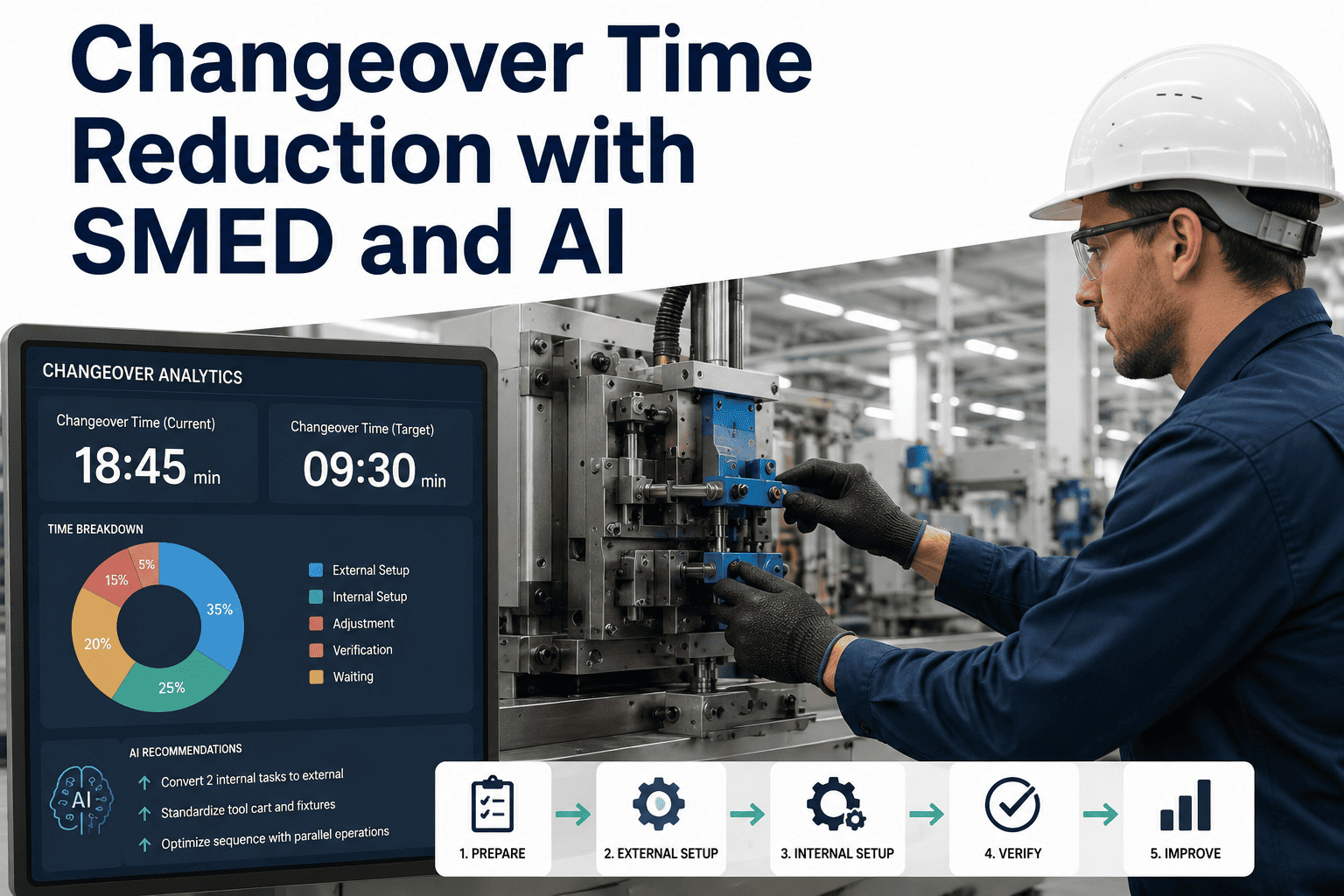
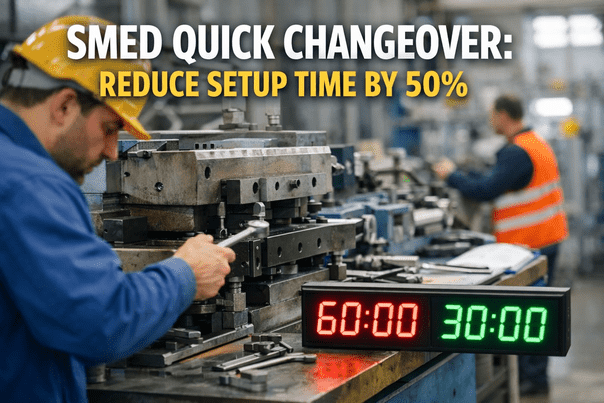
Most production managers ran a SMED program at some point, cut changeover time by a third within the first few months, and then watched the improvement quietly stall. The workshop energy fades, old habits creep back in, and nobody is measuring every changeover closely enough to know where the next minute is hiding. iFactory keeps SMED alive after the workshop ends — using computer vision and live changeover tracking to keep finding seconds that a one-time study never could. Book a demo to see what your current changeover data is actually telling you.
AI-Enhanced SMED + Changeover Reduction
SMED Got You 30% Faster Changeovers. AI Keeps Finding the Rest.
iFactory layers computer vision and live tracking on top of your SMED program so changeover time keeps dropping long after the workshop whiteboard comes down.
Why Most SMED Programs Plateau After 18 Months
Single-Minute Exchange of Die works. The problem is almost never the method — it is what happens after the initial study. Once the obvious internal-to-external conversions are made and the new standard is documented, most plants stop measuring changeovers closely enough to catch the smaller drift that creeps back in shift by shift.
50%+
Average changeover reduction when SMED is paired with continuous tracking, versus a one-time study
Weeks
How quickly old habits typically return once a SMED program stops being actively reinforced
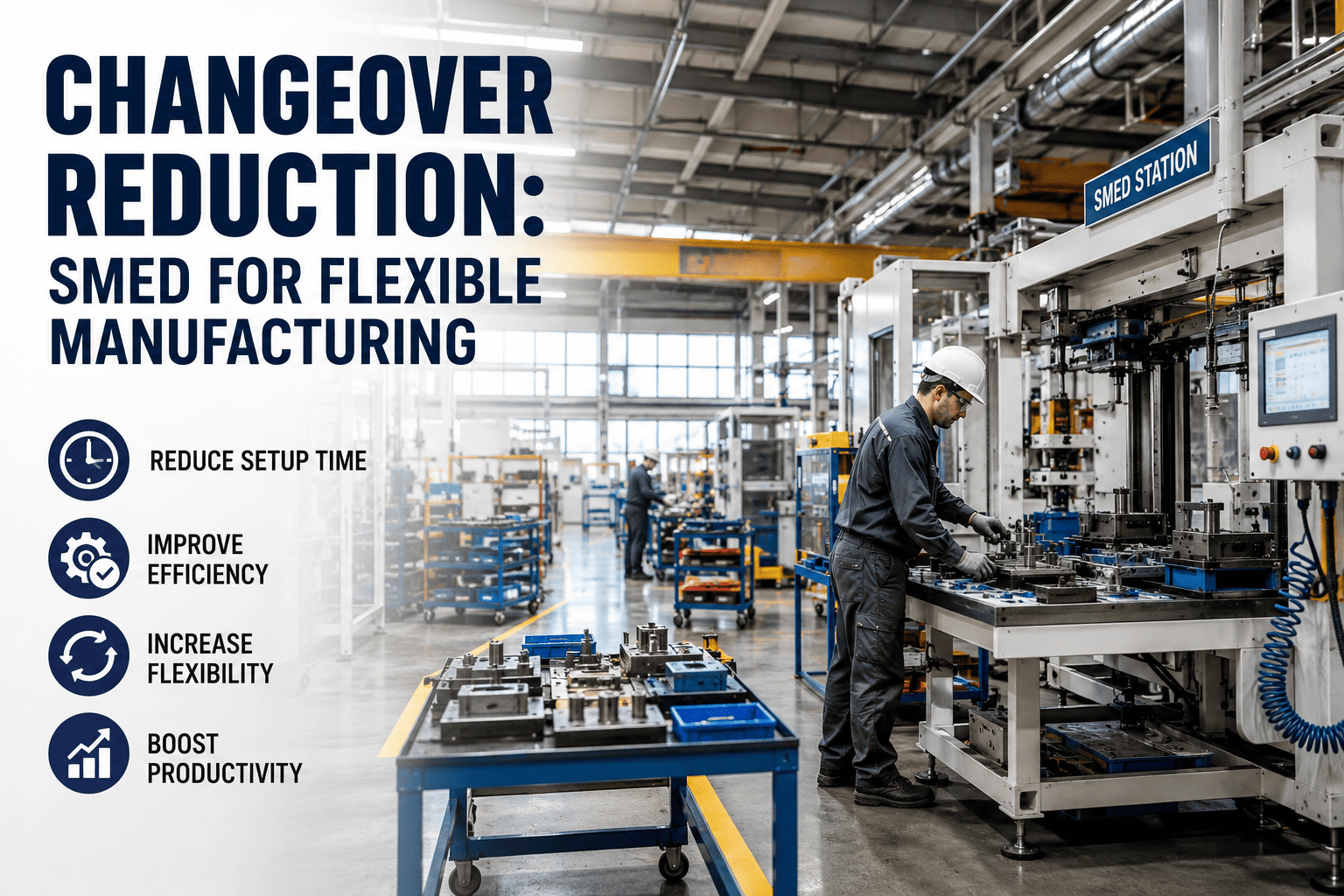
Internal vs. External: What SMED Already Got Right
Internal Tasks — Machine Stopped
Die removal
Tooling swap
Final alignment
Machine restart
First-off check
External Tasks — Machine Running
Pre-staging parts
Tool pre-set
Documentation prep
Cleaning materials ready
Next job briefing
Where AI Extends What the Workshop Started
Computer Vision Changeover Tracking
Existing cameras become a measurement tool, timing every changeover automatically instead of relying on a supervisor with a stopwatch once a quarter.
Movement Pattern Analysis
Vision AI detects excess walking, waiting, and search time that even an experienced SMED facilitator misses during a single observed run.
Sequence Adherence Alerts
When an operator skips a standardized step or works out of order, the deviation is flagged in the moment, not discovered in next week's scrap report.
Cobot-Assisted Pre-Staging
Where cobots are deployed, change parts and cleaning cycles are pre-staged automatically while the mechanical changeover runs in parallel.
First-Off Verification
Vision-based checks confirm settings before restart, catching a bad changeover before it becomes ten minutes of scrap on the first parts run.
Consistency Scoring by Operator and Shift
Changeover time by operator and shift becomes visible, turning coaching conversations from opinion into a specific, shared number.
Find Out What's Still Hiding in Your Changeovers
Bring your current changeover baseline to the call and we'll show you where AI tracking typically finds the next round of minutes.
Changeover Time: Before SMED, After SMED, After AI
Getting Started: A Four-Step Rollout
1
Baseline the Real Number
Vision tracking runs against your highest-volume line first, capturing true changeover time without relying on manual stopwatch samples.
2
Classify Internal vs. External
Every observed step is automatically tagged so the team can see exactly which tasks are still stealing machine-stopped time.
3
Standardize and Push Live
The improved sequence becomes the tracked standard, with deviation alerts keeping every shift accountable to the same target.
4
Keep Finding Minutes
Ongoing tracking surfaces new opportunities every month instead of letting the gains quietly erode after the workshop ends.
What Production Managers See After Rollout
50%+
Changeover time reduction versus SMED alone
±3 min
Consistency across operators and shifts
10 min
Achievable changeover time on many lines
Days
To first baseline data, not months
Where AI-Enhanced SMED Delivers the Most
Automotive Stamping and Press Lines
Die changes involve heavy tooling and tight tolerances, where vision-tracked sequencing catches misalignment risk before the first part runs out of spec.
Injection Molding
Mold swaps and material purges are highly repeatable, which makes them ideal candidates for cobot pre-staging and automated first-off verification.
Food, Beverage, and Personal Care Packaging
Frequent SKU changeovers on filling and labeling lines are exactly where FMCG plants have documented reductions of fifty percent or more using SMED with tracking.
CNC Machining Centers
Tool offset entry and program selection are common sources of setup error, and vision-based first-off checks catch a wrong offset before it becomes scrap.
What a Changeover Coaching Conversation Looks Like Now
Before tracking, a coaching conversation about a slow changeover usually started with an opinion — a supervisor's sense that a particular shift or operator ran slower than another. With every changeover timed and broken into internal and external steps automatically, that conversation starts with a specific number and a specific step. A supervisor can point to the exact stage where an operator's changeover ran four minutes longer than the shift average, discuss what happened at that step, and set a concrete target for the next attempt. The same data rolls up into a leaderboard-style view across operators and shifts, which most teams use to standardize on whichever approach is actually fastest rather than whichever was documented first.
FAQ: AI-Enhanced Changeover and SMED Programs
We already ran a SMED workshop. What does AI actually add on top of that?
A SMED workshop typically studies a handful of observed changeovers and locks in a new standard based on what the team saw during those sessions. AI tracking measures every single changeover going forward, which surfaces drift, operator-to-operator variation, and smaller inefficiencies that a one-time study cannot catch. Most teams find the AI layer keeps finding meaningful time even on lines they considered already optimized.
Do we need new cameras or hardware to get computer vision changeover tracking?
In most cases, existing camera infrastructure can be converted into an intelligent monitoring system rather than requiring a new hardware build. Where coverage gaps exist on a specific line, additional cameras can be added as part of deployment. The bigger factor in time-to-value is usually mapping the changeover sequence correctly, not the camera hardware itself.
How does the system tell the difference between a normal changeover and a problem?
The system learns the standardized sequence for each changeover type and flags deviations such as skipped steps, out-of-order work, or unusual dwell time between steps. Movement pattern analysis also identifies excess walking or searching that extends the changeover without necessarily breaking the documented sequence. Both signals are shown to supervisors as specific, coachable observations rather than a single pass or fail score.
Will this work on lines with cobots as well as fully manual changeovers?
Yes. On manual lines, tracking focuses on operator sequence and timing to guide coaching and standardization. Where cobots are already deployed, the same tracking layer coordinates pre-staging of change parts and cleaning cycles so mechanical and automated work happen in parallel rather than in sequence.
Support can walk through configuration for a mixed environment with both manual and cobot-assisted lines.
How long before we see measurable improvement after deployment?
Baseline data is typically available within days of deployment on a given line, since the system starts timing changeovers automatically from day one rather than waiting for a scheduled observation period. Meaningful reduction in average changeover time usually follows within the first few weeks as deviation alerts and coaching data start changing behavior on the floor.
Book a demo to see a realistic timeline for your specific line count and product mix.
AI-Enhanced SMED + iFactory
Don't Let Your SMED Gains Quietly Erode.
iFactory keeps every changeover measured, coached, and improving — turning a one-time workshop win into a number that keeps getting smaller.