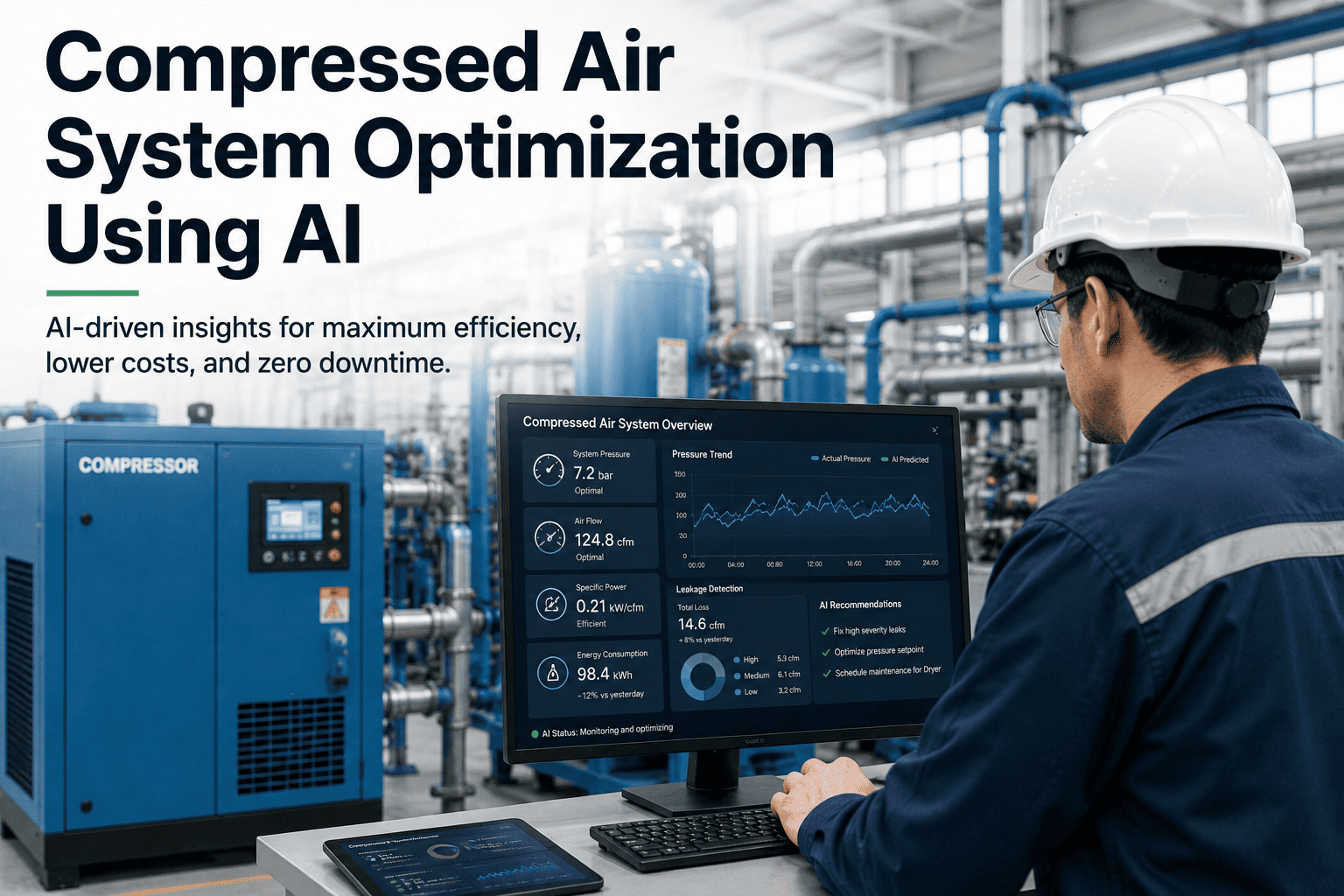
Walk any production floor on a Sunday afternoon when the lines are silent and you will still hear something — the faint, constant hiss of compressed air escaping through fittings, hose connections, and worn cylinder seals that nobody has walked past with an ultrasonic detector in years. Compressed air is the fourth utility in most plants, after electricity, gas, and water, and it is by far the most expensive to generate and the most wasteful to leave unmonitored. iFactory's AI platform listens to that hiss continuously, scores every leak by dollar impact, and optimizes compressor scheduling and pressure in real time, and you can book a demo to see it running against your own compressor room.
25 to 35 Percent of the Compressed Air You Generate Never Reaches a Production Tool — AI Finds Exactly Where It Goes
iFactory's AI continuously monitors pressure, flow, and compressor load to detect leaks, eliminate over-pressurization, and match supply to real demand — cutting compressed air energy costs without touching your production process.
Compressed Air Is the Most Expensive Utility in Your Plant — And the One Nobody Audits Regularly
Compressed air is typically seven to eight times more expensive per unit of work than the electricity used to produce it, because generating it requires compressing, cooling, drying, and distributing air through a network that loses efficiency at every joint and fitting. The figures below quantify the scale of that loss across a typical manufacturing facility.
The Four Categories of Compressed Air Waste iFactory's AI Monitors Simultaneously
Compressed air waste rarely comes from a single cause. It accumulates across four distinct categories that each require a different detection method and corrective action, which is why single-point fixes rarely deliver lasting savings on their own.
Distribution Leaks
Pipe fittings, quick-disconnect couplings, worn cylinder seals, and threaded joints that loosen over years of vibration and thermal cycling, each releasing a continuous, mostly inaudible stream of pressurized air.
Over-Pressurization
Systems run at higher pressure than any point of use actually requires, often to compensate for pressure drop caused by leaks elsewhere — every 2 psi of unnecessary discharge pressure adds roughly 1 percent to energy consumption.
Compressor Inefficiency
Oversized compressors running at partial load, poor staging between multiple units, and aging equipment operating well below its rated efficiency curve, all consuming more energy than the actual demand requires.
Inappropriate Use
Compressed air used for tasks better served by a blower or electric tool, such as open-blow cooling or cleaning, consuming premium-cost air for a job that does not require it.
How iFactory's AI Finds Every Leak and Fixes Pressure and Scheduling Automatically
iFactory combines continuous sensor monitoring with AI pattern recognition to detect and prioritize compressed air waste across all four categories, without requiring a scheduled shutdown or a manual ultrasonic survey team.
Continuous Pressure and Flow Monitoring
Sensors track pressure, flow, and compressor amperage across the distribution network around the clock, establishing a baseline for normal demand at every hour of operation.
AI Leak Scoring
The AI identifies leak signatures from idle-period flow readings and ranks each suspected leak by estimated annual dollar cost, so repair crews prioritize the highest-value fixes first.
Compressor Scheduling Optimization
Multiple compressors are staged automatically to match real-time demand instead of running on fixed schedules, minimizing the number of units operating at inefficient partial load.
Pressure Zone Optimization
The AI identifies the minimum pressure required to satisfy every point of use and recommends set-point reductions that eliminate the energy cost of system-wide over-pressurization.
What a Single Leak Actually Costs You Over a Year — By Leak Size
The relationship between a leak's physical size and its annual energy cost is not linear, which is why even a handful of small, seemingly insignificant leaks can add up to a meaningful share of your compressed air bill. The table below estimates annual cost at a typical industrial utility rate and continuous operation.
| Leak Diameter | Approx. Air Lost (CFM) | Estimated Annual Cost |
|---|---|---|
| 1/16 inch | ~6 CFM | $600 - $900 |
| 1/8 inch | ~25 CFM | $1,500 - $2,500 |
| 1/4 inch | ~100 CFM | $6,000 - $9,000 |
| 3/8 inch | ~225 CFM | $13,000 - $19,000 |
A Leak You Cannot Hear Is Still a Leak You Are Paying For Every Single Hour
iFactory's AI listens to your compressed air system continuously, scores every leak by dollar impact, and optimizes compressor staging and pressure automatically. Book a demo and see the AI mapping waste across your own compressor room.
From First Sensor Install to a Fully Optimized System in Four Stages
Compressed air optimization is one of the fastest-payback projects available to a plant manager, and iFactory's deployment model is structured to surface the first savings opportunity within days rather than months.
Baseline Audit and Sensor Install
Pressure, flow, and power meters are installed at the compressor room and key distribution points to establish a validated consumption baseline within the first week.
Leak Identification and Tagging
The AI flags suspected leak locations from idle-period flow data, and each is tagged with an estimated dollar cost for maintenance teams to prioritize repairs.
Compressor and Pressure Optimization
Compressor staging schedules and system pressure set points are adjusted based on validated real-time demand patterns rather than legacy fixed settings.
Continuous Monitoring and Reporting
The system continues monitoring for new leaks and demand changes indefinitely, with ongoing savings reporting tied directly to metered consumption data.
Results From AI-Driven Compressed Air Optimization Deployments
The figures below reflect measured outcomes from manufacturing facilities that deployed AI-driven compressed air monitoring and optimization over a minimum six-month period, validated against metered energy consumption.
Common Questions From Plant Managers About AI Compressed Air Optimization
The Cheapest Compressed Air You Will Ever Buy Is the Air You Stop Losing
Compressed air is generated at real cost every second your compressors run, and roughly a quarter to a third of that cost is escaping through leaks, unnecessary pressure, and inefficient compressor staging before it ever reaches a production tool. Fixing that waste does not require new equipment or a production change; it requires the continuous visibility that a manual, once-a-year audit simply cannot provide.
iFactory's AI platform gives plant managers that continuous visibility, converting invisible leaks and scheduling inefficiency into a ranked, dollar-quantified repair list your maintenance team can act on immediately. The result is a leak rate held consistently under 10 percent, lower demand charges, and a payback period measured in months rather than years. Book a demo to see iFactory's AI analyzing live compressed air data from your own plant.
Every Month You Wait Is Another Utility Bill Padded With Air Nobody Ever Used
iFactory's AI finds every leak, optimizes compressor staging, and eliminates over-pressurization automatically, cutting compressed air energy costs by up to 45 percent within a year. Book a demo and see the AI analyzing your own system in real time.