Most digital transformation programs don't fail because the technology didn't work, they fail because nobody with real authority was accountable for making the pilot's results actually change how the plant operates. A vision system proves it catches defects, a predictive maintenance model proves it predicts failures, and then both sit in a folder because no governance structure existed to turn a proven pilot into a funded, scaled rollout. iFactory's transformation advisory work starts with this governance question before a single sensor gets installed.
The pilot that never scales usually died in a governance gap
A steering committee with clear ownership, defined KPIs, and a real decision cadence is what separates a manufacturer running five permanent pilots from one running a plant-wide transformation program.
Pilots don't die from bad technology, they die from no owner
A plant engineer champions a pilot, gets it running, and proves the result, and then that engineer moves to a different project or the pilot's champion leaves the company, and nothing about the initiative was ever tied to a role rather than a person. Without a governance structure that survives personnel changes, even a technically successful pilot has no mechanism to become a funded, permanent part of plant operations. This is the single most common pattern behind stalled transformation programs, and it has nothing to do with whether the underlying technology actually worked.
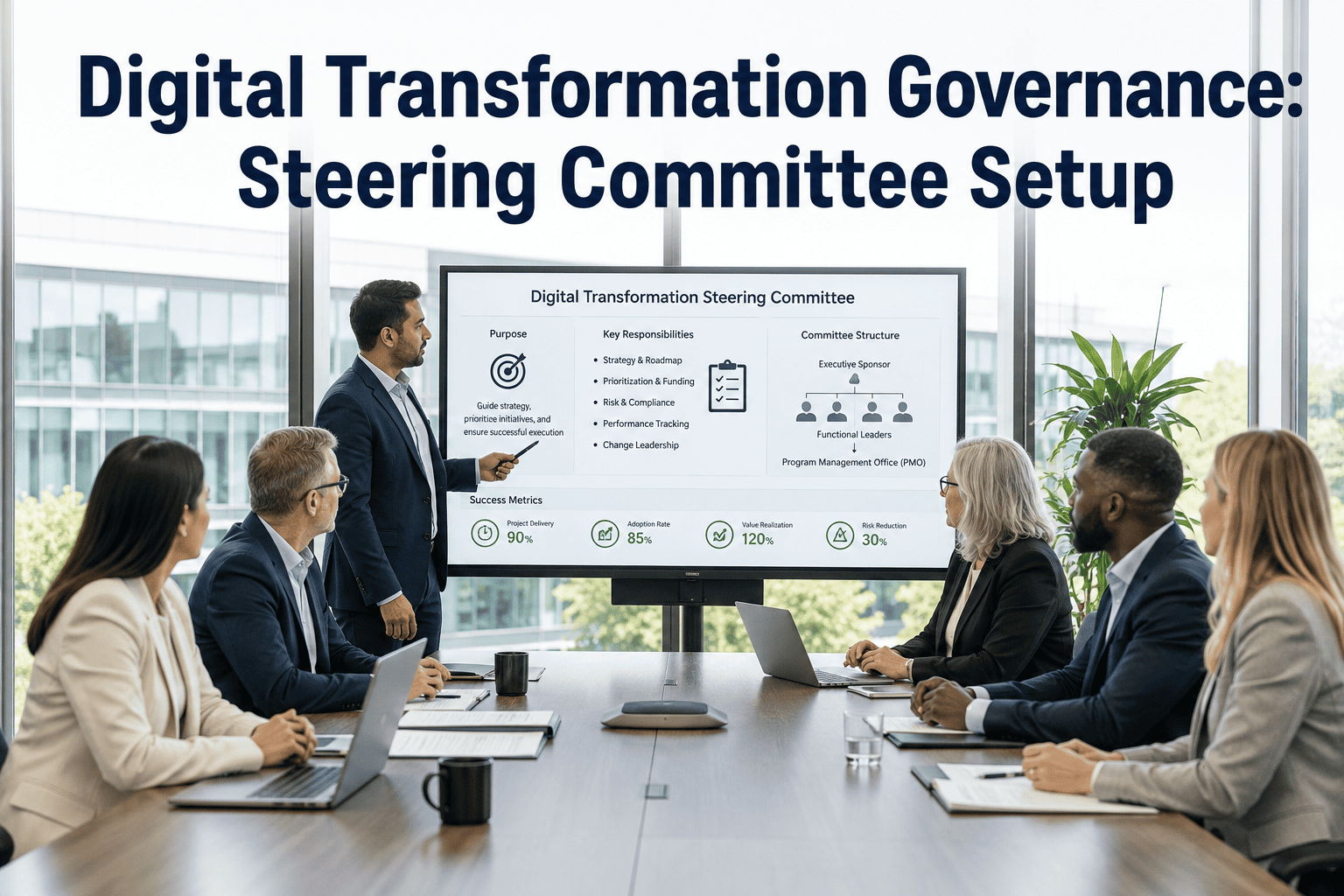
A steering committee needs six seats, not sixteen
Executive Sponsor
Owns the budget decision and removes organizational blockers a plant-level team can't clear alone.
Operations Lead
Represents the plant floor reality and vetoes anything that would disrupt production without proven value.
IT / OT Lead
Owns integration, security, and the technical feasibility of connecting new tools to existing systems.
Quality or Reliability Lead
Brings the domain expertise to validate whether a pilot's results are real and worth scaling.
Finance Partner
Translates pilot results into an ROI case leadership outside the committee will actually approve.
Program Manager
Owns the portfolio calendar, tracks every pilot's stage, and keeps the committee meeting on schedule.
Every additional seat beyond these six tends to slow decisions down rather than improve them. Larger committees are a common symptom of an organization trying to build consensus instead of building accountability, and consensus-seeking is exactly what stalls a pilot at the exact moment it needs a scaling decision.
Most transformation programs already have the right people somewhere in the building, they've just never been formally seated together with decision authority. Book a demo and we'll help you map your existing team to these roles.
A portfolio dashboard beats a status update deck
Committees that review a rotating set of PowerPoint status decks tend to lose the thread on which pilots are actually progressing and which have quietly stalled. A standing portfolio view that every pilot reports into, tracked against the same four metrics regardless of what technology it involves, makes stalled projects visible immediately instead of six months into a program review.
| Metric | Tracks | Review Cadence |
|---|---|---|
| Stage Gate Status | Pilot, validation, scale-ready, scaled | Monthly |
| Documented ROI | Actual savings versus projected business case | Monthly |
| Adoption Rate | Operator and team usage versus rollout target | Monthly |
| Blocker Status | Open issues requiring executive sponsor action | As raised |
What actually happens in a well-run monthly review
Portfolio snapshot
Ten minutes reviewing the stage-gate status of every active initiative against last month, no deep dives yet.
Escalation review
Any pilot with a flagged blocker gets committee attention and a specific decision, not a general discussion.
Scale-ready decisions
Pilots that hit their validation criteria get a formal go or no-go decision on expansion budget and timeline.
Next-quarter pipeline
New pilot proposals get prioritized against the existing portfolio rather than added on top of an already full plate.
What derails a steering committee in its first year
The most common mistake is treating governance as a formality to satisfy before the real work of piloting begins, rather than as the mechanism that determines whether piloting ever turns into scaling. A close second is populating the committee entirely with technology enthusiasts and no operations skeptic, which produces a committee that approves everything and a plant floor that trusts nothing it approves. The third recurring mistake is meeting quarterly instead of monthly, which sounds efficient but actually means blockers sit unresolved for up to twelve weeks at a time, long enough for pilot momentum and champion enthusiasm to fade entirely.
A subtler mistake is failing to define what "scale-ready" actually means before a pilot starts. Without agreed criteria set in advance, every scaling decision becomes a fresh debate instead of a straightforward check against a pre-agreed bar, which is exactly the kind of ambiguity that lets a proven pilot linger indefinitely in pilot purgatory.
Standing up governance before your next pilot, not after
The organizations that scale transformation programs successfully tend to stand up governance structure before their next major pilot rather than retrofitting it onto initiatives already underway. Ninety days is a realistic timeline to identify committee members, agree on the four core metrics, and run a first portfolio review, and that timeline fits comfortably ahead of most annual planning cycles.
If you already have several pilots running without a formal governance structure, the fastest fix isn't stopping everything to build one from scratch, it's retroactively mapping existing initiatives onto a stage-gate framework at the very next scheduled review, so the committee starts functioning with the work that already exists rather than waiting for a clean slate.
The bar every pilot should be measured against before launch
Setting scale-ready criteria after a pilot has already produced results almost always leads to moving goalposts, because whoever is skeptical of scaling can always find one more metric the pilot hasn't yet proven. Defining that bar before the pilot starts, and getting every committee member to agree to it in writing, turns the scaling decision into a straightforward check rather than a fresh negotiation months later when stakes and politics are higher.
Statistical Confidence
Results need enough data points, not just one good week, to distinguish a real trend from normal process variation.
Documented ROI
A dollar figure tied to actual observed savings, not a projected estimate the finance partner hasn't validated.
Operational Fit
The operations lead confirms the pilot didn't rely on extra attention that a scaled rollout couldn't replicate.
A pilot budget and a scale budget are different conversations
Many transformation programs get pilot funding relatively easily, since a single-site trial is a small enough ask that it doesn't require a full capital committee process, and then stall completely when the scale-up requires a much larger multi-site budget that has to compete against every other capital request in the company. Anticipating this gap early, and building the scale-phase budget case alongside the pilot rather than after it succeeds, prevents a proven pilot from sitting idle for a full budget cycle while a business case gets built from scratch.
The finance partner's seat on the steering committee exists specifically to close this gap. Involving finance from the pilot's first month, rather than bringing them in only once results are ready to present, means the ROI case is already built in a format the capital committee expects by the time the scale-ready decision actually needs to be made.
Governance structure, explained plainly
Build a governance structure your pilots can actually scale through
iFactory works with plant leadership to design a steering committee, KPI framework, and decision cadence built around your existing pilots and team.