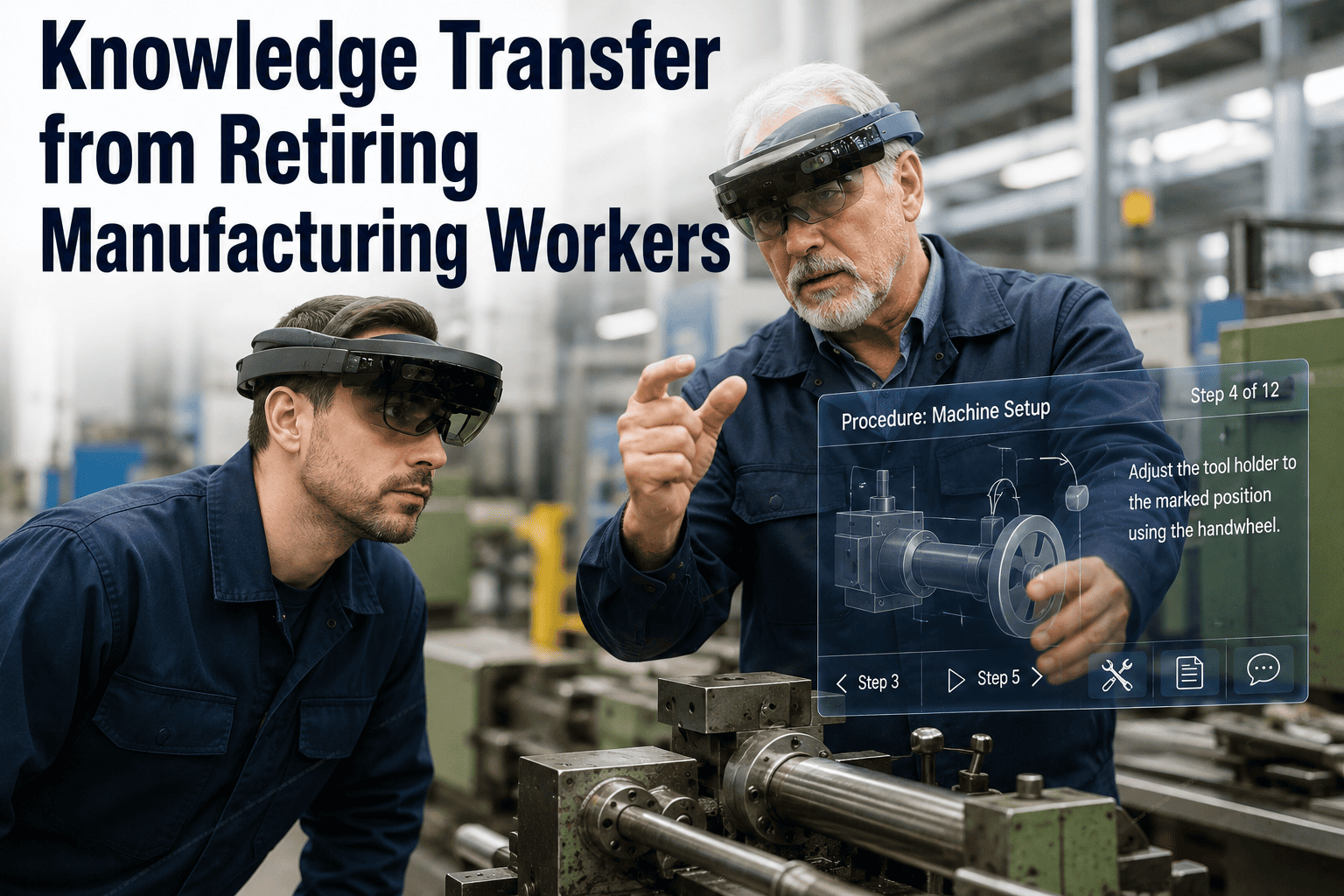
A plant manager gets the news two weeks before a planned retirement party: the technician who has kept a fifty-year-old extrusion line running through every strange vibration and seasonal quirk is leaving at the end of the month, and no one else on the floor can explain why he always adjusts the die temperature differently on humid days. There is no manual entry for that adjustment, no work order note, no line in a training binder, only a habit built over twenty-eight years that is about to walk out the door along with his badge. This scene repeats across manufacturing plants every week right now, because a quarter of the industry's workforce is old enough to retire and most of what they know was never written down in the first place. The knowledge does not disappear because anyone was careless, it disappears because tribal knowledge accumulates faster than documentation ever catches up to it, and by the time a plant notices the gap, the person who could have closed it has already left. Closing that gap before the next retirement notice is what this guide, and what you can see in a book a demo conversation with our team, is built to help with.
Every Retirement Party Is a Deadline for Capturing What That Person Knows
Decades of troubleshooting instinct, equipment quirks, and undocumented workarounds sit inside the heads of your most experienced operators, and none of it transfers automatically the day they clean out their locker.
The Real Cost of Losing an Expert Isn't Just an Empty Chair
Replacing a retiring technician on an org chart is straightforward, replacing what that technician actually knew is not, and the gap between those two things is where most of the operational damage happens. A requisition can be posted the same week someone gives notice, but the years of context that made the outgoing employee fast and reliable do not come bundled with the new hire's offer letter. A new hire can be trained on the documented procedure while still having no idea that a particular pump always needs a slower startup ramp in cold weather, and that single missing detail can cost more downtime than the entire formal onboarding program was designed to prevent.
Exit Interviews and Binders Were Never Built for This Problem
Most plants already have some version of a knowledge transfer plan, and most of those plans quietly fail for the same handful of reasons.
The Retirement Wave Isn't a Future Problem, It's Already Underway
It is tempting to treat workforce aging as a slow-moving trend that leaves time to react, but the numbers behind it describe something closer to a wave already breaking. Industry projections point to millions of manufacturing roles needing to be filled by the early 2030s, driven largely by retirements rather than growth, and a meaningful share of those openings are expected to go unfilled because the skills gap is widening faster than training programs can close it. That shortage changes the economics of knowledge transfer entirely, because a plant can no longer assume there will be a ready replacement waiting to absorb an expert's knowledge through years of overlap. Increasingly, the departing expert and the replacement hire never work the same shift at the same time, which means whatever knowledge isn't captured before the handoff simply has no path to reach the next person at all.
Surveys of manufacturing leadership consistently describe this as one of the most serious operational risks on the horizon, yet the same surveys find that most organizations still lack a consistent, repeatable process for capturing what a retiring expert knows before they leave. That gap between concern and action is where the real risk sits, because awareness alone does not preserve a single hour of troubleshooting instinct once the person holding it has cleared out their locker.
Start Capturing Knowledge Before the Next Retirement Notice
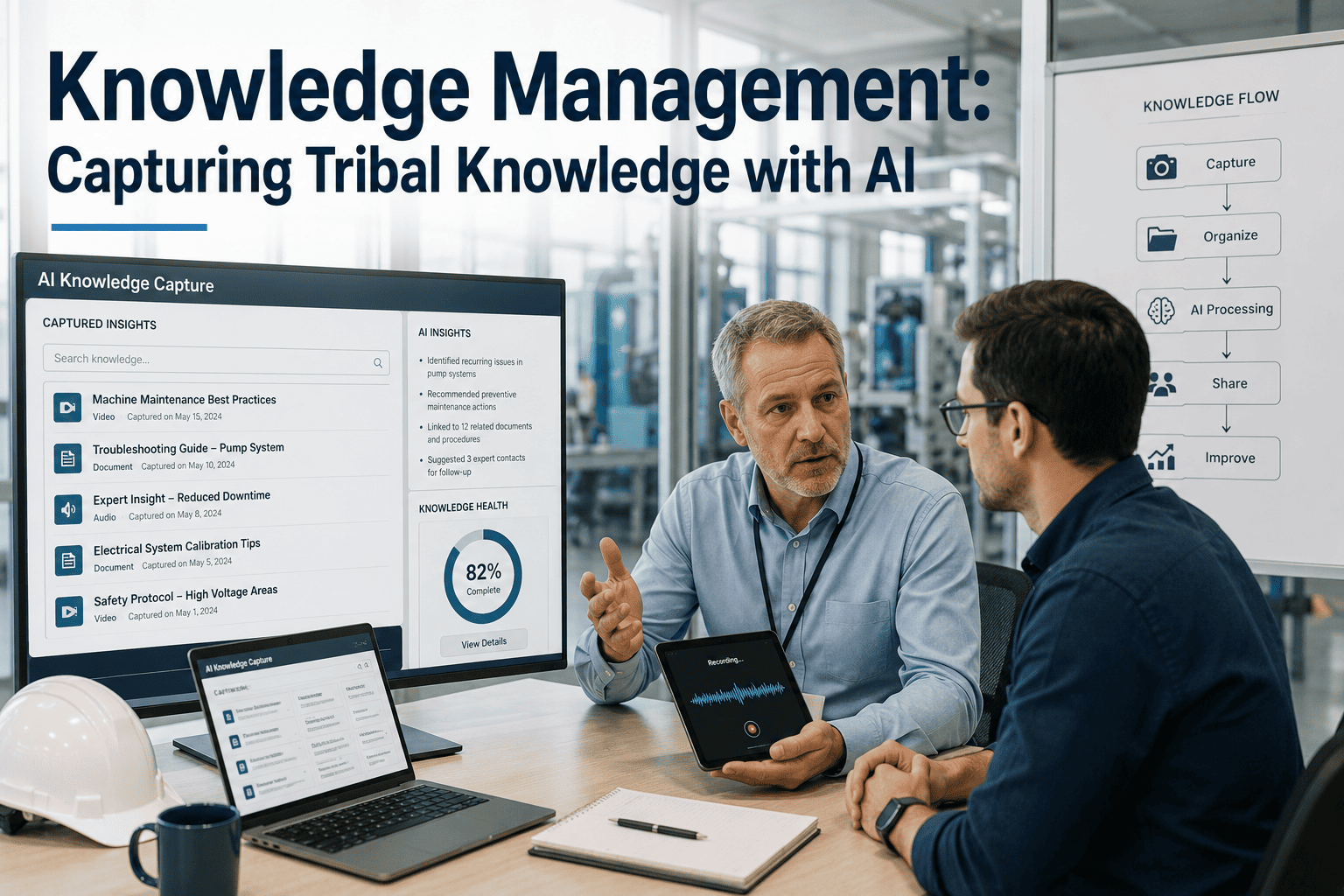
iFactory turns what your veteran operators know into structured, station-linked work instructions while they are still on the floor to validate every step. See how the capture workflow fits your current retirement timeline.
What Changes When Knowledge Capture Becomes Continuous Instead of a One-Time Event
The difference between a knowledge transfer effort that sticks and one that quietly fades after the retirement party usually comes down to whether capture is treated as a system or as a project.
| Factor | Traditional Capture | iFactory AI-Assisted Capture |
|---|---|---|
| When It Happens | Concentrated into a short window right before a known departure | Ongoing, pulling from work orders, notes, and instructions as they're created |
| What Gets Captured | The textbook procedure, rarely the exceptions and workarounds | Step-level detail tied to the specific station, equipment, and condition it applies to |
| Format | Static binder or shared drive document, easy to lose track of | Structured digital work instruction, searchable and linked to the equipment record |
| Validation | Rarely reviewed again once written | Reviewed and confirmed by the expert while they're still available to check accuracy |
| New Hire Ramp | Six to eighteen months depending on equipment complexity | Shortened by giving new hires guided, station-specific instructions from day one |
Five Steps to Capture Expertise Before It Walks Out the Door
Plants that succeed at this treat knowledge capture as a structured sequence rather than a single conversation, starting well before a retirement date is even announced.
The Technology Only Works If the Culture Around It Does Too
Every capture framework eventually runs into the same human obstacle: an experienced worker who feels that documenting their knowledge is either pointless paperwork or, worse, a step toward making themselves replaceable. Neither concern is unreasonable, and neither is solved by mandating participation from above. What tends to work better is treating the retiring expert as a co-author of the finished instruction rather than a source being mined for information, giving them visibility into how their knowledge will actually be used, and being explicit that the goal is protecting the plant's performance rather than replacing the person who built it.
It also helps to separate the capture conversation from performance reviews or disciplinary context entirely, since knowledge that took decades to build was often built through informal shortcuts that a worker may hesitate to describe if they think it will be scrutinized rather than valued. Plants that get the best results tend to frame the entire effort around legacy: the retiring expert's name stays attached to the instructions they helped build, and new hires are told explicitly whose experience shaped the guidance they are following. That framing turns a process that can feel extractive into one that feels like recognition, and workers who feel recognized tend to share far more than workers who feel interrogated.
Some Roles Deserve to Be Captured Before Any Others
Not every job carries the same knowledge risk, and plants with limited time and budget get the most value by prioritizing the roles where the gap would hurt the most.
Discrete Manufacturing Isn't Facing This Alone
The retirement wave hitting manufacturing floors is playing out in parallel across adjacent industrial sectors, which is useful context for any plant leader trying to gauge how seriously to take it. Aerospace and defense organizations report that roughly a quarter of their workforce is at or beyond retirement eligibility, much of it concentrated in engineering and supervisory roles carrying decades of program-specific knowledge. Construction faces an even steeper curve in some regions, with a large share of the current skilled trades workforce expected to retire within the next several years and a shrinking pipeline of younger workers behind them. What all of these sectors share is the same underlying pattern: knowledge concentrated in a shrinking group of senior employees, a hiring market that cannot fully backfill it, and a narrowing window during which capture is still possible before the people holding that knowledge are gone.
The upside of this shared timing is that manufacturers are not solving a novel problem in isolation. Capture methods proven in one industrial sector, structured interviews focused on exceptions, validation against real equipment, and station-linked digital instructions, generally translate well across sector lines, because the underlying challenge is the same regardless of whether the retiring expert spent their career on an assembly line, a turbine bay, or a job site.
Questions Plant Leaders Ask Before Starting a Capture Program
Don't Let the Next Retirement Party Erase Twenty Years of Expertise
iFactory helps plants turn what their most experienced people know into structured, searchable work instructions before that knowledge walks out the door for good. Book a demo and bring your upcoming retirement list into the conversation.