A plant can run its equipment efficiently and still pay a premium every month for power it technically never used, simply because its power factor sits below what the utility contract requires. Reactive power drawn by motors, VFDs, and transformers doesn't do useful work, but it still shows up on the demand charge line, and most facilities only notice the penalty after it has been quietly compounding for years. iFactory reads real-time reactive power draw against your utility's threshold to flag correction opportunities before they turn into an avoidable line item, which is easiest to see in a Book a Demo.
Low Power Factor Is A Penalty You're Paying Without Getting Anything For It
Utilities charge a premium when reactive power draw pushes your power factor below their threshold, and that charge grows with every motor, VFD, and transformer added to the load without corresponding reactive compensation. iFactory sizes and times capacitor bank switching to keep power factor above the penalty threshold without over-correcting into leading power factor territory.
Reactive Power Doesn't Do Work, But It Still Costs Money
Inductive loads such as motors, transformers, and variable frequency drives draw reactive power in addition to the real power that does useful work, and the combination shows up as apparent power on the utility meter. Power factor is the ratio of real to apparent power, and when it falls below a utility's contracted threshold, most tariffs apply either a direct power factor penalty or a demand charge calculated on apparent power rather than real power, effectively billing for capacity that produced no output. Plants with a heavy motor load, particularly those running many partially loaded motors, are the most exposed, since motor power factor drops meaningfully below rated speed and full load.
Lightly Loaded Motors
Motors running well below rated load draw proportionally more reactive power relative to real power, dragging down plant-wide power factor even when nothing is technically malfunctioning.
VFD And Harmonic Interaction
Variable frequency drives introduce harmonic distortion that complicates simple capacitor correction, since standard capacitor banks can amplify certain harmonics if sizing doesn't account for the drive population on that circuit.
Transformer No-Load Losses
Transformers draw reactive magnetizing current even under no load, meaning a plant with excess transformer capacity relative to its actual demand carries a reactive burden around the clock.
Why Fixed Capacitor Banks Alone Aren't Enough
A single fixed capacitor bank sized for average plant load corrects power factor adequately during typical operation but can overcorrect during low-load periods, pushing power factor leading rather than lagging, which utilities penalize just as readily as a lagging power factor below threshold. The more reliable approach switches capacitor stages in and out as load changes through the day, keeping power factor inside the target band rather than fixed at one compensation level regardless of what the plant is actually drawing at that moment.
Dynamic Stage Switching
Capacitor stages are switched based on real-time reactive load rather than a static schedule, avoiding both under-correction during peak load and overcorrection during light load.
Harmonic-Aware Sizing
Capacitor bank sizing accounts for the harmonic profile introduced by VFDs and other nonlinear loads on the same circuit, reducing the risk of resonance that a generic sizing approach can introduce.
Power Factor Penalties Are Often Buried, Not Itemized
Not every utility labels the power factor penalty as a clearly separate line item, and many roll it into the demand charge calculation by billing on kVA rather than kW, which makes the penalty invisible unless someone specifically calculates the implied power factor from the billed apparent power against actual real power consumption. This is one of the more common reasons a facility carries a correctable penalty for years without anyone flagging it internally, since the bill doesn't announce it the way a clearly itemized surcharge would.
kVA-Based Demand Billing
When demand is billed on apparent power rather than real power, a low power factor inflates the billed demand figure even though actual useful energy consumption hasn't changed.
Implied Power Factor Calculation
Comparing billed kVA against metered kW reveals the effective power factor being charged against, which is often the only way to spot a penalty that isn't itemized separately on the statement.
What Changes With Load-Responsive Compensation
| Aspect | Fixed Capacitor Bank | Dynamic Load-Responsive Correction |
|---|---|---|
| Performance during peak load | Often adequate | Tuned in real time to actual demand |
| Performance during light load | Risk of leading power factor | Stages reduced automatically |
| Harmonic resonance risk | Present if sizing ignores harmonics | Reduced through harmonic-aware sizing |
| Penalty avoidance consistency | Variable across the day | Maintained across load conditions |
Stop Paying A Penalty For Power You Never Used
iFactory times and sizes reactive compensation to keep power factor above your utility's penalty threshold.
Correction Isn't The Only Lever — Motor Right-Sizing Matters Too
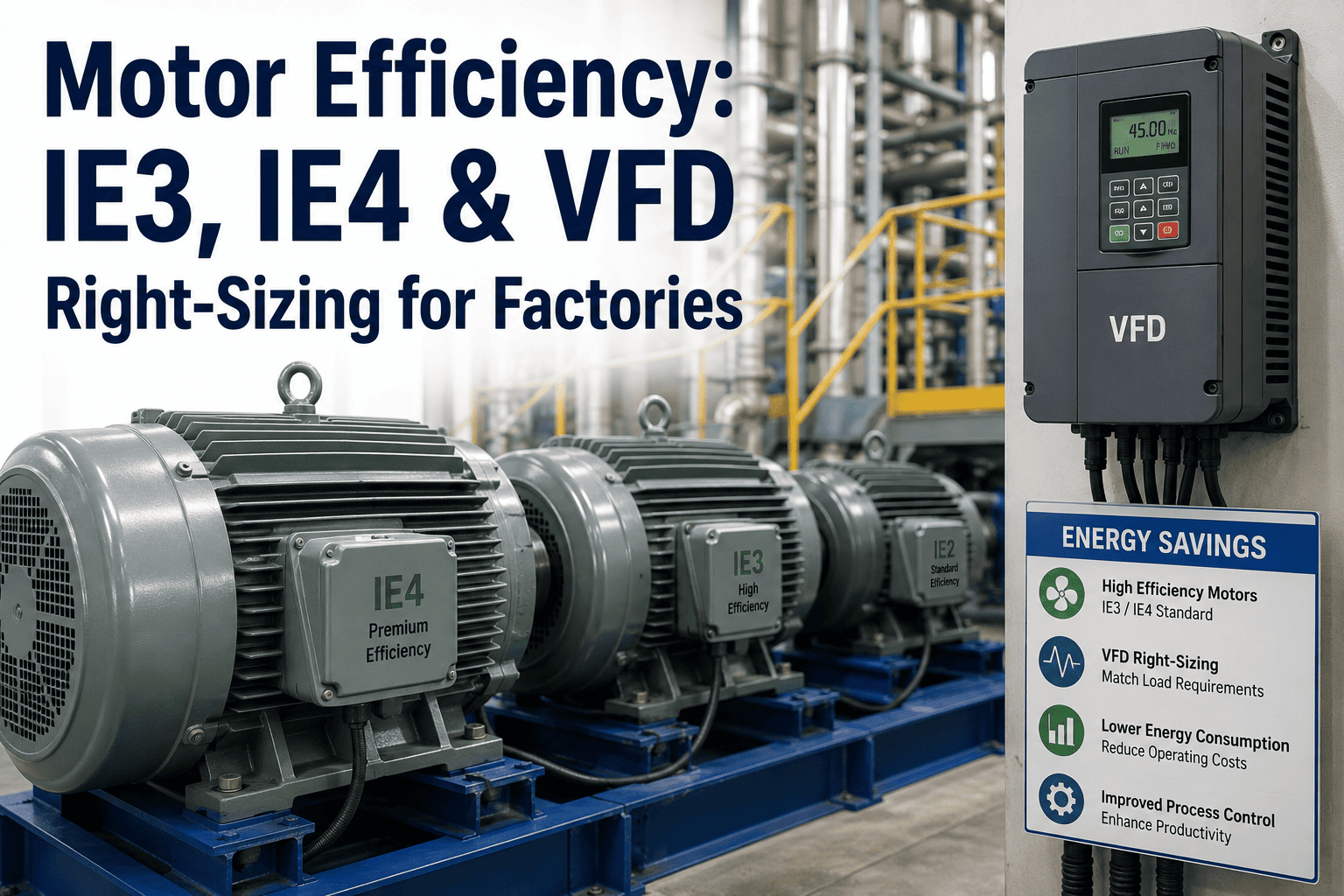
Capacitor correction treats the symptom, but a plant carrying a large population of oversized or lightly loaded motors is generating more reactive demand than it needs to in the first place. Motors selected with excessive safety margin for a load that never approaches rated capacity run at a lower power factor by design, and no amount of capacitor correction changes that underlying inefficiency, it only compensates for it after the fact at the switchgear level. Reviewing motor loading data alongside reactive power trends can surface a smaller number of genuinely oversized motors that, if right-sized or replaced during a normal end-of-life cycle, reduce the reactive burden a correction system has to manage going forward.
Motor Loading Review
Comparing actual running load against nameplate rating across the motor fleet identifies which units are carrying excessive safety margin and contributing disproportionately to reactive demand.
Right-Sizing At Natural Replacement Points
Rather than a disruptive fleet-wide replacement, oversized motors identified through loading review can be right-sized the next time they're due for replacement, reducing reactive burden gradually without unplanned capital spend.
We had a fixed capacitor bank installed for years and assumed it was handling things, but our power factor was still dipping below the utility threshold during our lighter shifts and we didn't have visibility into when it was happening. Once iFactory started tracking reactive load continuously and staging correction dynamically, we stopped seeing those dips and our monthly demand charge line has come down noticeably.
What Plants Report After Dynamic Power Factor Correction
Frequently Asked Questions
Q: Do we need new capacitor bank hardware to get started?
Many plants already have capacitor banks installed but running on a fixed or simple time-based schedule, and iFactory typically works with that existing hardware by adding the real-time switching logic rather than requiring a full replacement. Where existing banks are undersized for current load or harmonic conditions, that gap gets identified during the initial assessment. Reach out through Support Contact to review your current setup.
Q: How is our specific utility's penalty threshold factored in?
Utility tariff structures vary in how they calculate and apply the power factor penalty, so the target correction band is set against your specific contracted threshold rather than a generic industry default. This is confirmed against your actual utility bill structure during setup so the correction target matches what you're actually being billed against.
Q: Can over-correction actually cause problems of its own?
Yes, pushing power factor into leading territory during light load periods can trigger its own penalty under many tariff structures and, in more extreme cases, contribute to voltage rise issues on the plant's electrical distribution system. Dynamic stage switching is specifically meant to avoid this by matching correction to actual load rather than applying a fixed amount regardless of demand.
Q: Will this help with harmonic distortion from our VFD fleet too?
Capacitor sizing and placement decisions account for the harmonic profile of VFDs and other nonlinear loads present on the same circuit, which reduces the risk of resonance, though a plant with a significant harmonic distortion problem independent of power factor may still need dedicated harmonic filtering as a separate measure. Discuss your specific load profile during a Book a Demo session.
Q: How quickly does the demand charge reduction show up on our bill?
Since utility demand charges are typically billed monthly based on the billing period's recorded power factor or reactive demand, the reduction is generally visible on the very next billing cycle after correction is actively maintained, making this one of the faster-to-confirm categories of energy cost reduction available to a plant.
Turn Off The Penalty You've Been Paying By Default
iFactory keeps power factor inside your utility's threshold automatically, day and night, load condition by load condition.