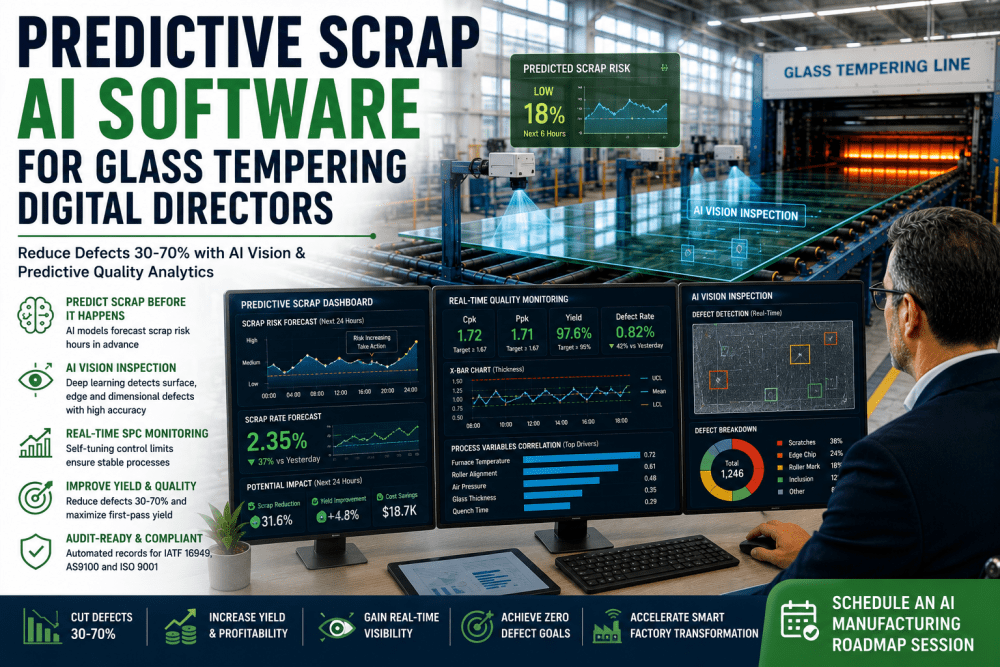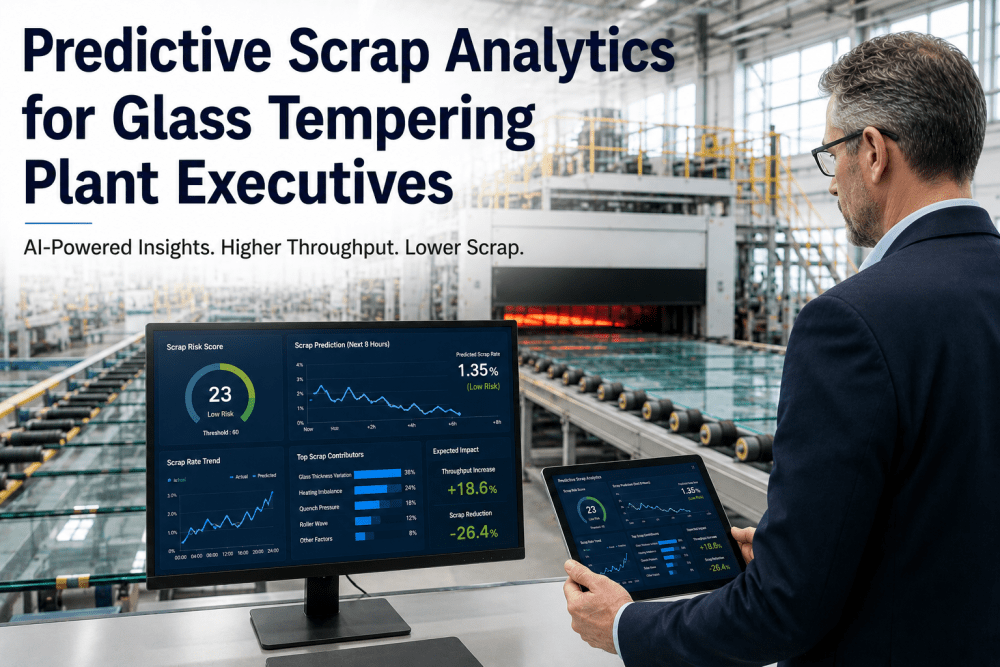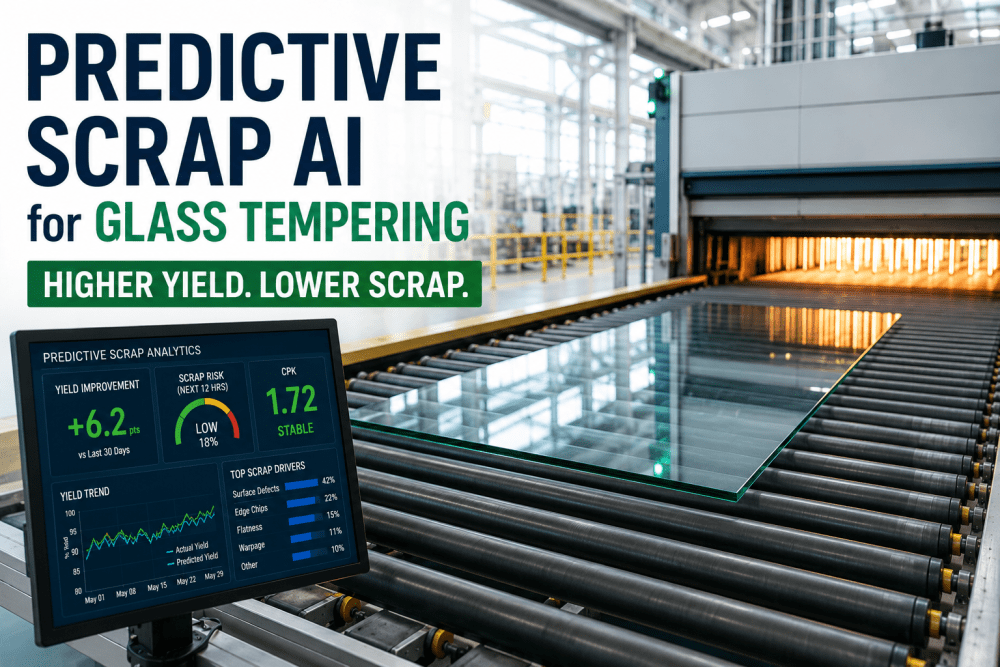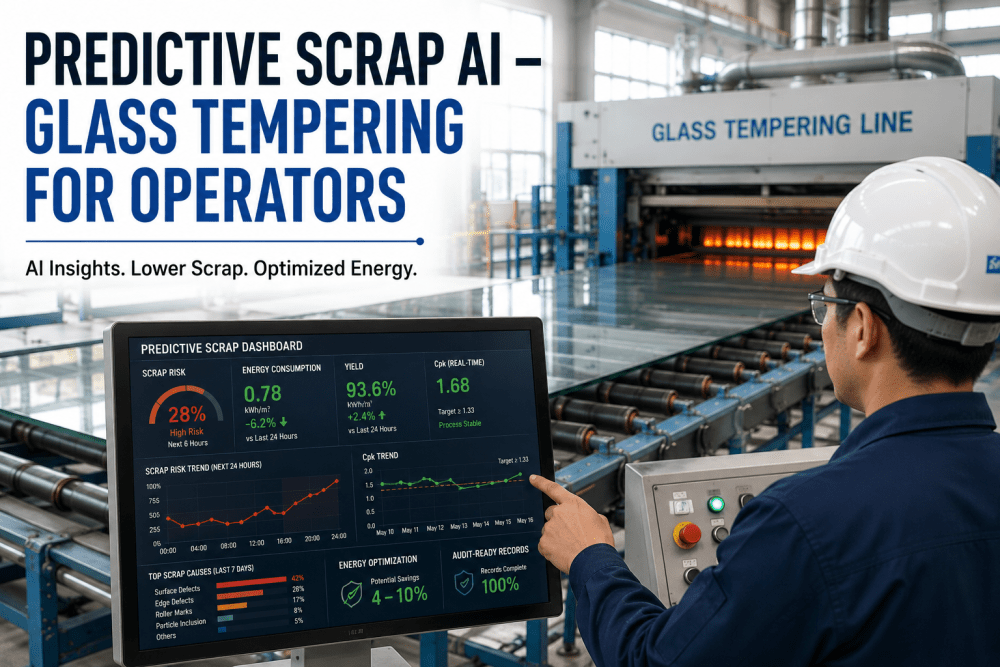
A Tier-1 architectural glass tempering facility producing 52,000 sq ft of tempered glass daily across three furnaces deployed iFactory's predictive scrap analytics platform — connecting AI-driven scrap forecasting with real-time SPC and furnace PLC data — to give operators a unified view of yield risk, energy consumption, and process capability before defects occur. Over a 12-week deployment, the platform's machine learning models predicted scrap events 45 minutes before they materialized with 91% accuracy, enabling operators to intervene before a single reject sheet was produced. Specific energy consumption dropped by 5.2 kWh per ton through AI-recommended temperature adjustments that maintained Cpk above 1.67 while reducing furnace energy input. First-pass yield improved from 88% to 95.8%, and scrap rate fell by 52%. Line operators evaluating predictive scrap analytics for glass tempering Book a Demo to review how the platform brings scrap forecasting, real-time Cpk tracking, and energy optimization to the tempering line operator's console.
Why Predictive Scrap Analytics Matters for Glass Tempering Operators
Glass tempering operators work in a high-speed, high-temperature environment where process drift is invisible until defects appear at the exit end. By the time a roller-wave pattern or nickel sulfide inclusion is visible to the human eye, the furnace has already produced 20–30 additional sheets with the same deviation. Traditional quality control — offline sampling, end-of-batch inspection, and reactive scrap sorting — identifies defects after they have already consumed energy, labor, and raw material. Predictive scrap analytics changes this paradigm by forecasting scrap risk before it occurs, giving operators the lead time needed to adjust furnace parameters, correct process drift, and prevent defects from forming in the first place. For shop-floor operators and line technicians managing tempering furnaces, the platform translates complex ML model outputs into actionable alerts — a recommended temperature adjustment, a dwell-time correction, or a quench pressure change — displayed on a single console alongside real-time Cpk values and energy consumption per ton. Book a Demo to review how predictive scrap analytics maps to your specific tempering line configuration and product grades.
How Predictive Scrap Analytics Works — Three-Stage Architecture
The predictive scrap analytics platform operates in three continuous stages that transform raw furnace PLC data and AI vision defect classifications into operator-directed scrap prevention actions. Each stage builds on the previous one, creating a closed-loop system from data ingestion to process adjustment.
Real-Time Data Ingestion from Furnace PLCs and Vision Systems — The platform ingests furnace PLC data — zone temperatures, dwell time, quench pressure, throughput rate, and glass thickness — at 100 ms intervals through native OPC UA and Modbus TCP connectors that require no PLC-side code changes. Simultaneously, the AI vision inspection stream feeds real-time defect classifications — nickel sulfide inclusions, roller wave, edge chips, surface scratches — with each detection timestamped and mapped to the specific glass sheet ID. The combined data stream creates a unified process-state vector that captures every variable influencing scrap risk at any given moment. Historical data — typically 6–12 months of production records — is used to train the initial prediction models, establishing baseline correlations between process parameters and downstream defect rates. The platform ingests approximately 18,000 data points per minute across a typical three-furnace tempering line, with all data stored in a compressed time-series database that supports queries spanning individual sheets to multi-year production trends.
Machine Learning Scrap Prediction Engine — The prediction engine runs a ensemble of gradient-boosted tree models and temporal convolutional networks that analyze the real-time process-state vector against historical scrap patterns. Each model independently forecasts scrap probability for the next 15, 30, and 45 minute windows, with the ensemble output weighted by each model's recent prediction accuracy on the specific product grade currently running. The models detect leading indicators of scrap events that humans cannot perceive — a 0.3 °C/min temperature drift in zone 3 combined with a 2% quench pressure oscillation that historically precedes roller-wave defects by 30–50 minutes. When the ensemble probability exceeds the operator-configured alert threshold (typically 70–80%), the prediction engine generates a scrap risk alert with the predicted defect type, estimated time to occurrence, contributing process variables, and recommended corrective action. During the deployment, the engine achieved 91% prediction accuracy for alerts with 45-minute lead time, with a false alert rate below 7% — ensuring operators trust and act on every alert without alert fatigue.
Operator Action Console with Real-Time Cpk and Energy Display — The operator console presents predictive scrap alerts alongside real-time Cpk values, X-bar and R control charts, and energy consumption per ton on a single dashboard. Each alert displays the predicted defect type, estimated time to occurrence, contributing process variables with their current vs. target values, and a recommended furnace adjustment — typically a temperature correction, dwell-time change, or quench pressure modification — that the operator can apply with a single confirmation. The console automatically logs every alert, operator response, and process adjustment, building a continuous audit trail that supports ISO 9001 compliance documentation and reduces audit preparation time from days to minutes. Operators managing three furnaces simultaneously report that the console reduces their decision latency from 15–20 minutes of cross-referencing multiple systems to under 30 seconds of alert review and confirmation — enabling them to prevent scrap events across all production lines rather than reacting to defects on one line at a time.
Key Benefits — Predictive Scrap Analytics for Glass Tempering Operators
Energy Optimization
ML-recommended furnace temperature and dwell adjustments reduce specific energy consumption by 4–10% while maintaining Cpk above 1.67. Operators see real-time kWh per ton alongside scrap risk and Cpk on a single dashboard, enabling data-driven furnace tuning decisions.
Scrap Prevention
Predictive alerts with 45-minute lead time and 91% accuracy enable operators to intervene before defects form — reducing scrap rate by 52% and improving first-pass yield from 88% to 95.8% within 8 weeks of deployment.
Real-Time Cpk & SPC
Continuous Cpk monitoring updates with every glass sheet — not every batch. X-bar and R charts, capability indices, and defect p-charts are automatically calculated and displayed with control limit violations flagged in color-coded alerts.
Audit-Ready Documentation
Every prediction, operator action, and process adjustment is logged with timestamps and context. The platform generates ISO 9001 and ASTM C1048 compliance reports on demand, reducing audit preparation from days to minutes.
Traditional Quality Control vs. Predictive Scrap Analytics
The table below compares how traditional end-of-batch quality control and predictive scrap analytics perform across the criteria that matter most to tempering line operators managing yield, energy, and process capability.
| Capability | Traditional QC | Predictive Scrap Analytics |
|---|---|---|
| Defect Detection Timing | After production — offline sampling at batch end | Before production — 45-minute forecast window |
| Scrap Prevention | Reactive — sort and discard after inspection | Proactive — adjust process before defects form |
| Cpk Monitoring | Calculated per batch or shift — 4–8 hour update cycle | Continuous per-sheet Cpk — every 15–60 second update |
| Energy Correlation | Not linked to quality data — separate reporting | Integrated — kWh per ton displayed alongside Cpk and scrap risk on one dashboard |
| Operator Console | 2–4 separate screens — PLC, camera, SPC, reporting | Single dashboard — alerts, Cpk, energy, SPC, and recommended actions |
| Documentation | Manual — paper forms or spreadsheets compiled after shift | Automated — every alert, response, and adjustment logged in real time |
Expert Perspective — Predictive Scrap Analytics on the Tempering Line
I have spent 21 years in glass manufacturing — from tempering operator to quality manager to plant superintendent. When our company committed to reducing scrap and energy consumption across four tempering lines, we had already tried traditional SPC software, operator training programs, and furnace upgrades. Each delivered incremental improvement — a few points of yield here, a percent of energy there. The breakthrough came when we deployed predictive scrap analytics that connected furnace PLC data, AI vision defect classifications, and ML-based forecasting in a single platform. In the first month, the prediction engine alerted our lead operator to a developing roller-wave condition on line 3 that our thermocouple array had not flagged because every individual zone was within its setpoint — it was the combined thermal gradient across the furnace that the model recognized as a precursor pattern. She adjusted the zone 4 setpoint by 5 °C and the defect never appeared. That single intervention saved 38 sheets of tempered glass that would have been scrapped and avoided the energy waste of reheating those sheets. Over the following weeks, operators began treating the prediction console as their primary furnace interface — they trusted the alerts because the platform showed them the specific process variables driving each prediction, not just a red light. For plant operators considering this technology, the critical insight is that predictive scrap analytics does not replace your operator judgment — it gives you a window into process behavior that has always been invisible, and it closes the loop from forecast to correction in a way that manual SPC cannot match.
— Plant Superintendent, Architectural Glass Manufacturing — 21 Years in Glass Tempering Operations and Quality ManagementConclusion — Predictive Scrap Analytics Delivers Measurable Energy and Yield Improvements for Glass Tempering Operators
This 12-week deployment demonstrated that predictive scrap analytics for glass tempering can reduce specific energy consumption by 5.2 kWh per ton, improve first-pass yield from 88% to 95.8%, and cut scrap rate by 52% — all while giving operators a unified console that forecasts scrap risk 45 minutes before it occurs and recommends the specific furnace adjustment needed to prevent it. The platform integrates with existing furnace PLCs without reprogramming, requires no additional sensors beyond the existing AI vision inspection system, and generates the real-time Cpk data and audit documentation that quality programs demand. Operators evaluating predictive scrap analytics for glass tempering operations Book a Demo to review the complete deployment dataset, including scrap prediction accuracy by defect type, energy reduction benchmarks, and projected ROI for your facility's specific line configuration, product grades, and current scrap rate baseline.
Frequently Asked Questions
The prediction engine generates scrap risk forecasts for three time horizons — 15, 30, and 45 minutes ahead — with accuracy increasing as the prediction window shortens. At 45-minute lead time, the ensemble model achieves 91% prediction accuracy with a false alert rate below 7%. At 15-minute lead time, accuracy exceeds 96%. The multi-window approach gives operators flexibility: they can act on a 45-minute alert with a furnace temperature adjustment that takes 10–15 minutes to stabilize, or they can use a 15-minute alert for faster corrective actions like quench pressure or belt speed changes. The prediction horizon and alert threshold are configurable per product grade, allowing operators to set more conservative thresholds for high-value architectural glass grades and more aggressive thresholds for standard framing grades.
The platform connects to furnace PLCs — Allen-Bradley, Siemens, Mitsubishi, or any OPC UA-compatible controller — to ingest zone temperatures, dwell time, quench pressure, throughput rate, and glass thickness data through read-only connectors that require no PLC-side code changes. From the AI vision inspection system, the platform receives real-time defect classifications with sheet-level timestamps. If an AI vision system is not yet installed, the platform can integrate with existing machine vision systems or operate in a predictive mode using only PLC data to forecast scrap probability based on process parameter trends — though the combined PLC-plus-vision configuration delivers significantly higher accuracy. The platform requires approximately 6–12 months of historical production data if available for initial model training, though the models can begin generating useful predictions within 2–3 weeks using transfer learning from similar furnace configurations while building facility-specific accuracy over time.
Traditional Cpk calculations require a minimum sample size — typically 25–30 subgroups of 3–5 samples each — before the index becomes statistically meaningful. The predictive scrap analytics platform uses a continuous capability model that updates the Cpk estimate with every new glass sheet while maintaining statistical validity through an exponentially weighted moving average approach that weights recent measurements more heavily than older data. This allows operators to see Cpk shifts within minutes of a process change rather than waiting for the next batch calculation. The console displays both the real-time Cpk estimate and the traditional batch Cpk for comparison, along with capability trend charts that show whether the process is improving, stable, or degrading. When Cpk drops below the operator-configured threshold (typically 1.67 for architectural glass), the platform generates an alert before the process produces out-of-spec product, giving operators time to investigate and correct the root cause.
The console is designed for shop-floor operators with no data science or machine learning background. The dashboard presents predictive alerts, Cpk values, and energy data in a visual interface with color-coded alerts, plain-language recommendations, and one-click confirmation for applying suggested furnace adjustments. Training consists of two 3-hour sessions delivered during the deployment's calibration phase — the first session covers console navigation and alert interpretation, the second covers responding to predictive alerts and reviewing post-shift performance reports. Most operators are independently managing all console functions by the end of the first week after go-live, and operators with prior SPC experience typically become proficient within two shifts. The platform includes an embedded training mode that simulates predictive alerts with historical data, allowing operators to practice response workflows without affecting production.
Yes — the platform automatically manages product changeovers with zero operator intervention required. When a new product grade is detected — through a PLC signal indicating glass thickness change or via operator input on the console — the platform loads the corresponding prediction model, Cpk control limits, alert thresholds, and energy optimization parameters for that specific grade. Each product grade has its own trained prediction model that accounts for the different defect patterns, acceptable Cpk thresholds, and optimal furnace parameters associated with that grade. During the deployment, the platform handled changeovers between 3 mm, 5 mm, 6 mm, and 10 mm architectural glass grades, plus two specialty low-iron grades, with each prediction model achieving accuracy within 2 percentage points of the primary grade model after less than two weeks of production data per grade. Book a Demo to review the platform configured for your specific product mix and quality specifications.
.png)