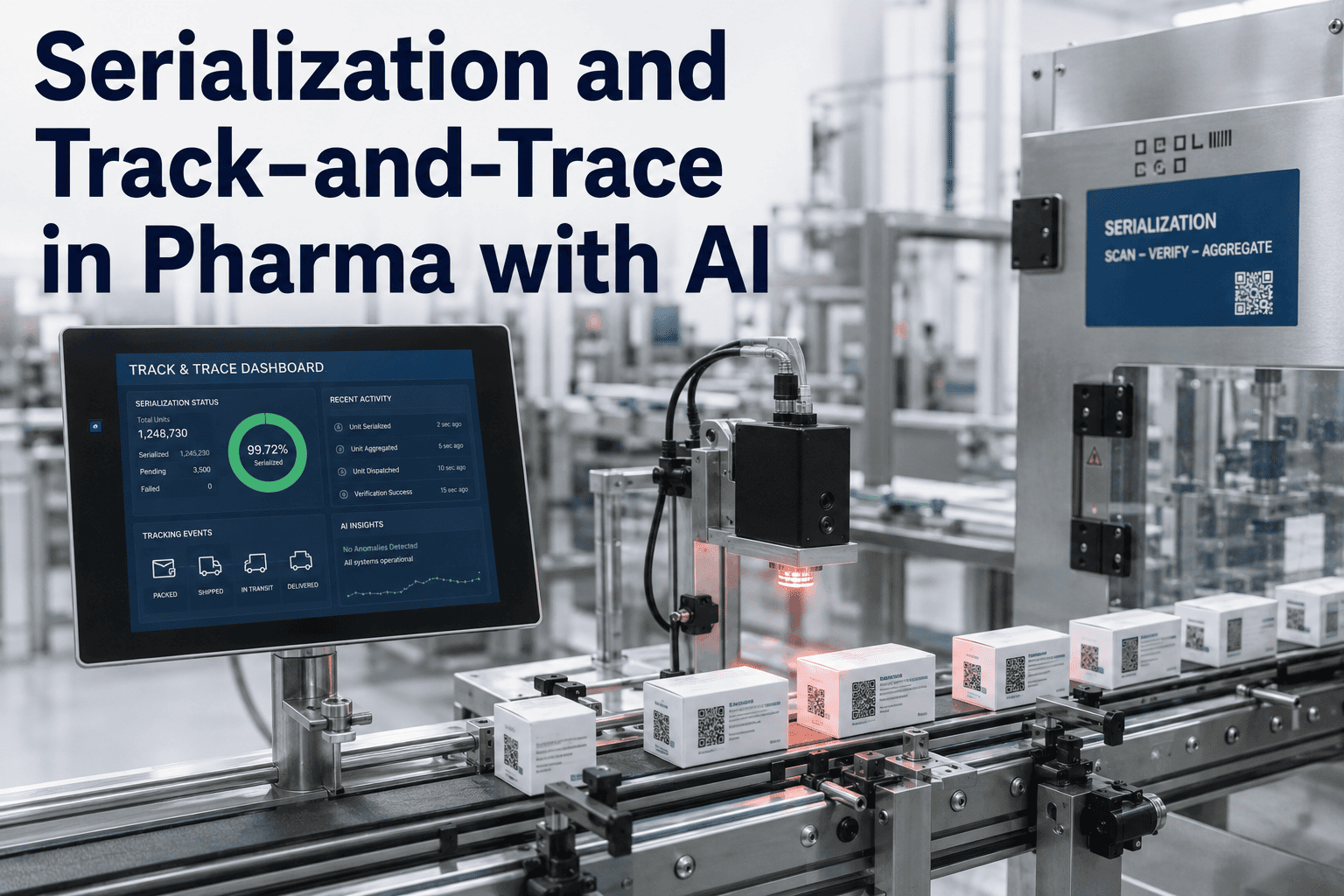
Every legitimate prescription drug package sold in the United States now carries a unique serialized identifier, the product of a decade-long regulatory buildout under the Drug Supply Chain Security Act. That achievement solved the identity problem: every unit can be scanned and matched to a manufacturer, lot, and expiration date. It did not solve the intelligence problem. Serialization tells a pharmacy that a barcode is correctly formatted, it does not tell anyone whether the transaction history behind that barcode makes sense, whether a diversion pattern is forming across a distributor network, or whether a cold chain shipment sat outside its temperature range for six hours somewhere between the warehouse and the loading dock. Facilities that want to close that gap can Book a Demo and see how AI applied on top of serialization data catches what compliance alone cannot, turning a decade of regulatory investment into an active defense rather than a passive paper trail.
Serialization Proves a Barcode Is Real. It Does Not Prove the Supply Chain Around It Is Clean.
iFactory layers AI-driven anomaly detection on top of your existing EPCIS and serialization data to surface counterfeit patterns, diversion, and cold chain exceptions before they reach a patient.
The Counterfeit Drug Trade Is Now One of the World's Largest Illicit Markets
Estimates of the global counterfeit medicine trade vary depending on methodology, but every credible source places it in the tens of billions of dollars at minimum, with several analyst estimates ranging as high as two hundred to four hundred billion dollars annually once falsified, substandard, and diverted product are all counted together. The World Health Organization has estimated that roughly one in ten medical products circulating in low- and middle-income countries is substandard or falsified, a rate that climbs meaningfully higher for specific high-value drug categories in parts of Latin America and Sub-Saharan Africa. The financial harm compounds into a public health harm: falsified and substandard medicines are linked to hundreds of thousands of preventable deaths a year, largely through treatment failure in infectious disease and chronic condition management.
Serialization mandates exist precisely because this problem cannot be solved through inspection alone. A counterfeit tablet can be visually indistinguishable from the genuine product, and by the time a suspicious batch is identified through adverse event reporting, it has often already reached patients. A unique, scannable identifier on every package gives every node in the supply chain, from manufacturer to wholesaler to dispenser, the ability to verify that a given unit is what it claims to be before it changes hands again.
What makes counterfeiting especially difficult to contain is that it rarely announces itself the way a contamination event does. A batch of falsified antimalarials or oncology drugs can move through several legitimate-looking distribution handoffs before anyone notices anything is wrong, and the criminal networks behind large-scale counterfeiting operations are sophisticated enough to replicate packaging, holograms, and even early-generation serialized barcodes convincingly. This is exactly why regulators worldwide have converged on the same conclusion as the pharmaceutical industry itself: identity verification at the package level is necessary, but it is only the foundation, not the finished defense.
A Decade in the Making: How Serialization Became Mandatory
The Drug Supply Chain Security Act was signed into law in 2013 with a ten-year phased implementation plan, and the equivalent European framework, the Falsified Medicines Directive, reached its own enforcement deadline in 2019. The U.S. path to full enforcement was anything but a straight line: the original 2023 target for interoperable electronic tracing was pushed back through a stabilization period, then further staggered through individual exemptions granted by trading partner type, a reflection of just how difficult it proved for thousands of manufacturers, wholesalers, and pharmacies to stand up compatible electronic systems on a shared timeline. The timeline below traces the major milestones from initial passage to the enforcement landscape as it stands today.
DSCSA Enacted
The Drug Supply Chain Security Act is signed into law, establishing a ten-year roadmap toward a fully interoperable, electronic, unit-level track-and-trace system for the U.S. pharmaceutical supply chain.
Product Serialization Required
Manufacturers are required to apply unique product identifiers, typically GS1-standard 2D barcodes encoding NDC, lot, expiration, and serial number, to every saleable unit.
EU FMD Deadline Passes
The European Falsified Medicines Directive reaches full enforcement, requiring safety features and an EU-wide verification system across member states.
U.S. Stabilization Period Ends
The FDA's grace period for interoperable electronic data exchange expires, setting the final, non-negotiable enforcement date for the U.S. supply chain.
Staggered Enforcement Takes Effect
Manufacturers face full enforcement from May 2025, wholesale distributors from August 2025, and larger dispensers from November 2025, following FDA exemptions granted to ease the transition.
Full Enforcement, Active Inspection
FDA and state boards of pharmacy now treat non-compliant trading partner data as grounds for a suspect product investigation, making DSCSA one of the most actively enforced areas of supply chain oversight.
The lesson for any company still catching up is straightforward: compliance timelines rarely offer a clean, permanent deadline anymore, they offer a series of enforcement waves that reward whoever builds real interoperability early and penalize whoever waits for the next extension. Large distributors have already gone further than the law strictly requires, some self-enforcing accelerated interoperability requirements on their trading partners years ahead of the federal timeline, which means a manufacturer or repackager that is only just now becoming DSCSA-compliant may still find itself locked out of shipping relationships with the largest distribution networks until its systems catch up.
Where a Serialized Package Travels, and Where It Can Go Wrong
A single package can pass through four or five custody changes before it reaches a patient, and serialization data is generated at every one of those handoffs. Each handoff produces its own EPCIS transaction event, and in a fully compliant supply chain those events should form an unbroken, logically consistent chain from the packaging line to the pharmacy counter. In practice, breaks and inconsistencies in that chain are common, not because any single trading partner is acting in bad faith, but because dozens of independent systems, each built by a different vendor on a different data model, are all trying to describe the same physical movement of goods. The flow below shows the standard path a package takes and the failure mode most associated with each node.
Manufacturer
Serial number generated and printed at packaging line. Risk: aggregation errors linking the wrong child units to a parent case or pallet.
Distributor / Wholesaler
Custody transferred with EPCIS transaction data. Risk: gray market diversion and unauthorized trading partner transactions.
Cold Chain / Logistics
Temperature-sensitive product moves through transit. Risk: excursions outside validated range that go undocumented at handoff.
Repackager
Product may be repackaged for a new market or format. Risk: broken serialization chain if repackaging data is not correctly re-linked.
Dispenser / Pharmacy
Final verification before dispensing to a patient. Risk: suspect product entering circulation if upstream verification was incomplete.
Every arrow in that chain is a point where a legitimate product can be swapped, diverted, or delayed, and it is also a point where an EPCIS event record is created. The opportunity is that this record already exists for compliance purposes; the work is in making sure someone, or something, is actually watching it in aggregate rather than filing it away until an audit or an investigation calls for it.
Why Temperature Logs Alone Don't Protect a Cold Chain Shipment
Biologics, vaccines, and an increasing share of specialty drugs require continuous cold chain custody, and most shippers already attach a temperature data logger to sensitive shipments. The problem is that a logger only records what happened, it does not connect that record to the serialized units inside the container or flag the exception before the shipment is accepted at the next node. A six-hour excursion recorded on a logger that nobody reviews until the shipment has already been received and shelved is functionally the same as no monitoring at all.
Correlating IoT temperature data with the serialized product identifiers inside a given shipment closes that gap. When an excursion is detected, the affected serial numbers can be automatically flagged for quarantine and further stability assessment rather than relying on a logistics coordinator to manually cross-reference a temperature report against a packing list days after the fact. This is one of the clearest examples of how serialization data and operational IoT data, which are usually managed by entirely separate teams and systems, become far more valuable the moment they are unified and monitored together.
What Serialization Alone Detects vs What AI Adds on Top of It
Serialization answers a narrow but important question: is this barcode correctly formatted and does it match a record that a manufacturer actually issued. It was never designed to answer the harder question of whether the pattern of transactions surrounding that barcode makes sense, whether the same serial number has been scanned in two geographically distant locations within an impossibly short window, or whether a distributor's ordering pattern has quietly shifted in a way that matches known diversion behavior. Those questions require analysis across the full network of transactions over time, not a single point-in-time scan. The comparison below shows where the boundary sits.
| Capability | Serialization Alone | AI on Top of Serialization |
|---|---|---|
| Barcode Format Validity | Confirmed | Confirmed |
| Duplicate or Cloned Serial Numbers | Not detected in real time | Flagged across the network within minutes |
| Diversion / Gray Market Patterns | Not visible from a single scan | Detected via transaction velocity and routing anomalies |
| Cold Chain Temperature Exceptions | Not captured by serialization data | Correlated against IoT sensor logs automatically |
| Aggregation Errors | Surface only at manual reconciliation | Surfaced immediately via automated hierarchy checks |
None of this requires abandoning the serialization infrastructure a facility has already invested years and considerable budget into building. The EPCIS event data, the GS1 barcodes, and the trading partner agreements already in place are the raw material the AI layer analyzes. What changes is the amount of human attention it takes to notice that something in that data is wrong: instead of a compliance team manually spot-checking transaction reports, the network is watched continuously, and only the transactions that actually look anomalous are surfaced for a human investigator to review.
Your Serialization Data Is Already Being Generated. It Just Isn't Being Watched.
iFactory connects to your existing EPCIS and serialization repository to start surfacing anomalies without a re-platforming project.
Three Layers of AI-Driven Track-and-Trace Intelligence
AI does not replace the serialization infrastructure a facility has already built to comply with DSCSA or the EU FMD. It sits on top of it as an additional analytical layer, and most deployments are built in three stacked layers, each depending on the data produced by the layer below it. Skipping straight to predictive modeling without first unifying the underlying data, or without first building reliable anomaly detection across the network, tends to produce noisy, low-confidence outputs that investigators quickly learn to ignore, which defeats the purpose of building the capability in the first place.
Predictive Diversion and Counterfeit Modeling
Models trained on historical investigation outcomes score new transaction patterns for counterfeit or diversion risk before a suspect product report is ever filed, prioritizing investigator attention on the highest-risk cases first.
Cross-Node Anomaly Detection
Machine learning models analyze EPCIS event sequences across the full trading partner network, flagging duplicate serials, implausible transaction velocity, and routing paths inconsistent with a legitimate distribution pattern.
Unified Serialization and IoT Data Capture
Serialization records, EPCIS transaction data, and cold chain IoT sensor logs are ingested into a single, time-aligned data layer that every higher analytical layer depends on.
Pharma Serialization, Track-and-Trace, and AI — Common Questions
Is DSCSA compliance fully enforced now, or are there still exemptions?
The stabilization period that gave the industry extra time to build interoperable electronic systems ended in November 2024. Since then, enforcement has moved forward on a staggered schedule by trading partner type, with manufacturers, wholesalers, and larger dispensers now expected to be fully compliant. Only very small dispensers retain a narrow exemption window. Teams unsure of their current status can Book a Demo to review their trading partner data exchange posture.
How is DSCSA different from the EU Falsified Medicines Directive?
Both frameworks require unit-level serialization and an electronic verification system, but DSCSA builds toward a fully interoperable, unit-level, trace-back-capable U.S. system on a staggered ten-year timeline, while the EU FMD centers on a single European verification hub that pharmacists check before dispensing. A company operating in both markets needs systems capable of satisfying both models simultaneously, since a single serialization strategy rarely covers both without adaptation, and the reporting formats, barcode standards, and verification touchpoints each region expects can differ enough that a copy-paste compliance approach usually creates gaps rather than closing them.
Can AI detect counterfeit product that already passed a serialization scan?
Yes, this is one of the most valuable capabilities AI adds. A cloned serial number can pass a basic format check while still being fraudulent, and only cross-node analysis, comparing where and how often a given serial number has been scanned across the network, reveals that the same identifier appears in two places at once or has moved through an implausible route. The iFactory Support team can walk through how this detection layer integrates with your current verification router.
Do we need new hardware to add AI analysis on top of our existing serialization system?
In most cases, no. The serialization and EPCIS data your systems are already producing to satisfy DSCSA or EU FMD requirements is sufficient input for anomaly detection models. Cold chain correlation benefits from existing IoT temperature loggers if they are already deployed, but AI analysis itself is typically added as a software layer on top of data you are already generating rather than a new hardware deployment.
What is the actual cost impact of counterfeit or diverted product reaching the market?
Beyond the direct patient safety harm, a confirmed counterfeit or diversion incident typically triggers a formal FDA investigation, recall logistics, notification obligations to trading partners and regulators, and reputational damage that can affect a brand for years. Analysts have placed the broader global counterfeit medicine trade in the range of tens of billions to several hundred billion dollars annually, underscoring how much value is at stake across the industry as a whole. For an individual manufacturer, a single confirmed incident tied to their product can also trigger heightened scrutiny of every other product line at the same facility, extending the cost well beyond the original event.
Compliance Proves the Barcode. Intelligence Protects the Patient.
Talk to iFactory about layering AI-driven anomaly detection over the serialization and track-and-trace data you already collect.