Total Productive Maintenance is one of the most quoted frameworks in manufacturing and one of the least fully implemented. Plants adopt the language of TPM — autonomous maintenance, zero breakdowns, operator ownership — while actually running a partial version that stalls after the first pillar or two. The framework was never designed to be implemented piecemeal; each of its eight pillars supports the others, and skipping foundational pillars to chase quick wins on visible ones is the most common reason TPM programs plateau well below their potential. Manufacturing leaders building a genuine TPM program can Book a Demo to see how iFactory supports pillar-by-pillar implementation with real-time equipment data.
Why TPM Programs Stall Before They Reach Full Implementation
TPM promises a compelling outcome: equipment that rarely breaks down, operators who catch problems before they escalate, and a culture where everyone on the floor takes ownership of asset reliability. The promise is real, but the path to it is longer and more structured than most programs acknowledge. Many plants launch with enthusiasm around autonomous maintenance — operators cleaning and inspecting their own equipment — see early wins, and then struggle to sustain momentum because the supporting pillars around planned maintenance, training, and early equipment management were never built out. The result is a program that produces visible activity without a corresponding drop in unplanned downtime. This pattern is common enough in continuous improvement circles to have earned its own name — "TPM theater" — where checklists get completed and improvement boards get updated, but the underlying reliability, defect, and safety metrics never actually move. Recognizing the eight pillars as an interdependent system, rather than a menu of optional initiatives to sample from, is the shift that separates programs that plateau from programs that compound.
The Eight Pillars: A Structure, Not a Checklist
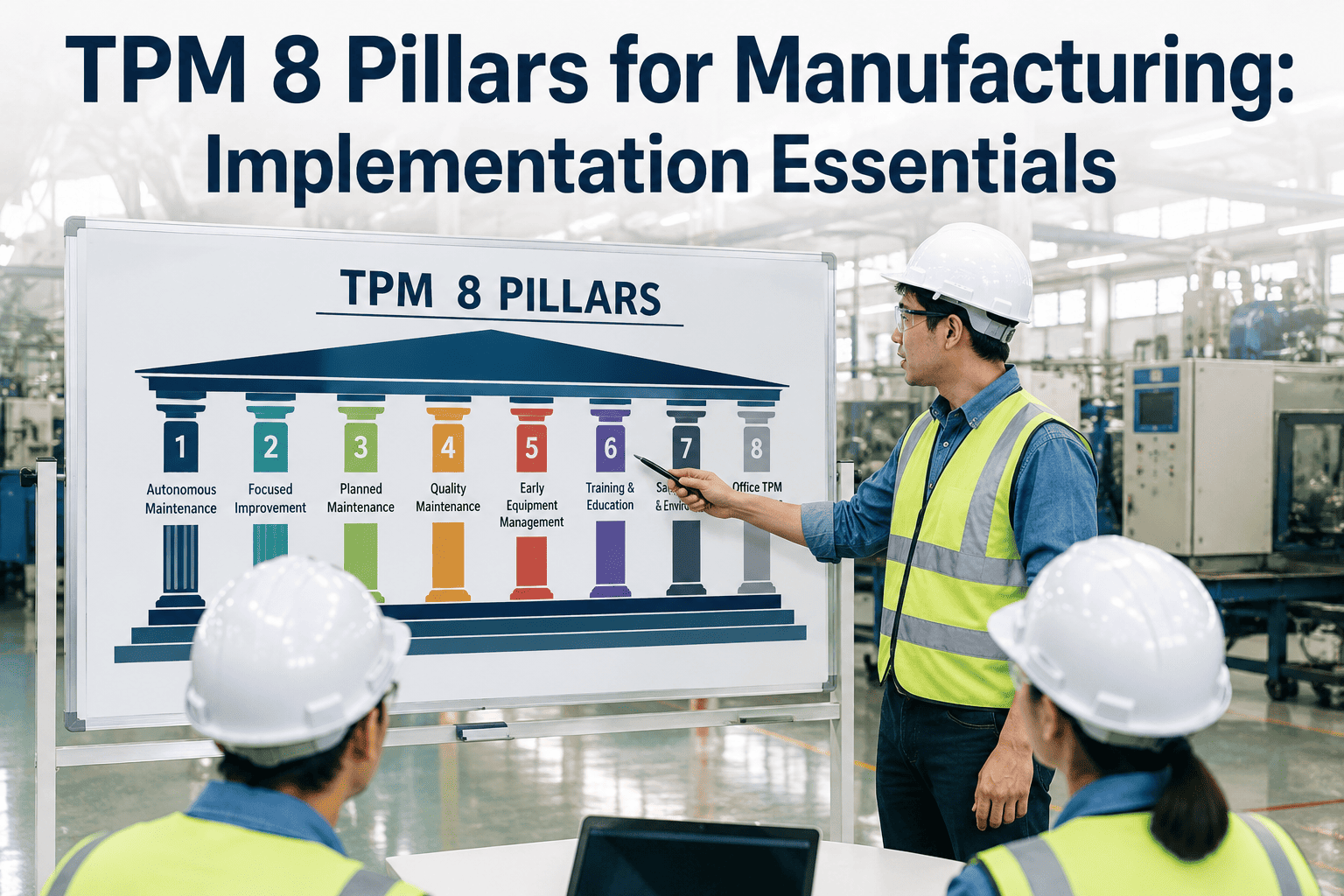
TPM is often visualized as a temple — a stable roof of zero breakdowns, zero defects, and zero accidents, supported by eight pillars rising from a foundation of 5S workplace organization. The metaphor matters because it captures something checklists miss: the pillars are not independent initiatives to be worked through in isolation. Autonomous maintenance depends on operator training. Planned maintenance depends on data from quality maintenance and focused improvement to prioritize which assets need attention first. Weakness in any single pillar limits how high the entire structure can perform, regardless of how strong the others are.
Autonomous Maintenance
Operators perform daily cleaning, inspection, and lubrication of their own equipment, catching early signs of wear before they become failures and freeing skilled technicians for higher-value work.
Planned Maintenance
A scheduled maintenance program based on failure history and criticality replaces reactive repair, shifting technician time toward prevention rather than firefighting.
Quality Maintenance
Equipment conditions that cause defects are identified and controlled at the source, linking maintenance activity directly to quality outcomes rather than treating them as separate disciplines.
Focused Improvement
Cross-functional teams target the biggest sources of loss — the top contributors to OEE gaps — using structured problem-solving rather than general continuous improvement activity.
Early Equipment Management
Lessons from maintaining existing equipment feed into the design and specification of new equipment, reducing the maintenance burden of assets before they ever reach the floor.
Training and Education
Operators and technicians build the technical skills to perform their expanded TPM responsibilities, since autonomous maintenance and planned maintenance both fail without adequate skill development.
Safety, Health, and Environment
A zero-accident target is built into equipment design and maintenance procedure, recognizing that reliability and safety improvements come from the same root-cause discipline.
TPM in Administration
Office and support functions — procurement, planning, scheduling — apply the same waste-elimination principles, since delays in these functions directly limit floor-level TPM performance.
Autonomous Maintenance: The Pillar Everyone Starts With — and Often Stops At
Autonomous maintenance is usually the entry point for TPM because it produces visible, tangible change quickly — operators cleaning equipment, spotting loose bolts, catching early leaks. But autonomous maintenance implemented in isolation, without the planned maintenance structure to act on what operators find, produces a stream of observations that go nowhere. An operator who reports the same vibration issue three times without seeing a work order generated stops reporting it. The pillar only delivers value when it feeds directly into a responsive maintenance planning process, which is why sequencing matters as much as the individual activities.
Initial Cleaning as Inspection
Operators clean equipment thoroughly for the first time in a structured event, using the process to discover hidden defects — leaks, loose fasteners, wear patterns — that routine operation had obscured.
Eliminate Contamination Sources
Rather than repeatedly cleaning the same contamination, teams identify and eliminate its source — a leaking seal, an exposed process — reducing the recurring cleaning burden going forward.
Develop Cleaning and Inspection Standards
Standardized checklists define what operators inspect, how often, and what condition constitutes a pass or a flag for maintenance attention, replacing informal habits with a repeatable standard.
General Inspection Training
Operators receive technical training to recognize deeper equipment conditions — bearing wear, hydraulic pressure irregularities — extending their inspection capability beyond visual cleanliness checks.
Autonomous Inspection
Operators independently execute the full inspection standard on a set schedule, with findings routed directly into the CMMS as work order requests rather than informal notes.
Standardization and Sustained Ownership
Autonomous maintenance becomes embedded in the operator's normal daily routine, tracked and audited like any other production standard rather than treated as a separate improvement initiative.
Measuring Pillar Maturity: A Practical Assessment Approach
Plants often overestimate how far along a given pillar actually is, particularly for pillars like planned maintenance or focused improvement where activity is easy to confuse with results. A practical maturity assessment scores each pillar against defined criteria rather than participation levels, distinguishing between a pillar that is active and one that is actually producing measurable improvement in downtime, defect rate, or safety incidents.
| Pillar | Early Stage Signal | Mature Stage Signal |
|---|---|---|
| Autonomous Maintenance | Cleaning events completed, checklists exist | Operator findings convert to work orders within 24 hours |
| Planned Maintenance | PM schedule exists, compliance inconsistent | 80%+ planned labor ratio, schedule compliance above 90% |
| Quality Maintenance | Defects tracked, root cause rarely equipment-linked | Equipment conditions causing defects identified and controlled |
| Focused Improvement | Kaizen events run periodically, ad hoc topics | Projects target top loss categories from OEE data |
| Training and Education | Onboarding training exists, no skill tracking | Skill matrix tracked per operator against TPM responsibilities |
The Six Big Losses: What Focused Improvement Should Actually Target
Focused improvement pillar activity is most effective when it is aimed squarely at the six big losses that OEE was designed to measure — the specific categories of equipment loss that separate theoretical maximum output from actual output. Without this targeting discipline, kaizen events tend to drift toward whatever problem is most visible or most recently discussed, rather than the loss category actually driving the largest OEE gap. Connecting focused improvement teams directly to OEE loss data ensures project selection is evidence-based rather than anecdotal.
Equipment Failure
Unplanned breakdowns stopping production, the most direct and visible availability loss category.
Setup and Adjustment
Time lost during changeovers and adjustments between product runs, an availability loss often underestimated in scale.
Minor Stops and Idling
Brief stoppages under a few minutes that rarely get logged individually but accumulate into significant performance loss.
Reduced Speed
Equipment running below its designed rate, often accepted as normal until benchmarked against rated capacity.
Process Defects
Scrap and rework produced during stable running conditions, a quality loss directly tied to process and equipment condition.
Reduced Yield
Startup and ramp-up losses before a process reaches stable output, a quality loss concentrated around shift starts and changeovers.
Ranking these six categories by their actual contribution to lost production hours, using data pulled directly from equipment monitoring rather than operator estimates, is what keeps focused improvement teams working on the highest-leverage problems instead of the most recently complained-about ones. A category that feels significant anecdotally — frequent minor stops that irritate operators throughout a shift — may in fact contribute far less total lost time than a less visible issue like gradual speed degradation across a full production run, and only systematic loss tracking reveals which is actually worth a dedicated improvement team's time.
The Overlooked Pillars: Early Equipment Management and TPM in Administration
Autonomous maintenance, planned maintenance, and focused improvement tend to dominate TPM conversations because their results show up directly on the plant floor in downtime and defect metrics. Early equipment management and TPM in administration receive far less attention despite having an outsized long-term impact on maintenance workload, because their benefits are realized further upstream and take longer to become visible in day-to-day metrics.
Early Equipment Management
When new equipment is specified and purchased without input from maintenance and operations, the plant inherits whatever maintenance burden the design carries — awkward access points for lubrication, components with short service life, or instrumentation that makes condition monitoring difficult. Early equipment management closes this gap by feeding maintainability lessons from existing assets directly into new equipment specifications, procurement criteria, and commissioning checklists. Plants with a mature early equipment management pillar routinely see new equipment reach stable, low-maintenance operation faster than plants that treat installation and commissioning as purely an engineering handoff.
TPM in Administration
Floor-level TPM performance is constrained by how quickly support functions move — how fast procurement processes a parts order, how quickly planning schedules a maintenance window, how efficiently a work request moves from submission to action. Applying the same waste-elimination and standardization principles used on the floor to these administrative processes closes delays that otherwise silently limit every other pillar's effectiveness. A planned maintenance schedule is only as good as the procurement process that gets parts to the technician on time, and a focused improvement project only delivers value as fast as the approval process behind it allows.
Safety, health, and environment is frequently treated as a compliance function running in parallel to TPM rather than as an integrated pillar, which undersells its role in the framework. The same root-cause discipline that reduces equipment failure also reduces the near-miss and incident conditions that lead to safety events — a machine guard bypassed to work around a chronic jam, a walkway blocked by parts staged for a repair that keeps recurring. Plants that fold safety incident review into the same focused improvement process used for downtime and defects tend to see safety metrics improve alongside reliability metrics, because many root causes are shared between the two.
Tracking TPM Results: OEE and the Metrics That Prove the Program Is Working
Overall Equipment Effectiveness remains the standard metric for judging whether TPM is producing real results, because it combines availability, performance, and quality into a single number that reflects the six big losses directly. A plant running at 60% OEE without a formal improvement program is not unusual, and world-class manufacturers sustaining mature TPM programs typically operate in the 80 to 85% range. The gap between those two numbers represents the cumulative effect of every pillar working together — fewer breakdowns from planned and autonomous maintenance, faster changeovers from focused improvement, fewer defects from quality maintenance, and more capable operators and technicians from the training pillar.
Tracking OEE alone, however, can mask which pillar is actually driving improvement or stalling progress. Plants that break OEE down by its three components — and further down into the six loss categories underneath — can attribute movement in the number to specific pillar activity, which is essential for deciding where to invest the next round of focused improvement resources. A facility with strong availability but weak performance, for example, points toward speed loss and minor stoppage issues rather than breakdown prevention, redirecting attention toward a different set of pillars and problem-solving teams than a facility struggling primarily with unplanned downtime. Reviewing this OEE breakdown on a fixed cadence, alongside pillar-specific leading indicators like autonomous maintenance completion rates and schedule compliance, gives leadership a balanced view that connects daily pillar activity to the lagging financial and reliability outcomes the program ultimately exists to deliver.
World-class manufacturers sustaining mature TPM programs typically operate in the 80 to 85% range, a level reached only when every pillar is contributing rather than one or two carrying the entire improvement effort. The gap between a plant's current OEE and that benchmark is rarely explained by a single missing pillar — it is almost always a combination of gaps spread across several, which is why isolated initiatives tend to plateau well short of the full potential a coordinated eight-pillar program can deliver over a multi-year horizon.
Frequently Asked Questions: TPM 8 Pillars Implementation
In what order should the eight pillars be implemented?
Most successful programs begin with 5S foundation work and autonomous maintenance, since these build the workplace discipline and operator engagement that later pillars depend on, followed closely by planned maintenance to ensure autonomous maintenance findings have somewhere productive to go. Quality maintenance and focused improvement typically follow once a baseline of equipment reliability data exists to target, with early equipment management, training, safety, and administrative TPM developing in parallel rather than strictly sequentially. Plants scoping a rollout sequence can Book a Demo to discuss a phased implementation plan.
How long does full TPM implementation actually take?
Realistic full implementation across all eight pillars, sustained to a mature level, typically takes two to three years for a facility of moderate complexity, not the six to twelve month timelines sometimes promised in program launches. Early pillars like autonomous maintenance can show visible results within the first six months, but achieving the measurable OEE and downtime improvements associated with mature TPM requires the later pillars — quality maintenance, early equipment management, focused improvement — to reach comparable maturity, which takes sustained investment over multiple years.
How does TPM relate to predictive maintenance and CMMS software?
TPM and predictive maintenance are complementary rather than competing approaches — TPM builds the organizational discipline and operator ownership culture, while predictive maintenance technology provides the data and early-warning capability that makes planned maintenance pillar activity more precise. A CMMS with real-time condition data lets planned maintenance shift from purely time-based schedules toward condition-based triggers, and gives focused improvement teams accurate loss data to target. Contact iFactory Support to discuss integrating condition monitoring into an existing TPM program.
What is the biggest reason TPM programs fail to sustain results after the first year?
The most common failure pattern is loss of management commitment once initial visible wins from autonomous maintenance and early kaizen events plateau, combined with insufficient investment in the training pillar needed to build the deeper technical skills required for later-stage pillars. Programs that sustain results treat TPM as a permanent operating model with dedicated resources and leadership accountability, rather than a time-limited improvement project that eventually reverts to a smaller footprint once initial enthusiasm fades.
Can TPM be implemented in a plant that hasn't stabilized its basic maintenance process yet?
TPM works best layered on top of a functioning maintenance foundation — a CMMS in active use, a defined work order process, and basic preventive maintenance already running — because the eight pillars amplify and structure existing maintenance discipline rather than creating it from nothing. Plants without this foundation typically benefit from stabilizing core maintenance management first, then introducing TPM's operator-ownership and continuous improvement layers once the underlying process is reliable enough to support them.