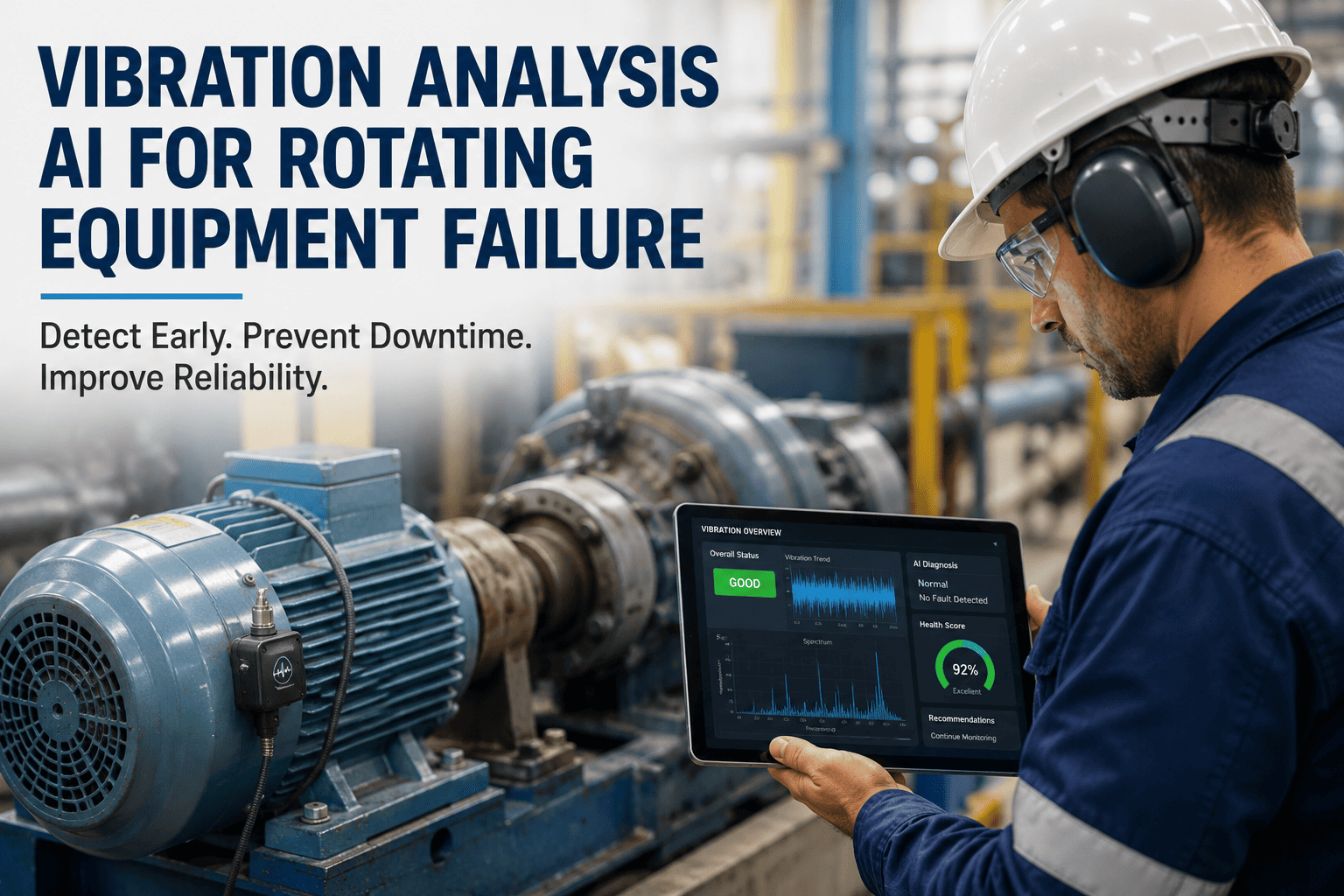
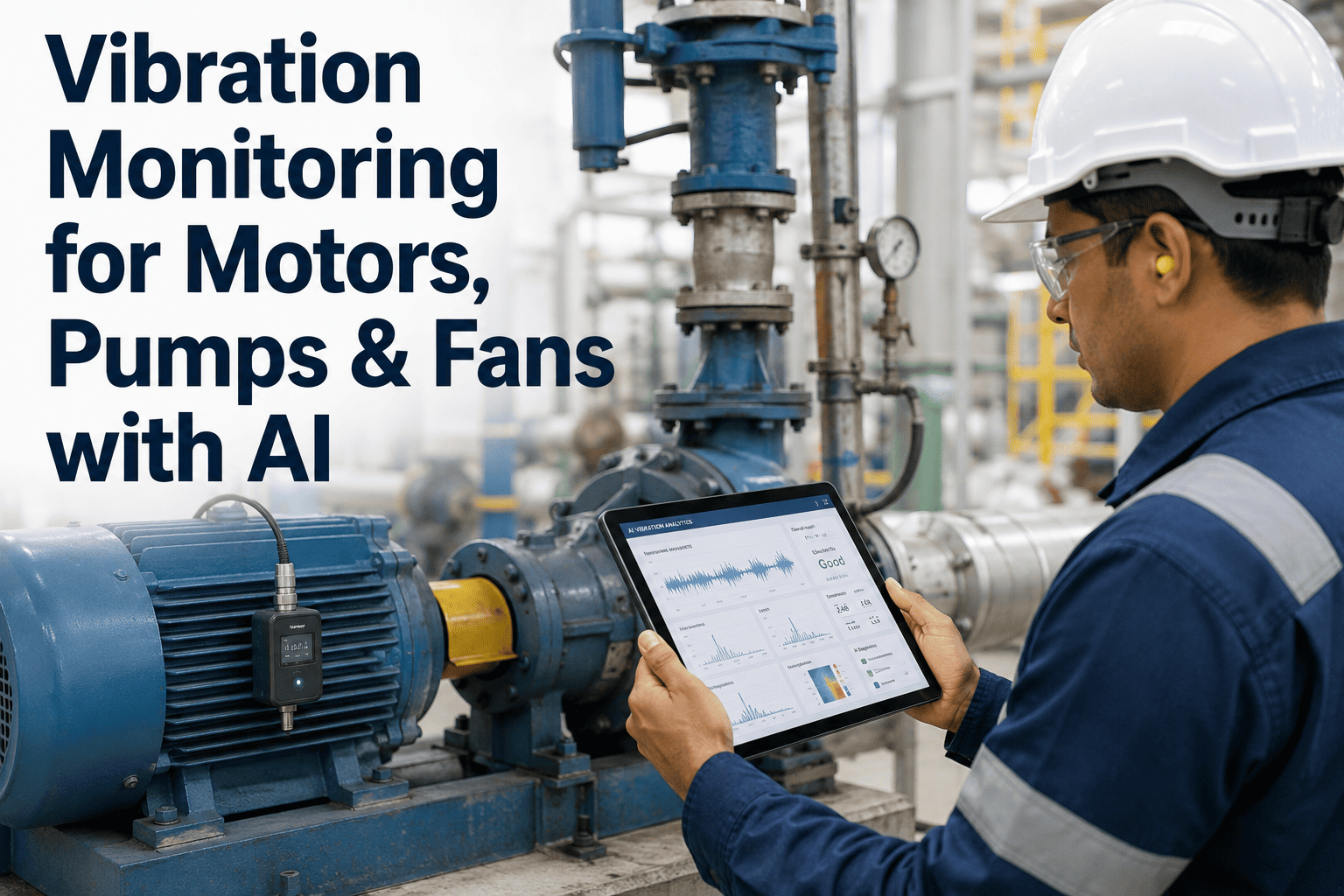
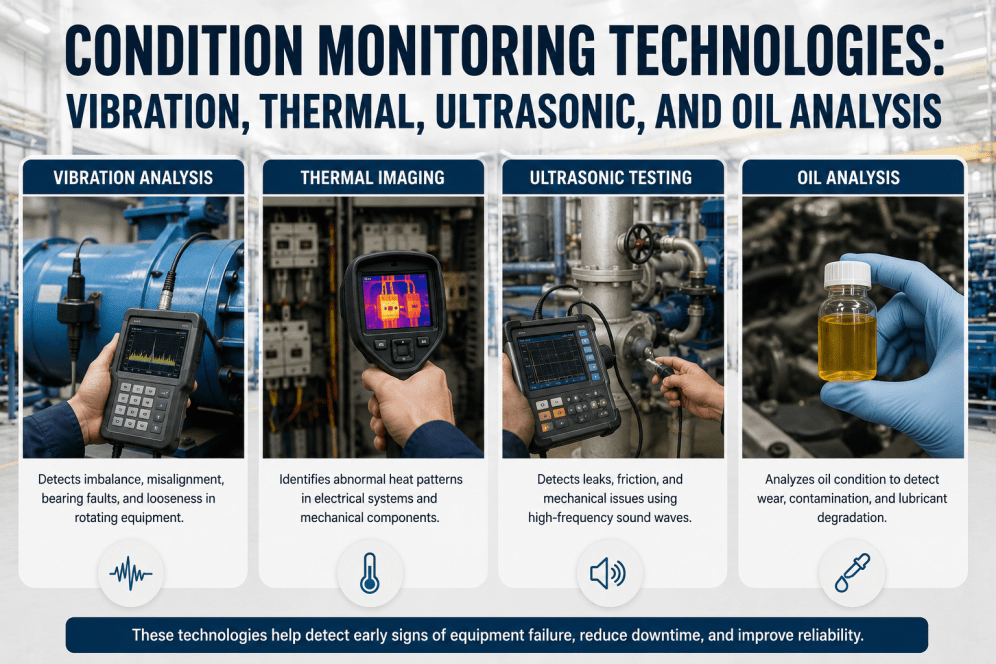
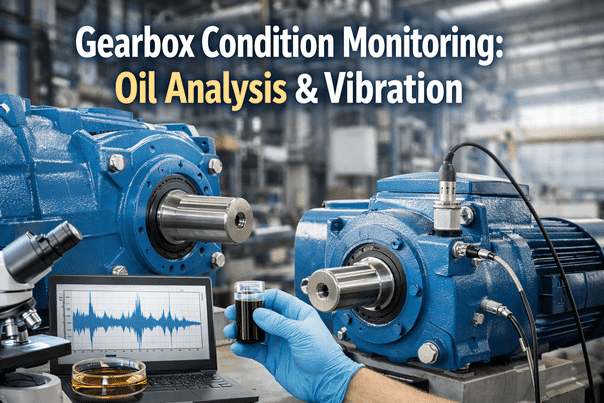
Every motor, pump, fan, gearbox, and conveyor drive on your plant floor depends on bearings, and bearings account for roughly 40-50% of all rotating equipment breakdowns. The good news for plant managers is that bearing failure is not a sudden event. It is a slow, physically measurable process that announces itself through vibration frequency shifts weeks or even months before anything breaks. Traditional route-based vibration checks, walked once a month by a certified analyst, capture a tiny fraction of that warning window. AI-driven continuous vibration analysis ingests accelerometer data around the clock, classifies fault signatures automatically, and estimates remaining useful life so repairs move from emergency stoppages to planned work orders. Plant managers who want to see this running on their own rotating equipment can book a demo and walk through a live fault-detection dashboard.
AI VIBRATION ANALYSIS · ROTATING EQUIPMENT · FAILURE PREDICTION
Hear a Bearing Failing Weeks Before It Happens
AI-driven vibration analysis turns raw accelerometer data into early fault classification and remaining useful life estimates, so repairs happen on your schedule, not the machine's.
40-50%
Share of all rotating equipment breakdowns caused specifically by bearing failure
30-90 Days
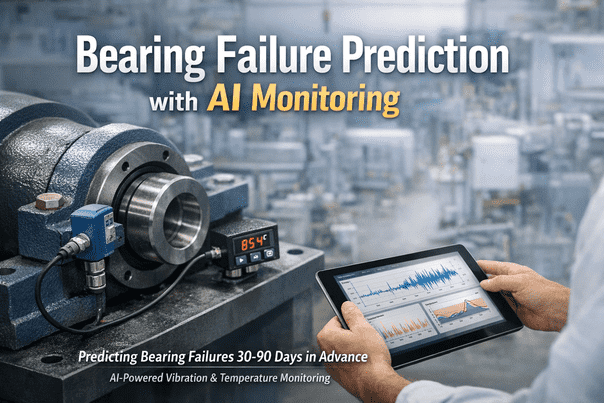
Advance warning AI-driven vibration and envelope analysis can provide before failure
80-95%
Fault classification accuracy achieved by mature AI vibration monitoring models
4-8x
How much more an unplanned bearing failure costs compared to a planned replacement
The Four Stages of Bearing Failure
Bearing failure follows a predictable physical progression. Plant managers who understand these stages know exactly why continuous monitoring catches problems that a monthly walk-around route simply cannot.
Stage 1
Micro-Cracks Forming
Subsurface fatigue cracks begin. No external symptoms. Only ultrasonic stress waves and early kurtosis rise are detectable.
Stage 2
Defect Frequencies Emerge
BPFO and BPFI signatures become visible in the vibration spectrum. Temperature deviates 2-5°C from baseline.
Stage 3
Spalling and Rising Noise
Broadband vibration climbs, sidebands appear, and temperature rises 5-15°C. This is the optimal repair window.
Stage 4
Functional Failure
Audible noise and extreme heat. Secondary damage to shaft and housing is already underway. Emergency shutdown only.
Reading the Frequency Signatures
Each bearing geometry produces characteristic vibration frequencies as it degrades. AI models watch all four continuously instead of relying on a technician to spot the right peak on a monthly spectrum plot.
| Signature |
What It Indicates |
Detection Difficulty |
| BPFO |
Outer race defect, the most common and earliest-detectable fault |
Straightforward once envelope analysis is applied |
| BPFI |
Inner race defect, rotating in and out of the load zone |
Harder to detect; requires continuous sampling |
| BSF |
Rolling element defect on the ball or roller itself |
Moderate; often paired with sideband analysis |
| FTF |
Cage defect, typically a sign of severe, advanced wear |
Late-stage indicator; action window is short |
AI VIBRATION ANALYSIS · ROTATING EQUIPMENT · 2026
See Your Bearings' Health in Real Time
Get a plant-specific risk assessment showing which motors, pumps, and gearboxes are closest to Stage 2 or Stage 3 degradation today.
Manual Route-Based Checks vs Continuous AI Monitoring
A certified analyst walking a plant with a data collector captures roughly 30 seconds of waveform data per bearing per month. That is a fraction of a percent of the bearing's total operating time. Continuous AI monitoring closes that sampling gap entirely.
Manual Route-Based Vibration Checks
Data collected once a month for roughly 30 seconds per bearing. Spectrum interpretation depends on analyst availability and experience. Faults between visits go unnoticed until the next scheduled route or the machine fails.
Continuous AI Vibration Monitoring
Accelerometer telemetry streams around the clock. AI classifies BPFO, BPFI, BSF, and FTF signatures automatically, assigns a severity stage, and estimates remaining useful life continuously as new data arrives.
Deploying AI Vibration Monitoring Without a Rip-and-Replace
Plant managers don't need to replace existing vibration hardware or certified analyst expertise to modernize their program. Three deployment paths fit most facilities.
Augment in Place
6-8 weeks
Existing sensors and software stay in place; AI adds the continuous ingestion and envelope analysis layer
Hybrid Migration
8-12 weeks
Critical assets move to continuous monitoring while lower-priority equipment stays on route-based checks
Full Modernization
10-14 weeks
Plant-wide continuous telemetry with automated fault classification and remaining useful life on every critical bearing
Frequently Asked Questions
AI VIBRATION ANALYSIS · ROTATING EQUIPMENT · 2026
Stop Losing Bearings to Emergency Failures
See how continuous AI vibration monitoring turns unplanned bearing failures into planned maintenance windows on your production floor.