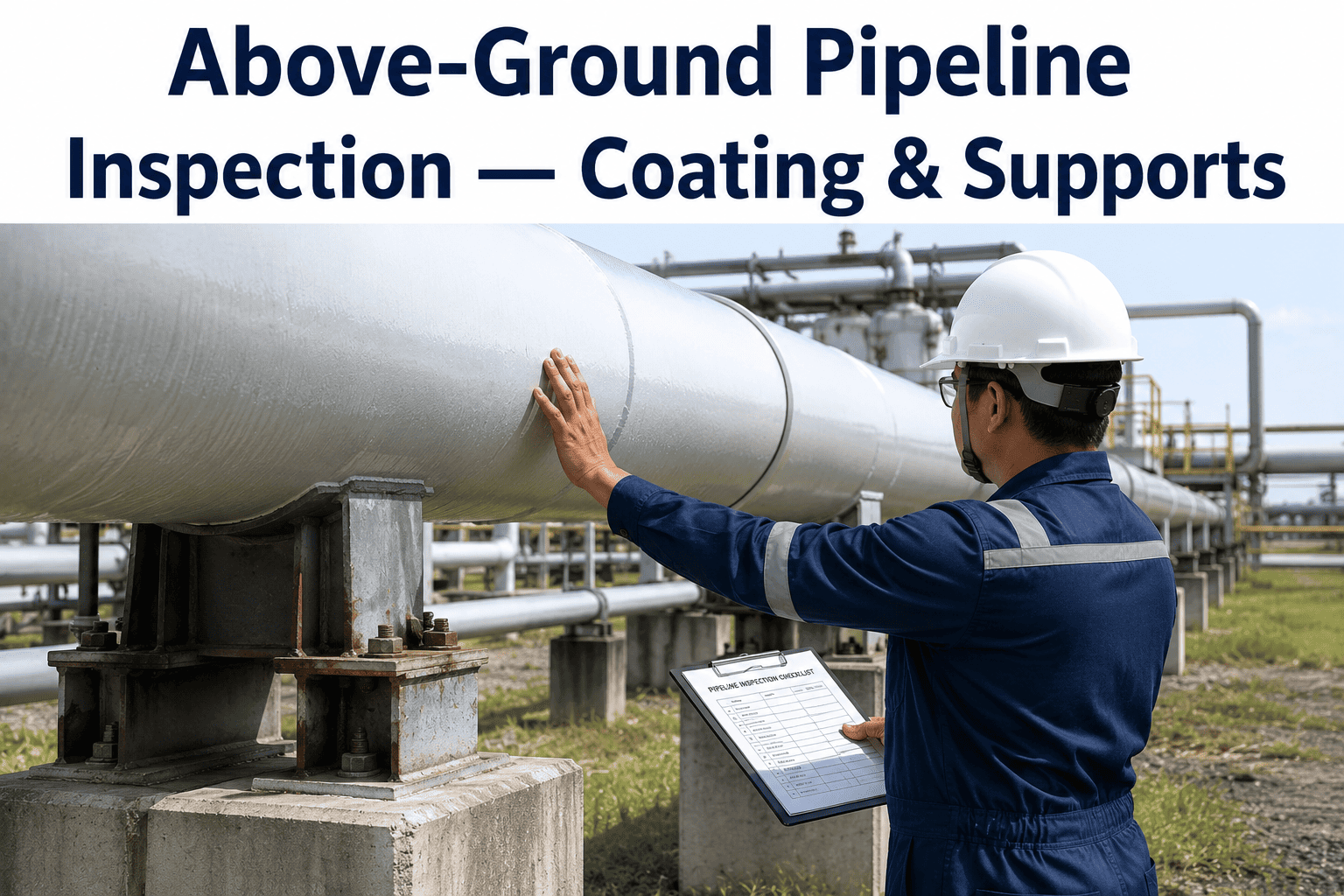
Above-ground pipeline sections get inspected less rigorously than buried pipe in a lot of integrity programs, on the assumption that anything visible must already be under control simply because someone can walk up and look at it. In practice, pipe racks, riser sections, and exposed spans at valve stations and pump stations see a different set of failure mechanisms than buried pipe entirely, and a visual walk-down every few months catches almost none of them early enough to matter. Coating breaks down under UV exposure in ways buried coating never experiences, pipe shoes wear through at support points from thermal cycling, and atmospheric corrosion sets in at bolted connections long before it becomes visible from ten feet away. Book a roadmap call to see how a structured above-ground inspection program closes these gaps before an exposed span becomes the next unplanned repair.
Above-Ground Pipeline Inspection Built Around the Failure Modes Buried Pipe Never Sees
Coating degradation, pipe support wear, thermal expansion stress, and structural integrity checks for pipe racks and risers, with inspection templates that catch what a routine visual walk-down misses.
Why Above-Ground Pipe Gets Under-Inspected Relative to Its Actual Risk
Regulatory attention and inspection budgets skew heavily toward buried pipe integrity because that is where the largest-consequence failures historically occurred. Above-ground sections quietly accumulate a different set of problems in the meantime.
typical coating life for above-ground pipe exposed to direct sunlight before UV degradation becomes visible
of above-ground corrosion commonly found concentrated at pipe support contact points rather than distributed across the span
visual inspection interval that remains the default for many above-ground segments regardless of exposure severity
approximate clearance at a pipe shoe where trapped moisture and coating breakdown most commonly go unnoticed
Failure Modes Specific to Above-Ground Piping
Above-ground pipe does not corrode the way buried pipe does, and an inspection program built around buried-pipe assumptions will miss the mechanisms that actually drive above-ground failures. Each of the four mechanisms below tends to progress silently for years before producing any indication visible from a casual walk-by.
Coating chalking and UV breakdown
Sustained ultraviolet exposure breaks down coating binder over years, leaving a chalky surface that no longer sheds water effectively even before any visible cracking or peeling appears. South- and west-facing exposures typically show this first given the additional afternoon sun load.
Atmospheric corrosion under insulation
Insulated above-ground spans trap moisture against the pipe wall in a way that is invisible from the outside, making CUI one of the most under-detected failure modes on insulated risers and pipe racks. Cyclic service temperatures that pass through the dew point repeatedly are especially prone to this.
Support-point wear and pipe shoe degradation
Repeated thermal cycling causes the pipe to slide against its supports, wearing through coating and eventually the pipe shoe itself at the exact points where visual access is hardest to get. Lines with frequent startup and shutdown cycles accumulate this wear considerably faster than continuously operating runs.
Vibration-induced fatigue at fittings
Small-bore fittings and instrument connections on above-ground piping see cyclic vibration from nearby rotating equipment that buried pipe is largely isolated from, driving fatigue cracking at threaded and welded joints. These failures often show no external warning sign until the connection actually cracks.
Inspection Checkpoints Along a Typical Pipe Rack Run
A useful above-ground inspection walks the same physical points every time in the same order, rather than a general visual sweep that depends entirely on what happens to catch the inspector's eye that day.
Coating condition at every support contact point
Checked first because this is where mechanical wear compounds with moisture retention, the single highest-risk combination on an above-ground run, and the location where recoating is cheapest if caught early.
Pipe shoe and hanger condition
Physical wear, corrosion, and freedom of movement at each shoe and hanger, confirming the support is still allowing the intended thermal expansion rather than binding, which would transfer unplanned stress elsewhere along the run.
Insulation jacket integrity on covered spans
Jacket seams, end caps, and low points checked for water ingress paths, since a compromised jacket is the leading indicator of CUI developing underneath long before any thickness loss becomes measurable from the outside.
Bolted flange and small-bore fitting condition
Visual and, where flagged, ultrasonic thickness checks at connections most exposed to vibration and atmospheric moisture accumulation, since these fittings fail disproportionately relative to their small share of total pipe surface area.
Riser base and grade transition point
The point where above-ground pipe transitions to buried pipe sees its own accelerated corrosion risk from splash zone moisture and soil-line coating stress, warranting a dedicated check every visit rather than being folded into the general run inspection.
Thermal Expansion and Support Design Considerations
Pipe support issues rarely start as a support problem. They start as a thermal expansion problem the original support design either accounted for correctly or did not, and the difference only becomes visible years later as wear accumulates at the contact point.
Coating Systems Used on Above-Ground Piping and Their Practical Limits
Choosing a coating system for above-ground pipe involves a different set of tradeoffs than buried pipe coating, since UV exposure, temperature cycling, and accessibility for recoating all factor into how long a given system actually holds up in service.
Get an Above-Ground Segment Assessed Against Its Actual Exposure
iFactory can walk through your pipe rack and riser inventory to flag which segments carry the highest coating and support wear risk given their exposure conditions.
The Cost Difference Between Catching Coating Failure Early and Late
Above-ground coating repair is inexpensive relative to almost any other pipeline maintenance activity when caught while it is still a coating problem. The cost curve changes sharply once the underlying steel starts losing wall thickness, and that shift usually happens faster than facility teams expect once a coating breach lets moisture reach bare metal.
Caught as chalking or early cracking
A spot recoat at the affected section, typically a routine maintenance task requiring surface prep and a coating application with no process interruption or engineering review needed, and one that can be scheduled around normal operations without any planning lead time.
Caught after coating loss with active corrosion
Requires ultrasonic thickness verification, an engineering fitness-for-service check against minimum required wall thickness, and potentially a temporary repair clamp before recoating can even begin, turning a routine task into a multi-step engineering-reviewed repair.
Support wear caught at coating stage
Recoating the contact strip and confirming shoe alignment during a routine visit, with no interruption to the support's function and no need to shore the pipe span while work proceeds.
Support wear caught after shoe failure
Requires temporary shoring of the pipe span, fabrication and installation of a replacement shoe, and inspection of the pipe wall at the contact point for any resulting mechanical damage, often on an unplanned basis that displaces other scheduled work.
Detection Methods for Corrosion Under Insulation
Because CUI develops beneath an intact-looking jacket, confirming its presence or absence requires methods that see through the insulation rather than relying on what the outside of the pipe looks like.
Profile radiography
Captures a cross-section image of the pipe wall through the insulation without removing it, showing wall loss directly but requiring radiation safety controls and access on both sides of the pipe.
Pulsed eddy current scanning
Measures average wall thickness through insulation and jacketing without removal, well suited to scanning long runs quickly to prioritize which locations warrant a more detailed check.
Infrared thermography
Identifies moisture trapped under insulation by detecting the thermal signature difference between wet and dry insulation sections, most effective under specific temperature and weather conditions.
Targeted insulation removal
Physically removing insulation at jacket seams, low points, and penetrations identified as highest risk for water ingress, confirming condition directly at the locations most likely to show a problem first.
Setting Inspection Intervals by Exposure Severity Rather Than a Single Default
Treating every above-ground segment on the same annual interval ignores how differently exposure conditions vary across a facility. A riser in a coastal, high-humidity environment ages very differently than an equivalent run in a dry inland climate.
Common Mistakes That Undermine an Above-Ground Inspection Program
Most above-ground inspection programs are not badly designed on paper. They lose effectiveness through small, repeated shortcuts that compound over years of inspection cycles.
Treating every segment on the same interval
A coastal insulated riser and a dry inland non-insulated run age at very different rates, and inspecting both on an identical annual cycle wastes attention on the low-risk segment while under-serving the high-risk one.
Recording findings without photo documentation
A written note that coating "looks fine" carries none of the comparative value of a photograph taken from the same angle every cycle, and most gradual degradation is only visible when two images are placed side by side.
Skipping insulation removal at flagged locations
Non-intrusive scanning methods are useful for prioritization, but skipping physical verification at the highest-risk locations means a program never actually confirms whether its screening methods are catching what matters.
No defined severity threshold for escalation
Without a documented scale for what counts as a finding that needs a work order versus one that gets monitored, escalation decisions end up depending entirely on which inspector happened to walk the route that cycle.
Above-Ground Inspection Program Checklist
Coating condition documented and photographed at every support point on every visit, not only when visible degradation prompts a closer look
Insulated spans flagged for CUI inspection on a defined interval rather than only when a leak or visible jacket damage triggers one
Pipe shoe and hanger freedom of movement verified, confirming the support is not binding against the thermal expansion it was designed to accommodate
Grade transition points at every riser base inspected as a distinct checkpoint separate from the rest of the run
Ultrasonic thickness readings trended at previously flagged locations rather than only recorded as a single pass/fail reading
Small-bore fittings near rotating equipment inspected for vibration fatigue on a shorter interval than the general run
Where AI-Assisted Vision Adds to Manual Walk-Downs
A manual walk-down is limited by what an inspector remembers to check and how much time is budgeted for the route that day. Vision-based inspection turns the same walk into a consistent, comparable dataset over time, which matters more the longer a facility relies on it.
Photo comparison against prior inspections
Each support point photograph is compared automatically against the same location from the previous inspection cycle, flagging coating changes a human reviewer would need to remember precisely to notice, especially across dozens of checkpoints on a long pipe rack run.
Consistent checkpoint coverage
A mobile inspection app walks the same GPS-referenced checkpoint sequence every time, so no support point or grade transition gets skipped because the route felt complete without it, even when a different inspector covers the route on a given visit.
Automatic severity scoring
Coating degradation and corrosion severity get scored consistently against a defined scale instead of relying on each inspector's individual judgment of what counts as moderate versus severe, removing a common source of inconsistency between different inspection cycles.
Work order generation for flagged points
A checkpoint scored above threshold routes directly into the CMMS with the photo history attached, rather than sitting in an inspection report until someone schedules a follow-up, shortening the gap between a finding and an actual maintenance action.
Frequently Asked Questions
How is above-ground pipeline inspection different from buried pipe integrity management?
Buried pipe integrity management focuses heavily on cathodic protection adequacy and coating holidays detected through indirect surveys, since the pipe cannot be directly viewed. Above-ground inspection relies on direct visual and instrumented access, but faces its own distinct failure modes including UV coating breakdown, support wear, and vibration fatigue that buried pipe rarely experiences. The two programs share reporting structures but need genuinely different checklists and inspection intervals, and treating them identically tends to under-serve whichever category gets less attention. Book a demo to see how both fit into a single integrity management platform.
What is corrosion under insulation and why is it so hard to catch?
Corrosion under insulation develops when moisture penetrates an insulation jacket and becomes trapped against the pipe wall, where it accelerates corrosion invisibly beneath an intact-looking exterior. It is difficult to catch because the jacket can appear undamaged from the outside while significant metal loss occurs underneath, which is why CUI-prone locations typically need a defined inspection interval with jacket removal or non-intrusive scanning rather than relying on visual walk-downs alone. Cyclic-temperature service lines that pass through the dew point repeatedly are typically prioritized first for this reason.
How often should pipe supports actually be inspected?
Annual visual inspection is a common regulatory floor, but support points under active thermal cycling, particularly near steam lines or process equipment with frequent startup and shutdown cycles, generally warrant a shorter interval given how quickly wear accumulates at a contact point under repeated movement. Segments identified as higher risk through prior findings should move to a shorter cycle rather than staying on the same schedule as the rest of the run, and a documented exposure-severity tier makes that adjustment defensible rather than arbitrary.
Can a mobile inspection app replace a qualified inspector?
No. A mobile inspection app structures the walk-down, captures consistent photo documentation, and flags condition changes for review, but a qualified inspector still makes the final determination on any flagged finding and any repair scope. The value of the tool is consistency and trend visibility across visits, not replacing the judgment a trained inspector brings to an ambiguous finding, and every flagged severity score is meant to prompt a human review rather than trigger an automatic repair decision.
How does iFactory integrate above-ground inspection data with existing systems?
Inspection checkpoints, photos, and severity scores feed directly into common CMMS and pipeline integrity management platforms so a flagged support point becomes a scoped work order without a manual data transfer step. This is designed to sit alongside your current inspection records rather than requiring a parallel data entry process for field crews already documenting findings on paper or in a separate system. Talk to a specialist about connecting your current inspection records rather than starting a separate system.
Build a Structured Above-Ground Inspection Program
Book a 30-minute scoping call and bring your pipe rack and riser inventory. iFactory will show you which segments carry the highest coating and support wear risk given their actual exposure conditions.