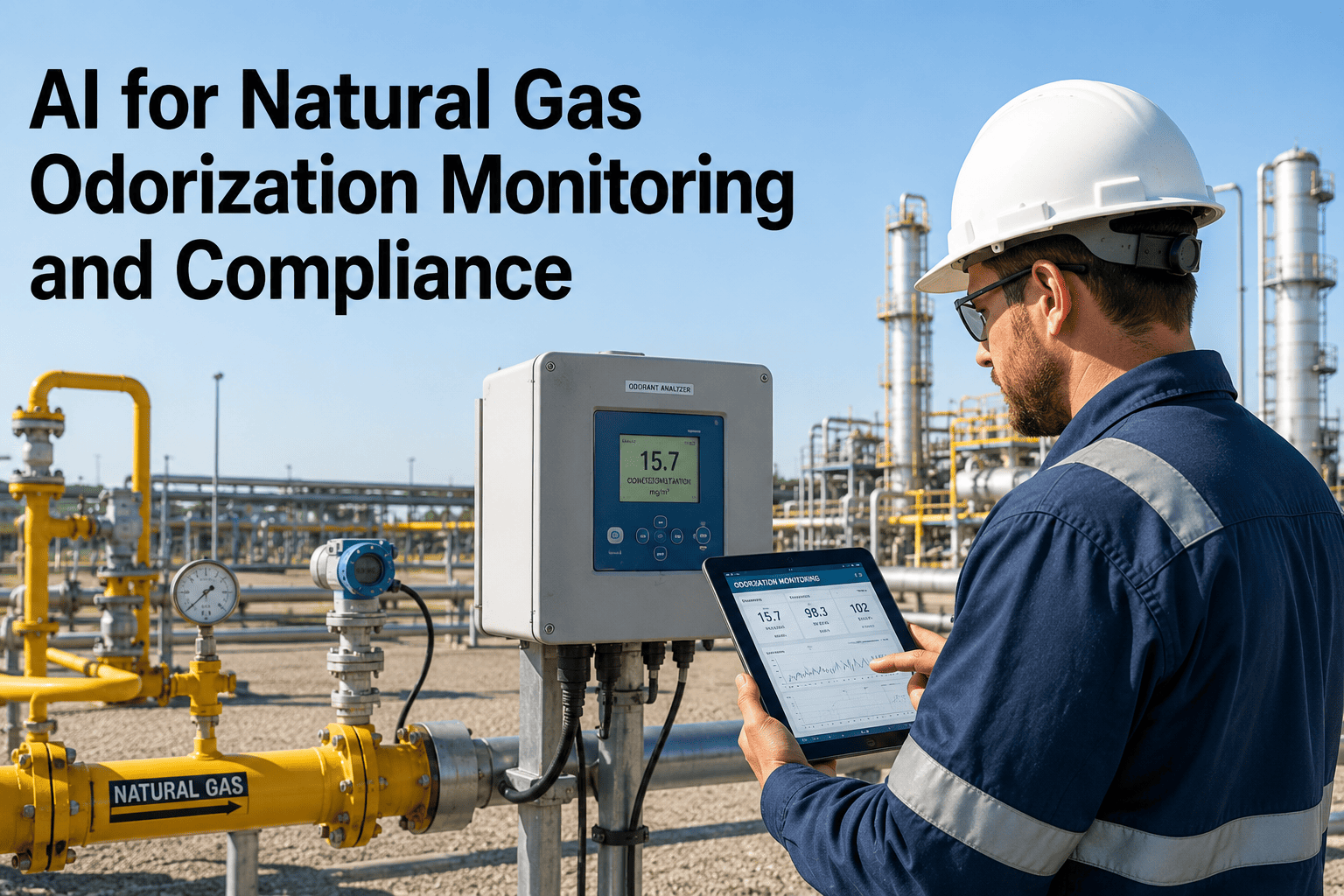
Natural gas distribution operators know the rule by heart: gas must be odorized so it is readily detectable at one-fifth of the lower explosive limit, and periodic sampling has to confirm that threshold holds at the far ends of the system. What far fewer operators can say with full confidence is whether every injection point, every remote regulator station, and every seasonal swing in gas composition is still meeting that standard on any given day, because most odorization programs still lean on manual sniff tests, paper logs, and injection equipment nobody checks between scheduled visits. A missed drift in mercaptan level rarely announces itself until a leak call comes in with no odor reported, and by then the conversation has shifted from routine compliance to an incident review. AI-based odorization monitoring closes that gap by watching injection rates and residual odorant levels continuously instead of periodically, flagging drift before it becomes a compliance finding or a safety event, and a working session with our team can show what that looks like against your own distribution system.
Midstream AI · Odorization Compliance
AI Monitoring for Natural Gas Odorization Rates and 49 CFR 192.625 Compliance
Continuous tracking of odorant injection rates and residual mercaptan levels at every delivery point, replacing scheduled sniff tests and paper logs with a live record that shows exactly where the system stands against federal odorization requirements at any moment.
Injection Rate
Within Range
Stable
Residual Mercaptan
Trending Low
Review Needed
Sniff Test Schedule
Next Due 4 Days
On Track
Where Odorization Programs Actually Break Down
A Periodic Sniff Test Only Proves Compliance at the Moment It Was Taken
Section 192.625 sets a clear technical bar: combustible gas in a distribution line has to be readily detectable by a person with a normal sense of smell at a concentration of one-fifth of the lower explosive limit, confirmed through periodic sampling at the extremities of the system. The requirement itself is simple. Meeting it consistently across a sprawling distribution network, month after month, through temperature swings, equipment wear, and seasonal gas composition changes, is where most programs run into trouble. A wick-type or bypass injection unit that was calibrated correctly in the spring can drift by summer as flow rates change, and nobody notices until the next scheduled sniff test happens to land after the drift has already occurred. Between those scheduled checks, the system is effectively running on faith. Operators are not ignoring the rule; they are working within the limits of a monitoring approach that was built around fixed intervals rather than actual conditions, and that gap between when odorant drift happens and when it gets caught is exactly where compliance exposure and public safety risk both live.
How Continuous Monitoring Works
Four Layers That Replace a Point-in-Time Sniff Test
A single sniff test answers one question for one moment: was the gas detectable when someone checked it. Continuous AI monitoring answers a different and more useful question by watching the conditions that actually drive odorant concentration, so a deviation gets flagged while it is still small enough to correct with a routine adjustment rather than an emergency response. The four layers below work together rather than in isolation, because injection rate alone does not guarantee residual concentration downstream, and residual concentration alone does not explain why a reading moved.
Injection Rate Tracking
Continuous readings from odorizer equipment compared against expected dosing for current flow, catching wick depletion or pump drift as it happens instead of at the next site visit.
Residual Level Sampling
Downstream mercaptan readings at delivery points and remote extremities, tracked over time to show whether odorant is actually reaching the far end of the system at a detectable level.
Sniff Test Scheduling
Automated tracking of required periodic sampling intervals under 192.625(f), with documentation generated as each test is logged so nothing is missed between manual visits.
Condition Compensation
Temperature, pressure, and flow variation factored into what a normal reading should look like, so a cold-weather dip in perceived odor gets explained rather than misread as equipment failure.
these four layers feed into
One Continuous Compliance Record, Updated in Real Time
Regulatory Mapping
What 192.625 Requires and Where Manual Programs Fall Short
Reading the regulation is straightforward. Proving continuous conformance across an entire distribution footprint, on the other hand, is where paper-based programs tend to accumulate gaps that only surface during an audit or an incident review.
| Requirement | Typical Manual Approach | Common Gap | AI Monitoring Coverage |
|---|
| Detectable at 1/5 LEL at any point in the line | Sniff test at select extremities on a set schedule | No visibility between scheduled checks | Continuous residual tracking at monitored delivery points |
| Periodic sampling per 192.625(f) | Field technician logs results on paper or spreadsheet | Missed or late intervals go unnoticed | Automated interval tracking with logged results |
| Odorant introduced without wide variation | Manual gauge check during site visits | Drift between visits undetected | Continuous injection rate comparison against expected dose |
| Equipment condition and calibration | Scheduled maintenance rounds | Wear-related drift missed until failure | Trend alerts on injection equipment behavior |
| Recordkeeping for inspection readiness | Filed paper logs and spreadsheets | Time-consuming to compile for an audit | Standing digital record ready for review at any time |
See Your Odorization Data Against 192.625 in One View
Most distribution operators have never seen their injection rates, residual readings, and sniff test history laid out together against the actual regulatory requirement. A short session walks through what that view looks like for your system.
Applied Example
How a Cold Snap Exposes a Gap a Manual Program Would Miss for Weeks
Consider a distribution segment served by a bypass-type odorizer that has run within normal range for months, with the last sniff test coming back clean and the next one not due for another three weeks. A sharp cold snap increases gas flow through the system as heating demand rises, and the odorizer's bypass ratio, tuned for typical flow, starts under-dosing slightly at the higher volume moving through it. Under a manual program, that shift sits unnoticed until the next scheduled test happens to catch it, or until a low-odor complaint comes in first. Under continuous monitoring, the injection rate tracker flags the mismatch between current flow and expected dosing within the same day the cold snap begins, well before residual concentration at the far end of the line drops anywhere near the detectable threshold. A field visit corrects the bypass setting, the deviation is logged with a timestamp and resolution, and the record shows a caught-and-corrected event rather than a gap nobody knew existed until it was reviewed after the fact.
Sniff Test vs Continuous Monitoring vs AI-Driven Monitoring
Three Approaches to the Same Regulatory Requirement
Every distribution operator is working toward the same outcome under 192.625, but the method used to get there determines how much of the gap between scheduled checks is actually visible. A manual sniff test program meets the letter of the periodic sampling requirement while leaving long stretches uncovered. Continuous instrument monitoring closes some of that gap but still requires someone to watch the readings and notice a slow drift against a backdrop of normal daily variation. AI-driven monitoring keeps a human in the loop on every decision while doing the pattern recognition that catches a slow drift long before it would be obvious to someone scanning a dashboard once a shift.
Manual Sniff Testing
Meets the minimum interval requirement but provides no visibility between scheduled tests.
Continuous Instrument Readings
Closes some of the gap but still depends on someone actively watching for drift.
AI-Driven Monitoring
Learns normal variation by site and flags real drift automatically, with a documented record attached.
What Is Actually at Stake
The Cost of a Missed Odorization Gap Rarely Shows Up Where You'd Expect
An odorization gap that goes uncaught carries risk on more than one front at once. There is the direct public safety exposure of a leak that goes unreported because the gas was not detectable at the concentration the rule requires, which is the entire reason the regulation exists in the first place. There is the compliance exposure that follows a PHMSA inspection finding a sampling interval that was missed or a record that cannot show continuous conformance, which can turn a routine audit into an enforcement action with corrective action deadlines attached. And there is the operational cost of discovering a drift only after a complaint or an incident forces a full system review, which is a far more expensive way to find a problem than catching it the day it started. None of these costs show up as a single obvious line item on a monthly report, which is exactly why the gap tends to persist in programs that only measure success by whether the scheduled test got done, rather than by whether the gas was actually within spec on every day in between.
The regulation was written around periodic sampling because that was the practical limit of what field testing could deliver at the time it was written. It was never meant to imply that the moments between tests don't matter, it's just that there wasn't a good way to watch them continuously. What we're seeing now is operators using the injection and residual data their systems are already generating anyway, and turning it into a running compliance record instead of a folder of quarterly sniff test sheets. The programs that adopt this fastest tend to be the ones that have already had a close call, whether that was a low-odor complaint or an inspection finding that took weeks to resolve because the records to disprove it simply weren't there.
Daniel Okafor-Reyes
Pipeline Safety and Compliance Advisor · 16 years in gas distribution operations
Getting Started Guidance
What to Confirm Before Adding Continuous Monitoring to Your System
A short readiness check up front shows how much of the setup connects to what already exists versus what needs to be added.
| Question | Why It Matters |
|---|
| What odorization equipment is currently installed at each injection point? | Determines what can be monitored directly versus what needs an added sensor |
| How are current sniff test results logged today? | Shapes how quickly historical records can feed into a continuous baseline |
| Which delivery points are farthest from the injection source? | Identifies where residual monitoring adds the most compliance value first |
| Who reviews and signs off on odorization records today? | Defines the workflow an automated alert needs to route into |
Common Questions
AI Odorization Monitoring — Frequently Asked
These are the questions compliance and operations teams tend to ask first before adding continuous monitoring to an existing odorization program.
Does this replace the periodic sniff testing required under 192.625(f)?
No, continuous monitoring works alongside required periodic sampling rather than replacing it, since the regulation specifically calls for sampling with an instrument capable of determining the gas-in-air percentage at which odor becomes detectable. What it changes is everything that happens between those scheduled tests, adding visibility into injection rates and residual levels so a drift gets caught early instead of waiting for the next interval.
Book a demo to see how the two work together on an actual system.
Can this work with our existing odorizer equipment, or does it require new injection units?
Most distribution systems can connect existing injection equipment and available flow data into a monitoring setup without replacing the odorizer itself, since the goal is to read what the equipment is already doing rather than change how odorant gets introduced. Where a site has no instrumentation at all, a lighter sensor addition may be needed to get useful readings.
Contact support to review what your current equipment supports.
How quickly would a drift in injection rate actually get flagged?
Once injection and flow data are connected, a deviation from expected dosing is compared against normal variation for that site continuously rather than at the next scheduled visit, so a meaningful drift is typically flagged within the same operating day it begins. That is a substantial improvement over discovering the same drift at the next periodic sniff test, which could be weeks away depending on the interval in place.
Book a session to see the detection timeline for your system.
Does this help during a PHMSA inspection or audit?
Yes, a standing digital record of injection rates, residual readings, and sampling history is far faster to produce during an inspection than compiling paper logs and spreadsheets from multiple field locations, and it demonstrates ongoing conformance rather than just a snapshot from the most recent scheduled test. Many operators find this becomes one of the most immediately useful parts of adopting continuous monitoring.
Ask our team about inspection readiness for your records.
Do smaller distribution systems benefit from this, or is it only useful at scale?
Smaller systems with fewer injection points often see value quickly because there are fewer sites to connect and the resulting record covers the entire system rather than a sample of it, while larger networks benefit from being able to prioritize which remote extremities get monitored first based on distance from the injection source. Either way, the underlying regulatory requirement is the same regardless of system size.
Book a call to talk through what fits your system's scale.
Know Where Your Odorization Program Stands Every Day, Not Just on Test Day
iFactory connects odorant injection rates, residual mercaptan readings, and sniff test scheduling into one continuous record, closing the gap between periodic testing and giving your compliance team a standing answer to what a 192.625 audit would ask.