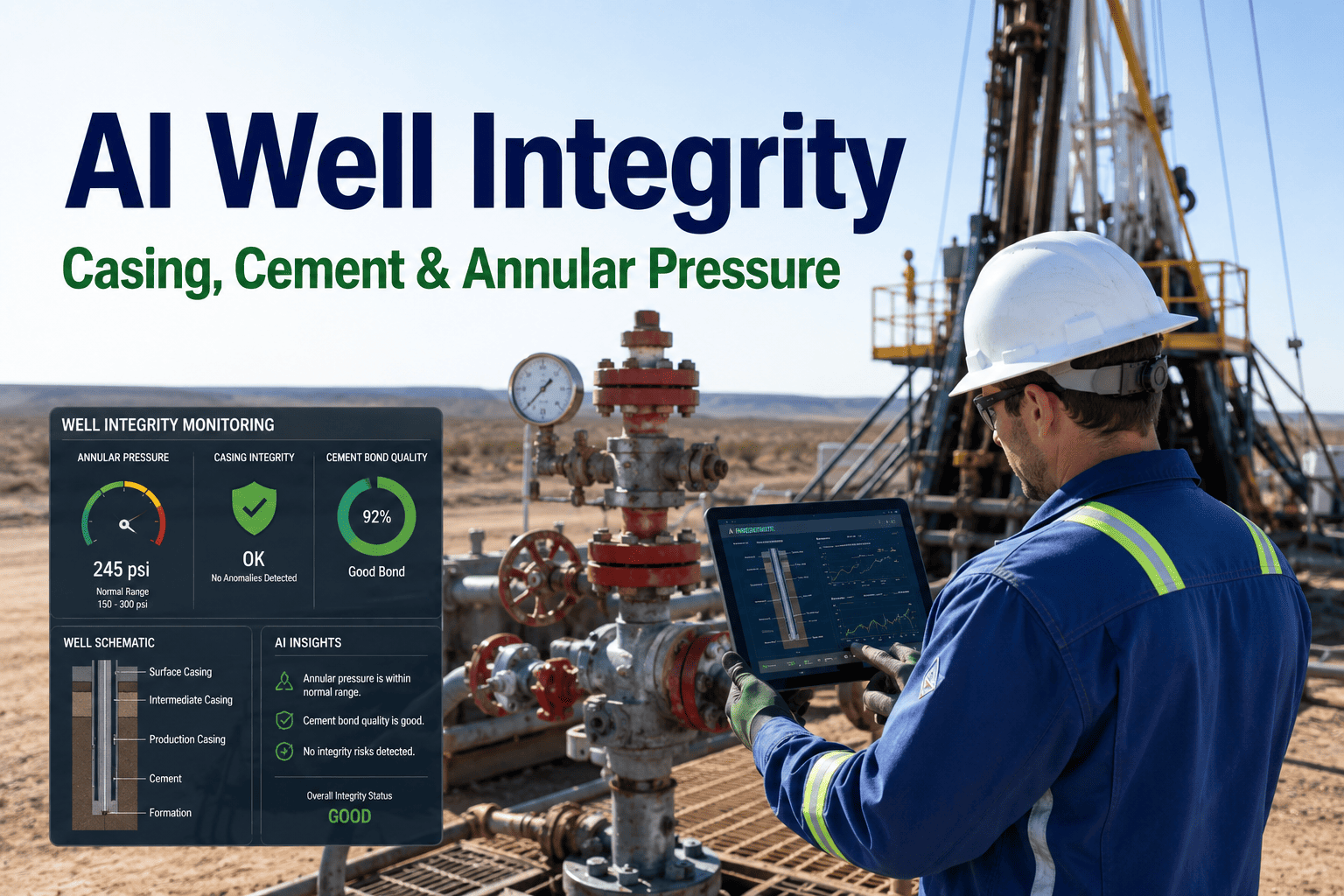
A well integrity engineer responsible for a few hundred wells across an aging field used to catch sustained casing pressure the same way most operators still do — a technician reads the annulus gauge during a scheduled semi-annual survey, notices the number climbed since the last visit, and opens an investigation that starts with a stack of prior bleed-off records instead of a clear picture of what changed. By the time the review confirms which barrier failed, the well may have been carrying an undiagnosed integrity issue for months. AI-based well integrity monitoring flips that timeline by continuously screening pressure, temperature, and cement bond data against physics-informed models, flagging a developing barrier problem while it is still cheap and safe to address. Book a demo to see well integrity monitoring applied to your own barrier data.
AI Well Integrity Monitoring for Casing, Cement, and Annular Pressure — Catch Barrier Failures Before They Become Incidents
Physics-informed machine learning screens sustained casing pressure, cement bond quality, and downhole vibration continuously across an entire well population, flagging the wells that need inspection or remedial work instead of waiting for the next scheduled survey to surface a problem that has already been developing for months.
Why Sustained Casing Pressure Is So Hard to Diagnose Manually
Sustained casing pressure is one of the clearest indicators that a well's barrier system is degrading, but the symptom is observed at the wellhead while its actual cause sits downhole — a compromised cement sheath, a corroded casing string, a failed tubing or packer seal, or a wellhead leak. Traditional diagnosis relies on manual interpretation of annular pressure trends, periodic bleed-off tests, and operational records, a process that is time-consuming, dependent on the analyst's experience, and difficult to scale once a field operator is managing hundreds or thousands of wells with inconsistent historical records.
The cost of that manual bottleneck compounds over a well's life. Cement sheath degradation from chemical attack, debonding, or microannuli formation rarely announces itself with a single dramatic event — it develops gradually, often invisible to a survey conducted every six or twelve months. A well carrying an undiagnosed barrier issue for an extended period faces a higher chance that a manageable repair becomes a full workover, and in the worst case, an uncontrolled leak with safety and environmental consequences that dwarf the cost of earlier intervention.
Physics-Informed Machine Learning for Barrier Diagnostics
Rather than treating annular pressure as a black-box classification problem, physics-informed models fold in known engineering principles — fluid compressibility, thermal expansion, and leak-path mechanics — so the diagnosis is both more accurate and explainable to the integrity engineer reviewing it.
What Gets Monitored, Where It Comes From, and What It Reveals
Each parameter below feeds a different piece of the barrier diagnosis — no single reading tells the whole story, which is exactly why manual review struggles to keep pace once a field grows past a handful of wells.
| Parameter | Source | What It Reveals |
|---|---|---|
| Sustained casing pressure | Wellhead annulus gauges | Primary indicator of barrier degradation |
| Cement bond quality | Cement bond & ultrasonic logs | Zonal isolation strength behind casing |
| Bleed-off & buildup rate | Annulus pressure survey history | Distinguishes leak path from trapped fluid |
| Downhole vibration | Permanent or intervention-based sensors | Early signal of casing wear or connection damage |
| Casing temperature trend | Distributed or point temperature sensors | Separates thermal effects from real pressure events |
A Barrier Diagnosis With a Physical Explanation Is Worth More Than a Black-Box Alert
Continuous screening, root-cause classification by barrier element, and a calibrated priority list your integrity team can act on immediately.
How Alerts Are Routed Once a Barrier Risk Is Flagged
A calibrated probability score is only useful if it reaches the right person quickly, with enough context to act — which is why the alerting layer is built around clear ownership and closure, not just a notification.
Well Integrity Monitoring Applies Across Conventional, Unconventional, and Storage Wells
Barrier integrity is not only a producing-well concern. Unconventional wells face distinct stresses from hydraulic fracturing cycles, while CO2 and hydrogen storage wells introduce corrosion, carbonation, and embrittlement risks that traditional oil and gas barrier monitoring was never designed around. A monitoring approach built on physics-informed models generalizes across these settings because the underlying barrier physics — pressure containment, zonal isolation, leak-path mechanics — apply regardless of what is being contained.
That matters increasingly as operators repurpose aging wells for carbon storage or convert fields toward hydrogen applications, where barrier failure carries a different but equally serious set of consequences. A monitoring platform that already understands cement, casing, and annular pressure behavior extends naturally into these newer well categories rather than requiring a separate system built from scratch.
How Continuous Monitoring Builds the Audit Trail Regulators Already Expect
Well integrity management does not exist in a regulatory vacuum. Standards such as ISO/TS 16530-2 define how annulus pressure surveys should be classified and interpreted, while API RP 90 sets out the annular casing pressure management practices most operators are already measured against during inspection. Continuous monitoring does not replace these frameworks — it generates the evidence they require automatically, instead of reconstructing it by hand before every audit.
Questions Well Integrity Teams Ask About AI-Based Barrier Monitoring
Stop Waiting for the Next Scheduled Survey to Find Out a Barrier Has Already Failed
See how physics-informed monitoring screens your well population for sustained casing pressure and barrier risk, with root-cause context built into every alert.