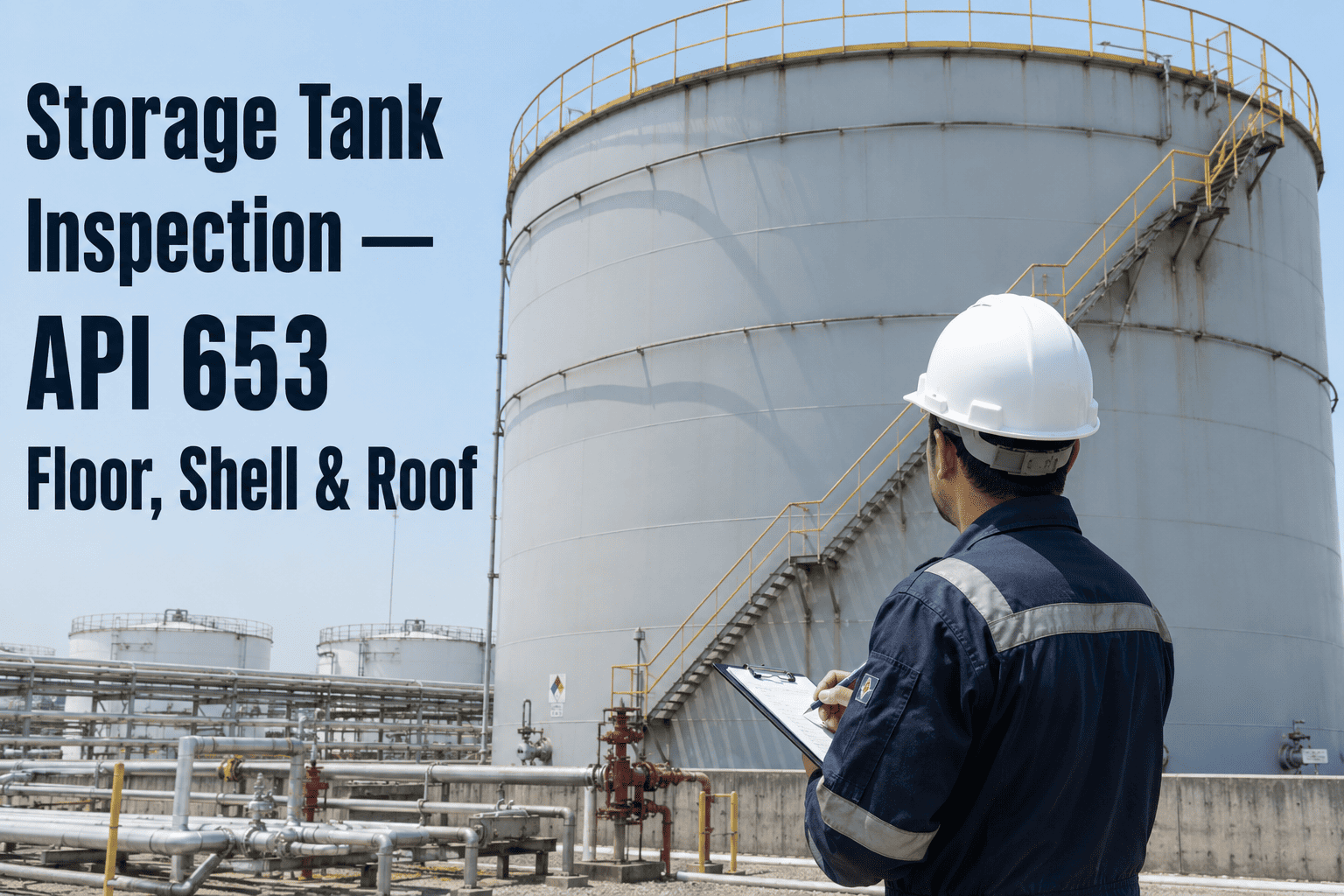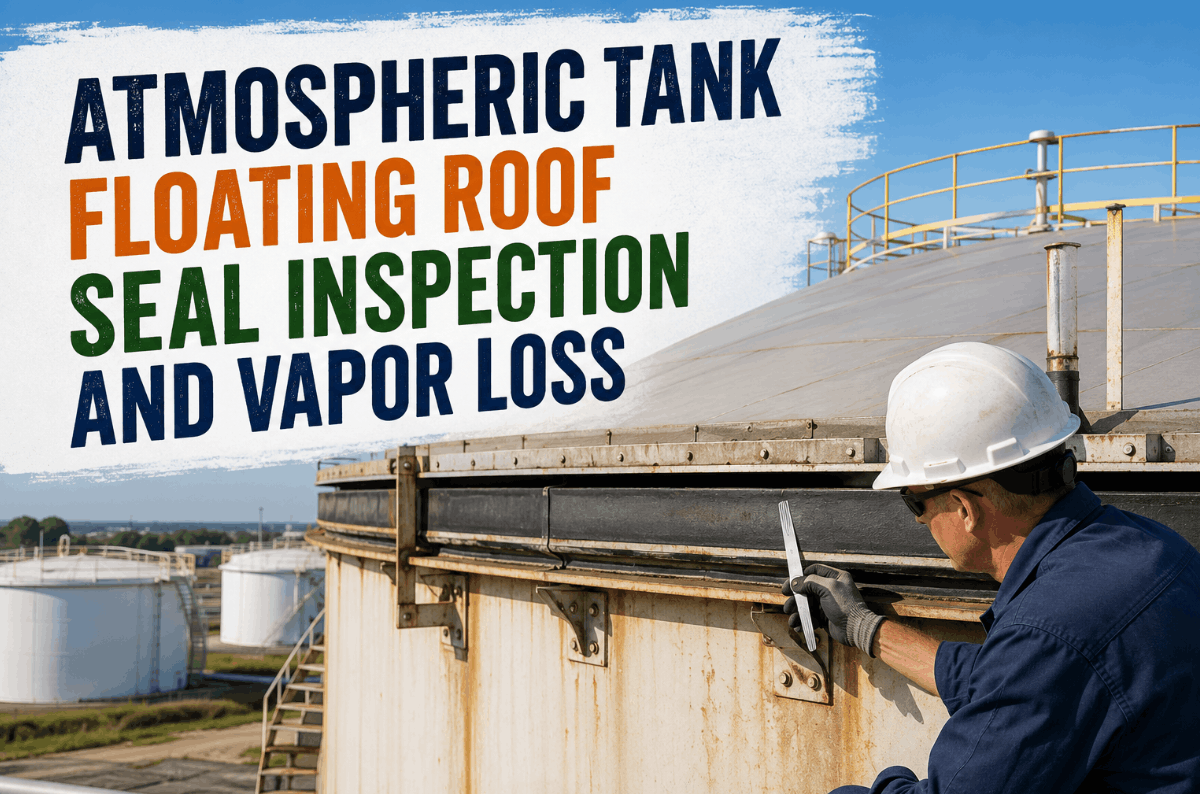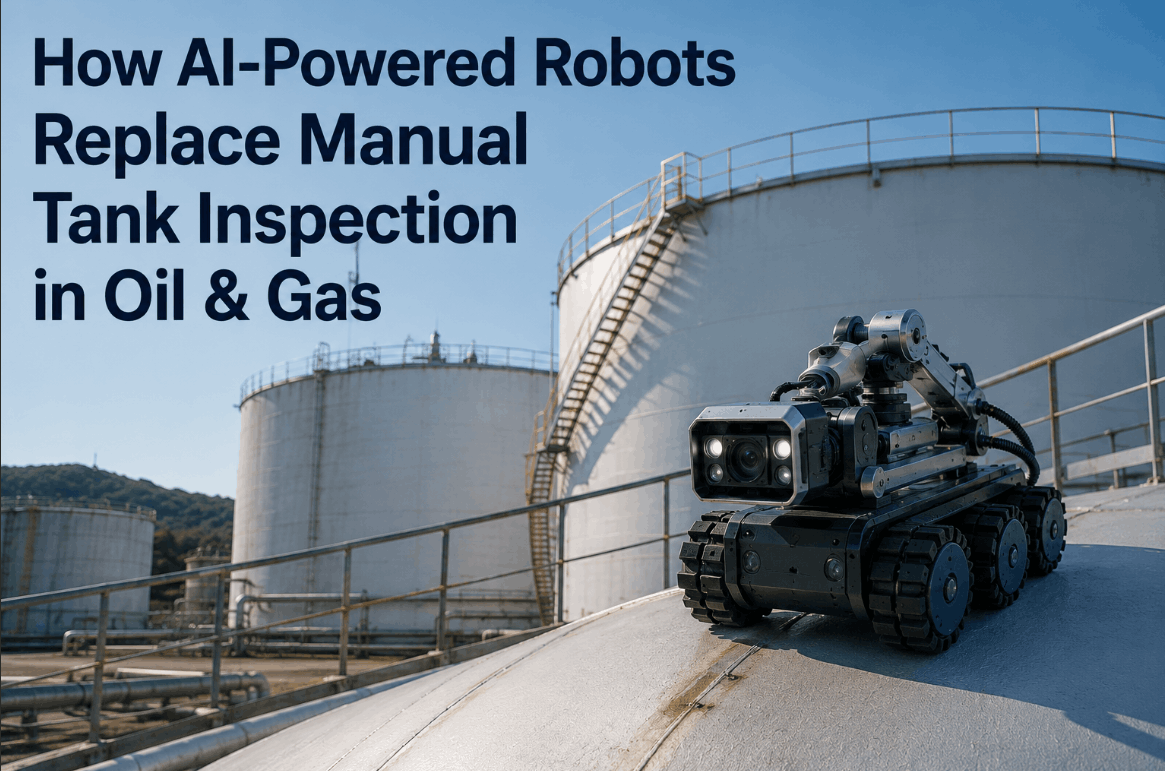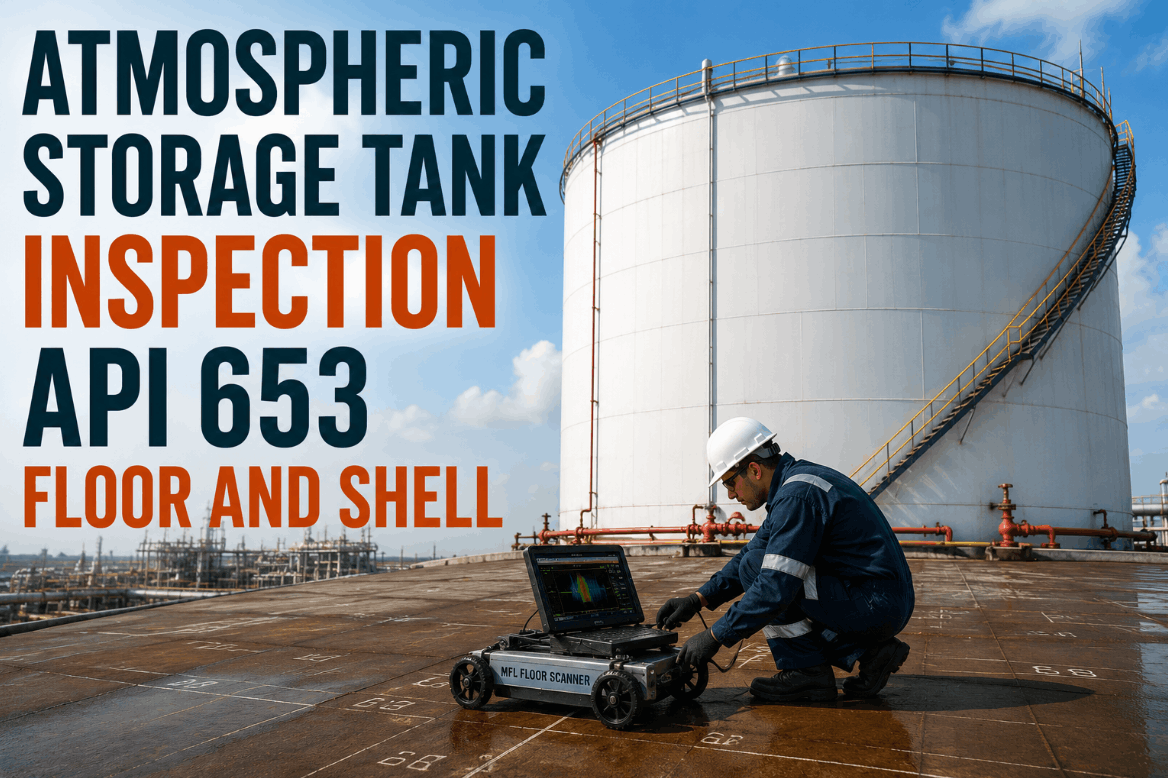
For any refinery, terminal, or chemical facility operating aboveground storage tanks, the difference between a well-managed API 653 program and a reactive one is measured in product losses, environmental liabilities, and unplanned outages. API 653 — Tank Inspection, Repair, Alteration, and Reconstruction — governs the in-service integrity of welded steel atmospheric storage tanks built to API 650 standards. Its requirements are concrete: external inspections every five years, internal inspections every ten years or based on calculated corrosion rates, floor scanning with Magnetic Flux Leakage (MFL) technology during internal inspection, and rigorous evaluation of shell settlement patterns that can compromise structural integrity long before a visible failure occurs. The challenge is not knowing what the code requires — it is building the operational infrastructure to execute those requirements consistently, document the findings digitally, and translate inspection data into predictive maintenance actions before product loss happens. iFactory AI provides that infrastructure, connecting tank inspection data to an active integrity management platform that tracks every floor CML, monitors shell settlement trends, and auto-schedules re-inspection work orders the moment a calculation approaches its threshold. Book a Demo to see how iFactory manages your entire API 653 program from a single dashboard.
Manage Your Entire API 653 Tank Integrity Program — Floor, Shell, and Settlement — on One Platform
iFactory connects MFL floor scan data, shell UT readings, and settlement surveys into a single active integrity platform that calculates remaining life, enforces inspection intervals, and dispatches work orders automatically.
What API 653 Actually Requires: Internal, External, and On-Stream Inspections
API 653 defines three distinct inspection types for aboveground storage tanks, each with its own interval logic, scope, and acceptance criteria. Understanding the distinction between them is essential before any tank integrity program can be structured — and before inspection findings can be correctly assigned, tracked, and acted upon.
External In-Service Inspection
Performed while the tank remains in service. Covers visual evaluation of the shell exterior, roof, nozzles, insulation condition, foundation, and secondary containment. Maximum interval: every 5 years or sooner based on corrosion rate. Tank bottom is not accessible during this inspection.
Internal Out-of-Service Inspection
Tank is taken out of service, degassed, and cleaned. The floor plates and at least the first shell course are cleaned to bare metal for MFL scanning and UT thickness testing. Welds are vacuum box tested. Maximum interval: every 10 years or half the calculated remaining life, whichever is less.
On-Stream Thickness Monitoring
A code-permitted alternative to periodic internal inspection when tanks cannot be taken out of service. Requires external UT thickness measurements at registered locations, corrosion rate calculations, and RBI-supported justification. iFactory manages the full measurement schedule and auto-calculates intervals.
The governing inspection interval is always the lesser of the code-specified maximum and half the remaining life calculated from measured corrosion rates. iFactory enforces this automatically for every tank in the asset registry, flagging any circuit approaching its threshold and generating the planned inspection work order before the due date is missed. Book a Demo to see how the interval engine works across a multi-tank terminal.
MFL Floor Scanning: Decoding the Most Critical Inspection Activity in API 653
The tank floor is the most vulnerable component in any aboveground storage tank. Bottom-side corrosion — accelerated by water bottoms, biological activity, and coating breakdown on the underside of floor plates — is invisible to visual inspection and undetectable without a systematic scanning program. Magnetic Flux Leakage (MFL) scanning is the API 653-mandated methodology for locating and quantifying this underside corrosion during internal inspection.
| MFL Inspection Stage | What It Detects | Follow-Up Requirement | iFactory Action |
|---|---|---|---|
| 100% Floor Plate MFL Scan | Topside and bottom-side pitting, general corrosion, and metal loss signals across all floor plates | Signal areas above threshold require UT backup for remaining thickness quantification | Ingests MFL scan report, maps signal locations to floor CML registry, flags UT follow-up zones |
| UT Thickness Confirmation | Exact remaining wall thickness at MFL-flagged areas and registered floor CMLs | Calculate corrosion rate from initial and current readings; compare to retirement thickness | Auto-calculates floor corrosion rate, remaining life, and next inspection interval per API 653 |
| Vacuum Box Weld Testing | Leaking lap welds in floor plates and the critical chime weld (shell-to-floor junction) | Any leaking weld requires repair before tank returns to service | Logs weld inspection results, links repair work orders, tracks weld history across inspection cycles |
| Annular Plate Inspection | Corrosion and thinning of the annular ring plate — the first 18–24 inches of floor near the shell | Annular plates have more stringent retirement thickness criteria than interior floor plates | Maintains separate CML tracking for annular zone with annular-specific tmin thresholds |
| Floor CML Trending | Long-term corrosion acceleration between inspection cycles at specific floor locations | LTCR and STCR divergence triggers reassessment of inspection interval | Flags CMLs where STCR exceeds LTCR by a configurable margin; auto-tightens next inspection interval |
The floor CML network is the backbone of any API 653 corrosion management program. iFactory structures this as a persistent digital registry — every floor plate CML carries its full measurement history, scan cycle reference, UT confirmation readings, and the calculated remaining life based on the highest corrosion rate observed. When a new MFL scan is completed, inspectors upload findings directly into iFactory, and the platform recalculates every floor interval automatically without a single spreadsheet lookup.
Shell Thickness Monitoring and Settlement Evaluation: The Two Structural Pillars
While floor corrosion is the most common cause of API 653 tank retirement, shell integrity failures — driven by external corrosion, coating breakdown, and foundation settlement — carry a higher consequence severity. API 653 Annex B provides a structured methodology for evaluating shell settlement patterns, and its acceptance thresholds are quantitative, not qualitative. Book a Demo to see how iFactory tracks shell UT readings and settlement survey data in parallel.
Uniform Settlement
The entire tank descends evenly with no differential movement. API 653 does not set a hard rejection limit for uniform settlement, but all external piping connections and nozzles must accommodate the movement without imposing loads on the shell. Requires documentation and monitoring.
Planar Tilt
The tank tilts uniformly to one side as a rigid body. While it does not induce internal shell stresses directly, planar tilt increases product height on the low side (raising hoop stress), can stress nozzles and piping, and worsens if soil conditions continue to deteriorate beneath one quadrant.
Differential Shell Settlement
Non-uniform settlement around the shell perimeter creates out-of-plane distortion and stress concentrations at the shell base. API 653 Annex B requires graphical representation of the settlement profile and comparison against wave-height acceptance limits based on tank diameter and shell course geometry.
Edge Settlement
The tank perimeter settles while the center remains elevated, inducing bending stress at the shell-to-bottom weld — the most structurally critical joint in the tank. When measured edge settlement exceeds 75% of the Annex B allowable limit and is greater than 2 inches (50.8 mm), API 653 mandates MT or PT examination of shell-to-bottom welds.
Localized Bottom Depression / Dishing
Bowl-shaped deformation in the tank floor caused by poor foundation consolidation or voids beneath the floor plates. Creates hydraulic pressure concentration and can accelerate bottom corrosion at the depression apex. API 653 Annex B evaluates dishing by comparing measured settlement against allowable limits based on plate span geometry.
Bottom Settlement Near Shell
Localized settlement of the floor in the annular zone close to the shell. This type stresses the annular-to-shell junction and must be evaluated per API 653 Annex B.3 against limits based on whether lap welds run parallel or perpendicular to the shell orientation — a distinction that significantly affects the allowable threshold.
"Before iFactory, our tank farm inspection data lived in three separate systems — MFL scan PDFs in a network drive, UT readings in an Excel workbook, and settlement surveys in a land surveyor's report that nobody in maintenance could access. When we finally integrated everything into iFactory, we discovered two tanks with floor corrosion rates that had been accelerating for two inspection cycles without triggering any alerts. The platform flagged them immediately when we loaded the historical data. That kind of visibility is what prevents a tank floor from becoming a product spill."
How iFactory Manages the Full API 653 Inspection Lifecycle
Most inspection management tools are passive record-keeping systems. iFactory is an active integrity platform — it doesn't just store your API 653 findings, it continuously calculates their implications and drives the next required action. The platform covers the complete inspection lifecycle from CML setup through post-inspection work order closure.
Tank Asset Registry & CML Setup
Build a digital asset record for every tank: diameter, shell course geometry, floor plate configuration, annular plate dimensions, product service, API 653 inspection class, and the complete CML network for floor and shell. Each CML is linked to its inspection zone in the tank layout diagram.
MFL & UT Data Ingestion
Import MFL floor scan reports and UT thickness readings from field instruments or CSV exports. iFactory maps signal locations and readings to the registered CML network, building the historical measurement record required for API 653 corrosion rate calculations.
Automated Corrosion Rate & Remaining Life
Upon each new UT entry, iFactory recalculates long-term and short-term corrosion rates for floor and shell CMLs, derives remaining life against the appropriate tmin, and determines the code-compliant re-inspection interval — applying the governing (higher) rate automatically.
Settlement Survey Integration
Upload survey elevation data from topographic settlement surveys. iFactory plots the settlement profile, identifies the settlement type (uniform, planar, differential, edge, or dishing), and compares measured values against the applicable Annex B thresholds — including the mandatory NDE trigger for edge settlement.
Inspection Work Order Dispatch & Audit Trail
Computed re-inspection due dates automatically generate planned work orders routed to the inspection team. Every calculation, finding, interval decision, and work order is timestamped in an immutable record — producing the complete documented inspection program API 653 and PSM audit requirements demand. Book a Demo to walk through a live tank integrity scenario.
Disconnected Records vs. iFactory: What Changes in Practice
The gap between a compliant-on-paper API 653 program and a genuinely effective one comes down to connectivity — whether inspection findings actually drive decisions, or whether they sit in folders waiting to be found after something fails.
| Inspection Task | Traditional Disconnected Approach | iFactory Integrated Approach |
|---|---|---|
| MFL Floor Scan Results | PDF stored in shared network drive; follow-up UT tracked in separate Excel file | Scan data imported, signal zones mapped to CML registry, UT follow-up work order auto-generated |
| Corrosion Rate Calculation | Manual calculation by corrosion engineer at turnaround planning time | Calculated automatically on every new UT entry; STCR/LTCR divergence flagged in real time |
| Settlement Survey Data | Surveyor's report delivered as PDF; evaluated by structural engineer only if escalated | Elevation data imported, settlement profile plotted, Annex B thresholds checked, NDE trigger auto-flagged |
| Re-Inspection Scheduling | Inspection coordinator manually reviews spreadsheet before each turnaround cycle | Planned inspection work orders generated automatically at computed due dates |
| PSM / Audit Documentation | Report compiled manually from multiple file sources before each audit | Complete timestamped calculation-to-work-order audit trail available on demand |
Why API 653 Programs Fail Between Inspection Cycles
"Most API 653 compliance failures I've seen are not failures to inspect — the inspections happened, the reports were written, the findings were documented. The failure is what happens next. An MFL scan flags 40 areas of accelerated floor corrosion, and the follow-up UT readings go into a spreadsheet that doesn't connect to the maintenance scheduling system. Two years later, nobody scheduled the re-inspection because the interval calculation never made it into a work order. That is the gap iFactory closes. The inspection data has to drive action automatically, or it's just expensive paperwork."
From Paper Compliance to Predictive Tank Integrity
API 653 provides a rigorous, proven framework for protecting aboveground storage tanks against the corrosion, settlement, and structural degradation that lead to product loss and environmental incidents. The code's requirements — MFL floor scanning, UT corrosion rate tracking, settlement survey evaluation against Annex B thresholds, and interval management based on calculated remaining life — are well established. What most tank farm operations lack is the operational infrastructure to execute those requirements consistently and connect inspection findings to maintenance action without manual intervention at every step.
iFactory provides that infrastructure: a digital CML registry for every floor and shell location, an automated corrosion rate engine that enforces API 653 interval logic without spreadsheets, settlement data integration with Annex B threshold monitoring, and planned work order dispatch that ensures no tank reaches its re-inspection due date without an active maintenance record. The result is an API 653 program that functions continuously between turnarounds — not just during them.
Stop Chasing Leaks. Start Predicting Them with iFactory.
iFactory's tank integrity platform automates your entire API 653 program — from MFL floor CML tracking and corrosion rate calculation to settlement Annex B evaluation and inspection work order dispatch.
API 653 Tank Inspection — Frequently Asked Questions
What is the difference between the external and internal inspection intervals under API 653?
External inspections are required at least every 5 years and are performed in-service; internal inspections are required every 10 years (or half the calculated remaining life, whichever is less) and require the tank to be taken out of service for floor MFL scanning and internal UT examination.
Why is MFL scanning required on tank floors rather than visual inspection alone?
Bottom-side corrosion on floor plates — driven by water bottoms, microbial activity, and coating failure on the underside — is completely invisible to visual inspection; MFL scanning detects metal loss signals from both the top and bottom surfaces of floor plates, making it the only reliable method for locating underside defects before a through-floor leak occurs.
When does API 653 require mandatory NDE examination of shell-to-bottom welds?
When edge settlement exceeds 75% of the Annex B allowable limit and is greater than 2 inches (50.8 mm), API 653 mandates magnetic particle (MT) or liquid penetrant (PT) examination of the shell-to-bottom welds and adjacent floor plate welds in the affected zone.
Can iFactory replace a traditional inspection management system for API 653 compliance?
Yes. iFactory maintains the full CML registry, measurement history, corrosion rate calculations, settlement data, and inspection interval tracking required for API 653 compliance — while actively connecting those records to planned work orders and turnaround planning, which passive inspection databases do not do.
How does iFactory handle tanks with no prior inspection history or recently reconstructed floors?
For tanks with limited or no historical UT data, iFactory allows corrosion rates to be seeded from similar-service tanks in the registry, published API 581 corrosion data, or early double-measurement readings — all per the API 653-approved methodology for establishing initial inspection intervals on new or reconstructed floors.