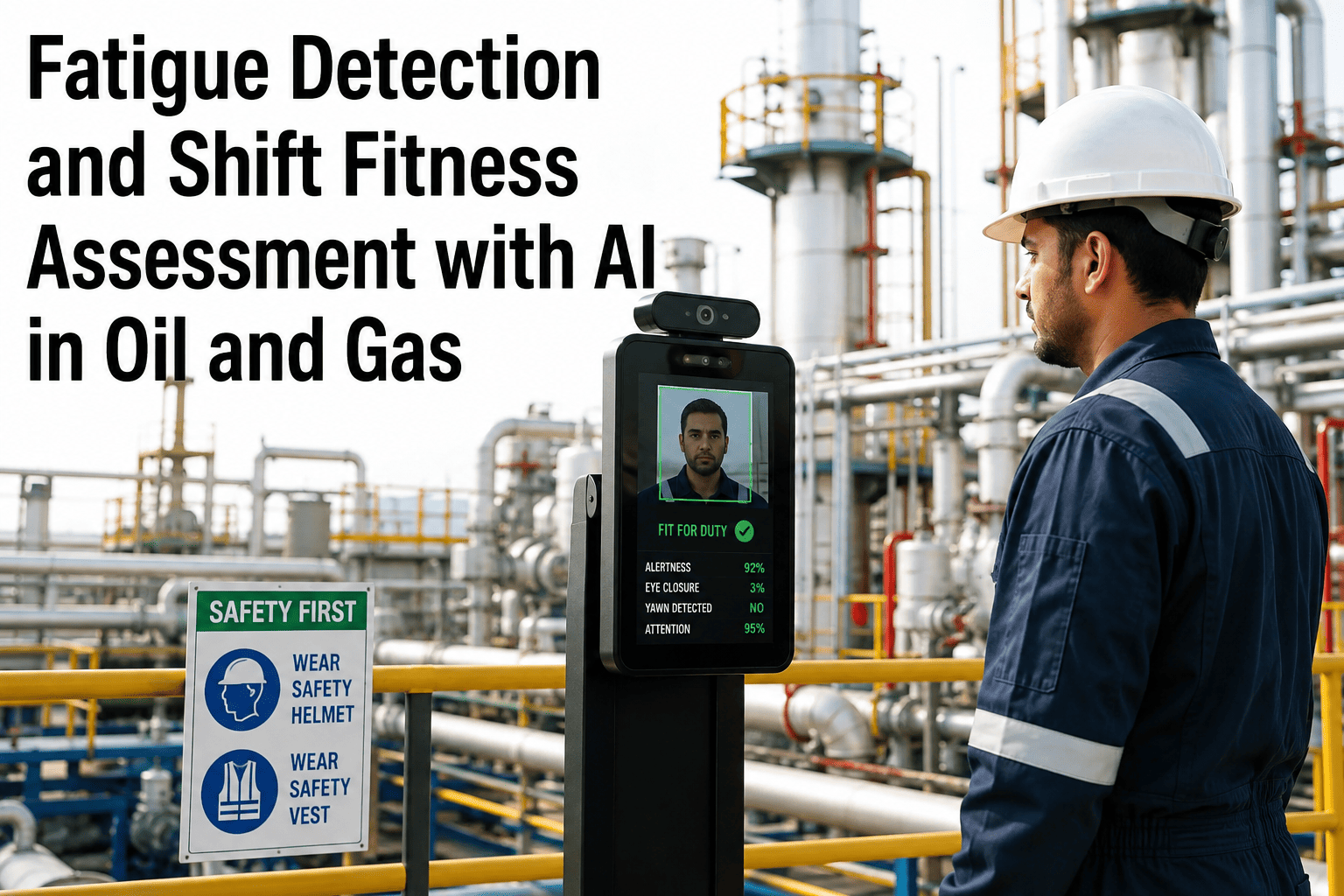
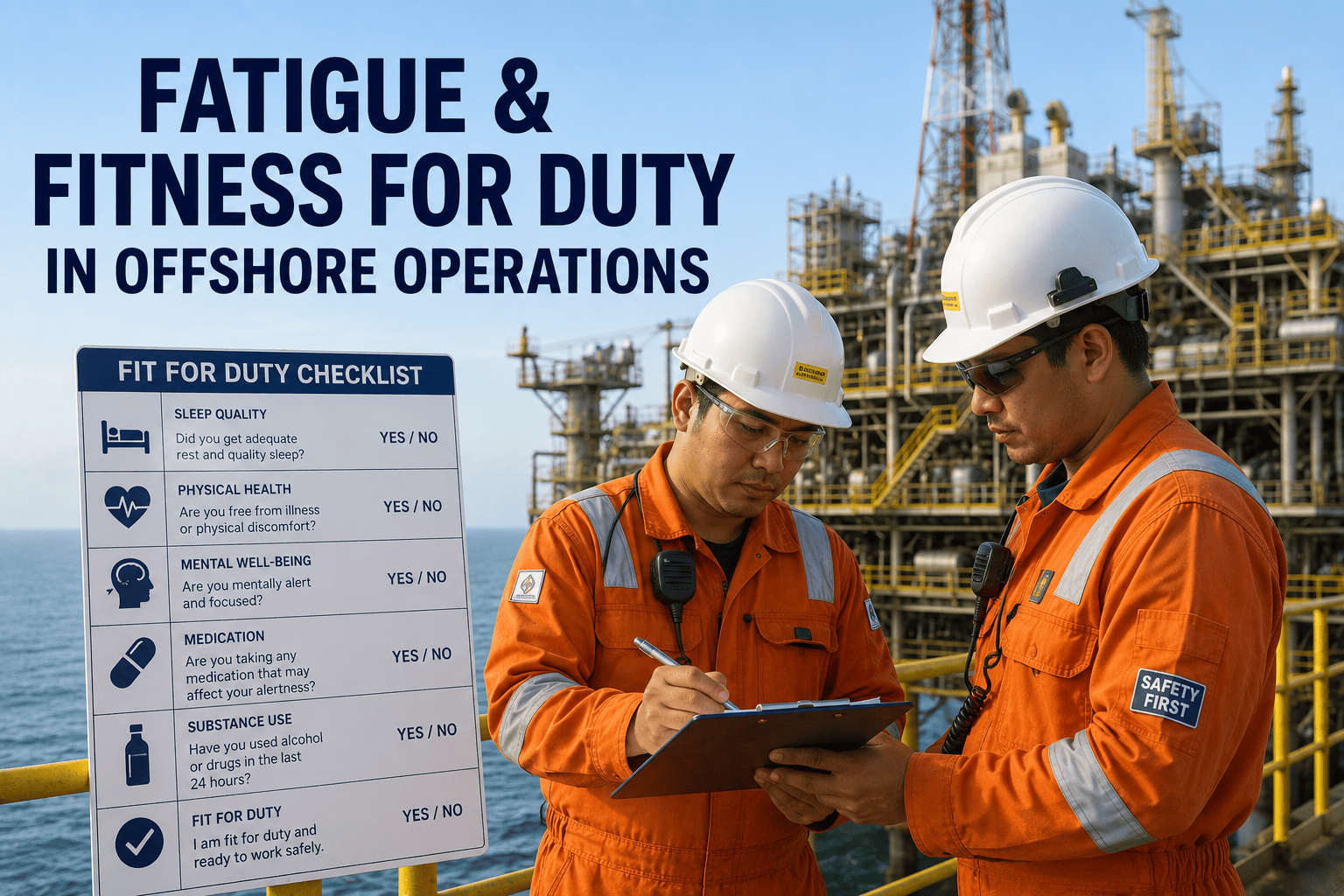
A worker who slept four hours before a night shift can pass a pre-shift breathalyzer, answer a fit-for-duty questionnaire honestly and still be operating equipment with reaction times comparable to someone legally impaired, because fatigue does not show up on the checks most oilfield and refinery safety programs actually run. Self-reported fitness assessments rely on the worker accurately judging their own impairment, which is precisely the judgment fatigue degrades first — a well-documented blind spot that leaves supervisors relying on a form that asks the most unreliable witness in the room to grade their own condition. See how iFactory monitors eye tracking, reaction time, gait, and shift history to flag fatigued workers before they operate critical equipment.
Worker Safety · Fatigue Risk Management
Fatigue Doesn't Show Up on a Self-Reported Fitness Form
AI that monitors eye tracking, reaction time, gait analysis, and shift history to flag fatigued workers before they operate critical equipment or enter hazardous zones.
The Self-Report Blind Spot
Why Asking a Worker If They're Fit for Duty Doesn't Catch Fatigue
Fatigue impairs judgment and self-awareness before it visibly impairs coordination, which creates a structural problem for any fitness-for-duty program built primarily around self-reporting. A worker several hours into sleep debt is not lying when they say they feel fine on a pre-shift form — they genuinely may not recognize the extent of their own impairment, because the same cognitive faculties needed for accurate self-assessment are among the first affected by accumulated fatigue. This is not a training or honesty problem that better forms or stricter policy can fully solve; it is a physiological limitation of self-report as a measurement method, which is why objective, passive fatigue indicators matter as a complement to — not a replacement for — an honest fitness culture.
Reaction Time Degradation
Extended wakefulness produces measurable reaction time slowing that closely parallels the impairment curve associated with legal blood alcohol limits, yet leaves no outward symptom a supervisor would reliably catch on a visual check.
Microsleep Episodes
Brief, involuntary lapses in attention lasting a few seconds can occur without the worker being aware they happened at all, making self-report fundamentally unable to capture the exact moments of highest operational risk.
Cumulative Shift Debt
Fatigue compounds across consecutive night shifts or extended overtime stretches in a way that isn't reset by a single night's sleep, meaning a worker can feel adequately rested while still carrying significant accumulated impairment.
Circadian Misalignment
Workers rotating between day and night shifts experience circadian-driven alertness dips at predictable points in the shift regardless of how much sleep they logged, a pattern self-report rarely accounts for.
Objective Indicators
Four Passive Signals That Detect Fatigue Without Relying on Self-Report
01
Eye Tracking
Blink rate, blink duration, and eyelid closure percentage (PERCLOS) are among the most validated objective fatigue measures, capturing drowsiness onset well before a worker reports feeling tired.
02
Reaction Time Testing
Brief pre-shift or periodic reaction time checks quantify psychomotor vigilance directly, giving an objective baseline comparison rather than relying on how alert a worker believes themselves to be.
03
Gait and Movement Analysis
Changes in walking pattern, balance, and movement smoothness detected through wearable or camera-based analysis correlate with fatigue-driven motor coordination decline that precedes more obvious impairment.
04
Shift History and Sleep Opportunity
Hours worked in the preceding 24 and 72 hours, consecutive night shifts, and time since the last confirmed rest period feed a cumulative fatigue risk score that flags workers trending toward high risk before any single shift begins.
Objective, Not Self-Reported
Catch Fatigue the Worker Themselves May Not Recognize Yet
iFactory combines eye tracking, reaction time, gait analysis, and shift history into a single fatigue risk score, flagging workers before they operate critical equipment while impaired.
Risk Scoring
How Cumulative Shift History Shapes Fatigue Risk
A worker's fatigue risk on any given shift is rarely explained by that shift alone. The table below reflects how consecutive shift patterns typically shift baseline risk, before any real-time physiological indicators are even factored in.
| Shift Pattern | Baseline Fatigue Risk | Key Driver |
|---|
| Standard day shift, adequate rest | Low | Normal circadian alignment |
| First night shift after days off | Moderate | Circadian adjustment lag |
| 3rd–4th consecutive night shift | Elevated | Cumulative sleep debt |
| Extended overtime, 12hr+ shifts | Elevated | Extended time on task |
| Back-to-back turnaround coverage | High | Compounded sleep debt + long hours |
Operational Workflow
From Risk Score to Safe Shift Decision
1
Pre-Shift Baseline Check
A brief reaction time and eye tracking check establishes a baseline reading alongside the worker's recent shift history before they're cleared for high-hazard duty.
2
Continuous In-Shift Monitoring
Passive monitoring through wearables or workstation-based eye tracking continues through the shift, watching for drift from the worker's established baseline.
3
Escalating Risk Alert
A rising fatigue score triggers a graduated response — a break recommendation at moderate risk, supervisor notification and task reassignment at elevated risk.
4
Shift Planning Feedback Loop
Aggregated fatigue trend data feeds back into shift scheduling, helping supervisors avoid stacking high-hazard tasks against workers already trending into elevated cumulative risk.
Priority Task Categories
Where Fatigue Monitoring Matters Most
Fatigue-related impairment is a concern across any role, but the consequence of a lapse varies enormously by task, which is why most programs prioritize deploying monitoring to the roles where a fatigue-driven error carries the highest safety consequence rather than attempting uniform coverage across an entire workforce on day one.
Heavy Equipment and Crane Operation
A fatigue-driven lapse of even a few seconds while operating a crane or heavy mobile equipment carries a disproportionately severe potential consequence relative to most other roles on site.
Control Room Board Operation
Sustained vigilance during long, low-stimulation shifts is exactly the kind of task where microsleep episodes are most likely to occur and least likely to be self-recognized.
Driving Between Wellsites
Long highway drives between remote locations after a night shift represent one of the highest-frequency fatigue-related incident categories in oilfield operations nationally.
Permit-to-Work Approval and Isolation Verification
Cognitive tasks requiring careful verification, such as confirming isolation points before work begins, are particularly vulnerable to fatigue-driven attention lapses that self-report rarely catches.
Common Questions
Frequently Asked Questions
Is fatigue monitoring meant to discipline workers who show up tired?
No — the intent is operational safety, not discipline. Most programs are explicitly framed around identifying fatigue as a hazard to be managed, similar to how a near-miss report is treated as a learning opportunity rather than grounds for punishment, since a punitive framing discourages the honest engagement the program depends on to work well.
Talk to support about how programs are typically structured around safety rather than discipline.
How intrusive is the monitoring — does it track workers constantly throughout the day?
Monitoring is generally focused on pre-shift baseline checks and periodic in-shift readings during high-hazard tasks, rather than continuous surveillance of every movement throughout a worker's day. The goal is capturing fatigue-relevant signals at the moments they matter operationally, not building a comprehensive activity log unrelated to safety.
What happens when a worker is flagged as high fatigue risk right before a critical task?
The typical response escalates based on severity — a moderate flag might trigger a mandatory short break or reassignment to a lower-hazard task, while a high-severity flag generally routes to a supervisor conversation and a fitness-for-duty reassessment before the worker is cleared to proceed with the original task.
Can shift scheduling itself be adjusted using the fatigue data collected over time?
Yes — aggregated, de-identified fatigue trend data is one of the more valuable long-term outputs, helping shift planners see which rotation patterns or turnaround coverage schedules are consistently producing elevated fatigue risk, so schedules can be adjusted proactively rather than only reacting to individual daily flags.
Does this replace existing fitness-for-duty policies and drug and alcohol testing programs?
No — fatigue monitoring addresses a specific gap that self-report and substance testing don't cover, since fatigue is a distinct impairment source from intoxication and isn't caught by a breathalyzer or drug screen. It's designed to work alongside existing fitness-for-duty policy as an additional, objective layer rather than replacing any current program.
Book a demo to see how it integrates with existing safety programs.
Fatigue Is a Hazard Like Any Other
Manage It With Objective Data, Not a Self-Reported Form
iFactory monitors eye tracking, reaction time, gait, and shift history to flag fatigued workers before they operate critical equipment or enter hazardous zones.