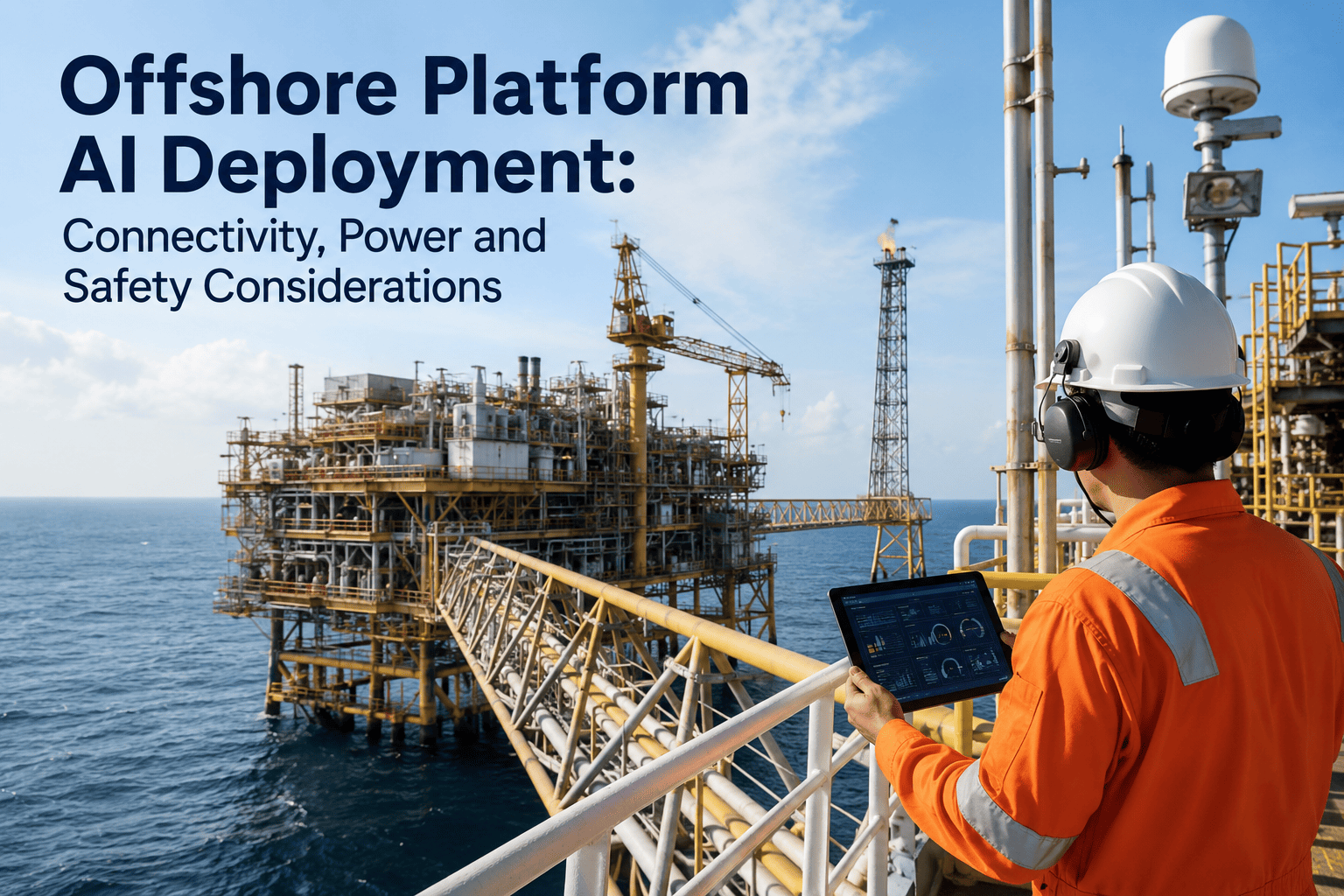
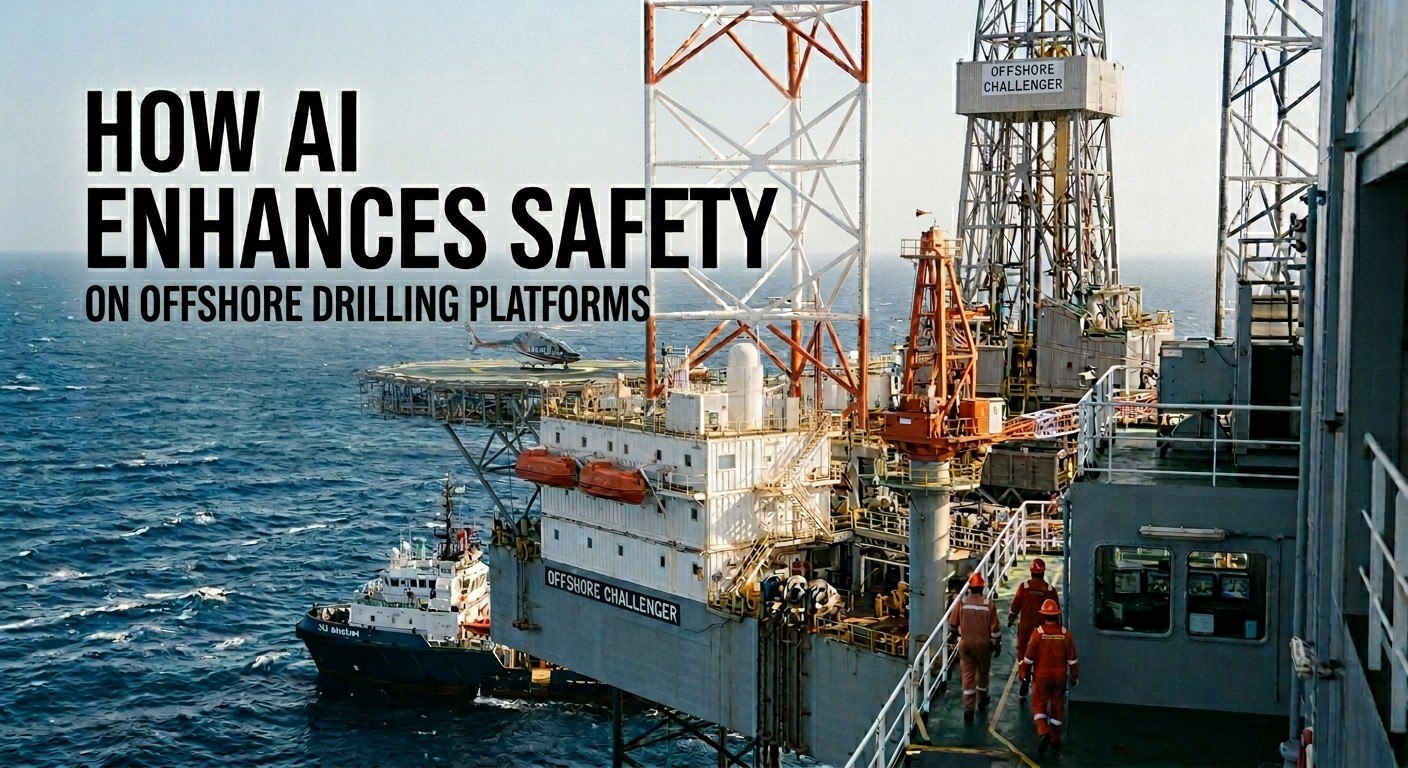
Offshore oil and gas platforms operate in some of the most unforgiving environments on the planet, yet they depend on continuous, high-reliability communication to function safely and profitably. Every sensor reading, SCADA telemetry packet, video surveillance feed, and crew welfare call travels over a network that must perform despite salt spray, constant vibration, extreme temperatures, and hundreds of miles of open water. The communication infrastructure you select for your platforms determines whether your remote asset monitoring delivers real-time operational visibility or delayed, incomplete data that obscures problems until they escalate into costly incidents. Choosing between VSAT, 4G/5G, mesh radio, and subsea fiber is not a textbook exercise. Book a demo to see how iFactory maps the right communication architecture to your specific offshore asset requirements.
Building Communication Networks That Keep Offshore Assets Connected
A structured approach to offshore network design compares VSAT, 4G/5G, mesh radio, and subsea fiber against your actual bandwidth, latency, and reliability requirements rather than vendor sales materials.
Why Offshore Communication Demands a Different Design Mindset
Onshore industrial networks deal with distance, interference, and scale. Offshore networks add saltwater corrosion, constant platform motion, zero local infrastructure, and the fact that a communication failure can mean an emergency helicopter evacuation. The engineering constraints are fundamentally different from anything on land.
Four Technologies That Power Offshore Connectivity
Every offshore communication network is built from some combination of these four technologies. Understanding what each one delivers, and where it breaks down, is the foundation of any network design decision.
Standalone platforms far from shore
High latency, rain fade, shared bandwidth
On-platform mobility and near-shore fields
Requires line of sight, limited over-water reach
Inter-platform links in multi-platform fields
Line of sight required, affected by weather
High-volume fields with permanent infrastructure
Very high deployment cost, inflexible once laid
VSAT Satellite: The Default Offshore Backhaul
Very Small Aperture Terminal satellite has been the backbone of offshore communication for decades because it works everywhere a satellite can see. A VSAT dish on a platform roof connects to a geostationary satellite, which relays traffic to a ground station on shore. The technology is mature, well-understood, and available from dozens of service providers globally. Ku-band VSAT delivers 2 to 20 Mbps typically, while newer Ka-band systems push past 50 Mbps and in some configurations exceed 100 Mbps. L-band systems offer lower bandwidth but better resilience in heavy rain, making them a common choice for safety-critical voice and low-data telemetry links that must remain operational regardless of weather conditions.
The fundamental limitation of geostationary VSAT is physics: a signal traveling 36,000 km to the satellite and 36,000 km back introduces a minimum round-trip latency of roughly 540 milliseconds, and real-world conditions typically push this to 600 to 700 ms. For SCADA polling, file transfers, and email, this latency is acceptable. For real-time remote control, collaborative robotics, or any application requiring sub-100 ms response, VSAT alone is insufficient. Rain fade affects Ku-band and Ka-band significantly, with signal degradation of 3 to 8 dB during heavy storms common in offshore environments. Most operators run a dual-VSAT configuration with a Ku or Ka-band primary link for data and an L-band backup for safety communications. Newer Low Earth Orbit satellite constellations are beginning to reduce latency to 20 to 50 ms, but coverage consistency over open ocean and industrial-grade pricing remain evolving factors for large-scale adoption.
4G/5G Private Cellular: On-Platform Mobility and Near-Shore Reach
Private LTE and 5G networks are increasingly deployed on offshore platforms to provide high-bandwidth, low-latency connectivity across the entire facility. A base station mounted on the platform derrick or helideck can blanket the platform with wireless coverage, eliminating the need to run Ethernet cables to every sensor, camera, and endpoint. This is particularly valuable on older platforms where retrofitting wired infrastructure through existing steelwork is prohibitively expensive or physically impractical. Over-water propagation at LTE and 5G frequencies extends to 20 to 30 km due to reduced terrain obstruction and the reflective properties of the sea surface, though this extended range requires careful frequency planning to manage interference from distant cells.
The critical constraint for offshore cellular is backhaul. A 5G base station on a platform still needs a path to shore, and that path is typically VSAT or fiber. Cellular extends the network across the platform surface, but it does not eliminate the need for a primary backhaul technology. Network slicing in 5G allows a single infrastructure to simultaneously support high-priority SCADA traffic, standard video surveillance, and lower-priority crew Wi-Fi on separate logical networks with guaranteed quality of service levels.
Mesh Radio: The Inter-Platform Backbone
In multi-platform fields where several production platforms, drilling rigs, FPSO vessels, and subsea tiebacks operate within visual range of each other, mesh radio networks provide a high-bandwidth, ultra-low-latency backbone that no satellite technology can match. Microwave and millimeter-wave radio links operating in licensed and unlicensed bands create a self-healing mesh where traffic can route around a failed node without interruption. Point-to-point links between adjacent platforms typically deliver 100 to 500 Mbps with less than 2 ms latency, making mesh radio the only technology suitable for applications that require true real-time response such as remotely operated vehicle control, collaborative drilling operations between platforms, and synchronized subsea pump control across multiple wells.
Mesh architectures provide inherent redundancy. If Platform B loses its direct link to the shore station, traffic from Platform B routes through Platform C and then to shore, provided the mesh topology includes those alternate paths. The primary limitation of mesh radio is line-of-sight dependence. Platforms must be within visual range, typically 20 to 50 km depending on antenna height, frequency band, and atmospheric conditions. Heavy fog, rain, and sea spray can degrade millimeter-wave links at 70 to 80 GHz significantly, though lower-frequency microwave links at 5 to 38 GHz are far more weather-resilient. Platform motion on FPSOs and floating production systems adds complexity because antenna alignment must either accommodate constant movement or use tracking systems that add cost and maintenance burden to the network.
Subsea Fiber: When the Field Justifies Permanent Infrastructure
Subsea fiber optic cables deliver bandwidth and latency that no wireless technology can approach, making them the only option for fields that generate massive data volumes such as those with extensive seismic monitoring arrays, hundreds of high-definition video feeds, or real-time reservoir simulation requirements. The decision to deploy subsea fiber is fundamentally a financial one rather than a technical one. Installation costs typically range from $50,000 to $200,000 per kilometer depending on water depth, seabed conditions, and whether the cable must traverse shipping lanes or fishing grounds. A 150 km link can therefore represent a $15 to $30 million capital investment before any terminal equipment is purchased.
This cost is only justifiable for large, long-life fields where the production timeline exceeds 15 to 20 years and aggregate bandwidth demand exceeds what hybrid architectures can deliver cost-effectively. Subsea fiber also introduces a single-point-of-failure risk since a cable damaged by anchor drag, trawl gear, or seabed landslide takes the entire communication path down. Repair involves mobilizing a specialized cable repair vessel at costs approaching $1 million per day. Most fiber-connected fields maintain a VSAT backup specifically for this scenario, meaning even fiber deployments typically involve a hybrid architecture rather than relying on a single technology.
Side-by-Side Technology Comparison
Selecting the right technology starts with comparing what each one actually delivers against what your operations require. This table strips away marketing language and focuses on the engineering parameters that matter for network design.
Matching Bandwidth to Offshore Applications
Not every application on an offshore platform needs the same bandwidth. Designing a network without mapping actual application requirements leads to either overspending on capacity you do not use or underprovisioning the links that matter most for safety and production.
Your Architecture Should Match Your Operations, Not a Vendor Catalog
iFactory helps oil and gas operators map actual data flows from remote assets to shore-based control centers, then designs communication architectures that match bandwidth, latency, and redundancy requirements to the technologies that actually deliver them.
A Practical Decision Framework for Offshore Network Design
The right architecture depends on a small number of hard constraints that eliminate most options quickly. Working through these five decisions in order produces a clear technology recommendation for any offshore field configuration.
How far is the nearest shore landing point?
Under 30 km: Fiber or microwave backhaul become viable options and should both be evaluated on cost and bandwidth grounds. 30 to 150 km: Microwave mesh or enhanced 4G/5G with directional backhaul are possible, with VSAT as the baseline fallback. Over 150 km: VSAT becomes the default primary backhaul. Evaluate LEO satellite as a latency-reduction supplement if interactive applications are required.
What is the total aggregate bandwidth demand across all applications?
Under 50 Mbps: A single VSAT link is sufficient for all combined applications. Add an L-band backup link for safety-critical traffic. 50 to 500 Mbps: Ka-band VSAT with compression optimization, or a hybrid VSAT plus 4G/5G on-platform architecture where cellular handles local distribution and VSAT handles the shore backhaul. Over 500 Mbps: Subsea fiber becomes financially justifiable if the field life supports the capital investment timeline.
Does any application require sub-50 ms latency?
No: VSAT is adequate for all applications on the platform. Yes, but only for on-platform use: Deploy 5G URLLC on the platform surface with VSAT handling the shore backhaul for data. The low-latency requirement stays local. Yes, for shore-to-platform real-time control: Mesh radio or subsea fiber is required. VSAT cannot meet this requirement under any configuration with geostationary satellites.
How many platforms must be interconnected in the field?
Single platform: A point-to-point backhaul link to shore is sufficient. No inter-platform networking required. 2 to 5 platforms: A mesh radio backbone between platforms with a single aggregated backhaul to shore reduces the number of satellite dishes and shore connections needed. Over 5 platforms: A multi-hop mesh with redundant shore connections and hierarchical routing ensures no single failure isolates any platform from the control center.
What is the field's expected productive life?
Under 5 years: Avoid permanent infrastructure investments. VSAT and radio provide adequate connectivity without committing capital to assets that will be decommissioned. 5 to 15 years: Hybrid architectures are optimal. Radio backbone between platforms with VSAT backup provides a balance of performance and flexibility. Over 15 years: Subsea fiber deployment becomes financially justifiable at sufficient bandwidth levels, and the long amortization period makes the upfront capital investment viable on a per-megabit basis.
What the Right Architecture Looks Like in Practice
The decision framework produces different recommendations for different field configurations. Here are three common scenarios and the architectures that emerge from applying the framework systematically to each one.
Frequently Asked Questions
Can LEO satellite networks replace VSAT for offshore communication?
LEO constellations reduce latency to 20 to 50 ms compared to 600 to 700 ms for geostationary VSAT, which is a significant improvement for interactive applications like remote collaboration and video conferencing from offshore. However, current LEO services have variable coverage over open ocean, industrial-grade service level agreements are still maturing, and pricing for committed information rates suitable for continuous offshore operations remains higher than equivalent VSAT capacity in many regions. LEO is best positioned today as a low-latency supplement to geostationary VSAT rather than a full replacement, particularly for safety-critical links where guaranteed availability under all conditions is non-negotiable. Book a demo to explore how LEO fits into a hybrid architecture for your specific offshore assets.
How does platform motion affect 4G/5G and mesh radio performance?
Floating production systems and FPSOs experience six degrees of motion including heave, sway, and roll, which directly affects antenna alignment for both cellular base stations and point-to-point radio links. For 5G on a single platform, the impact is manageable because the base station and user devices are on the same moving structure, so relative motion is minimal and handover between sectors handles residual movement. For mesh radio links between separate floating platforms, the challenge is significantly greater because both endpoints move independently and antenna tracking systems or wider beamwidth antennas become necessary. Selecting lower-frequency microwave bands below 15 GHz provides inherently wider beamwidth at equivalent gain, which tolerates more misalignment without sacrificing the link entirely.
Is subsea fiber ever worth it for a single standalone platform?
For a single platform, subsea fiber is rarely justified on bandwidth alone unless the platform hosts applications generating sustained traffic above 500 Mbps that cannot be compressed, prioritized, or deferred to off-peak transmission windows. The more common justification for single-platform fiber is when that platform serves as a hub for multiple subsea tiebacks and the aggregate data from those subsea wells, combined with platform-level applications, pushes total demand into the multi-gigabit range. In that configuration, the fiber serves the entire subsea field rather than just the single platform, which fundamentally changes the cost-per-megabit calculation and makes the capital investment defensible. Talk to a specialist to evaluate whether your field profile supports a fiber business case.
What happens to offshore communication during a hurricane or typhoon?
During extreme weather events, offshore communication faces cascading challenges across every technology. VSAT links on Ku-band and Ka-band experience rain fade that can reduce available bandwidth by 50 to 80 percent or cause complete link loss during the most intense periods. L-band VSAT maintains connectivity but at significantly reduced data rates. Mesh radio links at millimeter-wave frequencies degrade substantially in heavy rain and fog, while lower-frequency microwave links below 15 GHz are more resilient but can still suffer from antenna misalignment caused by extreme platform motion. Subsea fiber is the most weather-resilient option since the cable itself rests on the seabed, but the shore landing point and platform terminal equipment remain vulnerable to the same environmental conditions as any coastal infrastructure. A properly designed network ensures that safety-critical communication operates on the most weather-resilient link available at all times.
How do we migrate from legacy VSAT to a modern hybrid architecture without shutting down operations?
Migration from a legacy VSAT-only architecture to a hybrid system follows a phased approach that maintains existing connectivity at every stage without production interruption. The first phase installs new equipment such as 5G base stations or mesh radio nodes alongside the existing VSAT system without routing any active traffic through them. The second phase moves non-critical traffic including crew internet and standard surveillance onto the new infrastructure while keeping all safety-critical traffic on the proven VSAT link. The third phase validates the new paths under full operational load and confirms failover behavior before migrating safety-critical traffic. The legacy VSAT system is then retained as a backup rather than decommissioned, which is the correct final architecture anyway since no single technology should serve as the sole communication path for safety systems on an offshore installation. Book a demo to see a phased migration plan scoped to your current infrastructure.
Stop Designing Offshore Networks Around Technology Limits
Book a 30-minute architecture review. Bring your platform locations, application inventory, and current bandwidth bills, and iFactory will map the communication architecture that matches your actual operational requirements.