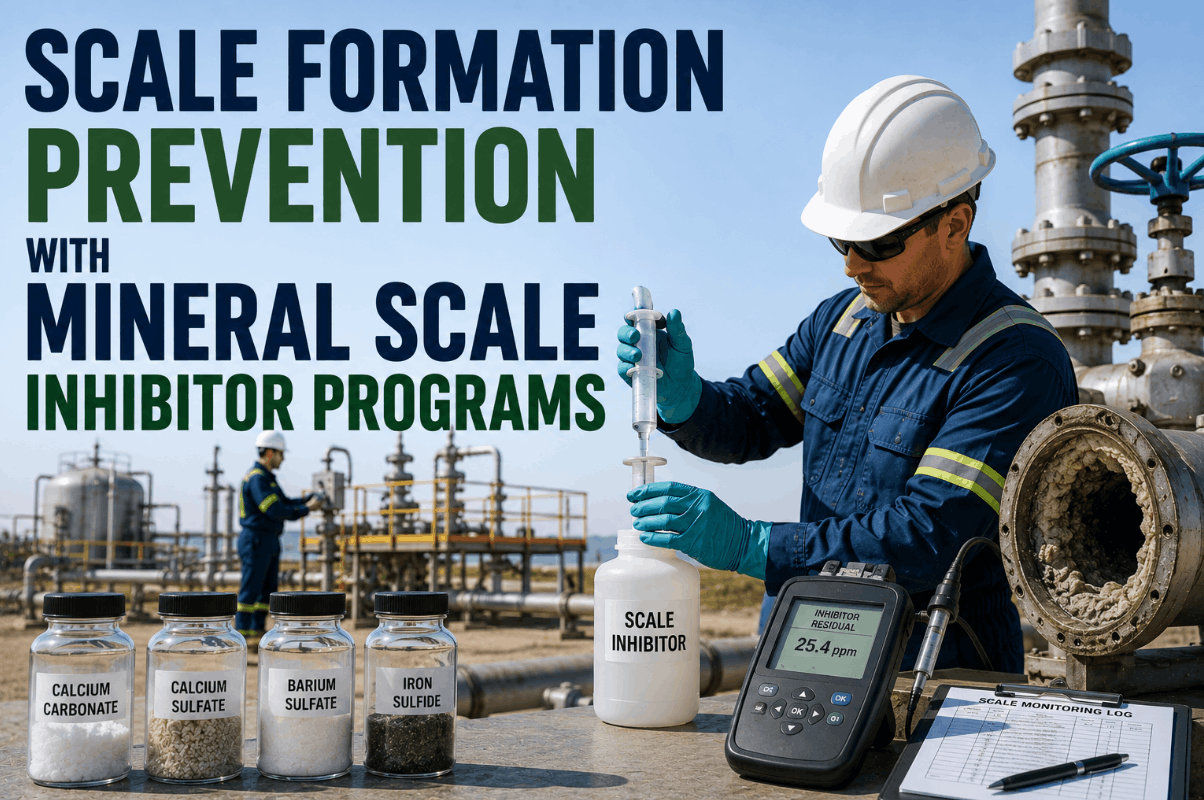
Mineral scale is one of the quietest production killers in oil and gas operations — calcium carbonate, calcium sulfate, and barium sulfate deposits build up gradually inside tubing, perforations, and surface equipment until a well's flow rate has dropped well below what artificial lift or pressure data alone would explain. Because scale forms from changes in pressure, temperature, or the mixing of incompatible waters, it is predictable in principle but easy to miss in practice when squeeze timing and residual inhibitor levels aren't tracked closely. This guide walks through how scale prediction, squeeze treatment design, and residual monitoring fit together into a defensible inhibitor program. Production teams reviewing scale-prone wells can Book a Demo with iFactory to see how field data supports that program once it's running.
Why Scale Forms — and Why It's Easy to Miss
The Chemistry Behind Calcite, Sulfate, and Sulfide Scales
Scale precipitates when formation or injection water becomes supersaturated with a sparingly soluble salt — most commonly calcium carbonate (calcite), calcium sulfate, or barium and strontium sulfate. The trigger is usually a shift in pressure or temperature as fluid moves up the wellbore, a drop in CO2 partial pressure that raises pH, or the mixing of two waters that are individually stable but chemically incompatible together. None of these conditions are random; they can be modeled. The challenge for most operators is not predicting that scale could form, but catching the early signs — a gradual choke pressure climb, a slow decline in injectivity — before the deposit has already narrowed the bore. Engineers reviewing a well's scaling history can Book a Demo to see how that trend data is surfaced automatically.
Predicting Scale Before It Forms
Saturation Index Modeling and Geochemical Software
Scale prediction generally starts with water analysis — the cation and anion content of produced or injection water — fed into geochemical modeling software such as PHREEQC. These tools calculate a saturation index for each scale type across the expected pressure and temperature range of the wellbore, identifying the depth or surface location where supersaturation is most likely. This modeling output becomes the basis for squeeze design: it tells engineers which scale type to target, how aggressive the treatment needs to be, and where future risk is concentrated as water cut increases over the life of the well.
Calcium Carbonate (Calcite)
The most common oilfield scale. Forms as CO2 flashes off during pressure drop, raising water pH and triggering rapid precipitation near the wellbore and tubing.
Calcium & Barium Sulfate
Forms when sulfate-rich injection water (such as seawater) mixes with formation water rich in barium or calcium, common in waterflood and EOR operations.
Iron Sulfide & Carbonate
Often coprecipitates with calcite, frequently linked to corrosion products elsewhere in the well rather than purely formation-sourced minerals.
Designing and Sustaining a Squeeze Treatment
From Inhibitor Placement to Residual Decline
A scale inhibitor squeeze places concentrated inhibitor solution into the near-wellbore formation, where it adsorbs onto rock surfaces or precipitates within pore spaces, then slowly desorbs back into produced fluids over weeks or months. The treatment is only as good as its monitoring: once the inhibitor concentration in produced water falls below the minimum inhibitor concentration (MIC), often referred to as the minimum effective dose, scale protection effectively ends even though the well still looks normal on a pressure gauge. Tracking that residual decline curve is what separates a planned re-squeeze from an emergency one. Reliability teams scoping a residual monitoring program can Book a Demo to walk through how trend alerts support that cadence.
| Program Stage | Core Activity | Typical Method | What It Tells You |
|---|---|---|---|
| Prediction | Water analysis & SI modeling | PHREEQC / geochemical software | Which scale type, where, and how severe |
| Treatment Design | Inhibitor selection & volume | Phosphonate, polymer, or carboxylate SI | Chemistry matched to scale type & brine |
| Placement | Squeeze injection | Adsorption or precipitation squeeze | Inhibitor placed in near-wellbore rock |
| Residual Monitoring | Produced water sampling | Colorimetric, ICP, or HPLC analysis | Whether concentration is still above MIC |
| Re-Treatment Planning | Squeeze life forecasting | Residual decline curve trending | When the next squeeze is actually needed |
What a Modern Scale Management Program Requires
Moving Beyond Fixed-Interval Re-Squeezing
Many operators still schedule re-squeeze treatments on a fixed calendar interval because residual sampling is infrequent or inconsistent across a well portfolio. The result is twofold: wells that scale up before their scheduled treatment, and wells that get re-squeezed early, wasting chemical and rig time. A stronger program ties re-treatment timing to the actual residual decline trend for each well, informed by water cut changes, rate changes, and prior squeeze life history. iFactory supports this by trending the production and water-chemistry signals that typically precede a residual concentration dropping toward the MIC threshold, helping teams prioritize which wells need a fresh sample or an earlier re-squeeze. Operators ready to compare this approach against their current re-squeeze schedule can Book a Demo with the iFactory team.
Expert Review
What Experienced Flow Assurance Teams Get Right
Experienced scale management programs share a common pattern: they treat prediction, treatment, and monitoring as one continuous loop rather than three separate tasks. Water analysis and saturation index modeling identify which wells carry real risk and which scale type to design around. Squeeze treatments are sized and chemically matched to that risk rather than applied uniformly across a field. And residual sampling is frequent enough to catch a concentration trending toward MIC before scale actually deposits. The most common gap reviewers flag is the monitoring step — many programs invest heavily in good squeeze design but then sample residuals too infrequently to catch the moment protection lapses. Closing that gap with consistent trend visibility, rather than periodic spot checks, is where a platform like iFactory adds the most practical value to an existing inhibitor program.
Frequently Asked Questions
What is the difference between calcite and sulfate scale?
Calcite forms mainly from pressure-driven CO2 loss and pH change, while sulfate scales like barium or calcium sulfate typically form when incompatible waters mix, such as seawater injection meeting formation brine.
What does MIC mean in scale inhibitor monitoring?
MIC, or minimum inhibitor concentration, is the lowest residual inhibitor level in produced water that still prevents scale formation. Below it, protection effectively ends even if no scale is visible yet.
How is scale risk predicted before it forms?
Operators typically run produced and injection water composition through geochemical modeling software such as PHREEQC to calculate a saturation index and identify where supersaturation is likely.
How often should scale inhibitor squeeze treatments be repeated?
Frequency depends on the residual decline curve for each well rather than a fixed calendar; tracking actual inhibitor concentration trends gives a more accurate re-treatment timing than scheduling alone.
Does iFactory replace scale inhibitor chemistry or lab testing?
No. iFactory adds continuous production and trend monitoring on top of existing water analysis and squeeze programs, helping teams time residual sampling and re-treatment more precisely.