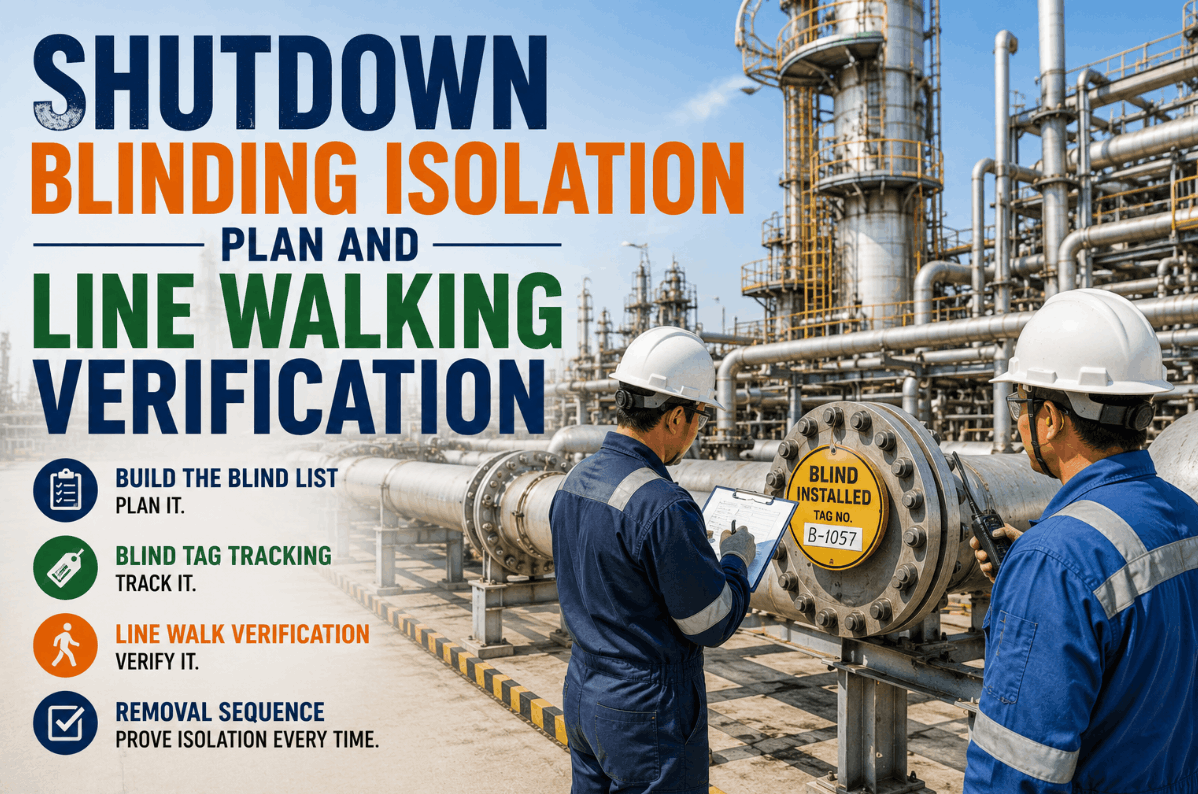
A worker entering a vessel believing it is isolated, when the wrong blind was installed or a blind was never removed from the open position, is one of the most well-documented causes of fatal incidents during refinery and chemical plant shutdowns. The mechanism is almost always the same — a blind list that exists on paper or in a spreadsheet, a field crew working from memory or a marked-up drawing, and no independent way to confirm that the physical state of every line matches what the isolation plan says it should be. Industry turnaround data shows that a single missed blind, installed in the wrong location, or never installed at all, can sit undetected for days inside a plant running thousands of isolation points simultaneously. iFactory's shutdown isolation platform closes that gap by giving planners and line walkers a live, verifiable blind list that ties every blind tag to a physical location, a removal record, and an independent walkdown confirmation before any entry permit or repressurization is authorized. Book a Demo.
Why the Blind List Is the Single Point of Failure in Shutdown Isolation
A blind list sounds simple in concept — a register of every spectacle blind, blank, or spade installed to physically isolate a line during shutdown. In practice, a major turnaround can require hundreds or thousands of blinds installed across dozens of systems, each one specified by location, rating, and installer, and each one requiring a matching removal record before the unit can be safely repressurized. The danger is not the concept of the blind list — it is the gap between what the list says and what is physically true in the field. A blind installed at the wrong flange, a blind list updated on paper but never reconciled against the physical plant, or a removal recorded before the blind was actually pulled, all produce the same outcome: an isolation boundary that looks complete on paper and isn't complete in reality.
The 5 Stages of a Verified Blind List Lifecycle
A blind list is not a static document — it moves through a defined lifecycle from initial isolation planning through final removal verification. iFactory's platform tracks every blind through each of these stages, so the plan, the physical installation, and the final removal record always stay synchronized.
Isolation Plan and Blind List Build
The isolation engineer identifies every line requiring physical isolation and specifies blind location, rating, and size, building the master blind list before shutdown begins.
Tag Issuance and Field Installation
Each blind is assigned a unique tag number before installation. The fitter installing the blind confirms location and rating against the tag before logging the install as complete.
Independent Line Walk Verification
A second person, independent of the installation crew, physically walks the line and confirms the blind tag, location, and orientation match the approved isolation plan.
Entry Permit and Work Execution Gate
Confined space entry and hot work permits remain blocked until the system confirms every blind tied to that boundary is verified installed, preventing entry on an incomplete isolation.
Removal Verification and Zero-Balance Close-Out
Every blind removed is matched against its original installation record, and the unit cannot proceed to repressurization until the blind register shows a verified zero balance. Book a Demo to see zero-balance tracking in action.
Mapping Blind List Functions to Safety Outcomes
Every function in a blind list management system exists to close a specific isolation failure mode. The table below maps iFactory's core blind tracking capabilities to the safety outcome each one is designed to guarantee. Request a blind list configuration walkthrough.
| Platform Function | Operational Action | Safety Outcome | Primary Owner |
|---|---|---|---|
| Tag-Level Blind Register | Assigns a unique ID to every blind before installation | Eliminates ambiguity about which blind is at which location | Isolation Engineers |
| Independent Line Walk | Second-person field verification against the approved plan | Catches wrong-location or missed blinds before entry | Line Walkers / QA |
| Permit Gate Lock | Blocks entry and hot work permits on unverified boundaries | Prevents work authorization on incomplete isolation | Permit Authorizers |
| Zero-Balance Removal Check | Matches every removal against its original install record | Guarantees no blind is left in place or unaccounted for | Shift Supervisors |
| Pre-Startup Isolation Audit | Full register reconciliation before unit repressurization | Confirms zero open isolation points before startup | Operations & PSM Teams |
Why Paper Blind Lists Fail at Turnaround Scale
A handful of blinds on a routine maintenance job can be tracked on a clipboard without much risk. A major turnaround with a thousand or more isolation points, multiple contractor crews, and three rotating shifts is a different problem entirely — and it is exactly the scale at which paper and spreadsheet blind lists most often fail.
A blind list updated on paper depends on every fitter, every shift, and every contractor crew writing down the same information in the same format and that paperwork making its way back to a central register before the next shift needs it. In practice, a blind installed on night shift may not be logged until the morning meeting, a removal may be marked complete by a supervisor who didn't personally witness it, and a line walk meant to catch discrepancies becomes a formality rather than an independent check. iFactory replaces this with a digital blind register where installation and removal are logged at the point of work, tied to a tag scan, and immediately visible to every shift and every authorizer — closing the lag between what happened in the field and what the record shows. Explore Live Blind Tracking.
The iFactory Isolation Platform: What We Deliver
iFactory is built to give shutdown and turnaround teams one connected system for isolation planning, blind tracking, and line walk verification — not a collection of disconnected spreadsheets, drawings, and paper sign-offs.
Digital Blind List Register
Every blind is tagged, located, and tracked from issuance through removal, replacing static spreadsheets with a live register every authorized user can see in real time.
Independent Line Walk Workflow
Line walkers confirm each blind's tag and location against the approved plan using a mobile checklist, with discrepancies flagged immediately rather than discovered at close-out.
Permit-to-Work Integration
Confined space and hot work permits are linked directly to the isolation boundaries they depend on, so a permit cannot be authorized while a required blind remains unverified.
Zero-Balance Startup Audit
Before repressurization, the platform reconciles every installed blind against its removal record, surfacing any unresolved item before the unit is cleared to start up.
Where Isolation Programs Lose Control: Six Recurring Failure Points
When isolation specialists review near-miss and incident data from past turnarounds, a consistent set of failure points keeps appearing. These are the specific gaps iFactory's blind list and line walking workflow is built to close.
"On a turnaround with close to a thousand blinds in scope, we used to rely on a master spreadsheet that three different people updated from handwritten field sheets. We had at least one case where a blind removal was logged before it was actually pulled. Since moving our blind register into iFactory, every install and removal is tied to a tag scan at the point of work, and our pre-startup audit now takes hours instead of days." — Turnaround Isolation Coordinator, Gulf Coast Refinery
Deploying Verified Blind Tracking: A 5-Phase Rollout
Implementing iFactory's blind list and line walking workflow follows a structured rollout designed to be live well before the next major shutdown window. Schedule your isolation readiness audit.
Isolation Plan Digitization
Existing isolation plans and blind lists are imported and structured into the platform, with each blind assigned a unique tag ahead of shutdown mobilization.
Field Tagging and Crew Onboarding
Physical tags are issued for every blind in scope, and installation crews are onboarded to log install confirmation directly from the field using a mobile device.
Line Walk Workflow Activation
Independent line walkers are assigned verification routes tied to the digital register, confirming each tag and location against the approved isolation plan.
Permit Gate Configuration
Confined space and hot work permit templates are linked to their dependent isolation boundaries, enforcing the rule that work cannot be authorized on an unverified blind.
Pre-Startup Zero-Balance Audit
As the shutdown moves toward startup, the platform runs a full reconciliation of every blind installed against every blind removed, flagging any unresolved record before repressurization.
Frequently Asked Questions: Shutdown Blinding and Isolation Verification
What is a blind list, and why does it matter during shutdown?
A blind list is the master register of every physical isolation blind installed during a shutdown, specifying location, rating, and installer — it is the document that proves a line is truly isolated before entry or hot work.
Why is an independent line walk necessary if the installer already confirmed the blind?
An independent line walk provides a second, unbiased verification of the same physical condition, catching wrong-location or missing blinds that a single installer's self-report could miss under schedule pressure.
What does "zero balance" mean for a blind register?
Zero balance means every blind installed during the shutdown has a matching, verified removal record, with no outstanding or unaccounted-for blinds remaining before the unit is cleared for repressurization.
How does iFactory prevent a confined space entry permit from being issued on an incomplete isolation?
iFactory links each permit to its dependent isolation boundary, so the system blocks authorization until every blind tied to that boundary shows a verified, independently confirmed installation.
Can iFactory's blind tracking integrate with our existing CMMS or work order system?
Yes. Blind installation and removal records sync with existing work orders and isolation registers, so turnaround teams gain live tracking without abandoning their current CMMS structure.