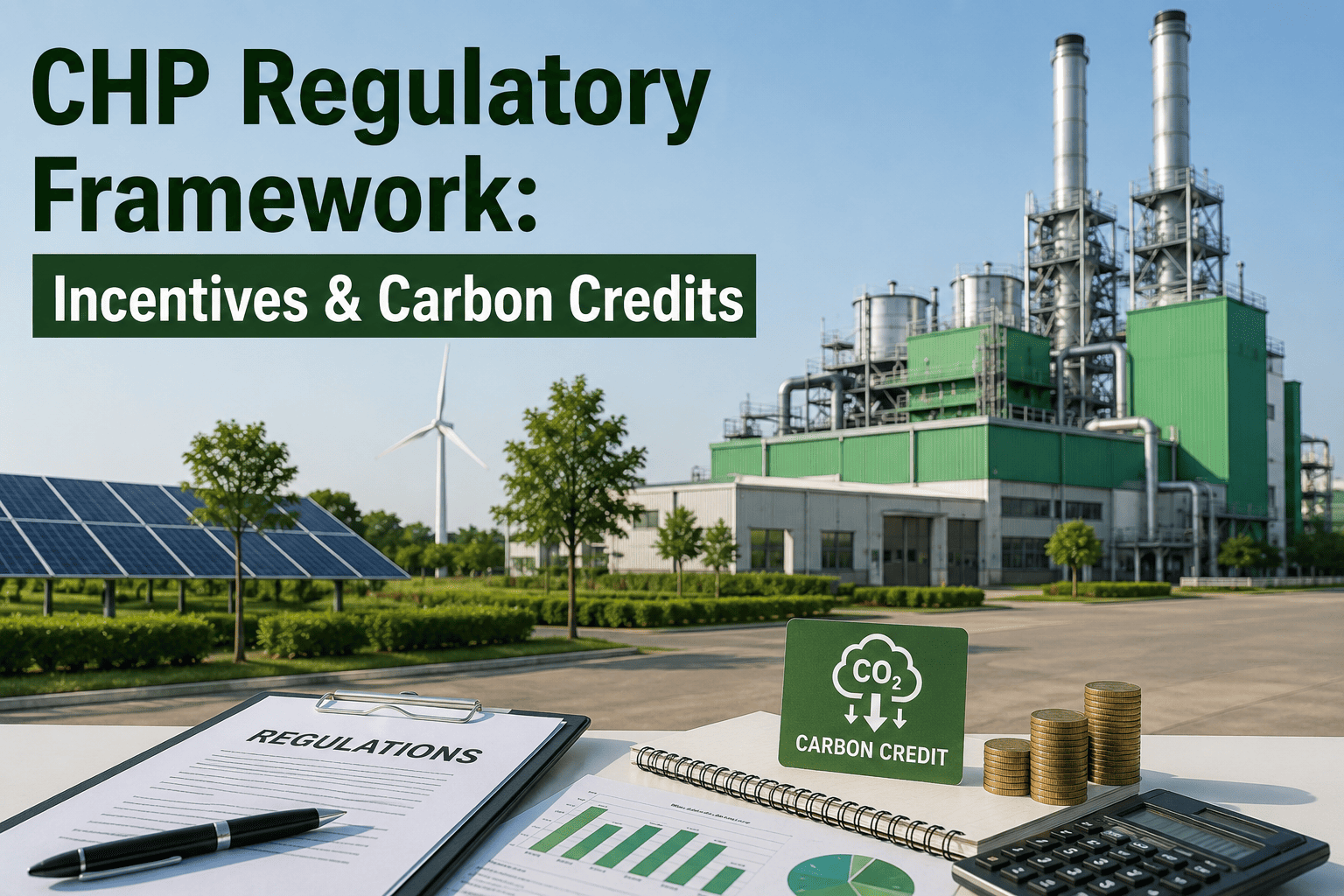
A combined heat and power project's economics rarely fail because the engineering was wrong — they fail because the incentive stack behind the payback model was misread. A federal investment tax credit, a state CHP incentive program, a utility standby rate, and a carbon market opportunity can each apply to the same project, but they come from different agencies, carry different efficiency and capacity thresholds, and now sit inside a tax code that changed substantially in 2025. Plants that treat these programs as a single line item in a spreadsheet instead of four separate compliance tracks routinely leave value on the table or discover an eligibility gap after construction has already started. Teams building or defending a CHP business case can Book a Demo to see how iFactory tracks efficiency, documentation, and deadline data across every layer of the incentive stack in one place.
On paper, combined heat and power looks like one of the more straightforward technologies to incentivize: it is efficient, it reduces grid demand, and it has decades of federal policy support behind it. In practice, a single CHP project can touch a federal investment tax credit, a state-level rebate or grant program, a utility interconnection and standby rate structure, and potentially a voluntary or compliance carbon credit market — four regulatory tracks administered by four different bodies, each with its own definitions of what counts as an eligible system.
The gap between what a project qualifies for on paper and what it actually captures usually comes down to documentation. Efficiency has to be measured and sustained, not just designed for. Construction start dates have to be proven, not estimated. Prevailing wage and apprenticeship records have to exist before the credit is claimed, not reconstructed afterward. None of this is exotic, but all of it depends on operating data that most plants are not set up to track continuously across a multi-year project timeline.
CHP also occupies an unusual policy position compared with wind or solar. Because it generates useful thermal energy and power from the same fuel input at a combined efficiency well above separate generation, regulators have historically treated it as a demand-side efficiency measure as much as a generation technology, which is why it shows up in efficiency portfolio standards, utility demand-side programs, and federal energy tax credit language all at once. That dual identity is an advantage when a project team knows which door to knock on for which benefit, and a source of missed value when it does not.
Most CHP projects that maximize their incentive value are stacking four distinct layers rather than relying on one program. Each layer sits on a different regulatory foundation, and a project can qualify for one layer while missing eligibility on another.
CHP systems up to 50 MW that exceed 60% overall efficiency can qualify for a Section 48 energy investment tax credit, with a base rate that multiplies significantly when prevailing wage and apprenticeship requirements are met on projects over 1 MW, plus additional bonus percentages for domestic content and energy community siting.
A number of states include CHP as an eligible resource under renewable or energy efficiency portfolio standards, and some run dedicated grant, rebate, or low-interest loan programs specifically for cogeneration projects, layered on top of whatever federal credit applies.
Utility standby charges and exit fees can quietly erode a CHP project's economics if the interconnecting utility does not offer favorable rate treatment, so states with defined interconnection standards and standby rate relief materially change the payback calculation for the same equipment.
Because a CHP system displaces grid electricity generated at a lower efficiency than the CHP unit itself, the emissions reduction can, in applicable markets and programs, be documented and monetized as a carbon credit or renewable energy certificate alongside the tax and rate incentives above.
These are the thresholds and figures that show up most often in CHP incentive eligibility discussions, and the ones worth confirming against current guidance before a project moves from design to construction.
Each program below is administered separately, has its own eligibility test, and produces a different kind of value for a CHP project — tax savings, rate relief, or a marketable credit.
| Program | Administered By | Core Eligibility Test | Value to Project |
|---|---|---|---|
| Federal Investment Tax Credit (Sec. 48) | IRS / Treasury | 60%+ efficiency, capacity cap, construction start date | Direct reduction of federal tax liability |
| State CHP Incentive / Grant Programs | State energy office | Varies by state; often ties to portfolio standard eligibility | Rebate, grant, or low-interest financing |
| PURPA Qualifying Facility Status | FERC / state utility commission | Cogeneration definition, ownership limits | Utility purchase obligation at avoided cost |
| Standby Rate Relief | State utility commission | Interconnection standard applies to CHP in that state | Reduced backup power and exit fee costs |
| Carbon Credit / Offset Market | Voluntary registry or compliance program | Documented, verified emissions displacement | Tradable credit revenue stream |
The tax credit landscape for energy projects shifted meaningfully with legislation signed in mid-2025, and while the most aggressive early terminations targeted wind and solar specifically, CHP projects still need to track the revised timeline carefully since the technology-neutral credit framework that now governs most non-solar, non-wind generation carries its own construction-start and placed-in-service milestones.
Projects that began construction under prior Section 48 rules generally continue under the framework that applied when construction started, largely unaffected by the 2025 legislative changes.
Non-solar, non-wind technologies, which includes most CHP systems, generally retain access to the full technology-neutral credit rate for projects that begin construction before this window closes.
Projects beginning construction in these years see the credit value step down in stages rather than disappear outright, making early planning materially more valuable than a last-minute filing.
Under current law the technology-neutral credit framework phases out entirely for projects beginning construction in this window, absent further legislative action.
This timeline reflects general provisions of current federal tax law as commonly summarized by energy and tax advisory sources, and is provided for informational context only — CHP incentive eligibility depends on project-specific facts, and any organization pursuing these credits should confirm current requirements with a qualified tax professional before relying on them in a project's financial model.
Every layer of the incentive stack eventually asks for proof, not just a design specification. These are the records that come up most consistently across federal, state, and carbon credit reviews.
Metered data showing the system sustains the required overall efficiency threshold in actual operation, not just at commissioning, since some programs allow re-review.
Physical work records or safe-harbor cost documentation establishing the date construction began, which anchors which version of the credit rules applies.
Certified payroll and apprenticeship program records for projects above the 1 MW threshold, required to claim the full credit rate rather than the base rate.
Utility correspondence and approval documentation showing the project followed the applicable state interconnection standard for CHP.
Verified methodology comparing CHP emissions against the grid electricity and separate heat source it displaces, required for any carbon credit or offset claim.
Manufacturer cost documentation supporting any domestic content bonus credit claim, tracked to the applicable percentage threshold for the year construction began.
Unlike the federal investment tax credit, which applies uniformly wherever the eligibility test is met, state-level CHP support is a patchwork. Some states have formally adopted interconnection standards specific to CHP, folded cogeneration into their renewable or efficiency portfolio standards, or built out standby rate relief that materially lowers the cost of keeping backup capacity available. Others have none of these in place, which means identical equipment installed in two different states can land on two very different payback timelines even before the federal credit is applied.
Several states have historically stood out for combining more than one of these supports at once — pairing an interconnection standard with a portfolio standard set-aside and a dedicated grant or rebate program for cogeneration. A project team evaluating a multi-site rollout across state lines needs to run this check site by site rather than assuming the incentive stack that worked at one facility will transfer cleanly to the next, since the utility rate structure and portfolio standard eligibility can differ even between neighboring states served by the same regional grid operator.
A project team that models a new facility using the incentive stack from a prior site in a different state routinely overstates or understates the payback, since interconnection standards, portfolio standard eligibility, and standby rate relief are set independently by each state utility commission.
Most missed CHP incentive value is not a rejected application — it is value nobody applied for because the eligibility went unnoticed or the paperwork could not be produced when asked.
Projects that stop at the federal investment tax credit often miss state-level programs, standby rate relief, and carbon credit opportunities stacked on top of it, all of which have separate applications and separate deadlines that do not wait for the tax filing.
Some incentive reviews and carbon credit verifications look at sustained operating efficiency, not just design efficiency, and a plant that never set up continuous tracking has no way to prove the system still qualifies years after startup.
Because credit value now depends heavily on when construction began relative to specific legislative dates, a project that delays breaking ground by even a few months can shift into a materially different credit rate without anyone flagging the change in the model.
Assuming a home state treats CHP the same as every other state leads to unexpected standby charges or exit fees that were never built into the original payback calculation.
Reconstructing a year or more of efficiency readings, payroll records, and interconnection correspondence in the weeks before a tax filing deadline is where most avoidable errors happen, and it is also when a plant is most likely to simply give up on a program it technically qualified for because the paperwork burden looked too large to start.
Most federal CHP tax credit provisions require the system to demonstrate overall energy efficiency above 60% on a lower heating value basis, combining useful electrical or mechanical output with useful thermal output. This threshold has to be documented, not just designed for, since some reviews and future audits can revisit whether the system continues to perform at that level in actual operation. Teams unsure whether their current system configuration meets this bar can contact iFactory Support to walk through how efficiency tracking gets set up.
In most cases, yes — federal and state CHP incentives are administered independently and are frequently designed to stack, since state programs often specifically target the portion of project cost the federal credit does not cover. The exact combination depends on each state's program rules, and some state incentives reduce the depreciable basis used for the federal credit calculation, so the interaction should be modeled carefully rather than assumed to be purely additive.
No — the most aggressive early terminations in the 2025 legislation targeted wind and solar specifically, while other technologies including CHP generally remain eligible for the technology-neutral credit framework for projects that begin construction before the applicable phase-down years. The rules did introduce new documentation requirements around foreign entity restrictions and adjusted timelines, which is why current project-specific guidance from a tax professional matters more than it did under the prior, more stable rules.
A CHP system can, in applicable voluntary or compliance markets, generate a marketable emissions reduction claim by demonstrating that its combined generation of electricity and useful heat displaces more carbon-intensive grid electricity and a separately fired heat source, since combustion efficiency well above standalone generation methods produces measurably lower emissions per unit of useful energy delivered. The claim requires a documented calculation methodology and, in most registries, third-party verification before credits can be issued or sold.
Pulling current metered efficiency data, original construction and commissioning records, and any prior incentive filings into one review is usually enough to identify which programs a system already qualifies for and which ones require additional documentation to pursue. Teams ready to run that review can Book a Demo to see how the process works against real operating data.