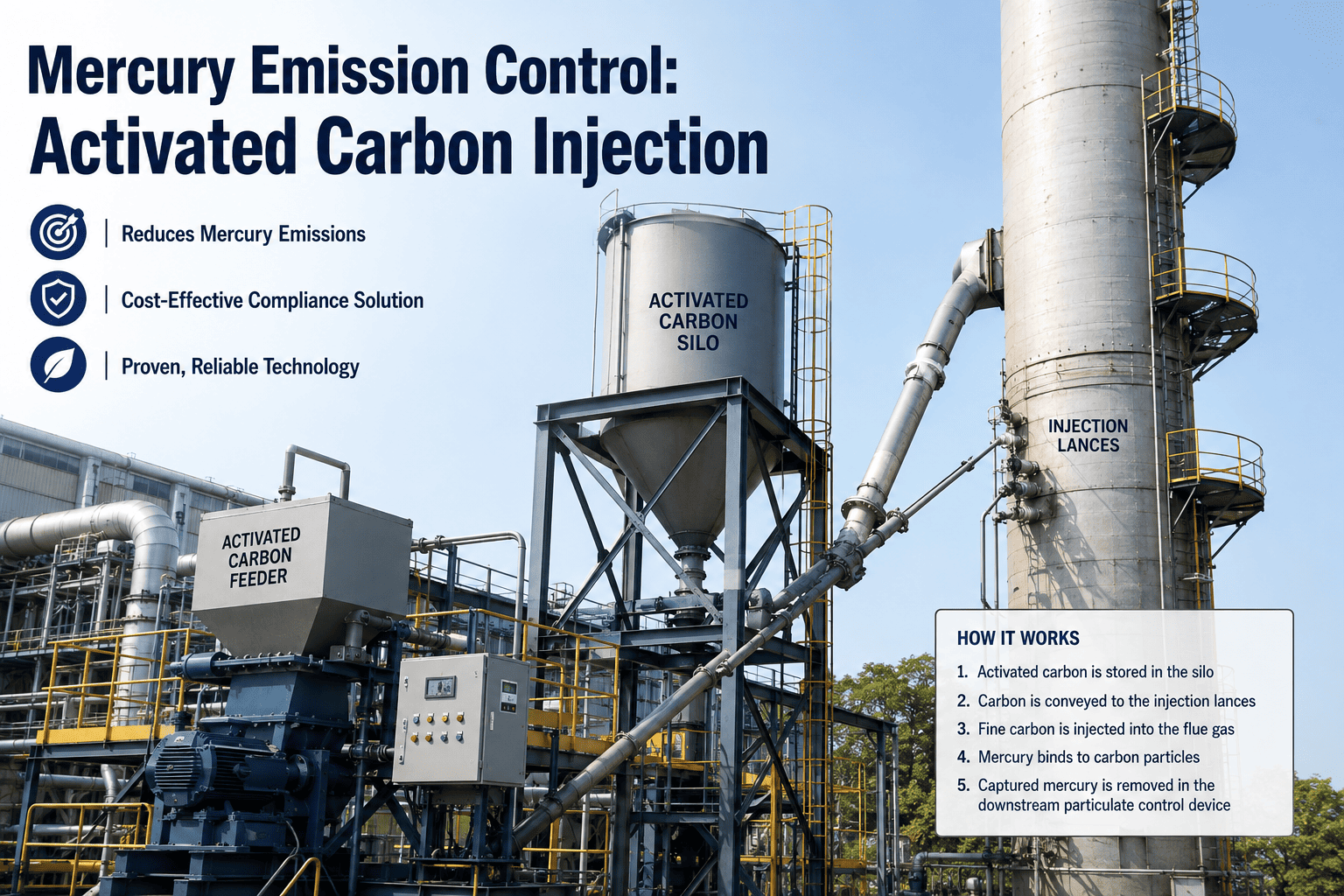
Coal-fired power plants have been living under the Mercury and Air Toxics Standards since 2011, and activated carbon injection remains the technology most plants lean on to keep mercury emissions under the compliance limit shift after shift. The challenge is that ACI performance is never a set-it-and-forget-it proposition — coal blend changes, flue gas temperature swings, and sorbent injection rate drift can quietly push mercury removal from a comfortable 95 percent down toward the compliance edge without anyone noticing until a stack test or a mercury CEMS trend flags it. Getting sorbent type, injection location, and injection rate matched to your specific coal and particulate control configuration is what separates a plant that runs ACI as a routine, low-cost operation from one that's constantly firefighting near-miss exceedances. This guide walks through how mercury actually moves through the flue gas path, how to select the right sorbent for your unit, and where ACI systems most commonly lose performance. You can book a demo to see how iFactory trends injection rate against stack mercury readings so drift gets caught before it becomes a compliance issue.
Keep Mercury Removal Comfortably Inside the MATS Limit, Not Riding the Edge of It
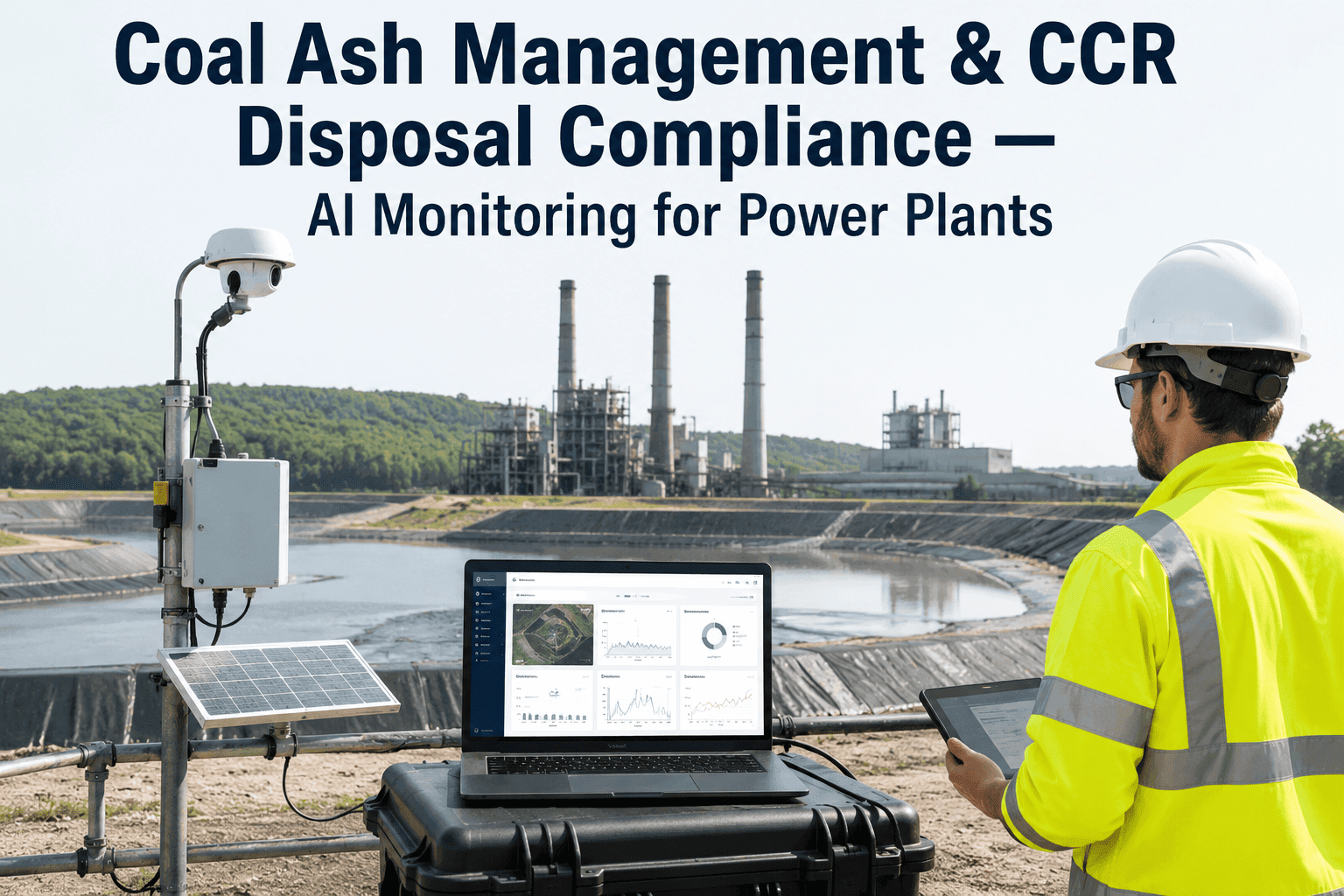
iFactory connects ACI injection rate, flue gas temperature, and stack mercury readings on one timeline, so drift in sorbent performance shows up as a trend instead of a surprise near-miss.
Mercury Removal Rarely Fails All at Once — It Erodes Quietly First
ACI systems are usually commissioned to hit 90 to 95 percent mercury removal with a healthy margin below the MATS limit, and for a while that margin absorbs normal variability without anyone paying close attention. The trouble starts when several small factors move in the same direction at once: a coal blend shift lowers chlorine content, flue gas temperature creeps up at the injection point, and the sorbent feeder drifts slightly low on rate. None of these alone would push removal below the limit, but stacked together they can erode a comfortable margin into a near-miss within weeks, and most plants only see it after the fact in a periodic stack test or a sorbent trap monitoring result.
Switching coal sources or blending ratios changes chlorine and sulfur content in the flue gas, both of which directly affect how well a given sorbent oxidizes and captures elemental mercury.
Sorbent adsorption capacity is highly temperature-sensitive, and a load-driven temperature increase at the injection location can quietly reduce mercury capture without any equipment actually malfunctioning.
Feeder calibration drift, bridging in the storage silo, or a partially clogged injection lance can reduce actual sorbent delivery well below the rate the control system believes it's injecting.
Elevated SO3 in the flue gas competes with mercury for active sites on the sorbent surface, and without an SO3 mitigation step this interference can significantly undercut ACI performance on high-sulfur coals.
Three Forms of Mercury, Three Different Capture Pathways
Mercury doesn't leave the boiler in one uniform state, and each form takes a different path through the plant's pollution control equipment. Understanding which form dominates on your coal and configuration is the starting point for choosing the right ACI strategy.
| Mercury Form | Characteristics | Primary Capture Device | Control Difficulty |
|---|---|---|---|
| Elemental (Hg⁰) | Gaseous and insoluble, passes through most conventional pollution control equipment untouched | Requires oxidation or direct adsorption onto activated carbon | Hardest — the primary reason ACI systems exist |
| Oxidized (Hg²⁺) | Water-soluble and more chemically reactive than the elemental form | Wet flue gas desulfurization (scrubber) | Moderate — captured well once oxidized |
| Particulate-Bound (Hgp) | Attached to fly ash particles after combustion | Electrostatic precipitator or baghouse | Easiest — captured along with normal particulate control |
The Right Sorbent Strategy Depends on Coal Type and Particulate Control
There is no single correct sorbent for every plant, and choosing based on what worked at a similar-sized unit elsewhere can leave real performance on the table. Coal type, chlorine content, and the particulate control device downstream of injection all shape which sorbent and injection strategy will actually hit target removal at the lowest sustainable cost.
Low native chlorine content typically calls for a calcium bromide fuel additive combined with non-halogenated PAC, or a brominated PAC injected at the air heater inlet where contact time is longest.
Higher native chlorine often allows non-halogenated or standard brominated PAC injected at the air heater outlet, though an SO3-tolerant sorbent may be needed if sulfur trioxide levels run high.
Higher inherent mercury content and unfavorable flue gas chemistry generally require brominated PAC at a higher injection rate than other coal types to hit the same removal target.
SO3 above roughly 5 ppm competes with mercury for sorbent surface sites, so injecting hydrated lime or trona upstream to reduce SO3 is often needed before ACI performance improves.
Your Downstream Equipment Sets the Performance Ceiling
The particulate control device sitting downstream of the injection point determines how much contact time the sorbent gets before it's captured, which has a direct effect on how much PAC you actually need to inject to hit target removal.
The filter cake on baghouse bags provides extended contact time between flue gas and sorbent, allowing lower injection rates while still achieving strong removal, even with untreated PAC on some bituminous coals.
Shorter effective contact time typically requires brominated PAC and higher injection rates, with a polishing baghouse sometimes added for the most challenging configurations.
The scrubber captures oxidized mercury directly, so ACI can be focused primarily on the elemental fraction, injected upstream of the ESP.
The SCR catalyst oxidizes a portion of elemental mercury to the oxidized form as a byproduct of NOx control, which can reduce the ACI injection rate needed downstream.
Five Variables That Actually Decide ACI Performance
Injecting further upstream generally provides more contact time before capture, but must be balanced against flue gas temperature limits at that point in the duct.
Sorbent adsorption capacity drops as temperature rises, so tracking temperature at the actual injection point, not just a nearby reference point, matters for consistent performance.
Finer PAC generally offers more surface area for adsorption, but also affects feeder behavior, dust loading, and downstream fly ash marketability.
Feeder calibration accuracy and lance condition determine whether the sorbent rate the control system reports matches what's actually reaching the flue gas.
Carbon-in-ash content from ACI can affect whether fly ash still qualifies for beneficial reuse in concrete, which is a real cost consideration alongside the mercury removal target itself.
Common Mistakes That Erode Mercury Removal Margin
Sticking with the sorbent chosen at commissioning without reassessing it after a coal supply change or a particulate control upgrade can leave real performance and cost savings on the table.
Watching PAC feed rate and mercury CEMS or sorbent trap data as separate, disconnected numbers makes it hard to catch a real performance drift before it approaches the compliance limit.
Assuming a sorbent that performed well on one coal blend will perform the same after a switch to higher-sulfur coal, without checking for SO3 competition effects on adsorption.
Overinjecting to build in a safety margin drives up sorbent cost and can hurt fly ash marketability, when a properly tuned rate could achieve the same compliance margin more efficiently.
Catching a Sorbent Performance Drift Before a Near-Miss Stack Test
A coal-fired unit running standard brominated PAC through an ESP-only configuration had comfortably met its MATS mercury limit for years. A gradual shift toward a higher-sulfur coal blend went unnoticed operationally, since boiler performance and emissions for other pollutants stayed within normal range, but SO3 competition was quietly eating into mercury adsorption capacity.
A periodic sorbent trap result came back showing removal had slipped from a comfortable margin to within a few percentage points of the compliance limit. Once flue gas SO3 levels were checked against the coal blend change timeline, the correlation became clear, and the plant added an upstream trona injection step to reduce SO3 interference, restoring the original mercury removal margin without needing to switch sorbent products entirely.
Building an ACI Program That Holds Its Margin
Document your current sorbent type, injection rate, and injection location against your specific coal blend and particulate control configuration as a baseline.
Track flue gas temperature at the actual injection point, not just a nearby process reference, since adsorption capacity is highly temperature-sensitive.
Connect PAC feed rate data to stack mercury or sorbent trap results on a shared timeline, so drift shows up as a trend rather than a surprise result.
Reassess sorbent selection whenever coal supply, blend ratio, or SO3 levels shift meaningfully from the conditions the original strategy was designed around.