Power plant outages generate more operational knowledge in a single week than most units produce in six months of normal operation, yet the vast majority of that knowledge evaporates within days of the outage closing meeting. Post-mortem reviews are conducted, lessons learned are documented, and improvement actions are assigned, but the organizational mechanisms for capturing, validating, tracking, and applying those lessons to future outages are consistently weaker than the mechanisms for planning and executing the outage itself. The result is a power generation industry that repeats the same outage execution mistakes across units, sites, and outage seasons not because the lessons are unknown but because the process for retaining and deploying them is fundamentally broken. Fixing this process requires treating outage lessons learned as a managed data stream rather than a meeting output, and you can see exactly how that works when you book a demo.
OUTAGE MANAGEMENT · LESSONS LEARNED · CONTINUOUS IMPROVEMENT
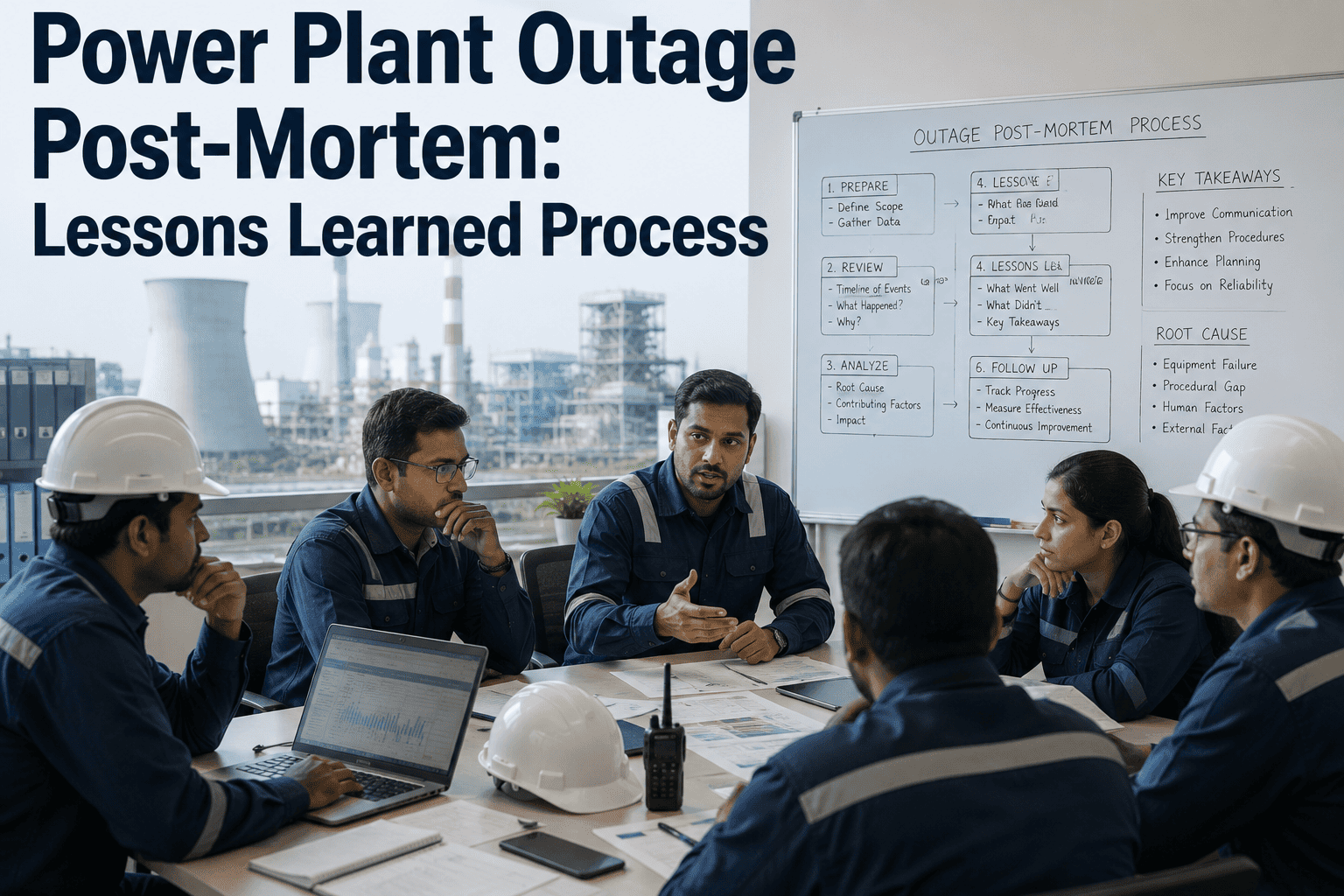
Power Plant Outage Post-Mortem: Lessons Learned Process
Structured post-outage analysis, action tracking, and knowledge management that converts single-outage experience into multi-outage institutional intelligence.
THE COST OF UNLEARNED OUTAGE LESSONS
What Happens When Post-Mortem Intelligence Dies in a Document
The financial and operational impact of failed lessons learned processes in power plant outages is substantial but almost entirely invisible because it manifests as avoidable costs embedded in the next outage rather than as a line item in the current one. When a scope growth issue that was identified in the spring outage post-mortem recurs in the fall outage because the corrective action was never implemented, the cost shows up as overtime, contractor extensions, and schedule delays in the fall outage, not as a failure of the spring post-mortem process. This cost invisibility is the primary reason that lessons learned processes receive far less investment and management attention than outage planning and execution processes, despite having an equivalent or greater impact on outage performance over time. The four cost dimensions below represent the most significant and most consistently underreported consequences of inadequate post-mortem knowledge management in power generation outage programs.
12–18%
Average outage cost premium attributed to repeated scope growth and schedule delays that were identified as lessons in previous outages but not effectively addressed before the next one
30–45%
Share of post-mortem action items that are never closed or verified, remaining in an open status until the next outage begins and the cycle repeats with the same unresolved issues
60–75%
Proportion of outage lessons that exist only in unstructured notes, personal files, or meeting minutes rather than in a searchable, indexed knowledge system accessible to future outage teams
8–14 Days
Average cumulative schedule delay per outage cycle attributed to relearning problems that were previously solved but the solution was not retained in outage planning baseline data
WHY POST-MORTEM LESSONS DISAPPEAR
Five Structural Failures That Turn Debriefs Into Documentation Exercises
The post-mortem process in most power plants follows a consistent pattern: a debrief meeting is scheduled within one to two weeks of outage completion, attendees are asked to share observations, someone documents the discussion in a meeting summary or lessons learned report, and the report is filed in a shared drive or document management system. This process produces a record of what was discussed but almost never produces a mechanism for ensuring the lessons are validated, converted into specific actions, tracked to completion, and integrated into the next outage plan. The five structural failures below explain why this well-intentioned process consistently fails to translate discussion into improved outage performance.
Debrief Timing Against Fatigue
Post-mortem meetings are typically scheduled in the first one to two weeks after outage completion, which is precisely when the outage management team, planners, and craft supervisors are most fatigued and focused on returning to normal operations. The participants in the debrief are the same people who just worked 60 to 80 hour weeks for the duration of the outage, and their cognitive availability for structured analysis, root cause discussion, and forward-looking recommendation development is at its lowest point. The result is a debrief that captures surface-level observations and obvious problems but rarely produces the deeper diagnostic insights that require fresh analytical energy.
Uncaptured Observations from Execution-Level Staff
The most operationally valuable lessons from any outage come from the craft personnel, equipment operators, and contractor foremen who were physically present during the execution of specific work activities, but these individuals are frequently absent from or peripheral to the formal debrief meeting. Their observations about what actually happened during a difficult lift, a confined space entry, or a valve replacement exist only in their personal experience and are never captured in a format that future outage teams can access. The debrief meeting is typically attended by management and planning-level personnel who can discuss schedule and budget performance but lack the execution-level detail needed to identify specific process or procedure improvements.
Lessons Without Validated Root Causes
Post-mortem discussions frequently produce statements like the welding scope took twice as long as planned or we had to order parts that were not in the initial bill of material, but these observations describe symptoms rather than root causes. Without a structured validation step that traces each lesson back to a confirmed cause, whether it was a planning error, a procurement gap, a procedure deficiency, or an execution deviation, the resulting improvement actions address the wrong problem. A lesson that says improve welding scope estimates is meaningless without understanding whether the underestimate was caused by inaccurate condition assessment, missing scope definition, productivity assumption errors, or unplanned rework due to discovered defects.
Action Items Without Ownership or Deadlines
Even when post-mortem discussions produce valid improvement recommendations, the actions are frequently assigned to a department or function rather than to a specific individual with a specific deadline. An action item like outage planning team to improve scope definition process has no accountable owner, no measurable completion criteria, and no deadline that creates urgency, which means it enters the work management system as a low-priority task that competes with daily operational demands and almost always loses. Within weeks, the action is forgotten until the next outage approaches and someone remembers that it was supposed to be done.
No Connection to Next Outage Planning Cycle
The most fundamental structural failure in most lessons learned processes is the absence of a formal mechanism for feeding validated, action-tracked lessons back into the planning process for the next scheduled outage. Post-mortem reports are filed, and outage planners for the next event start from the same baseline templates and historical data they always use, with no systematic requirement to review, incorporate, or account for the lessons documented after the previous outage. The knowledge capture process and the knowledge application process operate as two disconnected loops, which means the entire purpose of the post-mortem, which is to improve the next outage, is structurally undermined.
THE STRUCTURED POST-MORTEM PROCESS
A Seven-Stage Framework That Converts Outage Experience Into Institutional Intelligence
An effective outage post-mortem process is not a single meeting or a single report. It is a structured sequence of data collection, analysis, validation, action assignment, tracking, integration, and verification stages that collectively ensure outage experience is converted into measurable improvement in future outage performance. The seven-stage framework below represents the process architecture used by power generation organizations that have successfully closed the gap between lessons documented and lessons applied, achieving measurable reductions in repeated outage problems over successive outage cycles.
1
Structured Data Capture During Execution
Begin collecting post-mortem input during the outage itself, not after it ends. Assign a dedicated lessons-learned coordinator who circulates through the work areas daily, captures real-time observations from craft supervisors and contractors, and logs them in a structured format that includes the specific work activity, the observed problem, the immediate workaround or correction, and the suggested improvement. This approach captures accurate, detailed information while the experience is fresh and avoids the recall gaps and summary-level observations that dominate post-outage debrief meetings held weeks after the fact.
2
Categorized Observation Aggregation
After outage completion, aggregate all captured observations into a structured categorization framework that sorts lessons by type, including planning accuracy, procurement and material management, execution productivity, safety and environmental compliance, schedule management, contractor performance, and equipment condition findings. This categorization allows the post-mortem analysis to address each dimension of outage performance separately rather than treating all observations as equivalent, which produces clearer root cause identification and more targeted improvement actions for each category.
3
Focused Debrief Sessions by Category
Replace the single large-group debrief meeting with a series of focused debrief sessions organized by category, each attended by the specific personnel with direct knowledge of that aspect of the outage. A planning accuracy debrief includes planners and schedulers. A procurement debrief includes material coordinators and warehouse staff. An execution debrief includes craft supervisors and contractor foremen. This focused approach produces deeper, more specific, and more actionable discussions than a single meeting where participants sit through hours of topics that are outside their area of direct experience.
4
Root Cause Validation for Each Lesson
Every lesson that emerges from the debrief sessions is subjected to a structured root cause validation step before it is accepted as a valid lesson. This validation requires confirming the factual basis of the observation, tracing it to a specific root cause rather than accepting the surface-level symptom, and determining whether the lesson is specific enough to generate an actionable improvement or whether it requires additional investigation before an action can be defined. Lessons that fail validation are either returned for additional analysis or discarded if they cannot be substantiated with evidence.
5
Action Assignment With Single-Point Ownership
Each validated lesson is converted into a specific improvement action with a single named owner, a measurable completion criterion, and a deadline that is aligned with the next outage planning milestone where the action must be complete to be effective. Actions assigned to departments, teams, or committees are rejected and returned for individual ownership assignment. The deadline is not arbitrary but is calculated backward from the next outage planning cycle start date to ensure the action is complete before the planning process that depends on it begins.
6
Continuous Action Tracking and Escalation
All post-mortem action items are entered into a dedicated tracking system that monitors completion status, sends automated reminders as deadlines approach, and escalates overdue actions to the next level of management when the owner misses the deadline without a documented reason. This tracking system is separate from the general work order system because post-mortem actions have a different urgency profile, they are driven by the next outage timeline rather than daily operational priorities, and they require visibility at the outage management level rather than the maintenance supervision level.
7
Integration Into Next Outage Planning Baseline
Completed actions and validated lessons are formally integrated into the planning baseline for the next scheduled outage through a structured review step where the outage planning team must demonstrate, for each lesson from the previous outage, how the corresponding improvement has been incorporated into the current outage plan, scope, schedule, or procedure. This integration step is the single most critical stage in the entire process because it is the point where documented knowledge converts into operational change, and without it, every preceding stage produces no measurable outcome.
ACTION TRACKING MECHANICS
The Tracking Infrastructure That Prevents Post-Mortem Actions From Dying
The difference between a lessons learned process that produces results and one that produces documents is almost entirely a function of the action tracking infrastructure that follows the debrief. Without dedicated tracking, post-mortem actions enter the same work management queue as daily corrective maintenance and capital projects, where they are consistently deprioritized because they have no immediate operational consequence. The tracking infrastructure below describes the minimum system requirements for ensuring post-mortem actions survive long enough to influence the next outage planning cycle.
Dedicated Registry
Post-mortem actions are maintained in a dedicated registry separate from the CMMS work order system, with each action linked to the specific outage event, debrief category, and validated lesson that generated it. This separation ensures actions are visible as a group rather than scattered across thousands of unrelated work orders, and it allows the outage manager to see the complete portfolio of improvement actions and their collective status at a glance.
Milestone-Driven Deadlines
Each action deadline is tied to a specific milestone in the next outage planning cycle, such as scope definition freeze, procurement cutoff, or schedule baseline approval, rather than to an arbitrary calendar date. This milestone-driven approach ensures that actions are complete before the planning process that depends on them reaches the point of no return, and it makes the consequence of a missed deadline immediately visible to both the action owner and the outage planning team.
Automated Escalation Path
When an action approaches its deadline without a completion update, the tracking system automatically escalates visibility to the next level of management. First escalation goes to the action owner's direct supervisor. Second escalation goes to the outage manager. Third escalation goes to the plant manager. This escalation path ensures that no action can quietly expire without anyone noticing, which is the default behavior when tracking relies on manual follow-up by the same people who are busy with daily operations.
Your Outage Team Knows What Went Wrong. The Problem Is the Next Outage Team Does Not.
iFactory's platform captures outage lessons in real time, validates root causes, assigns trackable actions with milestone-driven deadlines, and integrates completed improvements directly into the next outage planning baseline so knowledge survives the gap between outages.
DOCUMENTED VS APPLIED
The Gap Between What Gets Written Down and What Gets Used
The most revealing measure of a post-mortem process is not the number of lessons documented or the thickness of the lessons learned report but the percentage of validated lessons that produce a measurable change in the next outage plan, scope, schedule, or execution procedures. In most plants, this percentage is strikingly low because the process treats documentation as the final step rather than the first step. The comparison below contrasts what a typical post-mortem process produces in terms of documented output against what actually gets applied to the next outage, revealing the scale of the knowledge loss that occurs between documentation and application.
What Gets Documented
Schedule variance observations and root causes from the current outage timeline
Scope growth events with estimated cost and schedule impact for each addition
Contractor performance assessments by company and by craft discipline
Safety incidents and near-misses with immediate corrective actions taken
Equipment condition findings that differed from pre-outage assessments
Material procurement issues including late deliveries, wrong parts, and shortages
What Gets Applied Next Outage
Schedule contingency adjustments based on validated duration drivers from previous outage
Pre-outage scope validation checklist expanded to address discovered scope growth sources
Contractor prequalification criteria updated with performance data from previous outage
Safety work package provisions modified to address incident precursors identified in debrief
Pre-outage inspection scope expanded based on condition findings that drove unplanned work
Procurement lead times and vendor qualification requirements adjusted based on delivery performance
The Application Gap
In a typical plant, 80 to 90 percent of items in the left column are produced during the post-mortem process, but only 15 to 25 percent of items in the right column are actually implemented before the next outage begins. Closing this gap is the single highest-impact improvement a plant can make to its outage performance trajectory over a three-to-five-outage cycle.
BUILDING INSTITUTIONAL OUTAGE MEMORY
A Continuous Improvement Cycle That Compounds Across Outage Seasons
The ultimate objective of a structured post-mortem process is not to produce better reports but to build an institutional outage memory that improves outage performance with each successive event. This memory is not a document repository or a shared drive folder. It is a living, indexed, searchable knowledge base that is directly connected to the outage planning process and grows in value with each outage cycle as new lessons are captured, validated, and integrated. The three-cycle progression below illustrates how institutional memory compounds over time when the post-mortem process is functioning as designed, producing measurable improvement in each successive outage without requiring additional planning resources.
Outage Cycle 1
Foundation Building
The first structured post-mortem captures lessons from the current outage using the new process for the first time. Data quality is imperfect, the debrief sessions are rough, and the action tracking system is being populated for the first time. The measurable impact on the next outage is modest because the process itself is still being learned, but the critical foundation of structured capture, validation, and tracking is now in place. The primary output of Cycle 1 is not improved outage performance but an improved process that will drive improved performance in Cycle 2.
Outage Cycle 2
First Measurable Returns
The second outage benefits from the actions tracked and completed after the first post-mortem, producing the first measurable reduction in repeated problems. Scope growth from known causes declines, schedule estimates improve in the categories where lessons were applied, and the post-mortem process itself runs more smoothly because the team has experience with the format. The Cycle 2 post-mortem now has a baseline of validated lessons from Cycle 1 to compare against, which allows the team to measure whether specific improvements actually produced the expected results or whether additional iteration is needed.
Outage Cycle 3+
Compounding Improvement
By the third outage cycle, the knowledge base contains two full cycles of validated, tracked, and applied lessons, and the planning team has a structured repository of known problems, validated solutions, and verified improvements that can be directly referenced during scope development, schedule preparation, and procurement planning. New lessons from each subsequent outage are smaller in magnitude and more specific in nature because the large, obvious problems have already been addressed in earlier cycles. The compounding effect means that the effort required to capture and apply lessons decreases while the value of each new lesson increases because it builds on an established foundation rather than starting from zero.
FREQUENTLY ASKED QUESTIONS
What Outage Managers and Reliability Teams Ask About Post-Mortem Processes
How do we get execution-level craft and contractor personnel to contribute meaningful observations when they are already fatigued from the outage?
The most effective approach is to capture observations during the outage rather than after it, using a dedicated coordinator who visits work areas daily with a short, structured input form that takes less than five minutes to complete. This approach captures accurate, specific observations while the experience is fresh and avoids the recall degradation and fatigue-driven disengagement that characterize post-outage debrief meetings. The coordinator should be someone who is not directly responsible for outage execution so they have the time and objectivity to collect input consistently throughout the outage window without being pulled into operational issues.
Book a demo to see how iFactory's real-time lesson capture interface works during active outage execution.
What is the difference between a post-mortem and a root cause analysis, and do we need both after an outage?
A root cause analysis is a deep, focused investigation into a single significant failure event or near-miss, producing a detailed causal chain and specific corrective actions for that one event. A post-mortem is a broad, structured review of the entire outage execution across all work categories, producing a portfolio of lessons and improvement actions that address planning, procurement, scheduling, execution, and contractor performance at a system level. Both are needed because RCA addresses individual failures while the post-mortem addresses systemic performance patterns, and they serve different purposes in the improvement cycle. iFactory's platform supports both processes by maintaining RCA findings in a format that feeds directly into the post-mortem analysis for the same outage event.
Contact our support team to discuss how post-mortem and RCA processes integrate within the platform.
How do we prevent the post-mortem process from becoming a blame exercise that discourages honest input?
The structural safeguard against blame is to separate the observation capture process from the evaluation and action assignment process, and to frame every lesson in terms of process and system failures rather than individual performance failures. When a scope growth event occurred because a pre-outage inspection missed a defect, the lesson is structured as a gap in the inspection scope or methodology, not as a failure of the individual inspector. The debrief facilitation guidelines should explicitly prohibit attributing lessons to named individuals and should redirect any blame-oriented discussion toward the process, procedure, or system that allowed the problem to occur. Over multiple outage cycles, this consistent process-focus builds the psychological safety needed for honest, detailed input.
Book a demo to see how iFactory structures lesson input to focus on process rather than personnel.
What if the next outage is more than a year away and action owners have changed roles by the time the actions are due?
This is one of the most common reasons post-mortem actions die between outages, and it is addressed by designing the action tracking system with role-based ownership rather than individual-based ownership wherever possible. When an action is assigned to the outage planning manager role rather than to a specific named person, the action automatically transfers to whoever holds that role when the deadline approaches, regardless of personnel changes. For actions that must be assigned to a specific individual because of specialized knowledge or authority, the tracking system includes a succession field that identifies who inherits the action if the original owner leaves the role before completion.
Contact our support team to discuss role-based action tracking configuration for your outage cycle timing.
Can post-mortem lessons from one unit or site be applied to outages at a different unit or site within the same fleet?
Cross-unit and cross-site lesson application is one of the highest-value capabilities of a centralized post-mortem knowledge management system, but it requires the lessons to be captured in a standardized format that allows matching between equipment types, work categories, and failure modes across different units. A lesson about boiler tube inspection scope gaps during an outage at one site is directly applicable to similar boiler outages at other sites, but only if the lesson is indexed by equipment type, work category, and root cause in a way that allows search and retrieval across the fleet. Without this standardized indexing, each site's lessons remain isolated in their own documentation system and the fleet-level learning opportunity is lost.
Book a demo to see how iFactory enables cross-site outage lesson search and application across a fleet.
Every Outage Generates the Lessons for the Next One. Make Sure They Survive the Gap.
iFactory turns your outage post-mortem from a documentation exercise into a continuous improvement engine that captures, validates, tracks, and applies lessons across every outage cycle so your team builds on experience instead of repeating it.