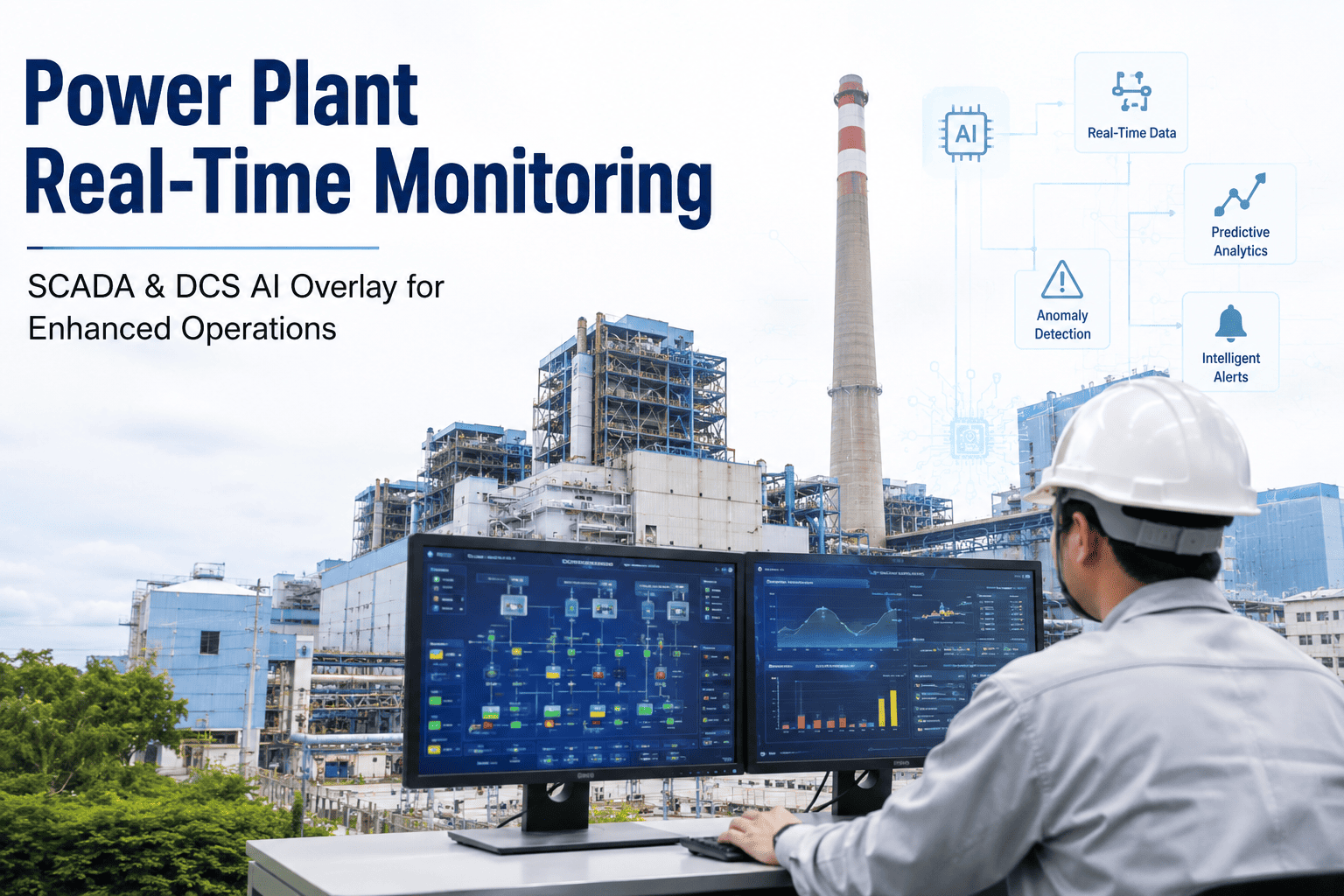
Power Plant Real-Time Monitoring — SCADA & DCS AI Overlay for Enhanced Operations

By Johnson on July 4, 2026

power-plant-real-time-monitoring-scada-dcs-ai-overlay

Ripping out a SCADA or DCS system that has run reliably for fifteen years is rarely a serious option for an Operations Director, and it shouldn't need to be. The control architecture you already have is doing exactly what it was built to do — supervisory control, real-time alarms, setpoint management. What it was never built to do is learn from years of accumulated operating data, predict a failure before a threshold is crossed, or recommend an optimization the control logic itself has no way of suggesting. iFactory AI adds that capability as an overlay, reading data from your existing SCADA and DCS without touching control logic, and layering AI-driven anomaly detection and optimization on top of it — Book a Demo to see the overlay running against your own control system data.

Real-Time Monitoring · SCADA & DCS AI Overlay
Enhance Your SCADA and DCS With an AI Analytics Overlay
Add predictive fault detection, anomaly scoring, and performance optimization on top of the control system you already run — no replacement, no re-architecture.

Why an Overlay Approach Beats a Control System Replacement

SCADA and DCS replacement projects are expensive, disruptive, and slow — full re-architecture efforts routinely run into years of planning, testing, and phased cutover, all while carrying real operational risk during the transition. Most of the value an Operations Director actually wants from a "smart" control system doesn't require replacing the control system at all. It requires reading the data that system is already producing and applying analysis it was never designed to perform: anomaly scoring across correlated tags, failure prediction based on historical patterns, and optimization recommendations grounded in actual plant performance rather than fixed setpoint logic.

An AI overlay sits alongside SCADA and DCS rather than inside them. It reads live and historical tag data through standard interfaces, applies continuously updated models to that data, and surfaces findings back to operators through its own dashboards and alerts — while the underlying control system continues operating exactly as it always has, with zero changes to control logic, setpoints, or interlocks.

Layer 1 — Existing Infrastructure

SCADA & DCS Control Systems

Your current control architecture continues running unchanged — alarms, setpoints, and supervisory control logic remain exactly as configured today.

Layer 2 — AI Overlay

Anomaly Detection & Prediction Engine

iFactory AI reads live and historical tag data from the control system layer and continuously scores deviations, correlations, and failure risk across assets.

Layer 3 — Actionable Output

Alerts & Optimization Recommendations

Operators and engineers receive prioritized alerts and optimization recommendations through a dedicated dashboard, without any changes to the control room's existing screens.

Add AI Intelligence Without Touching Control Logic
iFactory AI overlays anomaly detection and optimization analytics onto your existing SCADA and DCS infrastructure — deployed alongside, never inside, your control system.

What the AI Overlay Actually Monitors

The overlay's value comes from three distinct but connected capabilities, each built on the same underlying data pipeline from your SCADA and DCS systems. Rather than treating these as separate tools, iFactory AI runs them as one continuous analytics layer so a detected anomaly can flow directly into a predictive alert and an optimization recommendation.

The overlay continuously compares live tag values against expected operating ranges that adapt to load, ambient conditions, and process mode — rather than relying on fixed thresholds that generate false alarms during normal transients or miss slow drifts entirely. Cross-tag correlation identifies deviations that only become meaningful when viewed alongside related process variables, catching patterns a single-tag alarm would never surface.

Once an anomaly pattern is confirmed against historical failure data, the overlay generates a predictive alert that identifies the specific asset, the likely failure mode, and an estimated timeframe for action — giving maintenance planners the lead time to schedule intervention during a planned outage window rather than reacting to an unplanned trip.

Beyond fault detection, the overlay analyzes operating patterns to recommend setpoint and scheduling adjustments that improve efficiency or reduce equipment stress, referencing plant-specific historical performance rather than generic vendor benchmarks. Recommendations are presented to operators for review rather than applied automatically to control logic.

SCADA and DCS Platform Compatibility

Control System Common Vendors Overlay Connection Method Control Logic Impact
SCADA GE iFIX, Wonderware, Ignition, Rockwell FactoryTalk OPC UA / native API read connection None — read-only access
DCS Emerson Ovation, Honeywell Experion, ABB Symphony OPC DA/UA gateway or historian-mediated extraction None — read-only access
PLC-Based Systems Rockwell, Siemens, Schneider Electric OPC UA connection via existing SCADA layer None — read-only access
0
Changes required to existing control logic, setpoints, or interlocks
3–6 wks
Typical time to deploy the AI overlay across a facility's core SCADA/DCS tags
20–35%
Reduction in false-alarm fatigue reported after adaptive anomaly scoring replaces fixed thresholds

Frequently Asked Questions

Does the AI overlay require any changes to our SCADA or DCS control logic?
No. The overlay reads data from your SCADA and DCS through standard interfaces such as OPC UA, OPC DA, or a historian-mediated connection, operating strictly as a read-only data consumer. No control logic, setpoints, interlocks, or alarm configurations within the existing control system are modified as part of the overlay deployment. Any optimization recommendations generated by the platform are surfaced to operators for review rather than written back into control logic automatically, keeping the existing control architecture fully intact. Book a Demo to review the exact connection method for your specific SCADA or DCS vendor.
How is adaptive anomaly detection different from the fixed alarm thresholds we already have configured?
Fixed alarm thresholds trigger the same way regardless of load, ambient conditions, or operating mode, which means they either generate frequent false alarms during normal transients or are set loosely enough that they miss slow drift entirely. The AI overlay builds an expected operating range that adjusts based on current conditions, comparing live data against what is actually normal for that specific operating state rather than a single static limit. This typically reduces false-alarm volume while catching deviations that a fixed threshold would not flag until much later.
How long does it take to deploy the overlay across an existing facility?
Deployment across a facility's core SCADA and DCS tags typically takes 3 to 6 weeks, covering connection setup, tag mapping, and an initial calibration period where the overlay's adaptive models learn the facility's normal operating patterns before generating alerts. Facilities with cleaner tag naming conventions and more consistent historical data generally complete calibration faster. Expansion to additional tags or assets after the initial deployment is typically much quicker since the connection architecture is already established. Contact Support for a deployment estimate specific to your tag count and control system landscape.
Will control room operators need to learn a new interface, or does the overlay integrate with our existing SCADA screens?
The overlay operates through its own dashboard and alerting interface rather than modifying existing SCADA or DCS operator screens, since embedding new analytics directly into certified control system displays would require vendor-specific engineering work most facilities want to avoid. Operators and engineers access anomaly alerts, predictive maintenance flags, and optimization recommendations through iFactory AI's separate interface, which most teams find requires minimal training given its focus on prioritized, plain-language findings rather than raw tag data.
What happens if our SCADA or DCS system is later upgraded or replaced?
Because the overlay connects through standard interfaces like OPC UA rather than relying on proprietary integration with a specific control system version, most SCADA and DCS upgrades or vendor migrations require only a reconfiguration of the connection points rather than a full platform redeployment. iFactory AI's tag mapping and historical model training are preserved during this process, since they are built around asset and process context rather than the specific control system generating the data.
Layer AI Intelligence Onto the Control System You Already Trust
iFactory AI overlays predictive fault detection and performance optimization onto your existing SCADA and DCS — read-only, non-disruptive, and deployable in weeks.

Share This Story, Choose Your Platform!