When a steam turbine sits on turning gear overnight, gravity works against a horizontal rotor the moment it stops spinning fast enough to average out its own weight. The upper half of the shaft cools faster than the lower half, the rotor sags into a slight arc, and if it is brought up to speed before that arc straightens back out, the imbalance shows up as vibration that can trip the unit before it ever reaches full load. Plants that treat turning gear operation and eccentricity monitoring as a formality rather than a controlled procedure are the ones that discover rotor bow the hard way, usually during a cold start after an extended outage. Getting the warming and turning sequence right is less about following a fixed timer and more about reading what the rotor itself is telling you through eccentricity, differential expansion, and casing temperature readings before you ever touch the governor. Engineering teams working through startup optimization can Book a Demo to see how iFactory tracks rotor condition through every startup phase.
Why Rotor Bow Is a Startup Problem, Not a Running Problem
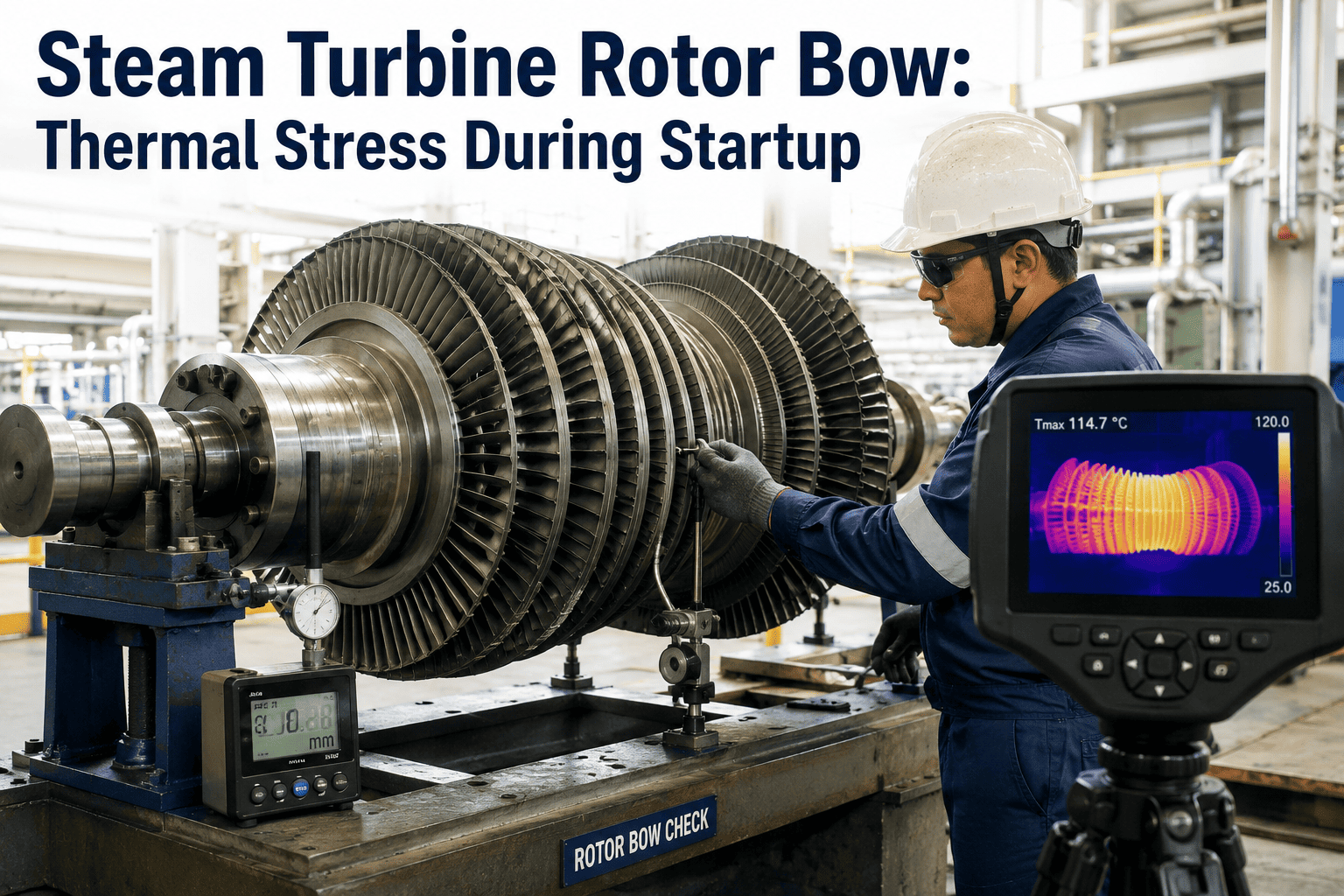
A steam turbine rotor is a long, heavy, horizontal shaft supported at two or more bearing points, and when it stops rotating fast enough to average temperature around its circumference, the top of the shaft loses heat to the surrounding casing air faster than the bottom, which sits closer to trapped steam and radiant heat from the lower casing half. That asymmetric cooling creates a temperature differential across the rotor cross-section, and metal contracts as it cools, so the top of the shaft shrinks slightly more than the bottom. The result is a gentle sag, or bow, that is often invisible to the eye but very visible to a shaft eccentricity probe mounted near the turning gear coupling. The bow is usually temporary and will relax on its own if the rotor is kept turning slowly and evenly, but a rotor accelerated to operating speed while still bowed behaves like an unbalanced shaft, generating vibration that increases with the square of the bow and the square of the speed.
Why Rotor Bow Keeps Catching Startup Teams Off Guard
Rotor bow is well understood in principle, but it remains one of the most common causes of aborted or extended turbine startups because the warning signs are subtle and the consequences only appear once the unit is already accelerating. Most plants have a documented startup procedure, yet the procedure often defaults to fixed time intervals rather than actual rotor condition, which means the same warming schedule gets applied to a two-day outage and a three-week outage even though the rotor's thermal state is completely different in each case.
Fixed-Time Procedures Ignore Actual Rotor State
A checklist that says "turn for six hours" treats every outage the same, but a rotor coming off a short trip retains far more residual heat than one that sat cold for three weeks, and the correct turning duration is not the same for both.
Eccentricity Probes Get Watched Only at Startup
Many plants only glance at the eccentricity reading right before rolling the unit, missing the trend that shows whether bow is actually relaxing or holding steady through the turning gear period.
Differential Expansion Gets Treated as a Separate Alarm
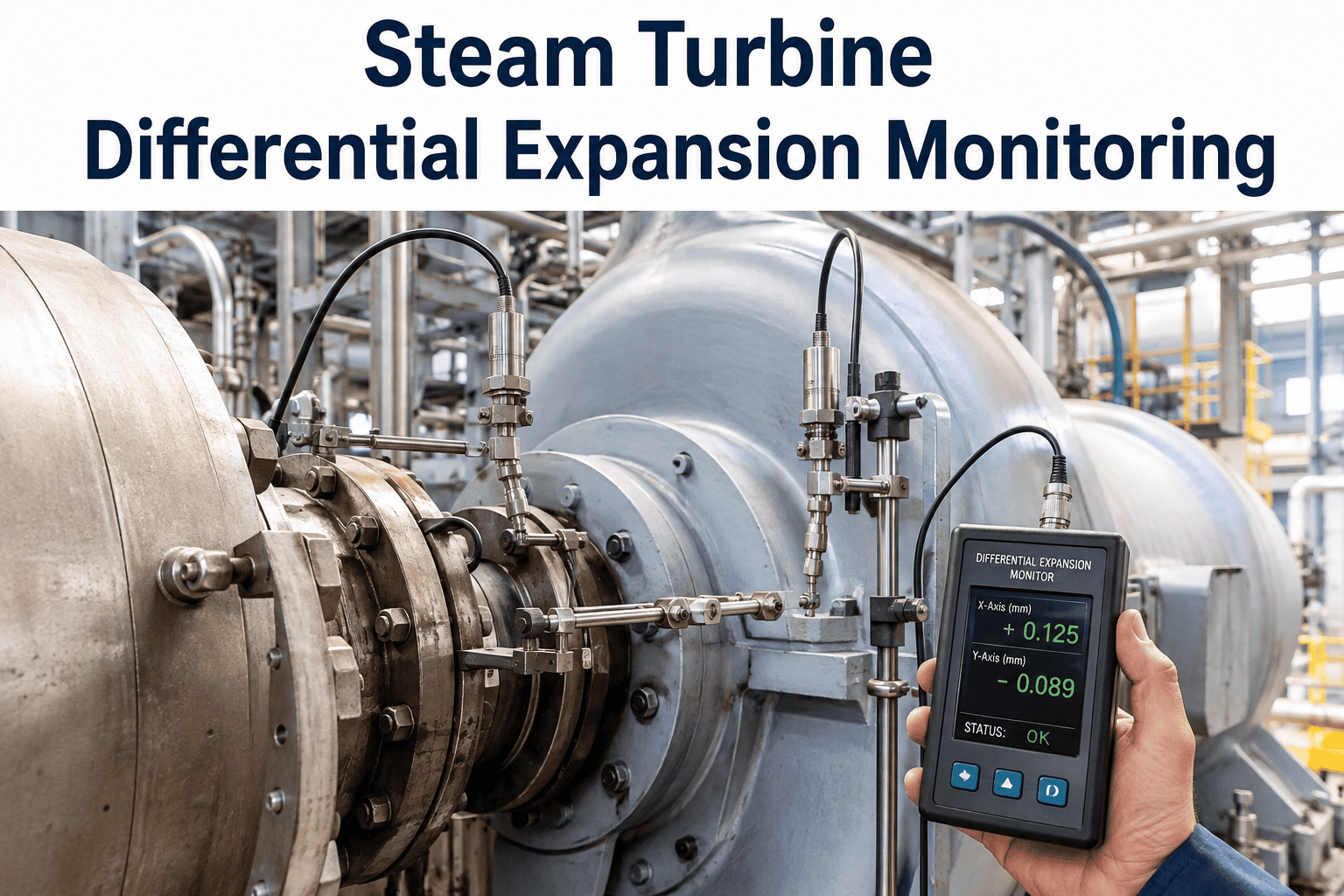
Casing and rotor expand at different rates during warming, and when differential expansion is monitored on a separate panel from eccentricity, operators lose the combined picture that actually predicts a safe roll.
Pressure to Return to Service Compresses the Warming Window
Outage schedules and production commitments create real pressure to shorten turning gear time, and without objective rotor-condition data to push back with, that pressure often wins over the conservative procedure.
Hot, Warm, and Cold Starts: Different Rotors, Different Rules
The correct warming and turning strategy depends heavily on how much heat the rotor retained since the unit was last running, which is why turbine manufacturers classify starts into categories rather than applying one universal procedure. Understanding which category applies, and what changes between them, is the foundation of getting the rotor to operating speed without exceeding thermal stress or vibration limits.
| Start Type | Typical Downtime | Primary Risk | Turning Gear Focus |
|---|---|---|---|
| Hot Start | Under 8 hours | Differential expansion between hot rotor and cooling casing | Short turning period to prevent uneven casing cooling |
| Warm Start | 8 to 48 hours | Moderate bow from partial cooling combined with casing shrink | Extended turning with close eccentricity monitoring before roll |
| Cold Start | Over 48 hours | Maximum thermal gradient across rotor and casing metal | Long, uninterrupted turning gear operation with staged warming |
| Post-Overhaul Start | Days to weeks | Fully cold rotor plus new seal and clearance tolerances | Slowest ramp, with eccentricity baseline re-established before roll |
The Warming Sequence: Five Stages From Barring to Full Speed
A controlled warmup is a sequence, and skipping or rushing any stage is what typically produces a bowed rotor incident. Each stage has a distinct purpose, and the transition between stages should be triggered by measured rotor condition rather than a fixed clock time whenever the instrumentation supports it.
Turning Gear Engagement
The rotor is placed on slow-speed turning gear immediately after the last trip or planned shutdown, before any significant bow can develop, and continuous rotation begins averaging temperature around the shaft circumference.
Eccentricity Baseline and Trend
Shaft eccentricity is logged continuously rather than spot-checked, establishing whether the reading is falling toward normal or holding at an elevated level that signals the rotor needs more turning time.
Casing and Steam Warming
Steam admission valves are opened in controlled steps to warm the casing gradually, keeping the rate of temperature rise within the manufacturer's stress limits and avoiding a mismatch between rotor and casing expansion.
Differential Expansion Check
Rotor and casing expansion are compared against each other, since a mismatch that grows too large can close internal clearances even when eccentricity alone looks acceptable.
Controlled Roll Through Critical Speed
Once eccentricity has returned to the acceptable band and expansion values are within limits, the rotor is accelerated in a controlled ramp, holding briefly below and above critical speed to confirm vibration stays within trip limits.
Temporary Bow vs. Permanent Set: Knowing the Difference Matters
Not every case of elevated eccentricity is the same kind of problem, and treating a permanent bow the same way as a temporary thermal bow can lead to a rotor being rolled when it should not be, or a unit being held out of service longer than necessary. The distinction comes down to whether extended turning gear operation actually resolves the reading.
Temporary Thermal Bow
Caused by uneven cooling after shutdown, this type relaxes steadily on turning gear as the shaft temperature equalizes around its circumference, and eccentricity trends downward toward the normal band over several hours.
Rub-Induced Bow
Contact between the rotor and a stationary seal or packing during a prior trip can locally heat one side of the shaft, producing a bow that behaves like thermal bow initially but may not fully relax without extended low-speed turning.
Permanent Set
If eccentricity plateaus above the normal band and does not continue trending down even after extended turning gear operation, the rotor may have taken a permanent bend and requires inspection before further startup attempts.
Common Mistakes That Turn a Manageable Bow Into a Trip
Rolling on a Fixed Clock Instead of a Trend
Waiting exactly four hours because the procedure says four hours, without checking whether the eccentricity trend has actually flattened out, ignores the one signal that tells you the rotor is ready.
Accelerating Too Fast Through the First Critical Speed
Rushing through the critical speed range to shorten startup time removes the hold period that lets operators confirm vibration is stable before pushing further, which is exactly when a marginal bow turns into a trip.
Restarting Turning Gear After an Unplanned Stop Without Reassessing
If turning gear trips or is manually stopped partway through warming, the bow condition can worsen during the stopped period, and resuming the same countdown without re-checking eccentricity carries the original risk forward.
Not Logging Eccentricity History Across Outages
Without a record of how long each past rotor took to relax after similar outage durations, planners have no baseline to judge whether the current trend is normal or unusually slow.
Case Scenario: A Cold Start That Almost Went Wrong
A combined-cycle plant returning a steam turbine to service after a three-week overhaul followed its standard eight-hour turning gear procedure and prepared to roll on schedule. Continuous eccentricity trending, introduced after a previous bow-related trip at a sister unit, showed the reading was still declining rather than flattening at the eight-hour mark, a pattern the fixed-time procedure alone would not have flagged. The startup team extended turning gear operation by roughly three additional hours, during which eccentricity settled into the normal band and held steady for over an hour before the roll began. The unit reached full speed with vibration levels well inside trip limits, and the delayed roll cost less than the outage time an aborted or tripped startup would have created, along with the risk to rotor and bearing hardware that a high-vibration excursion through critical speed can produce.
Startup Readiness Checklist
Frequently Asked Questions: Steam Turbine Rotor Bow
How long should a rotor stay on turning gear before a cold start?
Turning gear duration for a cold start typically runs eight to sixteen hours depending on rotor size and outage length, but the more reliable indicator is the eccentricity trend itself rather than a fixed number of hours, since two rotors coming off different outage durations can require meaningfully different turning times to reach the same relaxed condition. Plants that log eccentricity continuously through the turning period can extend or shorten the warming window based on what the shaft is actually showing, which reduces both the risk of rolling too early and the cost of turning longer than necessary. Reviewing historical eccentricity curves against outage duration, as described in this rotor bow guide, helps planners set realistic expectations before scheduling the next start.
What eccentricity reading is considered safe to roll?
Acceptable eccentricity thresholds are set by the turbine manufacturer and vary by rotor design and bearing span, but the more important signal is often the trend rather than a single absolute number, since a reading that is still actively declining suggests the rotor needs more time even if it happens to be near the threshold. A reading that has plateaued within the acceptable band and held steady for a defined period is generally a stronger indicator of readiness than a single instantaneous measurement taken at the moment of the roll decision.
Can rotor bow happen on a hot start, not just after a long outage?
Yes, a hot start carries its own version of the risk, though the mechanism is somewhat different — the rotor itself may still be hot and relatively uniform in temperature, but rapid casing cooling or uneven steam admission during a fast restart can create a differential expansion problem that behaves similarly to bow in terms of vibration risk. Hot start procedures typically focus more on differential expansion limits and admission valve sequencing than on extended turning gear time, since the rotor rarely needs hours of turning to relax when it was running only a short time earlier.
What causes a bow that does not relax even after extended turning gear operation?
A bow that fails to trend downward after a reasonable extension of turning gear time may indicate a localized rub occurred during a prior trip, leaving uneven heating that ordinary rotation cannot fully correct, or in less common cases a permanent set in the shaft itself. Either situation warrants pausing the startup sequence and involving a turbine engineer before attempting to roll, since accelerating a rotor with unresolved bow risks bearing damage or a vibration trip that can cause secondary damage.
How does continuous monitoring change rotor bow management compared to manual log sheets?
Manual log sheets capture eccentricity and expansion readings at fixed intervals, often every thirty minutes to an hour, which can miss the exact point where a trend flattens out and delay the roll decision unnecessarily, or worse, miss a reading that is still climbing between check intervals. Continuous monitoring tied into a platform that tracks eccentricity, differential expansion, and casing temperature together gives the startup team a live readiness picture instead of a series of disconnected data points. Teams looking to move from manual startup logs to continuous rotor tracking can contact iFactory Support to see what instrumentation integration is required.