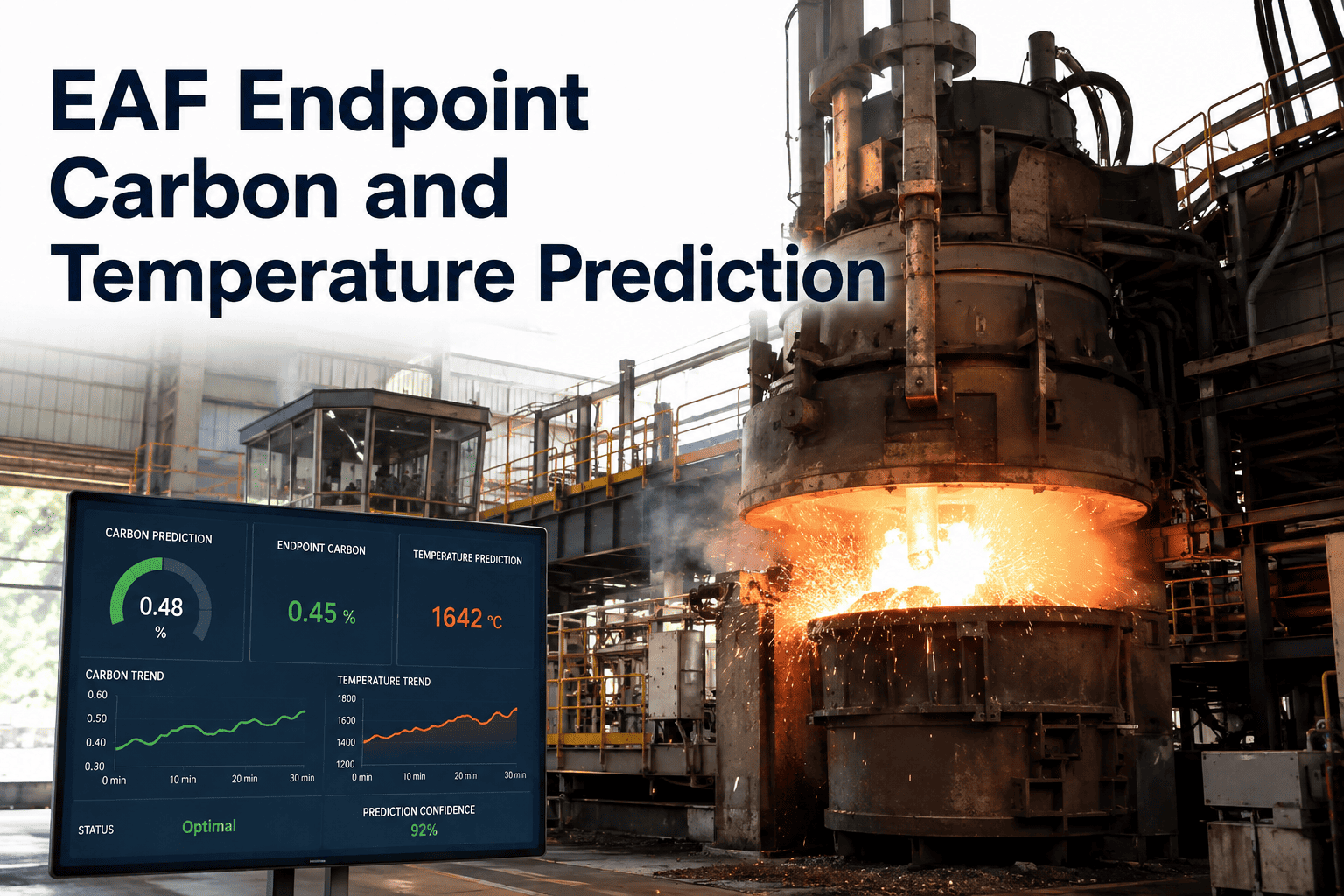
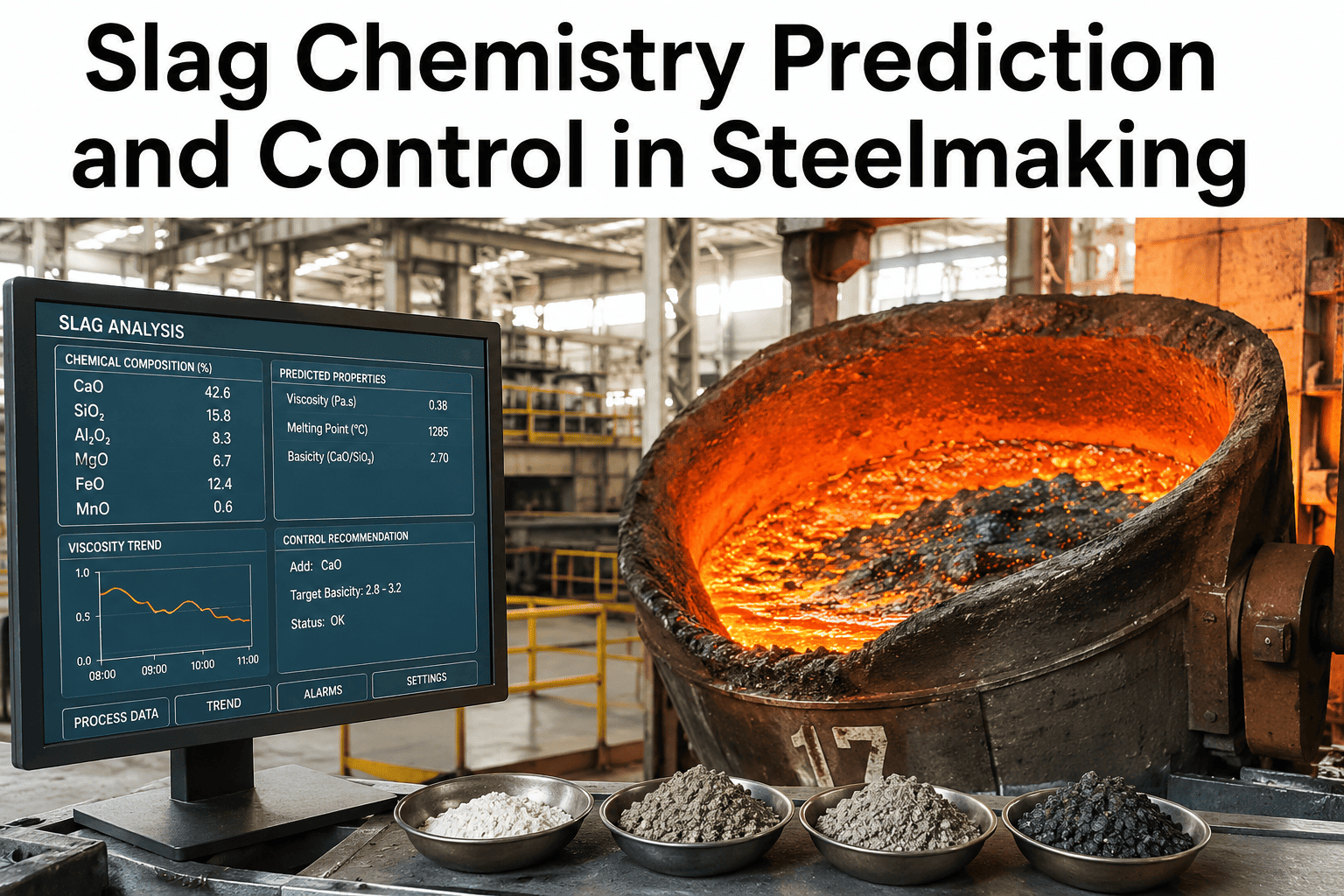
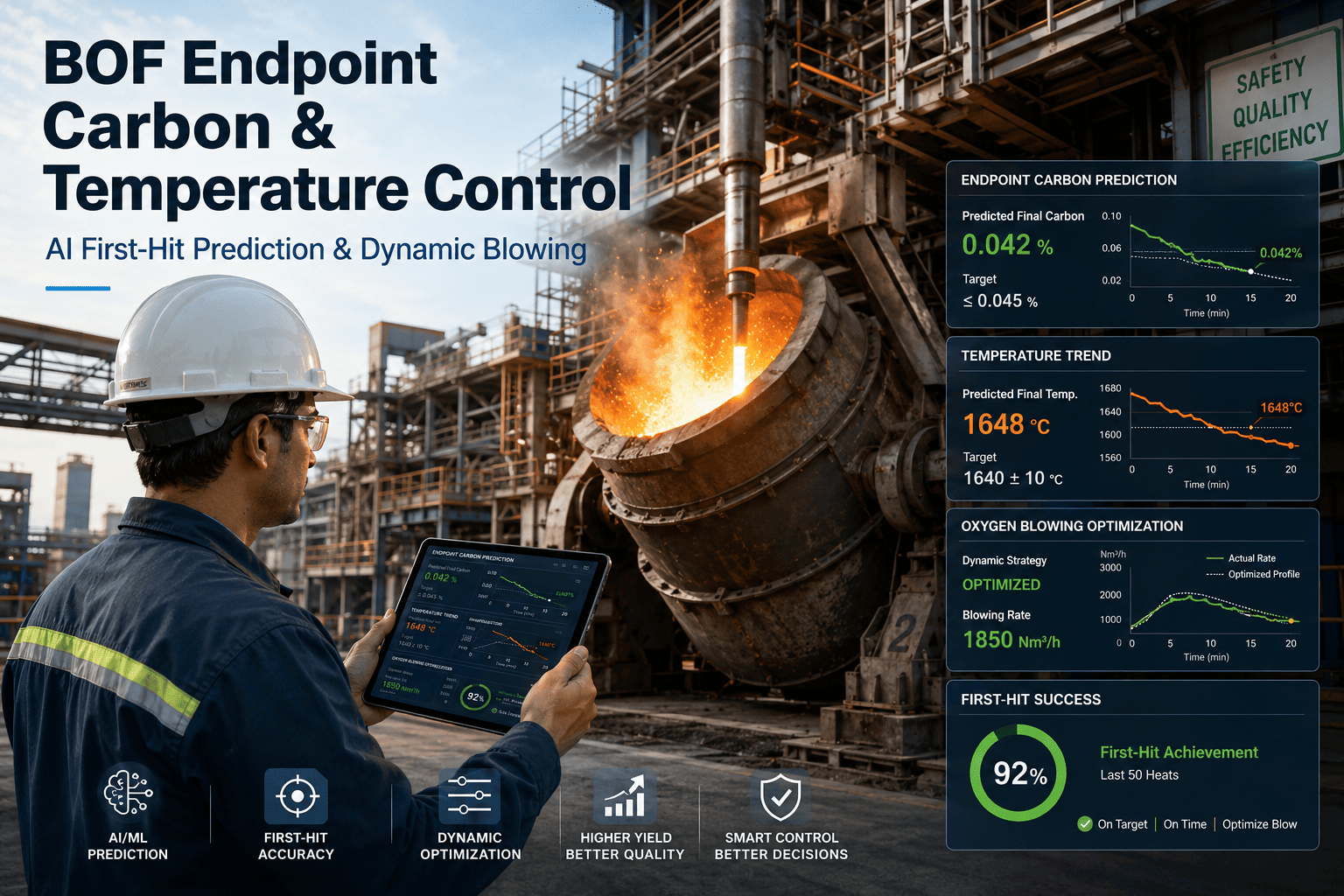
The basic oxygen furnace (BOF) converts molten iron from the blast furnace into steel by injecting high-purity oxygen through a water-cooled lance into the molten bath. The oxygen oxidizes carbon, silicon, manganese, and phosphorus in a 15-to-25-minute blow that generates intense heat and drives the bath temperature from approximately 1,300°C at charge to 1,600 to 1,680°C at tap. The endpoint decision — when to terminate the oxygen blow and tap the furnace — determines whether the heat meets carbon and temperature specifications or requires reblows, flux additions, or downgrading that add $2 to $8 per ton in avoidable cost. Traditional BOF endpoint control relies on sublance measurement during the final 2 to 3 minutes of the blow, operator experience interpreting flame characteristics and sound patterns and static charge models that calculate oxygen and coolant requirements before the blow begins. These methods leave the BOF operator making the endpoint decision with incomplete information about the current state of the bath — a gap that AI closes by predicting carbon content and temperature 1 to 3 minutes before the end of the blow from lance vibration, offgas analysis, and acoustic signature, enabling dynamic blow control that hits carbon and temperature targets on the first attempt. Book a Demo to discuss AI endpoint prediction for your BOF shop configuration, furnace size, and steel grade mix.
Can Your BOF Operator Predict Endpoint Carbon and Temperature Within ±0.02% C and ±5°C on Every Heat?
iFactory's BOF Endpoint AI predicts carbon content and temperature in real time from lance vibration, offgas analysis, and acoustic data — processed on an on-premise NVIDIA edge server with zero cloud dependency, read-only PLC connectivity, and no modifications to your existing BOF control system.
Why BOF AI Optimization Matters for Steelmaking Profitability in 2026
BOF converters produce 60 to 70% of the world's steel, and the endpoint carbon and temperature accuracy of each heat determines the downstream cost of secondary metallurgy, casting, and final product quality. Every additional reblow costs $500 to $1,500 in oxygen consumption, flux additions, and lost productivity. Every heat that requires temperature correction before tapping adds $200 to $600 in cooling scrap or chemical heating costs. Every heat that must be downgraded because carbon or temperature fell outside the grade specification loses $5 to $20 per ton of margin. A typical 250-ton BOF shop producing 350 heats per day with an 85% endpoint hit rate on carbon and 80% on temperature leaves $1.5 million to $4 million annually in avoidable endpoint correction costs on the table — costs that AI-enabled dynamic blow control eliminates by predicting the endpoint trajectory from data the BOF already generates but does not fully utilize: lance vibration patterns, offgas composition and flow rate, acoustic signatures, and lance cooling water temperature differential.
The Four Limitation Areas of Conventional BOF Endpoint Control
Conventional BOF endpoint control relies on three information sources: sublance measurement in the final 2 to 3 minutes of the blow, operator observation of flame characteristics and sound, and static charge models calculated before the blow begins. Each source has well-documented limitations that together create the endpoint accuracy gap. Understanding these limitations in detail reveals exactly where AI models deliver the greatest improvement to BOF shop performance.
Sublance Sampling Constraints
The sublance measures a single point in the bath during the final 2 to 3 minutes of the blow, providing carbon and temperature data at one instant when the bath is still actively decarburizing. The measurement represents the carbon content at that specific moment, but the decarburization rate in the final minutes of the blow is highly nonlinear — dropping from 0.3 to 0.4% C per minute at medium carbon to 0.05 to 0.10% C per minute as the bath approaches low carbon levels below 0.10% C. A 30-second delay between sublance measurement and blow termination can result in a 0.015 to 0.030% C miss, and sublance maintenance costs, probe replacement expenses, and mechanical reliability issues mean many shops operate with one measurement per heat rather than the multiple measurements that dynamic carbon trajectory tracking would require.
Static Charge Model Limitations
Charge models calculate the required oxygen volume, coolant scrap weight, and flux additions before the blow begins using mass and energy balance equations based on hot metal composition, weight, temperature, scrap quality, and lime purity. These models assume fixed decarburization rates and heat loss coefficients that do not account for real-time process variation during the blow — including changes in lance tip condition, nozzle wear, bath mixing dynamics that shift with scrap melting patterns, and foaming slag behavior that alters heat transfer from the exothermic oxidation zone to the bulk bath. The static model calculates a single oxygen target, but the actual oxygen requirement varies by 3 to 8% per heat due to these unmeasured dynamic factors, forcing operators to rely on sublance measurement and experience to fine-tune the endpoint rather than achieving first-attempt accuracy from the model alone.
Operator Experience Dependency
Flame appearance, sound frequency, and lance vibration feel remain primary endpoint cues for BOF operators at many shops, particularly for the period between 40% and 80% of the blow when sublance data has not yet been collected. Operator experience determines endpoint accuracy more than any other controllable factor, but experience is unevenly distributed across shifts, retirement of senior operators creates knowledge gaps that take 3 to 5 years to rebuild, and human cognitive limits mean that even the most experienced operator cannot process the full multivariate signal set that lance vibration, offgas composition, acoustic signature, and lance cooling water data provide simultaneously — information that AI models process continuously across every heat to detect decarburization regime transitions and endpoint approaching conditions that the human operator cannot perceive.
Offgas Information Underutilization
The BOF offgas stream contains a continuous, rich signal of the decarburization reaction state: CO and CO2 concentrations, offgas flow rate, temperature, and dust loading collectively describe the instantaneous carbon removal rate and the transition between the silica-manganese oxidation, rapid decarburization, and endpoint decarburization phases of the blow. Most BOF shops continuously measure offgas composition with infrared analyzers but use the data only for emissions monitoring and post-heat analysis rather than as a real-time endpoint control input. The offgas decarburization curve contains the information needed to predict the endpoint carbon trajectory 2 to 4 minutes before the sublance measures the bath — information that AI models extract from pattern recognition across thousands of historical heats and apply to real-time control.
Four AI Capabilities That Transform BOF Converter Endpoint Control
iFactory's BOF Endpoint AI platform delivers four integrated capabilities purpose-built for the operating dynamics of BOF steelmaking — covering the full process from lance practice optimization through dynamic blow control to slag management and maintenance prediction. Each capability operates on sensor data from existing BOF instrumentation and operates as an advisory decision-support tool without modifying existing control system logic.
Machine learning models trained on 12 to 24 months of BOF heat data — including sublance carbon measurements, offgas CO/CO2 concentration profiles, lance vibration signatures, acoustic data, and lance cooling water temperature differential — predict the current bath carbon content and the trajectory to endpoint carbon with 5-second update frequency. The model detects the transition from the rapid decarburization phase to the endpoint phase, predicts the remaining oxygen volume required to reach target carbon, and provides the operator with a continuous carbon countdown from 3 minutes before the projected endpoint. Typical prediction accuracy: within 0.01 to 0.02% C of the sublance measurement, validated on the sublance reading that occurs at 2 to 3 minutes before blow end.
The AI model predicts bath temperature trajectory from offgas energy balance data, lance cooling water temperature rise, radiant heat loss models calibrated per furnace, and scrap melting models that account for scrap type, size distribution, and charging sequence. Temperature prediction updates in real time as the blow progresses, providing the operator with a projected endpoint temperature that accounts for the exothermic oxidation reactions occurring at each phase of the blow. When the projected temperature diverges from the target range, the system recommends coolant additions or temperature management adjustments while sufficient blow time remains to implement the correction, rather than requiring a post-blow temperature trim.
Slopping — the violent expulsion of slag and metal from the furnace mouth during the blow — causes yield losses of 0.5 to 2.0% per event, lance damage, hood fouling, and safety hazards. AI slopping prediction models trained on acoustic signatures, lance vibration patterns, offgas flow rate deviations, and lance cooling water temperature spikes detect the precursor conditions 30 to 90 seconds before slopping onset. The model recommends lance position adjustments, oxygen flow rate reductions, or flux additions that prevent the slag overflow event, reducing slopping frequency by 60 to 80% in documented BOF shop deployments.
The AI platform analyzes lance vibration patterns and thermal history to recommend lance position trajectories, oxygen flow rate profiles, and flux addition timing that optimize bath mixing, slag formation, and lining wear distribution. Lance vibration signatures correlate with splashing patterns that affect refractory lining wear in the trunnion area and bottom cone. AI models trained on lining thickness measurements from laser profilometry data recommend lance practice adjustments that reduce localized wear hotspots by 15 to 25% and extend lining campaign life by 8 to 12%, saving $200,000 to $500,000 per campaign in refractory replacement costs at a typical 250-ton furnace.
Conventional BOF Control vs AI-Enabled BOF Endpoint Detection
The performance gap between conventional BOF endpoint control and AI-enabled dynamic blow control is visible across every operating dimension that determines BOF shop profitability. The comparison table below maps twelve critical BOF operating parameters against conventional and AI-enabled approaches, showing the performance improvement that an integrated endpoint prediction platform delivers. Book a Demo to discuss which AI capabilities deliver the highest ROI for your BOF shop configuration, furnace size, and product mix.
| Operating Parameter | Conventional Sublance-Dependent Control | AI-Enabled Dynamic Blow Control | Improvement |
|---|---|---|---|
| Carbon endpoint hit rate (±0.02% C target) | 65–78% first-attempt hit rate; relies on single sublance reading at 2–3 min before tap | 90–95% first-attempt hit rate; continuous carbon trajectory prediction from lance vibration, offgas, and acoustic data | +17 to 27 percentage points; eliminates the blind zone between sublance measurement and blow termination |
| Temperature endpoint hit rate (±10°C target) | 70–80% first-attempt hit rate; static energy balance calculated pre-blow with no mid-blow correction | 88–94% first-attempt hit rate; real-time temperature trajectory from offgas energy balance and lance cooling water data | +14 to 18 percentage points; enables proactive coolant addition before temperature deviation becomes a post-blow correction |
| Reblow rate | 8–15% of heats require oxygen reblow for carbon miss, temperature adjustment, or both | 2–5% reblow rate; dynamic trajectory correction during the blow prevents misses before the endpoint | 60 to 80% reduction in reblow frequency; saves $500–$1,500 per avoided reblow |
| Slopping frequency | 5–12% of heats experience significant slopping events causing yield loss, lance damage, and hood fouling | 2–4% slopping frequency; predictive detection 30–90 seconds before event onset enables preventive lance adjustment | 60 to 80% reduction in slopping events; saves 0.5–2.0% yield per affected heat |
| Lining wear monitoring | Periodic laser profilometry every 200–500 heats; reactive lining repair scheduling | Continuous wear estimation from lance vibration, thermal history, and slag chemistry data; predictive repair scheduling | 15–25% reduction in localized wear hotspot severity; 8–12% extension in lining campaign life |
| Lance practice optimization | Fixed lance position trajectory per steel grade; adjustments based on operator experience and post-heat review | Dynamic lance position control based on real-time decarburization rate, slag foaming index, and bath mixing conditions | Optimized decarburization efficiency across all blow phases; reduced oxygen consumption by 2–4% |
| Offgas data utilization | Used for emissions monitoring and post-heat analysis; not integrated into endpoint control decisions | Continuous CO/CO2 ratio tracking drives carbon trajectory prediction; offgas flow rate monitors decarburization phase transitions | Transforms a compliance monitoring stream into a primary process control input |
| Flux consumption | Static flux additions calculated from hot metal silicon and phosphorus analysis; no mid-blow flux adjustment | Dynamic flux recommendation based on real-time slag foaming index, sulfur pickup rate, and phosphorus partitioning | 3–6% reduction in total flux consumption through optimized slag chemistry management |
| Oxygen consumption | Static oxygen volume calculated from charge model; actual consumption varies 3–8% per heat due to unmeasured factors | Dynamic oxygen flow rate and total volume optimization based on real-time decarburization rate and bath temperature | 2–4% reduction in oxygen consumption per heat; saves $0.15–$0.30 per ton at typical oxygen costs |
| Tap-to-tap time | 35–45 minutes per heat including sublance measurement, post-blow sampling, and temperature correction when required | 30–38 minutes per heat; reduced reblow frequency and temperature corrections shorten average cycle time | 5–8 minute reduction in average tap-to-tap time; 3–5 additional heats per day per furnace |
| Operator workload | High cognitive load during final 3 minutes of each blow; operator must interpret flame, sound, vibration, and sublance data simultaneously | AI provides continuous carbon countdown, temperature projection, and slopping risk score; operator focuses on supervisory decisions and exception handling | Reduced operator cognitive load; standardizes decision quality across shifts with varying experience levels |
| Data integration and traceability | Manual logging of heat parameters, sublance data, and operator adjustments in shift reports and process databases | Automatic capture of all heat parameters at 1-second granularity; AI prediction outputs, operator responses, and heat outcomes stored in searchable database per heat | Complete digital record per heat for quality traceability, grade development analysis, and carbon accounting reporting |
Decision Framework — Selecting the Right AI Deployment Approach for Your BOF Shop
The optimal AI deployment approach for a BOF shop depends on the current instrumentation level, operator experience distribution, steel grade complexity, and organizational readiness for AI-assisted process control. Three deployment approaches span the range from advisory-only endpoint prediction through dynamic blow control to closed-loop lance and oxygen flow optimization. Each approach builds on the previous level's sensor infrastructure and data pipeline, enabling a phased deployment that delivers value at each milestone.
Four Common Pitfalls When Deploying AI for BOF Converter Optimization
Experience across AI deployments in BOF shops of varying sizes, instrumentation levels, and steel grade mixes reveals four recurring pitfalls that separate successful implementations from projects that stall or underdeliver. Recognizing these risks before committing capital to AI deployment is the discipline that differentiates optimization programs that achieve documented ROI from those that remain pilot projects without production impact.
The most common pitfall is deploying AI prediction models on sensor data that does not have sufficient quality, granularity, or coverage to train accurate endpoint predictions. BOF shops that attempt AI deployment using only the existing sublance data and charge model inputs typically achieve carbon prediction accuracy no better than 0.03 to 0.04% C — insufficient to reduce reblow rates. The minimum viable sensor set for effective BOF endpoint AI includes lance vibration accelerometer data sampled at 100 Hz or higher, offgas CO and CO2 analyzers with 1-second response time, lance cooling water temperature differential sensors at the inlet and outlet, and lance position feedback at 10 Hz. Shops that invest in sensor quality before model training consistently achieve carbon prediction accuracy within 0.01 to 0.02% C and temperature within ±5°C.
BOF operators have decades of experience interpreting flame characteristics, sound patterns, and lance vibration through tactile and intuitive knowledge that is difficult to codify but highly effective in their hands. Deploying an AI system that presents predictions without explanation, confidence intervals, or alignment with operator experience creates resistance that undermines adoption. Successful deployments invest in a 4-to-8-week parallel operation phase during which the AI predictions are displayed alongside the operator's normal decision-making process, the operator compares AI recommendations with their own judgment, and the model is refined based on operator feedback. Shops that skip this adoption phase see 40 to 60% of operators continuing to rely entirely on their traditional methods, leaving the AI system unused despite its demonstrated accuracy.
A BOF furnace is not a static process: lance tip erosion changes the oxygen jet profile over a 150 to 300 heat campaign, refractory wear alters furnace volume and thermal mass as the lining ages from new to end-of-campaign, and hot metal chemistry shifts with blast furnace operating conditions and iron ore source changes. AI models trained on data from a new lining and fresh lance tips lose prediction accuracy as these conditions change, with carbon prediction error increasing from 0.015% C at model deployment to 0.035% C after 200 heats without retraining. Deployments that budget for automated model retraining at 50 to 100 heat intervals maintain prediction accuracy within 0.015% C throughout the furnace campaign, while deployments that treat model training as a one-time event see accuracy degradation that erodes operator trust and ROI.
BOF shops that attempt to deploy AI endpoint prediction across all steel grades, furnace sizes, and operating scenarios simultaneously require 18 to 24 months of model training data covering the full product mix and take 6 to 9 months to go live. Shops that scope the initial deployment to a single furnace, a limited grade family (for example, low-carbon grades 0.04 to 0.08% C), and advisory-only predictions typically go live in 10 to 14 weeks, achieve carbon hit rate improvements of 8 to 15 percentage points within the initial scope, and use that validated success to justify expansion across the full product mix and additional furnaces. Starting with the highest-volume, most repeatable grade family and expanding outward from the validated base case is the deployment strategy with the highest probability of sustained production impact and documented ROI.
What a BOF Operations Manager Learned Deploying AI Endpoint Prediction on a 300-Ton Converter
Based on iFactory's deployments across BOF shops at U.S. integrated steel producers operating 200 to 330-ton furnaces with sublances, offgas analyzers, and level 2 process control systems, the following operational outcomes consistently emerge when AI endpoint prediction is deployed with proper sensor infrastructure, operator adoption discipline, and phased deployment planning.
"I have spent twenty-two years in BOF steelmaking operations across three integrated mills in the United States, managing furnaces ranging from 200 to 330 tons with every steel grade from ultralow-carbon automotive sheet through high-carbon tire cord and seamless tube. For the first eighteen of those years, the endpoint control philosophy was essentially the same: calculate the oxygen volume from a static charge model, drop the sublance at 2 minutes before the projected endpoint, and rely on the operator's ability to interpret the sublance reading and adjust accordingly. The sublance was treated as the ground truth, but it measures one point in time during a highly nonlinear decarburization process — the carbon content at the measurement instant tells you where you were, not where you are going in the final 90 seconds of the blow. The AI system changed that fundamentally. The first time I saw the carbon countdown prediction track the real decarburization rate through the transition from the end of rapid decarburization into the endpoint phase, and the operator used the trajectory to adjust the lance height and oxygen flow rate proactively rather than reactively after the sublance reading, I understood that this was not a marginal improvement in sublance interpretation. It was a change from single-point measurement to continuous trajectory control. We reduced our reblow rate from 11% to 3.5% in the first 90 days of advisory deployment on low-carbon grades, and the operators on every shift now request the AI prediction display as their primary endpoint reference rather than the sublance-based estimate."
BOF Converter AI Optimization — Frequently Asked Questions
How does AI predict BOF endpoint carbon and temperature without a sublance measurement?
The AI model does not replace the sublance — it augments sublance data with continuous signals that the sublance cannot provide. The model is trained on historical heat data pairing sublance carbon and temperature measurements with the lance vibration signature, offgas CO and CO2 concentration profile, lance cooling water temperature differential, and acoustic data that were recorded throughout each heat. Once trained, the model predicts the current bath carbon and temperature from the real-time sensor signals at 5-second update intervals, providing a continuous estimate between sublance readings. The model's carbon prediction accuracy (within 0.01 to 0.02% C of the subsequent sublance measurement) enables the operator to make informed control decisions in the 2 to 3 minute window before the sublance measurement is available, and to validate and supplement the sublance data rather than relying on it as the sole endpoint information source.
What sensors and data infrastructure are required for BOF endpoint AI deployment?
The minimum viable sensor set includes a lance vibration accelerometer (mounted on the lance carriage, 100 Hz sampling or higher), offgas CO and CO2 analyzers with 1-second response time, lance cooling water inlet and outlet temperature sensors, and lance position feedback at 10 Hz. Most BOF shops already have offgas analyzers installed for emissions monitoring and lance position feedback from the lance drive system. The additional sensor infrastructure typically includes the lance vibration accelerometer, cooling water temperature sensors, and an acoustic sensor array mounted on the furnace hood. An NVIDIA edge server is deployed on the plant network with all data processing contained on-premise, connecting to existing instrumentation through OPC-UA, Modbus TCP, or analog signal interfaces via read-only data links. No modifications to the BOF level 1 PLC or level 2 process control system are required.
Does the AI platform replace the BOF operator's role in endpoint control?
No. The AI platform operates as a decision-support tool that provides continuous endpoint predictions, trajectory projections, and advisory recommendations to the operator. The operator retains full control over all BOF process parameters — lance position, oxygen flow rate, flux additions, and blow termination — through the existing level 1 and level 2 control interfaces. The AI console displays predictions and recommendations, but no control commands are written back to any control system component. The platform is designed to reduce the cognitive load on the operator by providing real-time data fusion across multiple sensor streams that the human operator cannot process simultaneously, standardizing endpoint information quality across shifts with varying operator experience levels, and enabling the operator to focus on supervisory decisions and exception handling rather than continuous sensor data interpretation.
What is the typical ROI timeline for BOF endpoint AI deployment in a U.S. integrated steel mill?
Documented ROI from comparable BOF endpoint AI deployments shows full platform payback within 5 to 10 months at a typical 250-ton BOF shop producing 350 heats per day across two furnaces. Primary ROI drivers include reblow reduction from 11% to 3.5% that saves $800,000 to $2 million annually in oxygen consumption, flux additions, and lost productivity; slopping reduction of 60 to 80% that saves 0.5 to 1.5% yield per affected heat and reduces lance damage and hood maintenance costs; lining life extension of 8 to 12% that saves $200,000 to $500,000 per campaign in refractory replacement costs; and tap-to-tap time reduction of 5 to 8 minutes that enables 3 to 5 additional heats per day, increasing shop capacity without capital investment in furnace infrastructure. The total platform investment is $180,000 to $320,000 based on sensor infrastructure requirements and deployment approach.
How does AI endpoint prediction handle different steel grades and furnace operating conditions?
The AI model is trained on heat data that spans the full steel grade range produced in the BOF shop, with grade-specific features including target carbon range, target temperature range, flux addition practices, and lance position trajectories. When a new heat begins, the operator selects the steel grade on the AI console, and the model loads the grade-specific prediction parameters. The model also accounts for furnace operating condition changes including lance tip age (measured in heats since last tip replacement), refractory lining age (measured in heats since last reline), hot metal chemistry and temperature variability, and scrap type and quality. The model is automatically retrained at configurable intervals (typically every 50 to 100 heats) to adapt to gradual furnace condition changes. Shops that implement automated retraining maintain prediction accuracy within 0.015% C and ±5°C throughout the lining campaign and across the full product grade mix.
Hit Carbon and Temperature Targets on Every Heat with AI-Powered BOF Endpoint Control
iFactory's BOF Endpoint AI delivers a unified platform — dynamic endpoint carbon prediction, real-time temperature trajectory management, slopping prevention, and lance practice optimization — deployed on a pre-configured NVIDIA edge server with read-only PLC connectivity, no control system modifications required, and a 10 to 16 week deployment timeline. BOF operations managers at U.S. integrated steel mills trust iFactory's on-premise AI platform to reduce reblow rates from 11% to 3.5%, cut slopping frequency by 60 to 80%, and extend lining campaign life by 8 to 12%.
Deploy BOF Endpoint AI with iFactory
BOF operations managers at U.S. integrated steel mills trust iFactory's on-premise AI platform to connect lance vibration, offgas analysis, and acoustic data with real-time carbon and temperature prediction, slopping detection, and lance practice optimization — eliminating the 2-to-3-minute blind zone between sublance measurement and blow termination.