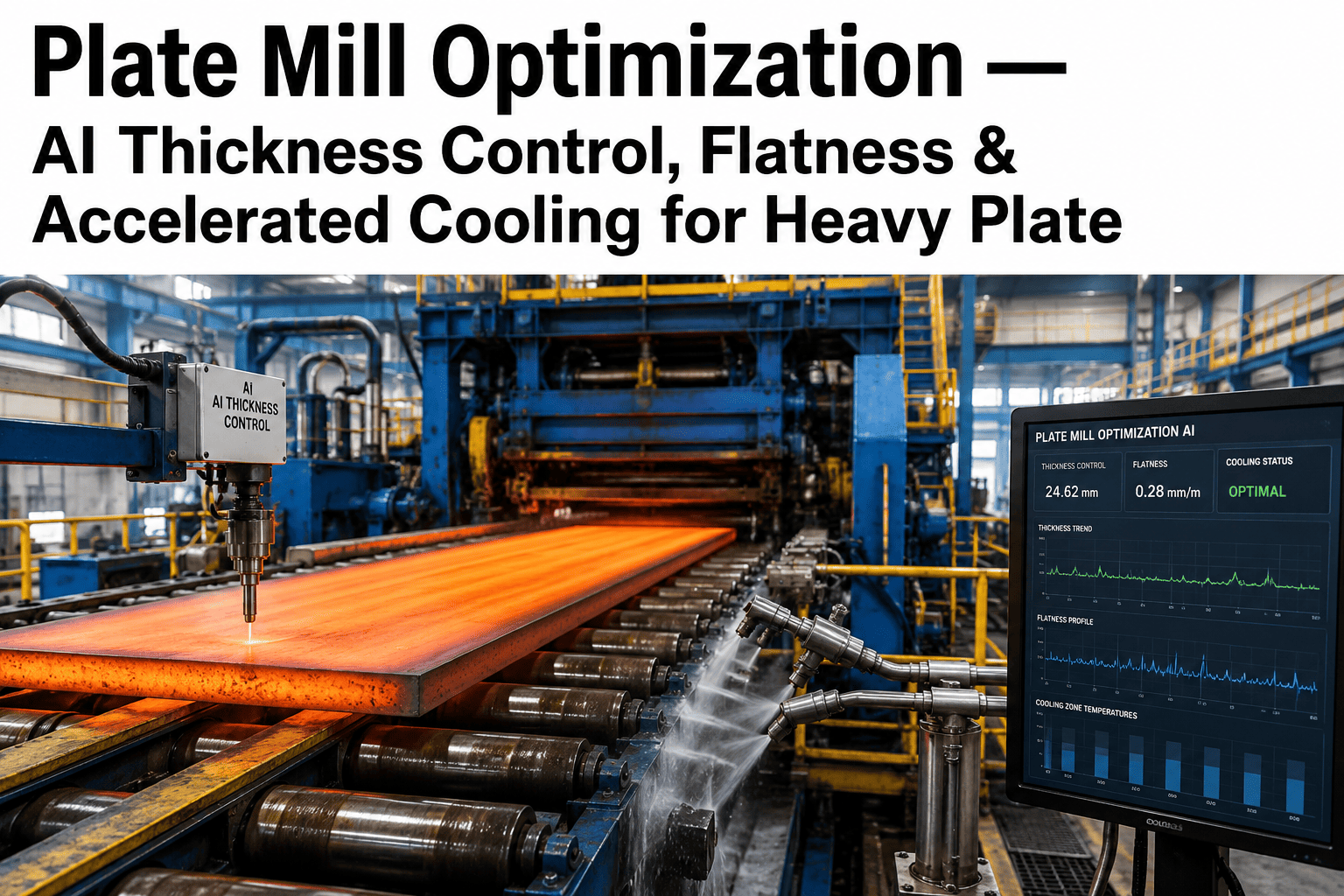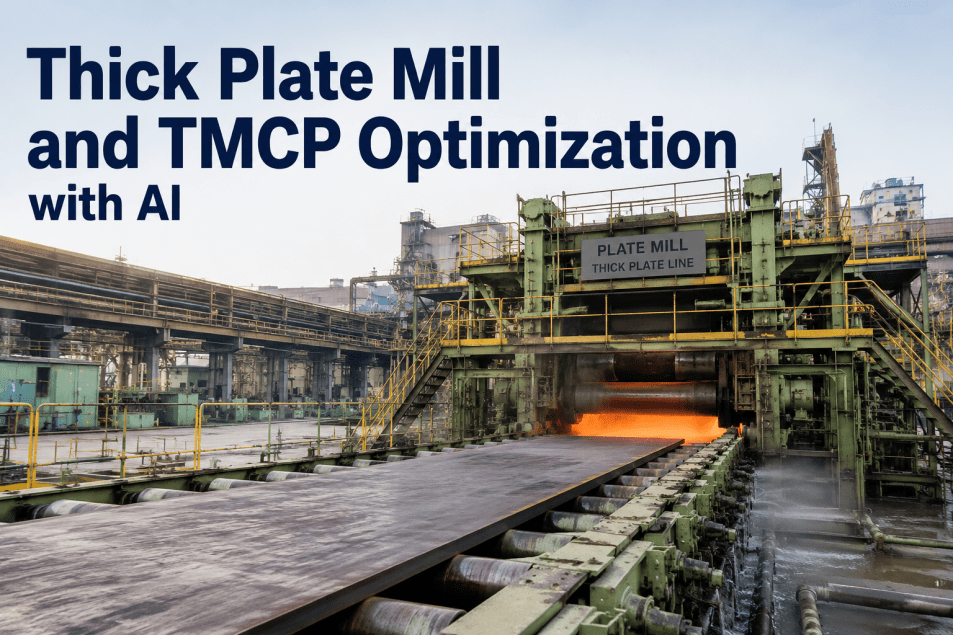
Thick plate mills producing heavy-gauge steel for shipbuilding, wind energy towers, structural construction, and pressure vessel applications face a fundamentally different optimization challenge than their light-gauge counterparts. Every plate — whether 40 mm for offshore wind monopiles or 120 mm for pressure vessel heads — must satisfy tight flatness tolerances, precise mechanical property targets, and demanding surface quality standards that are achieved through a complex interplay of pass schedule design, temperature control, and accelerated cooling strategy. Traditional approaches rely on operator experience and static mathematical models that cannot adapt to the mill's changing condition slab by slab. AI-driven plate mill optimization changes this by ingesting real-time pass data, thermal camera readings, and mechanical property feedback to continuously refine rolling and cooling parameters. For plate mill managers under pressure to increase yield, reduce rework, and meet TMCP certification requirements, the shift from reactive to predictive process control has become a competitive necessity. Book a plate mill assessment to evaluate how AI-driven pass schedule optimization and TMCP control can improve your thick plate production performance.
Thick Plate Mill AI Optimization: Pass Schedule, TMCP, and Cooling Control
A comprehensive technical framework for deploying AI-driven pass schedule optimization, real-time TMCP temperature control, and accelerated cooling analytics to improve yield, flatness, and mechanical property consistency across heavy plate production.
Critical Optimization Challenges in Thick Plate and TMCP Rolling
Thick plate production — typically defined as plates exceeding 25 mm finished thickness — presents a set of metallurgical and mechanical challenges that require continuous process adaptation. The pass schedule must balance reduction per pass against roll force limits and temperature loss, while the TMCP process demands precise control of finish rolling temperature and accelerated cooling rate to achieve target mechanical properties without distortion. AI-driven analytics addresses each of these challenges by learning the mill's specific behavior and recommending adjustments in real time. Schedule a process audit to identify your mill's highest-value optimization opportunities.
Pass Schedule Design for Heavy Plates
Each additional pass above 15 mm thickness requires precise temperature management to maintain deformation energy through the cross-section. iFactory AI recalculates optimal reduction distribution per pass based on actual roll force, torque, and entry temperature — adapting the schedule in real time as conditions change.
TMCP Finish Rolling Temperature
Finish rolling temperature windows for TMCP grades can be as narrow as 30 degrees C. iFactory's thermal model predicts slab core-to-surface temperature differentials and recommends inter-pass delays or reduction adjustments to keep the final passes within the prescribed temperature band.
Accelerated Cooling Uniformity
Non-uniform cooling across plate width and length causes hardness variation and flatness defects. AI models analyze cooling header flow patterns, plate speed, and temperature profiles to adjust zone-specific cooling rates for consistent mechanical properties across every plate.
Plate Flatness & Camber Control
Heavy plates are prone to center buckle, wavy edge, and longitudinal camber from uneven reduction or cooling. iFactory's flatness prediction model correlates each pass's reduction and temperature profile with measured flatness outcomes to recommend corrective roll gap adjustments.
Mechanical Property Prediction
Tensile strength, yield strength, and Charpy impact values depend on cumulative thermomechanical history. AI models trained on historical mill data and lab test results predict as-rolled properties from pass parameters, reducing the need for destructive testing on every plate.
Roll Wear & Crown Management
Thick plate rolling places extreme loads on work rolls, accelerating crown wear that degrades flatness consistency across a campaign. iFactory tracks cumulative rolling load per roll position and predicts when crown deviation will exceed tolerance for the next scheduled product.
AI Impact: Thick Plate Mill Performance Benchmarks
Quantifying the impact of AI-driven pass schedule optimization and TMCP temperature control across the four most critical thick plate production KPIs.
AI-Driven Pass Schedule Optimization for Thick Plate Production
The pass schedule is the single most influential variable in thick plate quality. Each pass — from the initial roughing reductions to the final finishing passes — must deliver sufficient deformation to refine grain structure, maintain temperature within the target window, and produce a flat, dimensionally accurate plate. Conventional pass schedule models use fixed reduction patterns that are calculated offline and adjusted manually when quality deviations are detected. iFactory's AI-driven pass schedule optimization replaces this static approach with a dynamic model that recalculates the optimal reduction distribution for each remaining pass based on the plate's current temperature, force response, and flatness measurement. Rolling managers integrating these models typically book a demo to see how dynamic pass scheduling adapts to their specific mill configuration and product mix.
Adaptive Reduction Distribution
AI analyzes actual rolling force and torque from each pass and compares it against the modeled prediction. Deviations trigger a recalculation of remaining pass reductions — shifting load from overloaded passes to underloaded ones — ensuring total deformation targets are met without exceeding mill mechanical limits.
Temperature-Compensated Speed Control
Roll speed and inter-pass delay are optimized per pass to maintain target temperature trajectory. When entry temperature drops below the modeled value, AI recommends reduced inter-pass time or adjusted reduction to prevent the final passes from falling below the minimum finishing temperature for the grade.
Flatness-Feedback Pass Correction
In-line flatness measurements from the profile gauge or flatness roll are fed back into the pass model. If center buckle or wavy edge is detected, the AI adjusts the roll gap profile or reduction sequence for subsequent passes to correct the developing flatness deviation before the final pass.
Campaign-Learning Optimization
AI models retain learning across roll campaigns, building a knowledge base of optimal pass schedules for each product-grade-thickness combination. When a recurring order is scheduled, the platform retrieves the best-performing pass schedule from previous campaigns and adapts it to current roll condition.
TMCP & Accelerated Cooling Analytics Framework
Thermomechanical Controlled Processing is the most demanding rolling regime in plate production, requiring precise coordination between finish rolling temperature, reduction distribution, and accelerated cooling rate to achieve target mechanical properties without post-rolling heat treatment. iFactory's TMCP analytics module monitors every variable in the TMCP process window and provides real-time guidance to operators and process engineers.
| TMCP Control Parameter | Conventional Approach | AI-Driven Approach | Quality Impact |
|---|---|---|---|
| Finish Rolling Temperature | Manual pyrometer checks per plate | Continuous thermal model with pass-by-pass temperature prediction and correction | 34% fewer temperature excursions outside TMCP window |
| Accumulated Reduction Below Recrystallization | Calculated from offline pass schedule | Real-time recrystallization model updated per pass based on actual temperature and strain | Grain refinement consistency improved by 28% |
| Accelerated Cooling Rate | Fixed cooling header settings per product family | AI adjusts zone-specific flow rates based on plate temperature profile and target cooling curve | Mechanical property variation reduced by 42% |
| Cooling Stop Temperature | Operator judgment based on pyrometer reading | AI predicts temperature evolution and triggers cooling stop at target with 5-degree C accuracy | Eliminates tempering rework from incorrect stop temperature |
| Plate Flatness After Cooling | Inspected at cold leveler entry | Flatness prediction model incorporates cooling pattern and plate geometry to flag high-distortion risk | 58% fewer plates requiring cold leveler correction |
"Our plate mill produces 120 mm thick plates for pressure vessel applications that require Charpy impact values at -50 degrees C. Meeting those specifications under TMCP conditions requires the finish rolling temperature to land within a 25-degree window after 13 passes through the reversing stand. Before iFactory's AI-driven pass optimization, we were hitting that window about 68% of the time — the rest required costly post-rolling heat treatment or were downgraded to structural grades. The AI model reduced the standard deviation of our finish rolling temperature by 62% within 90 days, and our TMCP compliance rate is now 94%. The pass schedule recommendations were initially met with skepticism by our rolling crew, but after the first month of seeing the AI consistently recommend adjustments that improved flatness and reduced camber, the operators became the platform's strongest advocates."
Thick Plate Mill AI Optimization — Frequently Asked Questions
Q: What data infrastructure is required to deploy AI-driven pass schedule optimization?
iFactory requires access to the Level 2 process data historian containing pass-level rolling force, roll gap, speed, and temperature data. Most plate mills already capture this data. Integration is typically completed within 1-2 weeks with no production disruption.
Q: Can the AI model handle the full product mix including TMCP and non-TMCP grades?
Yes. iFactory maintains separate process models for each product family. TMCP grades activate the full temperature control and reduction tracking module, while non-TMCP grades use the base pass optimization model. The platform automatically selects the appropriate model based on the production order.
Q: How does the AI improve accelerated cooling uniformity across the plate width?
The AI analyzes cooling header flow distribution, plate speed profiles, and thermal camera data to identify non-uniform cooling patterns. It then recommends zone-specific header pressure adjustments to balance cooling rate across the plate, reducing hardness variation from edge to center.
Q: Does iFactory integrate with existing Level 2 automation systems?
Yes. iFactory integrates with all major plate mill Level 2 platforms including Siemens, ABB, Primetals, and Danieli automation systems. The platform reads pass data from the existing data historian and writes optimized pass schedule recommendations back to the operator level display.
Q: What is the typical ROI timeline for AI-driven plate mill optimization?
iFactory's plate mill optimization deployments typically reach full ROI within 6-12 months. The primary drivers are yield improvement from reduced crop losses (2-4%), flatness reject reduction (typically 40-60%), and TMCP compliance improvement that eliminates post-rolling heat treatment costs.
Optimize Your Thick Plate Mill Pass Schedule and TMCP Control
Speak with an iFactory plate mill specialist about deploying AI-driven pass schedule optimization, TMCP temperature control, and accelerated cooling analytics across your heavy plate production lines.