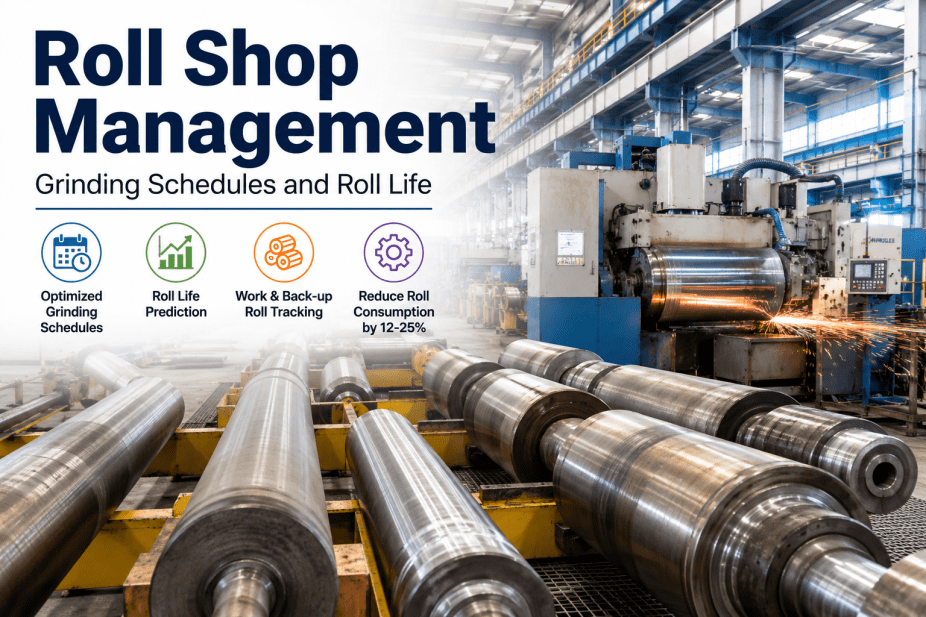
Roll shop operations are the single highest-impact support function in any rolling mill — and the most frequently managed on intuition rather than data. Work rolls and backup rolls across a hot strip mill, plate mill, or section mill represent a capital investment of $8 million to $25 million per roll set, with each grinding cycle consuming 0.15 to 0.50 mm of roll diameter that can never be replaced. The roll shop manager who extends average roll life by 15% without sacrificing surface quality or dimensional conformance has delivered a capital savings equivalent to one full roll set acquisition every 6 to 8 campaigns. The roll shop manager who reduces grinding time per roll by 20% while maintaining surface finish specifications has recovered hours of mill availability per week without a single dollar of equipment spend. Yet most roll shops schedule grinding on fixed intervals, track roll consumption in spreadsheets, and rely on operator judgment to decide when a roll is ready for return to service. iFactory's Roll Life AI platform replaces this judgment-based approach with continuous roll surface analytics, grinding optimization models, and consumption forecasting that extends roll life, reduces grinding cost, and eliminates unplanned roll-related mill downtime. Schedule a roll shop optimization assessment to evaluate how AI-driven roll life prediction and grinding schedule optimization can reduce your roll consumption by 12 to 25 percent.
Why Roll Shop Analytics Is the Highest-ROI Investment in Your Rolling Mill
Roll shop optimization is structurally different from other process improvement programs in a rolling mill because the roll shop is simultaneously a cost center, a quality gate, and a throughput constraint — and its performance influences all three in ways that conventional tracking systems fail to quantify. A work roll returned to service with a surface finish 0.15 microns Ra above specification produces a detectable transfer of surface texture to the strip for the first 12 to 18 coils of the campaign — a surface quality defect that is invisible to the operator at the mill stand but measurable at the customer's receiving inspection. A backup roll ground to an incorrect crown profile induces a flatness deviation across the strip that the AGC and roll bending system cannot fully correct, producing off-flatness coils that are downgraded or rejected at the recoil line. These quality events are attributed to "rolling mill issues" in the quality report, but their root cause is in the roll shop — and the roll shop never receives that feedback because no system connects the roll's last grinding record to the surface quality and flatness measurements from the campaign it served.
iFactory's Roll Life AI closes this feedback loop by maintaining a complete digital record for every roll in the shop — work rolls and backup rolls, top and bottom, operator side and drive side — that links each roll's grinding history, diameter loss trajectory, surface condition, and campaign performance to the downstream quality measurements from every coil or plate it processed. The platform uses this data to predict remaining useful life per roll, optimize grinding schedules based on predicted surface degradation, and recommend the optimal roll change point when the roll's predicted performance for the next scheduled campaign falls below the dimensional or surface quality threshold for the product grade. Book a roll shop analytics demo to see how closed-loop roll tracking transforms your shop's performance.
Roll Categories and AI Monitoring Framework
Different roll types in a rolling mill serve fundamentally different functions and experience fundamentally different wear mechanisms. Work rolls contact the material directly and wear primarily through thermal fatigue, surface texturing, and abrasive wear from scale. Backup rolls support the work rolls and wear through contact fatigue, spalling, and profile degradation from cyclic loading. Each roll type requires a distinct monitoring framework with specific parameters, degradation models, and optimization objectives. iFactory's Roll Life AI maintains separate analytical models for each roll category while integrating their data into a unified roll shop management dashboard.
Work Roll Wear Monitoring and Grind Optimization
Work roll degradation is driven by thermal cycling — each revolution of the roll in contact with the hot strip heats the roll surface by 150 to 300 degrees Celsius, followed by rapid cooling from roll coolant. This thermal cycle induces surface microcracking (firecracking), roll texturing changes, and diameter loss through abrasive wear. The wear rate is not uniform across the roll barrel: the center of the barrel, where strip contact is continuous, wears differently from the edges. iFactory monitors work roll surface roughness evolution, firecrack density trending, and diameter loss per campaign to predict the optimal grinding interval and stock removal required to restore the roll to service-ready condition.
Backup Roll Profile and Contact Fatigue Management
Backup rolls do not contact the strip directly but experience the highest cyclical contact stress of any roll in the mill — the Hertzian contact pressure between the backup roll and work roll barrel can exceed 1,500 MPa, producing subsurface fatigue that ultimately manifests as spalling on the roll surface. Backup roll profile degradation — crown wear, taper development, and surface spalling — has a direct and measurable effect on strip flatness that the AGC and roll bending system can only partially compensate for. iFactory tracks backup roll crown evolution, contact band wear, and surface condition against the cumulative tonnage and product mix processed during each campaign, predicting the optimal re-grind interval and crown restoration profile for the next campaign's product schedule.
Section Mill, Plate Mill, and Specialty Roll Monitoring
Universal mill rolls for beam and section rolling, plate mill work rolls, and specialty rolls for bar and rod finishing blocks experience wear mechanisms that are distinct from hot strip mill work rolls. The pass calibre in a section mill roll wears at different rates across the flange root, flange face, and web contact zones — producing a profile change that shifts the section geometry across the campaign. Plate mill work rolls experience non-uniform thermal expansion from the plate width variation and require crown control that is specific to each product thickness range. iFactory maintains specialized wear models for each roll type category, calibrated against the specific contact geometry, thermal loading, and material grade of the rolling operation.
AI-Driven Grinding Optimization: From Fixed-Interval to Condition-Based Grinding
The standard practice in most roll shops is to grind each roll at a fixed interval — every 50,000 tonnes for work rolls in a hot strip mill, every 500,000 tonnes for backup rolls — with a standard stock removal of 0.20 to 0.35 mm regardless of the roll's actual surface condition. This practice guarantees two forms of waste. Rolls that could have run 60,000 or 70,000 tonnes before requiring re-grinding are taken out of service early, consuming grinding capacity and reducing the available roll inventory. Rolls that ran 50,000 tonnes under conditions that accelerated surface degradation — a run of high-strength grades or a thermal excursion during a mill delay — return to the stand with residual firecracking or surface texture damage that compromises the first 15 to 20 coils of the next campaign. iFactory's grinding optimization model replaces fixed-interval and fixed-stock-removal grinding with condition-based scheduling that predicts the optimal tonnes-at-risk point for each roll based on its actual surface degradation trajectory, not a calendar or tonnage average. Book a grinding optimization review to benchmark your current roll shop practices against AI-optimized benchmarks.
Roll Life and Consumption Benchmarks by Mill Type
Roll consumption varies significantly by mill type, product mix, and roll material specification. The following benchmarks provide a reference framework for evaluating your current roll shop performance against industry baselines and iFactory AI-optimized performance targets. All figures represent annual consumption for a typical operation in each mill category.
| Mill Type | Roll Category | Conventional Annual Consumption | iFactory AI-Optimized | Annual Savings at 5th Year |
|---|---|---|---|---|
| Hot Strip Mill — 3.5M TPY | Work Rolls (18 sets) | 8.2 sets per year — $2.8M annual roll spend | 6.6 sets per year — $2.25M annual roll spend | $550K per year |
| Hot Strip Mill — 3.5M TPY | Backup Rolls (6 sets) | 3.1 sets per year — $1.55M annual roll spend | 2.5 sets per year — $1.25M annual roll spend | $300K per year |
| Plate Mill — 800K TPY | Work Rolls (8 sets) | 4.8 sets per year — $960K annual roll spend | 3.9 sets per year — $780K annual roll spend | $180K per year |
| Section Mill — 500K TPY | Universal Rolls (4 sets) | 5.2 set equivalents per year — $680K annual | 4.1 set equivalents per year — $540K annual | $140K per year |
| Bar & Rod Mill — 600K TPY | Finishing Block Rings | 14 ring sets per year — $420K annual spend | 11 ring sets per year — $330K annual spend | $90K per year |
Roll Inventory, Change Scheduling, and Procurement Optimization
Roll inventory management is a capital optimization problem that most roll shops treat as a supply stocking problem — with predictable results: either too much capital is tied up in spare roll sets that sit unused for months, or too few rolls are available and mill change planners are forced to run campaigns past the optimal change point because the ground roll set is not ready in the shop. The cost of overstocking rolls is the carrying cost of capital — typically 8 to 12 percent of the roll set value per year. The cost of understocking is dimensional and surface quality degradation from overextended campaigns, plus the production loss from mill waiting time when a roll change is delayed because the ground set is not ready. iFactory's roll inventory optimization module balances these competing costs by integrating roll shop grinding schedule, mill campaign plan, and roll procurement lead times into a single inventory optimization model that recommends the optimal roll inventory level and change sequence for each product mix scenario.
- Recommended spare roll set count per roll type based on mill capacity, campaign duration, and grinding cycle time
- Carrying cost reduction from optimized inventory — match spare count to actual consumption rate, not maximum historical usage
- Roll procurement lead time integrated into reorder point calculation — no emergency roll purchases or expedited freight
- Roll retirement forecast enables planned procurement instead of reactive ordering when a roll reaches minimum diameter
- Cross-mill roll pooling optimization for facilities with multiple rolling lines sharing common roll sizes
- Optimal roll change point determined by predicted surface condition at the change point, not fixed tonnage intervals
- Product mix sequencing within each campaign to maximize roll life — soft grades at end of campaign, high-strength early
- Mill delay windows identified for roll changes — a 30-minute delay becomes an opportunity for a 20-minute roll change
- Grinding shop capacity integrated with mill change schedule — no roll change delayed by unavailable ground rolls
- Change planner dashboard shows real-time roll readiness status, next predicted change point, and conflict alerts
Expert Review: What AI Roll Analytics Changes in Roll Shop Operations
I managed roll shop operations at a major integrated steel producer for 14 years, and the single biggest frustration was the absence of data feedback from the mill to the roll shop. We would grind a roll set to specification, deliver it to the mill, and then have no structured information about how that roll set performed on the stand. If a surface quality issue appeared in the first 20 coils of the campaign, we would hear about it informally from the mill supervisor — but we never got the data we needed to connect the grinding parameters to the surface outcome. The result was that we ground every roll identically, regardless of its actual wear history, because we had no data to support a differentiated approach. iFactory's platform solves this by providing exactly that feedback loop: the grinding parameters, roll condition data, and campaign performance are linked per roll ID, and the AI model uses the campaign outcome data to adjust the grinding recommendation for the next cycle. In our first 6 months with the system, we reduced average stock removal from 0.32 mm to 0.18 mm per grind — extending roll life by 28% — while actually improving campaign surface quality consistency because we stopped returning rolls with residual firecracking from insufficient stock removal. The roll shop became a data-driven operation for the first time, and the mill saw the difference within the first two roll campaigns.
Frequently Asked Questions
iFactory requires roll shop grinding records — roll ID, date of grind, diameter before and after grind, stock removal amount, crown measurement, and surface finish measurement — for at least the most recent 6 months of operations. For full campaign feedback integration, the platform additionally requires mill stand data linking each roll set to the campaigns it ran, the product grades processed, and the tonnage per campaign. Most roll shops already capture the required data in their CMMS or a grinding machine data system — the gap is not data availability but data connectivity to the mill's campaign and quality records. Integration is typically completed within 2 weeks.
iFactory maintains separate wear rate models for each roll material type — indefinite chill cast iron, high-chrome iron, high-speed steel, forged steel, and composite roll grades — calibrated against the specific hardness range of each roll. The platform reads the roll material and hardness specification from the roll master data and loads the appropriate wear model parameters for that material grade. As the platform accumulates campaign data for each roll ID, the wear model is progressively refined from the generic material model to a roll-specific wear prediction calibrated to that individual roll's observed performance history.
Yes. iFactory integrates with all major roll grinding machine OEMs — including Waldrich Siegen, Pomini, Herkules, and Naxos-Union — via OPC-UA or direct PLC interface to read grinding parameters and measurement data. The platform also connects to CMMS systems including SAP PM, IBM Maximo, and Infor EAM to synchronize roll master data, grinding work order status, and roll inventory records. The platform operates as a roll shop analytics and recommendation layer alongside existing grinding machine controls and CMMS workflows.
The optimal roll change point is the predicted tonnage at which the roll's surface condition will degrade below the minimum acceptable standard for the product grade scheduled next. iFactory's model considers the roll's current surface condition and diameter, the wear rate trend established in the current campaign, the remaining tonnage in the current product block, and the surface roughness requirement for the next scheduled product grade. The recommendation is recalculated after each coil or plate processed, updating the predicted change point as actual wear data accumulates.
iFactory's roll shop deployments typically reach full cost recovery within 6 to 10 months of deployment. The primary value drivers are roll consumption reduction from optimized grinding (12–25%), grinding time savings from minimal stock removal (18–22%), and reduction in surface quality-related coil downgrades from improved roll surface condition management. An ROI modeling session using your mill's specific roll consumption data, grinding costs, and roll procurement prices is available at no cost.
Conclusion: The Data Your Roll Shop Needs to Become a Profit Center
The gap between a roll shop that manages roll life by spreadsheet intuition and one that extends every roll's service life by 20 percent through data-driven grinding decisions is not a capital gap — it is an analytics gap. The grinding records exist in the machine control system. The campaign tonnage data exists in the mill Level 2 historian. The surface quality measurements exist in the inspection system. These data sources are all generating information that could tell the roll shop exactly when each roll needs to be ground, how much material needs to be removed, and when each roll should be retired — but they are not connected to each other, so the insight never reaches the roll shop manager making the grinding decision today.
iFactory's Roll Life AI platform closes that gap by connecting the roll shop's grinding data with the mill's campaign records and the quality system's surface measurements into a single predictive analytics engine. The result is a roll shop that grinds less material off each roll, extends every roll's service life, reduces unplanned roll changes, and cuts annual roll spend by 12 to 25 percent — with no new grinding equipment required and no disruption to the existing shop workflow. The roll life data is already there. The analytics just needs to be applied to it.