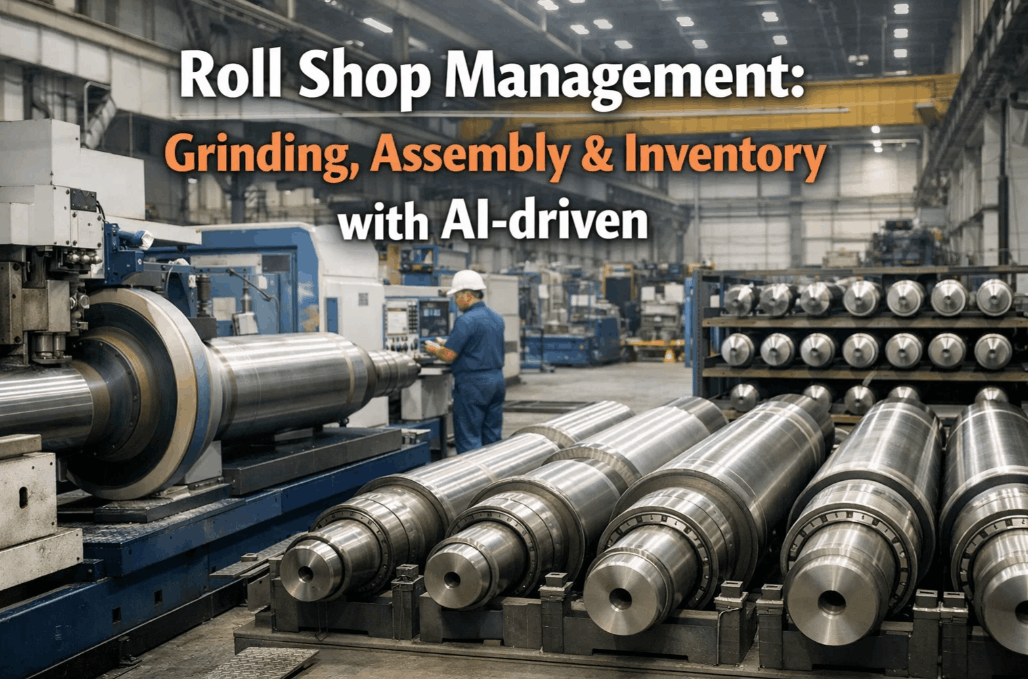
Roll shop management is one of the most underdigitised functions in a rolling mill — yet rolls represent 15–25% of total conversion cost and directly determine product surface quality. Most roll shops still track grinding schedules on whiteboards, manage inventory in spreadsheets, and rely on operator experience to decide when a roll has reached end-of-life. This approach leads to premature scrapping of rolls with remaining life, late grinding that causes surface defects, and stock-outs that force emergency procurement at 2–3x the normal price. A mid-sized hot strip mill consuming 3,000–5,000 work rolls per year spends $4–8M annually on roll procurement alone — and wastes 12–18% of that through suboptimal grinding, poor campaign tracking, and inventory mismanagement. Traditional roll shop tools like Morgan Morgracan, ABB RollView, or custom Excel systems track grinding but cannot predict roll performance degradation, optimise campaign length based on product mix, or integrate with SAP PM for automated work orders. iFactory's Inventory Management and Analytics platform manages the complete roll lifecycle — from receipt to grinding to campaign to scrap — cutting roll consumption 10–18% while improving product surface quality.
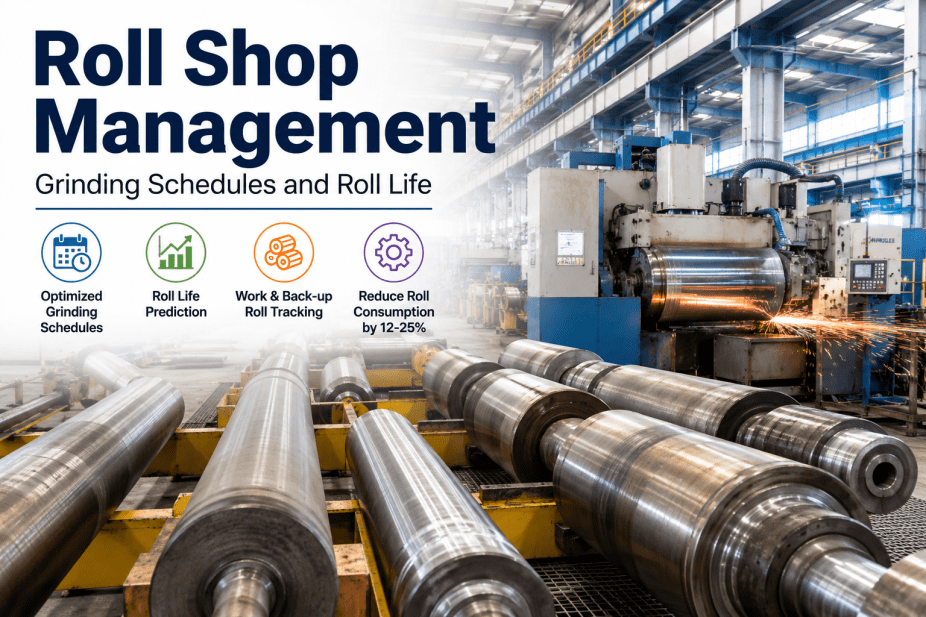
Rolling Mill Roll Shop Management System
Optimise roll grinding, inventory, and campaign tracking — cut roll consumption 10–18% and improve surface quality with iFactory.
Complete Roll Lifecycle — What iFactory Tracks at Every Stage
Every roll passes through a repeating cycle of grinding, campaign, inspection, and re-grinding until it reaches minimum diameter. iFactory tracks performance and wear at every stage — so you know the exact condition of every roll in your shop at all times. See your roll inventory live.
Receipt & Registration
Manufacturer data, hardness, initial diameter, and roll grade recorded in iFactory asset register.
CNC Grinding
Crown profile, roughness, removal depth, and grinding machine ID logged per grind cycle.
Campaign Assignment
Roll matched to stand position based on product mix, tonnage target, and surface requirement.
In-Mill Performance
Tonnage rolled, surface defect feedback, force data, and thermal crown tracked per campaign.
Post-Campaign Inspection
Wear pattern, fire cracks, spalling, and remaining diameter measured and recorded.
Scrap Decision
AI calculates remaining grind cycles from wear history — scrap only when true end-of-life is reached.
iFactory vs Traditional Roll Shop Tools — The Difference
Legacy tools like Morgan Morgracan, ABB RollView, and Excel-based trackers manage grinding schedules but lack predictive analytics, SAP integration, and real-time performance feedback from the mill. iFactory combines all three — grinding management, performance prediction, and maintenance integration — in one platform.
Roll Shop KPIs iFactory Tracks Automatically
Down from 0.51 kg/ton — 18% reduction through optimised campaign length.
Rolls ground and ready before scheduled campaign start — zero delays.
Up from 12.1 — rolls used to true end-of-life instead of early scrap.
Down from 0.31% — roll condition matched to product quality requirements.
iFactory's AI Stack for Roll Shop Excellence
AI Camera Vision
Post-campaign roll surface inspection via AI camera — detecting fire cracks, spalling, and wear patterns that determine whether a roll can be re-ground or must be scrapped. Replaces subjective operator judgment.
AI Digital Twin
Per-roll performance model predicts remaining grind cycles from wear history, tonnage, product mix, and rolling force data — maximising roll life while maintaining surface quality.
PLC Integration
Direct feed from CNC grinding machine PLCs (crown profile, roughness, removal depth) and rolling mill PLCs (force, speed, gap, strip temperature) — building a complete roll performance record automatically.
SAP PM + Procurement
Roll grinding work orders auto-generated from campaign schedule. Inventory reorder triggered at optimal stock level. Roll cost per ton tracked and reported to finance automatically via SAP integration.
What a Roll Shop Manager Said
We were scrapping work rolls with 2–3 grind cycles of remaining life because our old system couldn't predict wear accurately. iFactory's digital twin added an average of 2.7 extra grind cycles per roll — saving us $680,000 in the first year on a roll budget of $5.2M. Surface quality actually improved because rolls are now matched to the right product grade.
Frequently Asked Questions
How does iFactory predict remaining roll life?
AI digital twin uses wear history, tonnage, product mix, rolling force, and surface inspection data to calculate remaining grind cycles per roll. See the prediction in action.
Does iFactory replace our existing grinding machine software?
No — iFactory reads CNC grinding data via PLC integration and adds campaign management, performance prediction, and SAP connectivity on top.
Can iFactory manage backup roll inventory and reorder automatically?
Yes — inventory levels tracked by roll grade, diameter range, and stand position. Reorder triggered automatically when stock reaches the optimal threshold.
What ROI should we expect from roll shop optimisation?
10–18% reduction in roll consumption cost plus 35% fewer surface quality claims. For a $5M/year roll budget, that is $500K–$900K annual savings.
Cut Roll Costs with iFactory
Roll lifecycle management live in 3 weeks.