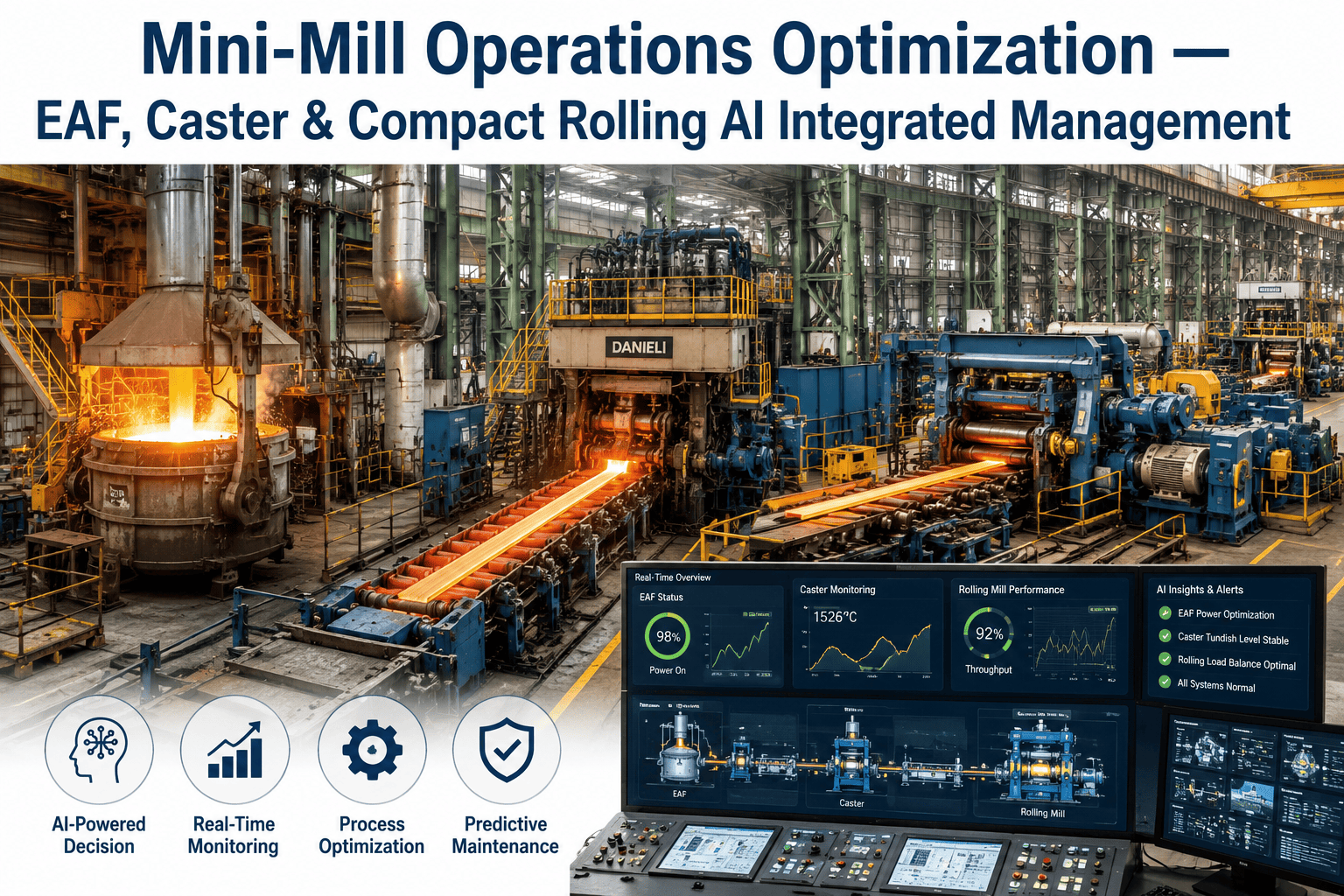
Mini-Mill Operations Optimization — EAF, Caster & Compact Rolling AI Integrated Management
By James Smith on July 27, 2026
The entire economic case for a mini-mill rests on speed — scrap goes into the EAF, liquid steel goes straight to a thin slab caster, and the cast strand goes almost directly into a compact rolling mill, often with minimal reheat. That tight coupling is what makes the mini-mill route efficient, but it also means a problem anywhere in the chain propagates everywhere else immediately: a slow tap on the EAF pushes the caster off its ideal casting speed, and a caster speed change arrives at the rolling mill as a temperature profile the mill wasn't tuned for. Optimizing a mini-mill one unit at a time misses the point of the mini-mill design. AI-integrated management treats EAF, caster, and rolling mill as one coordinated system instead of three separate ones. iFactory's mini-mill optimization platform is built around that integrated view.
iFactory Mini-Mill Integration AI
Run EAF, Caster & Rolling Mill as One Coordinated System
Optimize the mini-mill route end to end with AI that coordinates EAF tap timing, thin slab caster speed, and compact rolling mill scheduling — capturing the efficiency the mini-mill design was built for.
Most mini-mills already run some form of optimization on each unit individually — an EAF power model, a caster speed controller, a mill pass schedule. The problem is that optimizing each in isolation can actually work against the other two: an EAF model tuned purely for tap-to-tap time can produce liquid steel timing that forces the caster into a speed change it wasn't ready for, and a caster speed change shows up at the mill as a strand temperature the rolling schedule didn't anticipate. The diagram below shows the loop these three units actually form.
The Mini-Mill Loop — Where Coordination Matters
A change at any one unit reaches the other two — coordination has to work the same way.
What Coordinated Optimization Actually Controls
AI-integrated management works by giving each unit visibility into what the others are doing and about to do, then adjusting recommendations so the whole chain stays synchronized rather than each unit chasing its own local optimum.
EAF Tap Timing
Tap-to-tap scheduling accounts for caster readiness, not just furnace power efficiency in isolation.
Caster Speed Optimization
Casting speed is set with the downstream rolling mill's ideal entry temperature in mind, not purely for caster throughput.
Rolling Mill Scheduling
Pass schedule adapts to the actual strand temperature profile arriving from the caster, instead of assuming a fixed nominal input.
Thermal Continuity
Temperature is tracked continuously from tap to finished coil, flagging where heat loss is eroding the mini-mill's energy advantage.
Want to see this modeled against your own tap-to-coil timeline? Book a 30-minute walkthrough with our mini-mill team.
The Efficiency the Mini-Mill Route Was Built For
The compact footprint and near-direct casting-to-rolling connection of the mini-mill route exist specifically to save the energy and time that a conventional integrated route spends reheating and transporting semi-finished steel. Every degree of temperature lost to poor coordination between EAF, caster, and mill erodes that advantage, which is why thermal continuity across the three units is treated as a first-class metric rather than an afterthought.
From Scrap to Coil — Keeping the Advantage Intact
1
Melt
EAF tap scheduled against real caster readiness, not fixed timing
2
Cast
Thin slab caster speed set with rolling entry temperature in mind
3
Roll
Compact mill schedule adapts to the actual arriving strand profile
4
Coil
Finished coil reflects minimal reheat energy lost across the chain
What Integrated Optimization Delivers
These outcomes reflect what mini-mill operators typically see once the EAF, caster, and rolling mill are being managed as one coordinated system instead of three separately optimized units.
Higher
Thermal efficiency
less reheat energy lost between casting and rolling
Fewer
Caster speed changes
EAF tap timing coordinated with caster readiness
Steadier
Rolling entry temperature
mill schedule adapts instead of reacting to surprises
Higher
Overall throughput
the full chain runs closer to its coordinated capacity
See what coordinated scheduling could do for your own mini-mill. Talk to our operations team about your production data.
Frequently Asked Questions
We already run separate optimization tools on our EAF and caster — do we need to replace them?
Not necessarily. The integration layer is typically designed to sit alongside existing unit-level optimization tools, taking their outputs and recommendations as inputs while adding the cross-unit coordination that a single-unit tool cannot provide on its own. In most cases this means your existing EAF and caster models keep running, with the coordination layer adjusting their targets so the three units stay synchronized rather than replacing the tools you already have in place.
How does coordinating EAF tap timing with the caster actually reduce downtime?
When an EAF taps before the caster is genuinely ready, the caster either has to hold liquid steel in a way that costs temperature or force a speed change that disrupts the strand profile heading to the mill, both of which create downstream problems. By scheduling the tap against real-time caster readiness signals instead of a fixed tap-to-tap target, the system reduces the frequency of these forced adjustments, which is where a meaningful share of mini-mill downtime and quality variation actually originates.
Can this help us run a wider mix of grades without losing efficiency?
Yes — grade mix changes are exactly the kind of disruption that benefits most from coordination, since a grade change often means a different target chemistry, casting speed, and rolling schedule all at once. Instead of each unit reacting independently to a grade change, the coordinated system anticipates it across the chain, adjusting EAF, caster, and mill parameters together so the transition costs less time and temperature than it would under separately managed optimization.
What data do you need from our EAF, caster, and mill to set this up?
Typically this starts with process historian data from each unit's existing control system, including EAF power and tap timing data, caster speed and temperature data, and mill pass schedule and entry temperature data. From there, the coordination models are built specifically around your mill's layout and product mix, since the ideal handoff timing and temperature targets vary meaningfully from one mini-mill configuration to another.
Is this only useful for CSP-style thin slab casting, or does it apply to other mini-mill layouts too?
While thin slab casting paired with direct or near-direct rolling is the most common mini-mill configuration this applies to, the underlying coordination approach is not limited to one specific casting technology. Any mini-mill layout where EAF, caster, and rolling mill are tightly coupled with limited reheat between stages benefits from the same principle: treating the three units as one system rather than three independently optimized ones.
Capture the Efficiency the Mini-Mill Was Built For.
See EAF, Caster & Rolling Coordinated as One System
Bring tap timing, casting speed, or mill schedule data from a recent production run. We'll show how AI coordinates the three units to protect thermal efficiency and throughput across your mini-mill.