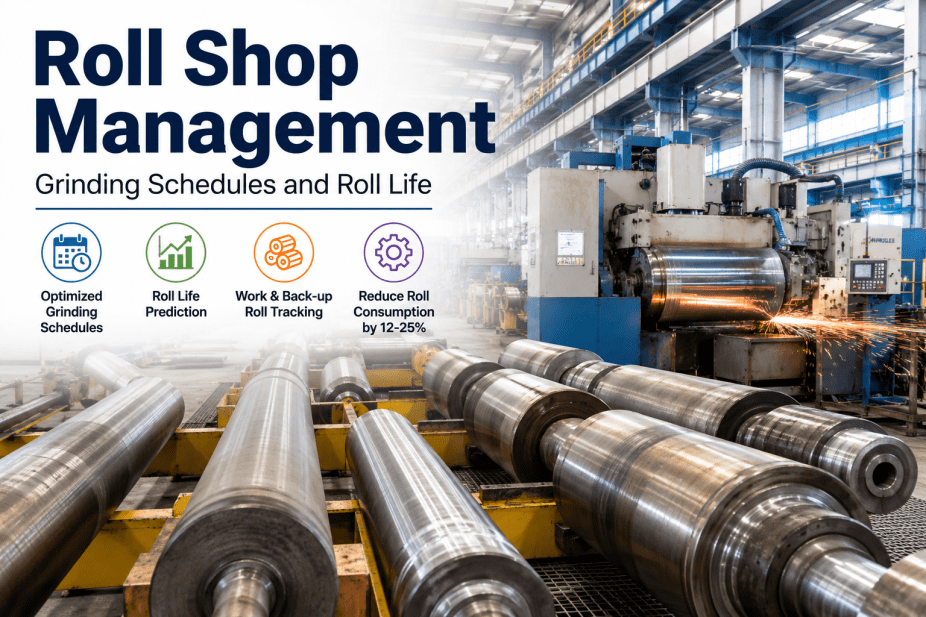
Every rolling mill manager has lived through the same expensive surprise: a work roll starts throwing surface marks mid-campaign, the shift supervisor calls for an emergency swap, and the roll shop has nothing ground and ready because grinding was scheduled around machine idle time instead of mill demand. That single scramble can cost more production than a week of planned changeovers, and it happens for the same root reason almost everywhere it happens — roll shop scheduling is treated as a shop-floor task instead of a mill-availability discipline. Getting it right means matching grinding capacity to campaign consumption before the mill ever asks, and plants that get this right can Book a Demo to see how that matching gets automated.
Why Roll Shop Scheduling Is a Mill Availability Problem, Not a Shop Problem
Most roll shops schedule grinding the way a job shop schedules any queue: first in, first out, worked around whichever grinder is free. That approach makes sense inside the four walls of the shop and fails completely the moment you connect it to what the mill actually needs. A rolling mill does not consume rolls evenly. Campaign length varies by product mix, roll wear accelerates non-linearly toward the end of a run, and the mill's appetite for a freshly ground roll spikes exactly when a changeover is coming — which is precisely when a FIFO grinding queue is least likely to have the right roll ready. The mismatch between shop-paced scheduling and mill-paced consumption is the single largest hidden driver of avoidable roll-related downtime.
The fix is not more grinders or more roll stock, although both help. The fix is scheduling grinding against a forward view of mill campaign consumption instead of against shop queue position. When the roll shop knows which campaigns are running, how many rolls each will consume, and when the next changeover window opens, it can sequence grinding to have the right roll ready before the mill asks — not after. That single shift in planning logic is what separates roll shops that are a bottleneck from roll shops that are invisible, which is exactly the goal: a well-run roll shop is a shop nobody in production ever has to think about.
Campaign Planning: Matching Grind Schedule to Roll Consumption
Campaign planning starts with a simple question the shop rarely gets asked directly: how many rolls will this campaign burn through, and when will each one need to be pulled? Once that consumption curve is known, grinding sequence stops being a guess and becomes a calculation. The four inputs below are what turn a rough campaign schedule into a grinding plan the shop can actually execute against.
The Grind-Ahead Strategy: Building a Buffer Without Overbuilding Inventory
Grind-ahead scheduling means the shop always keeps a small, calculated buffer of ready rolls staged ahead of the mill's actual pull rate — enough to absorb normal variability in campaign length without tying up capital in an oversized roll inventory. The discipline is in the word calculated: an arbitrary buffer either starves the mill during a demand spike or ties up grinding capacity and working capital in rolls that sit idle for weeks. A properly sized grind-ahead buffer is set by three numbers working together — average daily roll consumption, the standard deviation of that consumption, and the grinding lead time required to turn a worn roll back into a ready one.
Plants that get grind-ahead sizing right typically run a rolling three-to-five day buffer on high-consumption roll positions and a smaller buffer on low-turnover positions, recalculated whenever the production schedule shifts significantly. The recalculation step is where most shops fall short — a buffer sized for last quarter's product mix does not protect against this quarter's campaign schedule, and a static buffer quietly becomes either too small or too expensive as mix shifts. Tying buffer sizing to a live schedule feed rather than a quarterly review is what keeps the grind-ahead strategy accurate as conditions change.
Reactive vs. Planned Roll Shop Scheduling: The Operational Difference
The table below lays out what actually changes on the shop floor and in the mill's uptime numbers when scheduling shifts from reactive to campaign-based planning. The differences compound — a shop that starts each week reactive stays reactive, while a shop that starts planned tends to stay ahead of demand because the buffer never fully depletes.
| Operating Dimension | Reactive Scheduling | Campaign-Based Planning |
|---|---|---|
| Grind sequence basis | Shop queue arrival order | Forward campaign consumption |
| Typical roll availability | Frequent last-minute shortages | Buffer staged ahead of demand |
| Emergency grind frequency | Several per week | Rare, exception-driven only |
| Grinder utilization pattern | Uneven, reactive spikes | Smoothed across shop capacity |
| Roll inventory carrying cost | High, uncalculated buffer | Right-sized to actual variability |
| Mill downtime attributable to rolls | Significant and recurring | Minimal and predictable |
Roll Inventory Management: Categorizing What the Shop Actually Holds
Not every roll in inventory carries the same scheduling priority, and treating them identically is a common source of wasted grinding capacity. Segmenting the inventory into clear categories lets the shop apply the right buffer strategy to each rather than a single blanket rule that overserves some positions and underserves others.
Five Mistakes That Quietly Undermine Roll Shop Scheduling
Even shops that have adopted campaign-based planning in principle often lose part of the benefit to a handful of recurring execution mistakes. None of these are dramatic failures on their own, but each one erodes the accuracy of the grind schedule enough that the shop drifts back toward reactive behavior without anyone deciding that it should.
The Business Case: What Roll Availability Actually Costs
Quantifying the cost of poor roll shop scheduling helps make the case for investing time and system support in campaign-based planning, because the numbers involved are usually larger than intuition suggests. Every hour of unplanned mill downtime attributable to roll unavailability carries the full cost of lost production capacity for that hour, plus the disruption cost of restarting the mill and stabilizing quality on the next several coils or bars produced after the restart — a cost that rarely shows up in a simple downtime tally but is very real to anyone who has managed a restart.
Beyond the direct downtime cost, reactive scheduling carries a second, quieter cost in emergency grinding: rolls ground under time pressure are more likely to be pulled before they have reached optimal wear, wasting usable roll life, or ground with less attention to surface finish quality than a properly sequenced grind would receive, creating downstream quality risk. Shops that shift to campaign-based planning typically see both costs fall together, because the same discipline that prevents the emergency also prevents the rushed grind that emergency would have required. Building the visibility to catch demand shifts early — before they become emergencies — is where the return on scheduling investment concentrates most heavily.