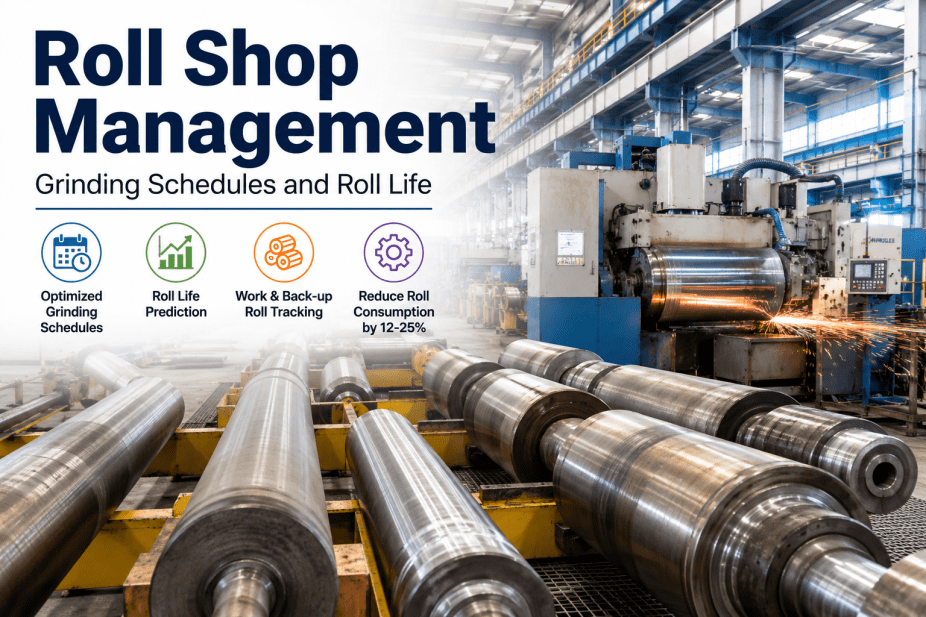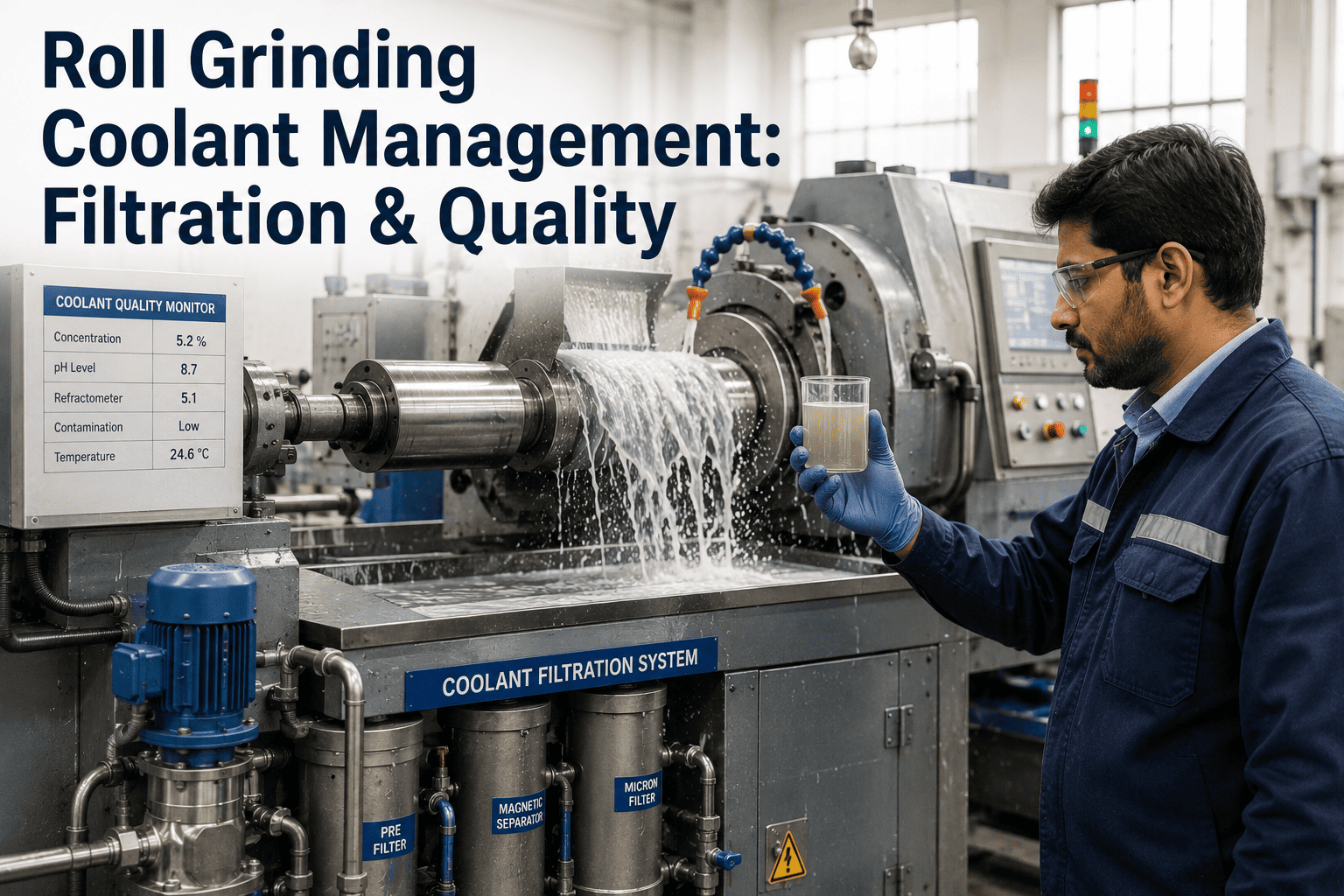
Roll grinding is only as precise as the coolant flowing across the wheel-to-roll interface, and most grinding shops discover this the hard way — through chatter marks, thermal cracking, or a roll that fails surface finish inspection after a full shift of otherwise perfect setup work. Coolant quality is not a housekeeping task bolted onto grinding; it is a process variable with the same weight as wheel speed, infeed rate, and dress frequency, and it degrades continuously from the moment a tank is filled. Grinding shops that treat filtration, concentration, and coolant life as an active control loop rather than a weekly top-off routine consistently post fewer roll rejects and longer wheel life, and teams evaluating their own coolant discipline can start the conversation by reaching out to iFactory's support team for a walkthrough of what a monitored coolant loop looks like on a live grinder.
Coolant Is Not Housekeeping — It Is a Grinding Process Variable
Filtration quality, concentration control, and coolant life extension decide whether a roll comes off the grinder within tolerance or goes back for rework. iFactory turns the coolant loop into a monitored, correctable system instead of a maintenance afterthought.
Why Coolant Quality Decides Roll Grinding Outcomes
A grinding wheel removes metal by abrasion and friction, and every pass generates heat that has to leave the workpiece before it changes the roll's metallurgy. Coolant does three jobs at once — lubricating the wheel-workpiece interface, flushing swarf out of the cutting zone, and carrying heat away fast enough to prevent grinding burn. When any one of those three functions is compromised by dirty, under-concentrated, or contaminated coolant, the roll surface pays the price in the form of chatter, burn marks, or dimensional drift across a long roll body.
Lubricity drops first, so friction and heat climb even before anyone notices a problem. The wheel loads faster with swarf, dressing frequency increases, and thermal cracking or burn on the roll surface becomes a matter of time rather than chance.
Foaming increases and coolant fails to penetrate the grinding zone as cleanly, which paradoxically raises the risk of thermal damage even though more concentrate is in the tank. Filters clog faster, sump residue builds up, and coolant cost climbs with no quality benefit.
Filtration Systems Compared for Roll Grinding Service
Roll grinding swarf is fine, abrasive, and produced continuously, which rules out filtration approaches that work fine on lower-precision operations. The four systems below are the ones most roll shops choose between, each with a different balance of cleanliness, cost, and maintenance burden.
Paper Bed / Gravity Settling
Low cost and simple to maintain, but settling alone rarely reaches below 25-40 microns on a continuous-duty roll grinder, leaving enough fine swarf in circulation to score the wheel-workpiece contact zone on precision passes.
Cyclonic Separation
Effective against heavier, denser swarf particles at high flow rates with minimal consumable cost, but cyclonic separators lose efficiency quickly on the very fine particulate that fine-finish roll grinding actually produces.
Magnetic Separation
Excellent for ferrous swarf at very low operating cost, but does nothing for non-ferrous contamination, tramp oil, or the fine abrasive grit shed by the wheel itself, so it is almost always paired with a secondary stage.
Cartridge or Fine Media Filtration
Reaches the 5-10 micron range precision roll grinding needs, at the cost of higher consumable spend and a filter-change schedule that has to be tracked or the system silently reverts to bypass flow.
See Your Coolant Loop as a Live Process Variable
Book a 30-minute walkthrough and see how iFactory tracks concentration, filtration health, and tramp oil trend lines against every roll ground on the line.
The Coolant Circuit, Stage by Stage
Coolant does not sit still between grinds — it moves through a circuit, and quality can degrade at any stage of that loop. Understanding where things go wrong is the first step to building a monitoring plan that catches a problem before it reaches the roll surface.
Central Reservoir
Coolant is mixed and stored here, and this is where concentration is set and where bacterial growth first takes hold if the tank sits idle over a weekend without agitation.
Delivery Pump and Nozzles
Flow rate and nozzle positioning determine whether coolant actually reaches the wheel-workpiece contact zone or simply floods the machine bed while the cutting zone runs dry.
Grinding Zone
Coolant absorbs heat and picks up swarf on contact — this is the moment its cleanliness and concentration are actually put to work, and where a shortfall shows up instantly as burn or chatter.
Return Trough and Skimming
Used coolant drains back carrying swarf and tramp oil, and a skimmer at this stage is what keeps floating tramp oil from re-entering circulation and coating the wheel face.
Filtration Stage
Swarf is pulled out before coolant re-enters the reservoir — the effectiveness of this single stage determines almost everything about surface finish consistency downstream.
Target Ranges Worth Monitoring Continuously
A coolant sample checked once a week tells you almost nothing about what happened to the roll ground on Tuesday at 2am. The table below lists the variables that matter most on a precision roll grinder and the ranges most shops target.
| Variable | Typical Target Range | Check Frequency | Consequence of Drift |
|---|---|---|---|
| Concentration | 3-6% for most semi-synthetic roll grinding fluids | Refractometer check every shift | Chatter, burn, or foaming and filter loading |
| pH | 8.5-9.5 for corrosion protection | Daily strip test or inline probe | Roll surface staining, rancidity, bacterial bloom |
| Tramp Oil | Below visible surface film | Visual check plus weekly skim log | Wheel loading, reduced cooling, odour and bacteria |
| Filtration Cleanliness | 5-10 microns for precision finishing passes | Particle count sampling weekly | Scoring, inconsistent surface finish, wheel wear |
| Bacteria / Fungal Load | Below odour and slime-forming threshold | Dip-slide test biweekly | Coolant rancidity, skin irritation, premature dump |
A Composite Scenario: The Chatter That Was Never the Wheel
A roll shop running a precision finish pass on backup rolls kept seeing intermittent chatter marks that appeared and disappeared without any change to wheel dress cycle, infeed rate, or spindle bearing condition. Three wheel changes and a spindle inspection later, the marks kept returning on the same shift pattern — always on the second half of a run that started with a freshly filled tank.
A coolant audit found the answer: concentration was correct at fill, but the shop's gravity-bed filtration was only reaching roughly 30 microns, well above the 8-micron target the wheel spec called for. As the tank cycled through a shift, fine swarf accumulated faster than the bed could settle it, and by hour four the effective cleanliness had degraded enough to reintroduce abrasive particles into the grinding zone — creating exactly the chatter pattern the team had been chasing in the wheel and spindle. Adding a cartridge stage downstream of the existing bed dropped particle count by roughly 70% and eliminated the shift-pattern chatter within a week.
Choosing a Coolant Chemistry for Roll Grinding Service
Filtration and concentration control only matter as much as the coolant chemistry underneath them, and roll grinding shops generally choose between three broad families, each with different tolerances for the contamination and thermal loads a grinder produces.
Neat Cutting Oils
Excellent lubricity and the least prone to bacterial growth, but heat dissipation is weaker than water-based fluids and mist control becomes a bigger housekeeping concern on high-speed roll grinders running long cycles.
Soluble Oil Emulsions
A balance of lubricity and cooling that suits general roll grinding well, though emulsions are more prone to splitting under high tramp oil loads and need closer concentration monitoring than straight oils.
Semi-Synthetic Fluids
The most common choice for precision roll grinding because they combine strong cooling with reasonable lubricity and better filtration compatibility than full emulsions, at a moderate cost premium.
Full Synthetic Fluids
The best heat dissipation and the longest sump life of the four families, but lubricity can fall short on aggressive stock-removal passes, which is why many shops reserve synthetics for finishing operations specifically.
What Continuous Coolant Monitoring Actually Changes
The economics of coolant management rarely get the attention they deserve, because coolant itself is a modest line item compared to the roll it grinds. That framing misses the real cost: a single rejected backup roll, a burned work roll surface, or a wheel replaced early because of avoidable contamination all cost far more than the coolant that could have prevented them.
Shops that shift from a weekly manual log to continuous or high-frequency monitoring typically describe the change less in terms of coolant cost and more in terms of avoided surprises — fewer unexplained chatter marks, fewer emergency coolant dumps, and a much shorter list of "we don't know why this roll failed inspection" conversations at the end of a shift. The bigger shift is cultural: operators stop treating coolant as a background utility and start treating a concentration or filtration alert with the same urgency as a spindle vibration alarm, because both are now visible on the same dashboard and both carry the same downstream cost when ignored.
Mistakes That Quietly Shorten Coolant Life
Topping Off Without Checking Concentration
Adding water or premix to a tank without a refractometer check lets concentration drift in either direction for weeks, silently degrading lubricity or triggering foaming long before anyone notices a surface finish problem.
Ignoring Tramp Oil Because It "Looks Fine"
A thin tramp oil film is often invisible to a casual glance but still coats the wheel face and insulates the grinding zone from the coolant meant to cool it, cutting effective heat removal well before any visible sheen appears.
Letting Filtration Run Past Its Service Life
Cartridges and media beds lose efficiency gradually, and a filter that is technically still flowing can be delivering coolant well outside the cleanliness target the wheel specification assumes.
Treating Every Grinder's Coolant the Same
A rough-grind operation and a precision finish pass have very different filtration and concentration needs, and a shared tank or a one-size schedule usually shortchanges the finishing operation the most.
Skipping Weekend Agitation on Idle Tanks
A tank left static over a weekend is where bacterial and fungal growth gets a head start, and the resulting odour and rancidity often force an early, unplanned coolant dump on Monday morning.
Logging Coolant Checks on Paper Nobody Reviews
A concentration log that exists only on a clipboard rarely gets trended, which means a slow drift across weeks goes unnoticed until it shows up as a batch of rejected rolls.
Rolling Out a Monitored Coolant Program
Moving from a paper log to a monitored coolant loop does not require ripping out existing tanks or filtration hardware. Most shops phase the change in over a few weeks, starting with the highest-value grinder and expanding once the approach proves out.
Baseline the Current State
Sample concentration, pH, tramp oil, and particle count on the target grinder over a full week to understand how much the existing system already drifts between manual checks before changing anything.
Instrument the Highest-Impact Variable First
Most shops start with concentration and filtration cleanliness since these two variables drive the majority of surface finish issues, adding pH and microbial tracking once the first two are stable.
Set Alert Thresholds Tied to Roll Specification
Thresholds should reflect the tightest tolerance grinder in the fleet rather than a generic industry number, since a threshold too loose for precision finishing defeats the purpose of monitoring at all.
Review Trend Data on a Fixed Cadence
A weekly review of trend lines, not just alert responses, is what catches the slow drifts that never trip a hard threshold but still erode surface finish consistency over a month.
Expand to the Rest of the Grinding Fleet
Once the first grinder shows a measurable drop in rejects or wheel consumption, the same monitoring plan typically rolls out to the remaining grinders within one or two more maintenance cycles.
Is Your Coolant Program Ready for Tighter Control
You check concentration with a refractometer, not by eye
Visual estimation of coolant concentration is unreliable across operators and lighting conditions, and a refractometer reading takes less time than the guesswork it replaces while removing the biggest source of shift-to-shift variation.
You know your actual filtration micron rating, not the nameplate spec
Filtration systems lose efficiency as media loads, and the number on the equipment nameplate describes day-one performance rather than what is actually reaching the grinding zone on a Thursday afternoon three weeks into the filter's service life.
Someone owns the tramp oil skimming schedule
Skimming is easy to defer when the shift is busy, but a tank that goes a week without skimming accumulates a tramp oil load that is disproportionately harder to recover from than one skimmed on schedule.
Coolant data is trended, not just logged
A single reading tells you today's status; a trend line tells you whether the system is drifting toward a problem, and that distinction is what separates a coolant program that prevents rejects from one that only explains them afterward.
Frequently Asked Questions
How often should roll grinding coolant be checked for concentration?
Most precision roll grinding shops check concentration at least once per shift with a refractometer, since usage patterns, evaporation, and top-offs can shift the ratio meaningfully within eight to twelve hours of continuous operation. High-precision finishing operations often check more frequently, sometimes at the start and midpoint of a shift, particularly during seasonal humidity swings that change evaporation rates. Teams that want continuous rather than spot-check visibility can review how iFactory's monitoring approach handles this by contacting support for a walkthrough of the sensor options available.
What filtration micron rating is actually needed for precision roll grinding?
Precision finish passes on backup and work rolls typically need filtration in the 5 to 10 micron range, since particles larger than that reintroduce scoring risk into a surface finish measured in single-digit microinches. Rougher grinding operations can tolerate 25 to 40 microns without meaningful quality impact, which is why matching filtration investment to the actual precision requirement of each grinder avoids both under- and over-spending on filtration hardware.
Why does coolant that tests fine on concentration still cause chatter or burn?
Concentration is only one of several variables that determine grinding performance, and a coolant sample can pass a concentration check while still carrying excess tramp oil, degraded filtration cleanliness, or bacterial contamination that affects lubricity and heat transfer independently of the concentration ratio. A full coolant audit checking pH, tramp oil, particle count, and microbial load alongside concentration is usually what uncovers the actual cause when symptoms persist despite a passing concentration reading.
How much can better filtration actually extend wheel life?
Shops that upgrade from gravity settling or basic cyclonic separation to fine cartridge or media filtration commonly report wheel life extending by a factor of two to four, since the abrasive re-circulating swarf that shortens wheel life and degrades surface finish is exactly what fine filtration is designed to remove. The magnitude of the improvement depends heavily on the baseline filtration quality and the swarf load of the specific roll material being ground. Book a demo to see how coolant condition is tracked alongside wheel life data on lines running iFactory today.
Is it worth monitoring coolant condition continuously instead of on a manual schedule?
Manual spot checks catch a problem only if it happens to be active at the moment of the check, which means slow drifts between checks routinely go unnoticed until they show up as a rejected roll or an unplanned coolant dump. Continuous or high-frequency monitoring turns coolant condition into a trend line rather than a snapshot, which is what allows a shop to catch a filtration or concentration drift while it is still a minor correction rather than a batch of rework.
Turn Your Coolant Loop Into a Controlled Process, Not a Guess
iFactory's platform tracks concentration, filtration health, and tramp oil trends against every roll ground on the line, catching drift before it becomes a rejected roll. Book a walkthrough to see it running on grinders like yours.