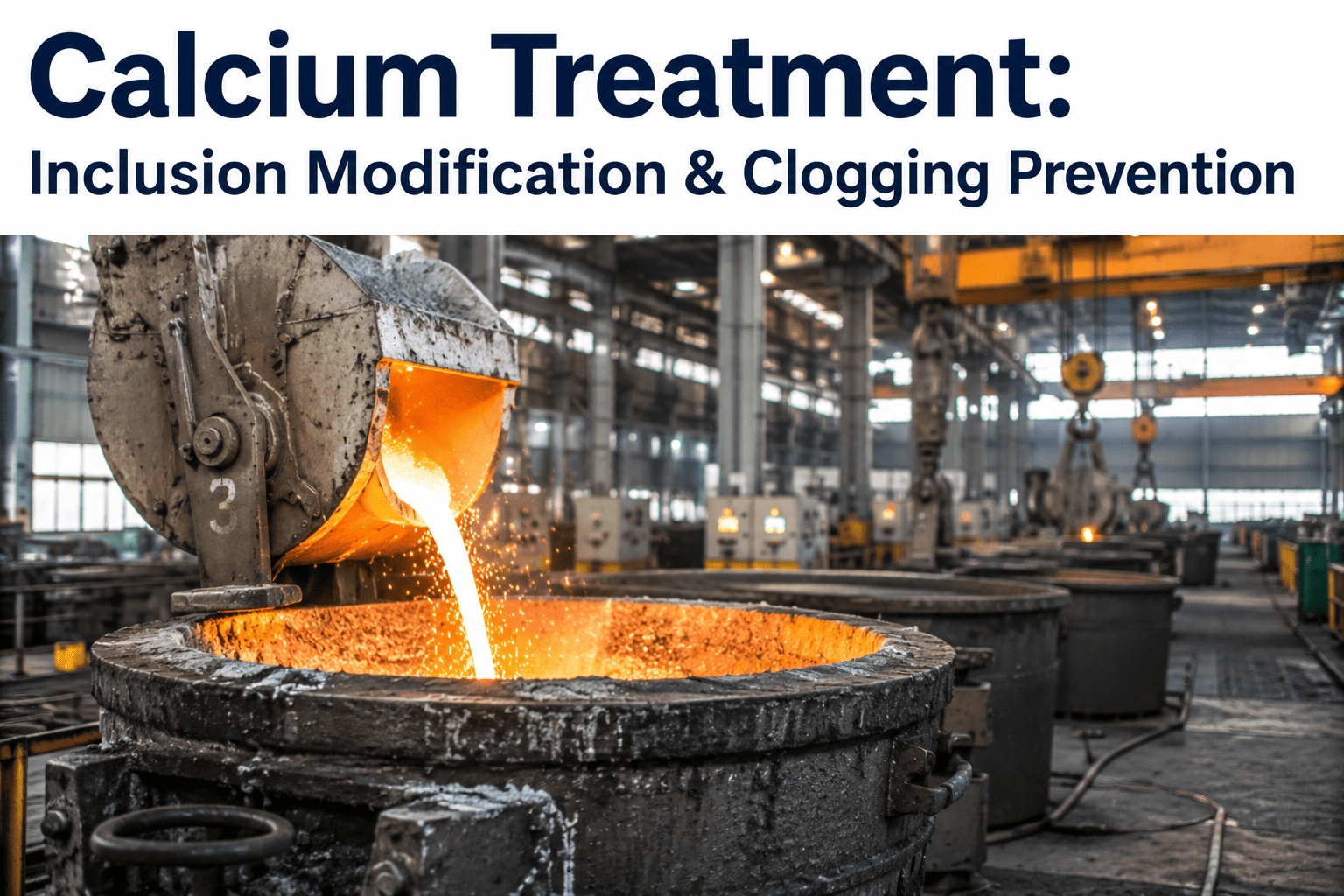
Nothing derails a caster sequence quite like an SEN clogging mid-cast, and more often than not the root cause was set minutes earlier at the calcium treatment station, not at the caster itself. Calcium treatment modifies solid alumina inclusions into liquid calcium aluminates that flow out of the nozzle instead of building up inside it, but getting the injection rate, wire feed timing, and resulting inclusion morphology right takes more than a standard recipe applied to every heat. Reviewing what modification actually happened, heat by heat, is where iFactory's process analytics platform gives clean steel teams a real edge.
SECONDARY METALLURGY · CALCIUM TREATMENT
Calcium Treatment: Inclusion Modification and SEN Clogging Prevention
CaSi wire injection, inclusion shape control, and clogging prevention tracked together to protect caster sequences and deliver consistently clean steel.
What an SEN Clogging Event Actually Costs
Sequence risk
a severe clogging event can force an early caster shutdown, cutting a planned sequence short
Flow variation
restricted flow from partial clogging changes casting speed and can affect surface quality
Alumina origin
solid alumina inclusions are the primary material responsible for nozzle buildup in most grades
Modification window
calcium treatment must reach the right inclusion composition before the heat reaches the caster
How Calcium Treatment Actually Prevents Clogging
01
Solid Alumina Inclusions Form
Deoxidation with aluminum produces solid alumina inclusions that, left untreated, accumulate on the SEN inner wall as steel flows past during casting.
02
CaSi Wire Injection
Calcium silicon wire is fed into the ladle at a controlled rate and depth, delivering calcium into the bath where it reacts with existing alumina inclusions.
03
Inclusion Composition Shifts
Solid alumina converts toward liquid calcium aluminate, changing the inclusion's melting point and physical state at casting temperature.
04
Liquid Inclusions Flow Through the Nozzle
Properly modified inclusions remain liquid at casting temperature, passing through the SEN with the steel flow instead of adhering to the nozzle wall.
Know Whether Your Modification Actually Worked, Before Casting
iFactory tracks wire injection parameters and links them to downstream casting performance, so clogging risk is visible before it becomes a sequence-ending event.
What Controls Calcium Treatment Effectiveness
Calcium Treatment Parameter Reference
| Parameter | Effect on Modification | Common Issue if Wrong |
|---|---|---|
| Wire feed rate | Calcium dissolution and recovery efficiency | Too fast causes calcium loss to vaporization |
| Injection depth | Contact time with bath before surfacing | Shallow injection reduces recovery rate |
| Post-injection stirring time | Inclusion float-out and homogenization | Insufficient time leaves inclusions unmodified |
| Total calcium addition | Degree of alumina-to-aluminate conversion | Under-treatment leaves solid inclusions present |
| Time from treatment to cast | Risk of inclusion reversion before casting | Extended holding can allow reoxidation |
Why Treatment Sometimes Fails to Prevent Clogging
Fixed Addition Rate Regardless of Aluminum Level
A standard calcium addition applied without accounting for actual residual aluminum content can under- or over-treat the heat relative to what the inclusion population actually needs.
Insufficient Post-Injection Stirring
Cutting stirring time short after wire injection leaves calcium unevenly distributed, producing inconsistent modification across the bath.
Extended Hold Time Before Casting
A long gap between treatment and casting increases the chance of reoxidation, which can partially reverse the modification achieved during treatment.
No Feedback Loop From Caster to LF
Without linking clogging events back to the specific heat's treatment parameters, the same under-treatment pattern can repeat undetected across multiple heats.
Building a Feedback Loop for Clean Steel
1Log wire feed rate, depth, and total addition for every treated heat, not just the target values
2Track casting performance and any clogging indication back to the originating heat's treatment data
3Review treatment-to-cast time and flag heats held longer than the normal window
4Adjust addition targets based on measured residual aluminum rather than a single fixed rate
5Build a heat-by-heat record connecting treatment parameters to caster sequence outcomes
Calcium Treatment — Common Questions
How much calcium is typically needed to prevent clogging in an aluminum-killed steel?
The required amount depends heavily on residual aluminum content, total oxygen level, and heat size, which is why a single fixed addition rate applied to every heat often under-treats some and over-treats others. Calibrating addition to actual measured aluminum content produces more consistent modification results than a blanket standard.
How can we confirm calcium treatment actually modified the inclusions before casting?
Total calcium and total oxygen sample results, taken after treatment and adequate stirring time, are the most direct indicators of modification success, alongside historical correlation with clogging outcomes for similar treatment parameters. Waiting to see clogging behavior at the caster is the least useful confirmation method since by then the risk has already materialized.
Does holding a treated heat too long before casting undo the modification?
Extended holding time increases exposure to reoxidation sources such as air ingress at the ladle surface, which can partially convert modified liquid inclusions back toward solid alumina. Minimizing unnecessary hold time and monitoring heats that are delayed is an important part of protecting treatment effectiveness through to casting.
Can treatment parameters really be linked back to a specific clogging event at the caster?
Yes, when treatment data is logged per heat and tied to the same heat identifier used at the caster. iFactory's platform connects that data across the process path, making it possible to identify whether a clogging pattern correlates with a specific treatment parameter rather than treating each event as isolated.
Is calcium treatment necessary for every steel grade, or only specific ones?
Calcium treatment is most critical for aluminum-killed grades prone to alumina inclusion formation, particularly those cast through small-diameter nozzles where clogging risk is highest. Some grades and casting configurations are less sensitive, so treatment practice is typically tailored to the specific grade and caster combination rather than applied uniformly.
SECONDARY METALLURGY · CLEAN STEEL
Protect Your Caster Sequence Before It Starts
See how iFactory connects calcium treatment data to casting performance across your clean steel program.