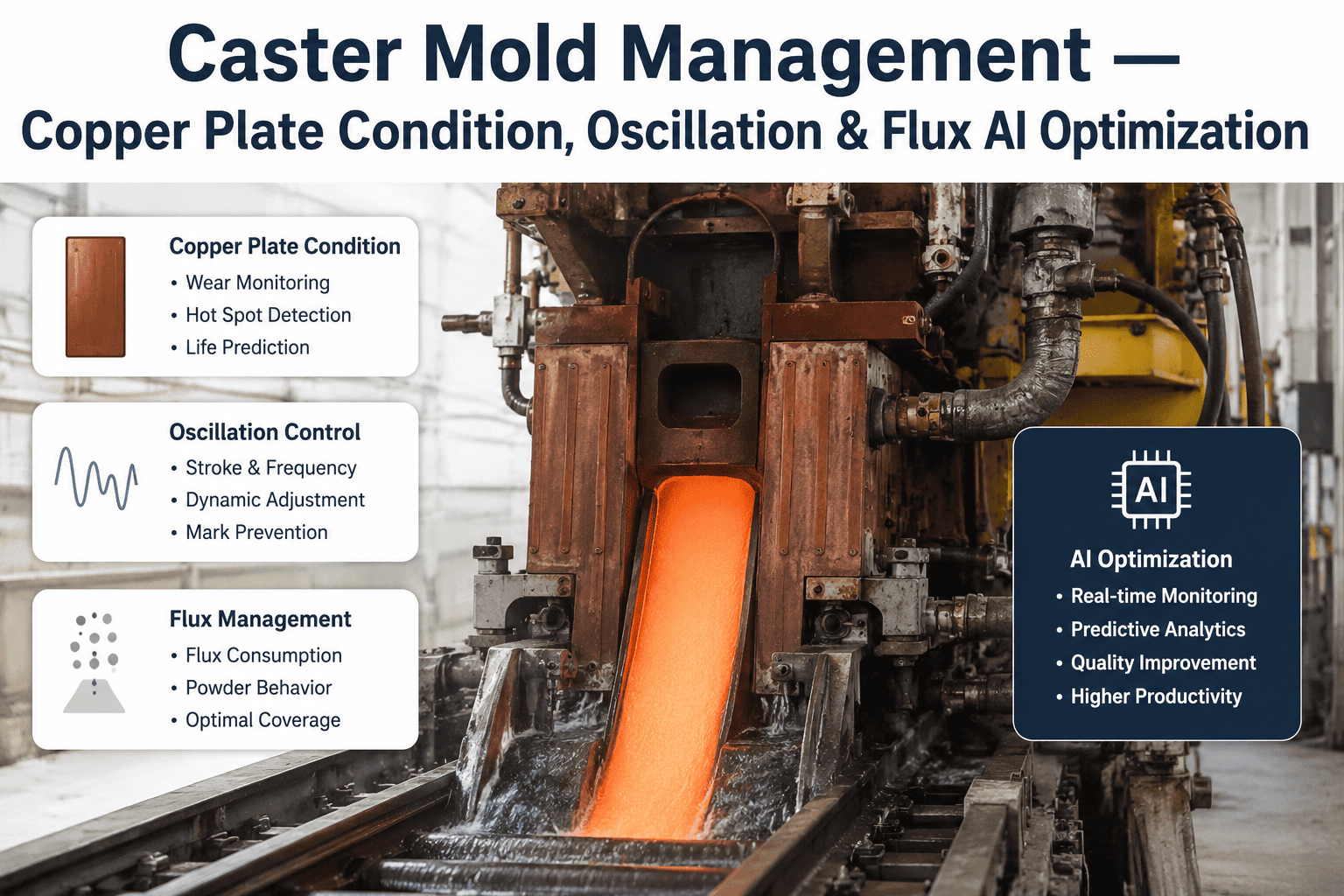
Caster Mold Management — Copper Plate Condition, Oscillation & Flux AI Optimization

By James Smith on July 29, 2026

caster-mold-copper-plate-oscillation-flux-management-ai

A continuous caster mold is a deceptively small piece of equipment carrying an outsized influence on both surface quality and maintenance cost, since copper plate wear, oscillation parameter drift, and flux performance all interact to determine how many casts a mold can safely run before quality risk outweighs the cost of changing it out. Maintenance managers responsible for mold campaign planning typically rely on cast count and periodic visual inspection to schedule mold changes, an approach that either leaves usable mold life on the table through overly conservative changeouts or risks a breakout by running a degrading mold too long. AI-powered mold tracking from iFactory continuously monitors copper plate condition, oscillation behavior, and flux performance to extend safe mold campaigns without increasing breakout risk.

Copper Plate Wear Oscillation Parameters Flux Performance

Caster Mold Management: AI Tracking of Copper Plate Wear, Oscillation, and Flux Performance

iFactory continuously tracks copper plate wear patterns, oscillation frequency and stroke consistency, and mold flux consumption to extend usable mold campaign life while maintaining surface quality and reducing mold-related breakout risk.

10-20% Typical mold campaign extension achievable through data-driven wear tracking
$50K-$150K Typical cost of a premature mold changeout including downtime and copper plate replacement
Every Cast Frequency at which mold condition should ideally be reassessed but rarely is manually

Mold Lifecycle Stages: What the Data Shows at Each Point

A mold's condition changes measurably across its campaign, and each stage carries a different risk profile that a maintenance manager can plan around if the data is available continuously rather than only at scheduled inspection points. Understanding where a specific mold sits in its lifecycle, rather than relying purely on cast count, is what allows campaigns to be extended safely on molds performing well and shortened proactively on molds showing early wear.

Early Campaign
Stable Heat Transfer and Oscillation
Copper plate thickness and thermal conductivity at their strongest, with oscillation parameters holding tightly to design specification across every stroke.
Mid Campaign
Gradual Wear Pattern Development
Copper plate wear begins concentrating at the meniscus zone, with heat flux distribution starting to shift measurably from the fresh-mold baseline.
Late Campaign
Localized Wear and Flux Sensitivity
Wear at high-stress zones accelerates, and mold flux performance becomes more sensitive to small variations in casting speed and steel grade.
End of Campaign
Changeout Threshold Reached
Copper plate wear or oscillation drift crosses the threshold where continued use meaningfully increases surface quality risk or breakout probability.

Live Mold Condition Dashboard: What Maintenance Teams Track

Wear Ranking
Every active mold ranked by estimated remaining copper plate life across the caster
Oscillation Drift
Stroke consistency tracked continuously against the original oscillation table specification
Flux Consumption Trend
Flux consumption rate per ton tracked against historical baseline for the current grade and mold condition
See Your Mold Fleet's Remaining Campaign Life Today

iFactory connects to existing mold thermocouple arrays, oscillation control systems, and flux consumption data to build a continuously updated wear and remaining-life model for every mold on your caster fleet.

Cast-Count Scheduling vs AI Condition-Based Mold Management

Scroll to compare approaches
Mold Management Task Cast-Count Based Scheduling iFactory AI Condition-Based Tracking
Changeout Timing Decision Scheduled at a fixed cast count regardless of actual mold condition variability Determined by actual copper plate wear and oscillation condition specific to that mold
Early Wear Detection Localized wear at high-stress zones often not identified until visual inspection during changeout Localized wear patterns tracked continuously through thermocouple data throughout the campaign
Flux Performance Monitoring Flux consumption reviewed periodically in aggregate reports without mold-specific correlation Flux consumption tracked per mold and correlated with wear stage to flag developing sensitivity
Campaign Length Optimization Conservative fixed cast-count limits applied uniformly across all molds to manage breakout risk Campaign length extended safely for molds performing well while flagging others for earlier changeout

Before and After AI Mold Condition Tracking

Before AI Mold Tracking
Mold changeout scheduled at a fixed cast count applied uniformly across the mold fleet
Localized wear patterns discovered primarily during physical inspection at changeout
Campaign length kept conservative to manage breakout risk across variable mold condition
After iFactory AI Mold Tracking
Changeout timing determined by actual condition data specific to each individual mold
Localized wear patterns tracked continuously throughout the campaign via thermocouple data
Campaign length extended safely on well-performing molds, improving overall mold utilization

Expert Perspective

We had always scheduled mold changeouts at a fixed cast count that was really a conservative average across a fleet where individual molds actually wear quite differently depending on grade mix and casting speed history. The AI tracking model let us see that some molds were performing well beyond our standard changeout point while a few others were developing localized wear faster than expected and needed earlier attention. Extending campaigns on the well-performing molds alone has meaningfully reduced our copper plate replacement cost, and catching the early wear on the others has kept our breakout incident rate low even as we push campaign length further than we used to.
— Maintenance Manager, Continuous Casting Operations · Steel Producer

Frequently Asked Questions

Q: Does extending mold campaigns based on AI tracking increase breakout risk?
The goal of condition-based tracking is the opposite: extending campaigns only on molds whose actual wear data supports continued safe operation, while flagging molds showing early localized wear for earlier changeout than a fixed cast-count schedule might have caught. Overall, this approach is designed to reduce breakout risk by responding to actual condition rather than a blanket average assumption. Book a Demo to review the specific wear thresholds used.
Q: What mold instrumentation is required for this level of tracking?
Most continuous casters already have mold thermocouple arrays and oscillation control system data as part of standard process control, and iFactory connects to this existing instrumentation rather than requiring new mold-embedded sensors. Flux consumption data is typically already tracked through existing process logs as well.
Q: Can the model account for differences between mold sizes and steel grades cast on the same caster?
Yes, wear and flux performance patterns are modeled separately for different mold configurations and grade groups, since a mold cast primarily with lower-carbon grades wears differently than one used mainly for higher-carbon or crack-sensitive grades. Contact our team to discuss your specific mold and grade mix.
Q: How is mold condition data presented to the maintenance team?
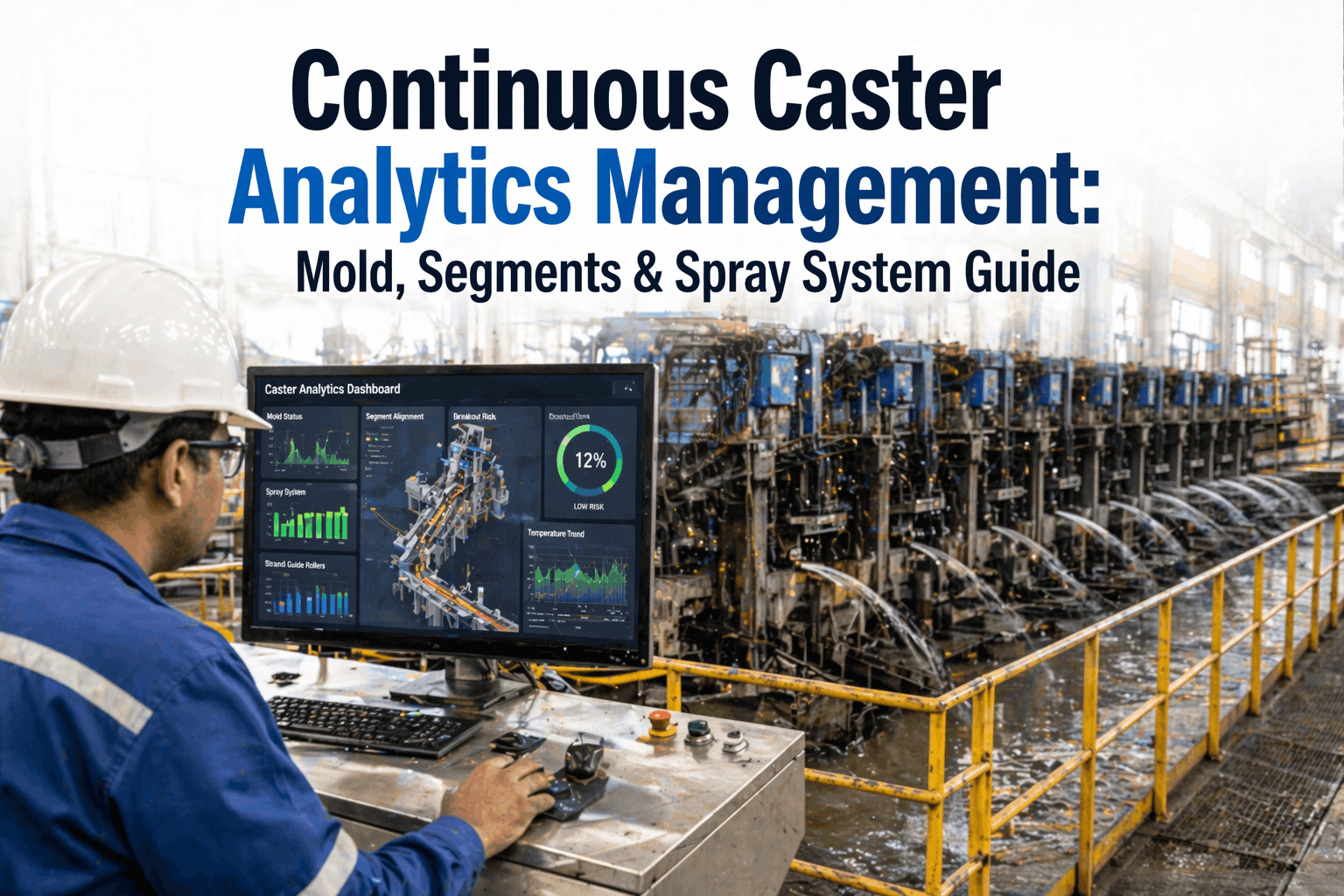
The platform provides a ranked dashboard showing every active mold's estimated remaining life, current wear stage, and any flagged localized wear zones, designed to support quick daily review during maintenance planning meetings rather than requiring detailed data analysis.
Q: How long does it take to build a reliable mold wear model for a specific caster?
Most casters see an initial working model within four to six weeks, with accuracy continuing to improve over subsequent campaigns as the model observes a wider range of mold conditions, grades, and casting speed profiles specific to that caster.
Extend Mold Campaigns Safely with Continuous AI Condition Tracking

iFactory helps maintenance managers track copper plate wear, oscillation consistency, and flux performance continuously across every mold, reducing premature changeouts while keeping breakout risk under control.


Share This Story, Choose Your Platform!