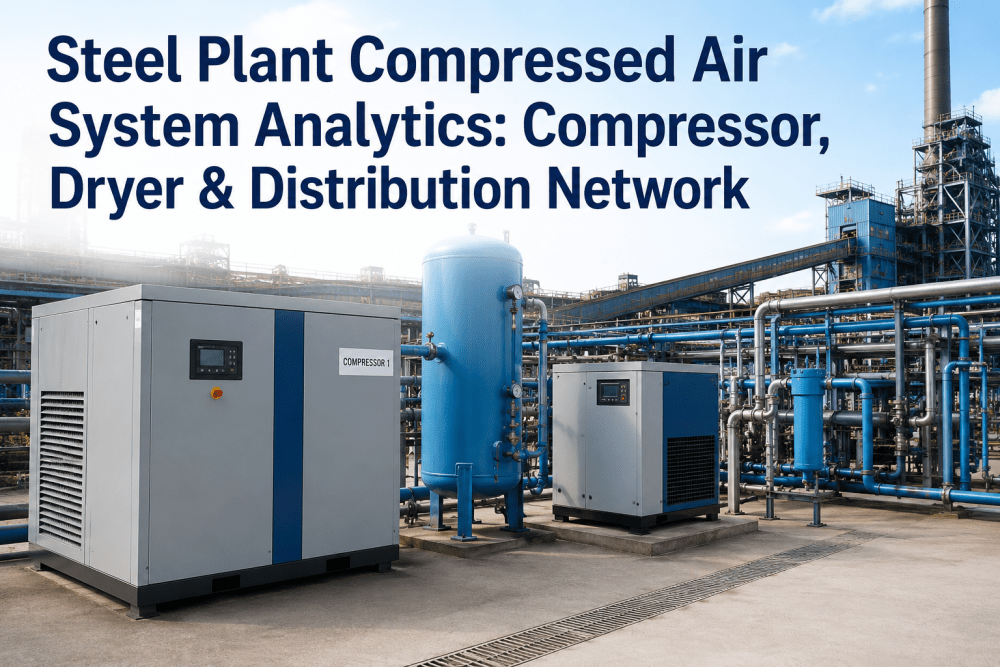
Compressed air is often called the most expensive utility in a plant, and steel operations rarely question that reputation once they actually measure how much of it leaks out through fittings, hoses, and valves that nobody has walked past with a leak detector in years. A single quarter-inch leak at typical plant pressure can waste enough electricity annually to cover a meaningful piece of a maintenance budget, and most facilities have dozens of leaks of varying size running continuously, nights and weekends included, even when production has stopped. iFactory tracks compressed air flow, pressure, and compressor loading continuously, flags abnormal baseline consumption that points to leaks, and helps size the fix against actual measured waste rather than a rough walk-through estimate. You can book a demo to see your own compressed air system's baseline consumption and loss estimate.
COMPRESSED AIR · LEAK DETECTION · PRESSURE OPTIMIZATION
The Leak You Cannot Hear Is Still Costing You Every Hour
iFactory monitors compressed air flow and pressure continuously, separates genuine production demand from leakage and idle loss, and quantifies exactly what fixing each leak and right-sizing system pressure is worth in energy cost.
1/16"
Smallest leaks add up fast
1/8"
Common at worn fittings
1/4"
Runs 24/7 even when idle
3/8"+
Often hides in plain sight
THE WASTE HIDING IN PLAIN SIGHT
Leaks and Over-Pressure Are the Two Costs Nobody Budgets For
Compressed air systems lose money two ways that rarely show up as a distinct line item anywhere: leaks that run continuously regardless of production status, and system pressure set higher than any actual point of use requires, which increases compressor energy draw across every single cycle. Both problems are common precisely because compressed air is treated as always-available background infrastructure rather than a metered utility with its own efficiency target.
20-30%
Typical share of total compressed air generated that is lost to leaks in an unmanaged system
1-2%
Compressor energy increase for every 2 psi of unnecessary system pressure
24/7
Hours a leak continues wasting energy, including nights, weekends, and planned downtime
FINDING WHAT AN ANNUAL WALK-THROUGH MISSES
An Effective Audit Follows a Structured Sequence
Compressed air problems are found reliably through a consistent process, not a single annual walk-through with an ultrasonic detector, since new leaks develop continuously as fittings age and hoses flex under normal operation.
✓
Establish a baseline flow measurement during a period of confirmed zero production demand to isolate pure leakage and idle loss.
✓
Ultrasonic scan high-risk zones including quick disconnects, solenoid valves, and hose connections that flex during normal operation.
✓
Review system pressure against actual point-of-use requirements rather than a legacy setpoint nobody has revisited in years.
✓
Check compressor loading and sequencing to confirm the right number of units run at the right time relative to actual demand.
✓
Tag, prioritize, and repair leaks by size so the largest and most accessible losses are fixed first for the fastest payback.
Find Out What Your System Is Actually Losing
iFactory measures your compressed air baseline continuously and flags abnormal consumption that points to leaks or pressure inefficiency. Book a demo and review your own system data.
WHERE PRESSURE OPTIMIZATION FITS IN
Lower Pressure Where the Process Actually Allows It
Beyond leaks, many systems run at a pressure set to satisfy the single most demanding point of use in the plant, forcing every other application to also run on pressurized air it does not need.
Zone Pressure Mapping
Identify which areas can run on lower pressure once separated from the single high-demand point driving the overall setpoint.
Compressor Sequencing
Run the right combination of compressors for actual demand instead of leaving oversized units cycling inefficiently.
Storage and Demand Buffering
Add or reposition receiver tanks to smooth short demand spikes without forcing the whole system to a higher baseline pressure.
Dedicated Low-Pressure Circuits
Separate low-pressure uses onto their own circuit so the main system pressure can be reduced plant-wide.
UNMANAGED VS OPTIMIZED SYSTEMS
What Actually Changes Once the System Is Actively Monitored
The difference between an unmanaged compressed air system and an actively monitored one is rarely about new equipment, it is about knowing where the losses actually are and fixing them in priority order.
| Factor |
Unmanaged System |
iFactory Monitored System |
| Leak Detection |
Found during infrequent walk-throughs, if at all |
Flagged from continuous baseline flow monitoring |
| Pressure Setpoint |
Set once, rarely revisited |
Reviewed against actual point-of-use demand data |
| Off-Hours Loss |
Often unnoticed since nobody is watching after hours |
Baseline flow during idle periods flagged automatically |
| Repair Prioritization |
Ad hoc, based on whichever leak is noticed first |
Ranked by estimated energy cost of each identified loss |
WHO THIS SERVES
Any Plant Running Compressed Air as a Core Utility
Compressed air optimization applies wherever pneumatic tools, actuators, or process air represent a meaningful share of plant electrical load, which covers most steel production and finishing operations.
Rolling and Finishing Lines
Monitor air used for pneumatic actuators, cylinders, and cleaning applications across the line.
Maintenance and Tooling Areas
Catch leaks at quick disconnects and hose stations that see frequent connection and disconnection.
Multi-Building Plants
Identify which building or zone is driving system pressure requirements plant-wide.
Multi-Shift Operations
Compare compressed air consumption across shifts to catch behavioral differences in equipment shutdown discipline.
FREQUENTLY ASKED QUESTIONS
Questions Maintenance and Energy Teams Ask First
How is a baseline leak measurement actually taken without shutting down production?
The most reliable baseline is captured during a planned non-production window, such as a weekend or shift changeover, when flow through the system should theoretically be zero, so any measured flow during that window is effectively leakage or idle equipment loss. iFactory can also estimate a rough baseline from continuous data even without a perfectly clean window, refining the estimate as more idle periods are captured.
Book a demo to see how a baseline would be established on your production schedule.
Is ultrasonic leak detection still necessary if we have continuous flow monitoring?
Continuous flow monitoring tells you that leakage exists and roughly how much it is costing, but locating the specific fitting or valve responsible still requires a physical scan, typically with an ultrasonic detector, once the monitoring data indicates it is worth the maintenance time. The two methods work together, with monitoring data prioritizing which zones deserve a physical scan first.
Contact our support team to discuss combining monitoring with a targeted scan program.
How much can we safely reduce system pressure without affecting production quality?
The safe reduction depends entirely on the single most pressure-demanding point of use in your system, since dropping below that requirement would affect that specific application even if every other point of use would tolerate lower pressure comfortably. Mapping actual point-of-use requirements is what allows a defensible pressure reduction rather than a guess.
Book a demo to review pressure requirements across your zones.
Do we need new sensors installed throughout the plant to start monitoring?
Many plants already have flow and pressure instrumentation on their compressors and main distribution lines that can be connected directly, and additional metering can be added incrementally at specific zones identified as worth deeper visibility rather than requiring a full sensor rollout up front.
Contact our support team to review what your current compressor instrumentation already supports.
How quickly does fixing leaks and adjusting pressure typically show up in the energy bill?
Because compressed air losses are continuous rather than seasonal, the impact of fixing a significant leak or reducing system pressure typically shows up within the very next billing cycle, making it one of the faster paybacks available compared to capital-intensive energy projects elsewhere in the plant.
Book a demo to estimate savings timing for your identified losses.
Stop Paying to Compress Air You Never Actually Use
iFactory monitors your compressed air system continuously, flags leaks and pressure inefficiency, and ranks fixes by what they are actually worth. Book a demo and see your own system baseline.