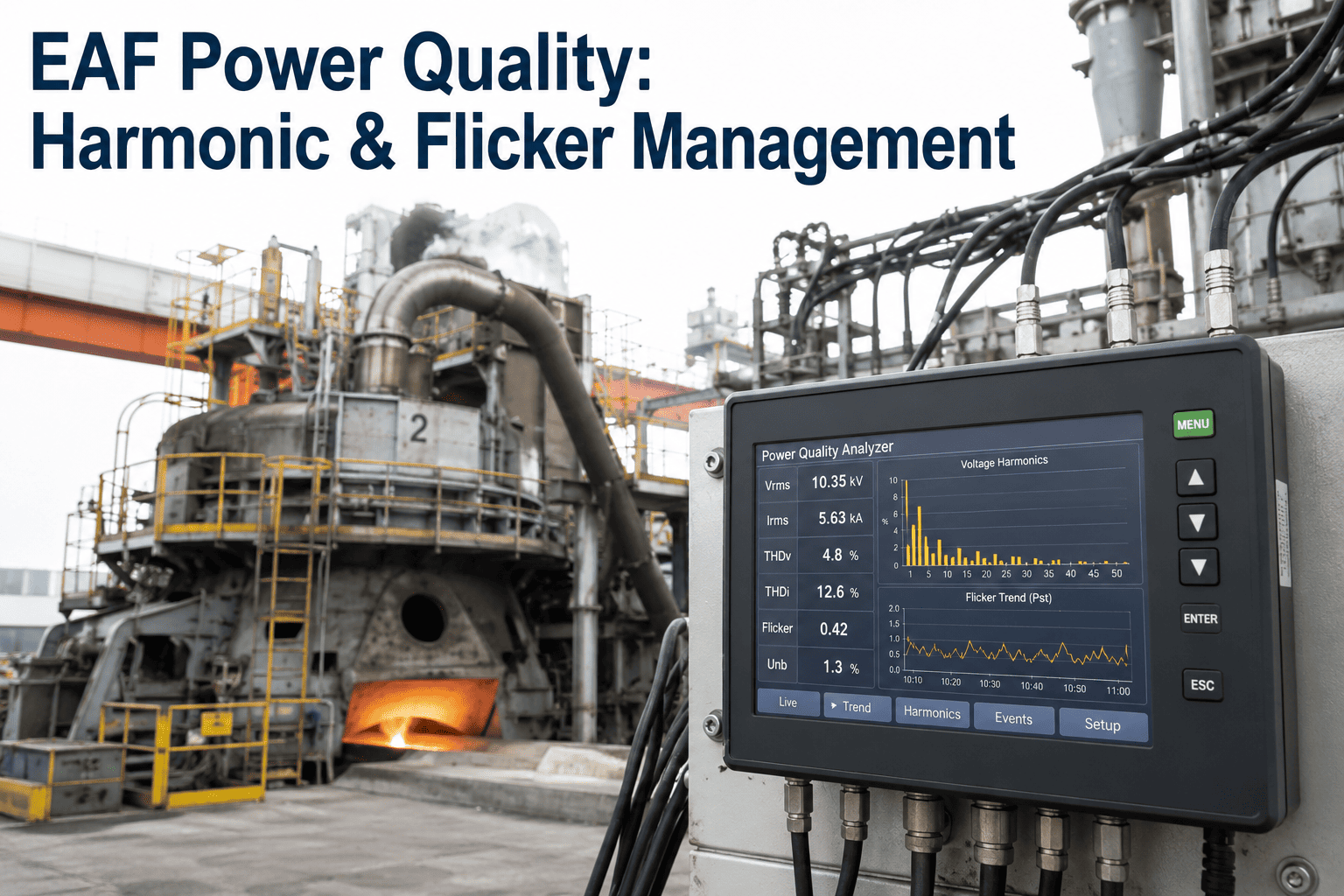
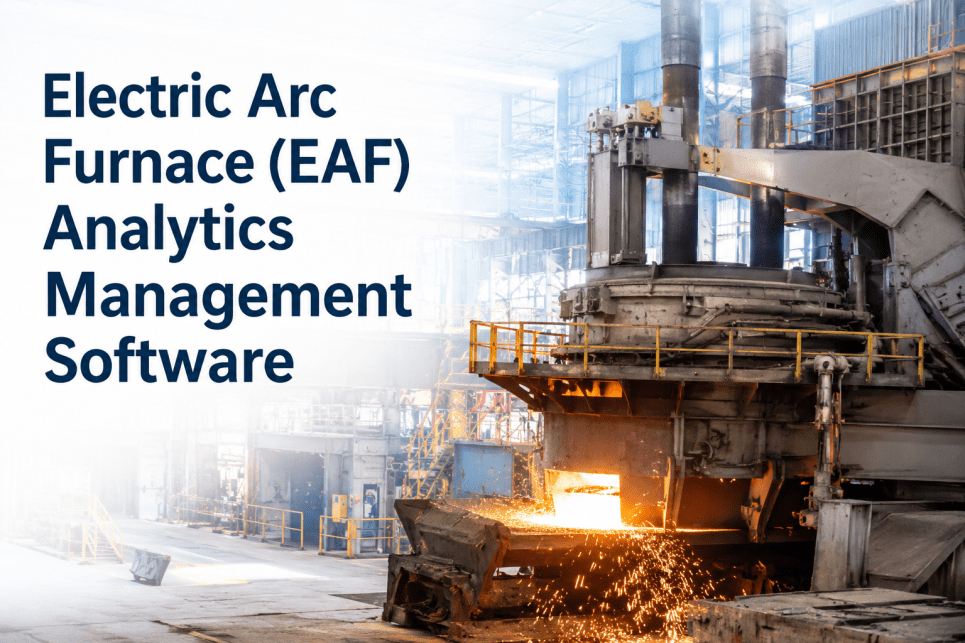
An electric arc furnace draws power in a way almost nothing else on a grid does, striking an unstable arc through scrap that creates rapid, random current swings the moment it starts melting. Left unmanaged, those swings show up on the grid as voltage flicker that can be visible in nearby lighting, and as harmonic distortion that stresses transformers, capacitor banks, and sensitive electronic equipment both inside the plant and on neighboring connections. Utilities increasingly enforce power quality limits as a condition of the connection agreement itself, which means a furnace running outside those limits risks penalties, curtailment, or a forced compensation project on a timeline the utility sets rather than the plant. iFactory tracks harmonic content and flicker severity continuously against your actual grid connection limits, so a compensation strategy can be planned proactively instead of reactively. You can book a demo to see your own furnace's power quality profile against your grid agreement limits.
EAF POWER QUALITY · HARMONICS · VOLTAGE FLICKER · GRID COMPLIANCE
Your Furnace Talks to the Grid Every Time It Strikes an Arc
iFactory monitors harmonic distortion and voltage flicker generated by your EAF continuously, compares it against your utility connection limits, and helps size the right compensation strategy before a violation becomes a penalty or a forced outage.
VOLTAGE SIGNAL, CLEAN VS DISTORTED
WHY THIS IS NOT JUST AN ELECTRICAL FOOTNOTE
Power Quality Problems Have a Way of Becoming Contract Problems
Most grid connection agreements for large industrial loads like an EAF specify limits on harmonic distortion and flicker severity as a condition of service, not as a suggestion, because a furnace generating enough distortion or flicker can degrade power quality for neighboring customers on the same distribution network. A plant that exceeds those limits risks financial penalties, mandated curtailment of furnace operation, or a compensation project imposed on the utility's timeline rather than one planned on the plant's own capital schedule.
2-5%
Typical voltage flicker severity generated by an uncompensated EAF during active melting
5-15%
Total harmonic distortion commonly seen at the point of common coupling without filtering
80-90%
Typical flicker reduction achieved with properly sized SVC or STATCOM compensation
TWO DISTINCT PROBLEMS, ONE FURNACE
Harmonics and Flicker Are Related but Not the Same Issue
Harmonic distortion and voltage flicker both originate from the same unstable arc, but they affect the grid differently and are addressed with different, sometimes overlapping, compensation equipment.
Voltage Flicker
Rapid voltage fluctuation caused by the arc's constantly changing impedance during melting, most noticeable as visible lighting flicker on the same feeder.
Harmonic Distortion
Non-sinusoidal current drawn by the furnace and its power electronics, which distorts the voltage waveform and stresses connected equipment.
Voltage Dips
Short-duration voltage drops during arc ignition or scrap collapse that can affect sensitive equipment elsewhere on the same connection.
Unbalance
Uneven current draw across the three phases during single-phase arc conditions, which can affect motor and transformer performance nearby.
See Where Your Furnace Sits Against Grid Limits Today
iFactory monitors harmonic distortion and flicker continuously against your actual connection agreement. Book a demo and review your current compliance margin.
COMPENSATION TECHNOLOGY
Matching the Fix to the Specific Problem
Compensation equipment is not one-size-fits-all, and choosing the wrong technology for the dominant problem at a given furnace often means paying for compensation capacity that never actually solves the compliance issue.
Static VAR Compensator (SVC)
Thyristor-controlled reactive power compensation, widely used and cost-effective for flicker mitigation on EAF loads.
STATCOM
Faster-responding voltage source converter technology, generally providing superior flicker mitigation where response speed matters most.
Harmonic Filters
Tuned passive or active filters that target specific harmonic orders generated by the furnace and its associated power electronics.
Series Reactors
Added impedance that smooths arc current fluctuation at the source, reducing both flicker and harmonic generation together.
UNCOMPENSATED VS MONITORED AND COMPENSATED
The Difference a Continuous Compliance View Makes
Power quality compliance is typically confirmed through periodic utility measurement, which means a plant can drift out of compliance for months before anyone outside the furnace crew notices.
| Factor |
Periodic Utility Measurement Only |
iFactory Continuous Monitoring |
| Detection Timing |
Found during scheduled utility audits, sometimes annually |
Tracked continuously against your connection limits |
| Root Cause Visibility |
Aggregate reading with limited operational context |
Correlated with specific furnace operating conditions |
| Compensation Sizing |
Based on a single measurement snapshot |
Based on a full operating range of conditions over time |
| Compliance Risk |
Penalty or curtailment risk between measurement cycles |
Early warning before a limit is approached |
WHO NEEDS TO MANAGE THIS ACTIVELY
Any Operation With a Large, Variable Electrical Load
Power quality management matters most wherever a large, rapidly varying load shares a grid connection with sensitive equipment or other customers who can be affected by that variability.
Electric Arc Furnace Steelmakers
Manage flicker and harmonics generated during the melting cycle at the primary source.
Plants on Weaker Grid Connections
Facilities connected to a distribution network with limited short-circuit capacity face tighter compliance margins.
Facilities Adding Furnace Capacity
Plants planning a new or upsized furnace need to evaluate compensation requirements before commissioning.
Utilities and Grid Operators
Monitor industrial customer compliance against connection agreements at the point of common coupling.
FREQUENTLY ASKED QUESTIONS
Questions Electrical and Operations Teams Ask First
How do we know if our current flicker and harmonic levels are actually close to our connection agreement limits?
The only reliable way is continuous measurement at or near the point of common coupling compared directly against the specific limits written into your connection agreement, since those limits vary by utility and by the strength of the local grid connection. A single annual utility measurement snapshot may not capture your furnace's full operating range across different scrap mixes and melt cycles.
Book a demo to review your current margin against connection limits.
Would an SVC or a STATCOM be the right choice for our furnace?
The right choice depends on how fast your specific flicker events develop and how much harmonic filtering is needed alongside flicker mitigation, since STATCOM technology generally responds faster but at a higher cost than a comparably rated SVC. Measured data on your furnace's actual flicker characteristics is what allows that comparison to be made specifically rather than generically.
Contact our support team to review compensation technology options for your furnace profile.
Can power quality problems affect equipment inside our own plant, not just the neighboring grid?
Yes, harmonic distortion generated by the furnace does not stop at the plant boundary, it can also stress transformers, capacitor banks, and variable frequency drives elsewhere in the same facility, sometimes causing nuisance trips or accelerated equipment wear that gets misattributed to unrelated causes. Monitoring at multiple points in the plant helps separate internal equipment issues from furnace-driven distortion.
Book a demo to see monitoring across multiple points in your distribution system.
What happens if we exceed our connection agreement limits before a compensation project is in place?
Consequences vary by utility and jurisdiction, but commonly include financial penalties, a formal notice requiring a remediation plan, or in more serious cases a mandated reduction in furnace operating capacity until compliance is restored. Continuous monitoring is what allows a plant to see a developing trend early enough to plan compensation proactively rather than under a utility-imposed deadline.
Contact our support team to discuss early warning thresholds for your agreement.
How is a compensation project sized correctly the first time?
Correct sizing depends on capturing your furnace's full range of operating conditions, not just a single melt cycle, since flicker and harmonic severity vary with scrap mix, arc stability, and furnace age. Data gathered over a representative production period gives equipment suppliers a realistic design basis instead of relying on a manufacturer's generic assumption for a furnace of similar rated capacity.
Book a demo to build a sizing profile from your own furnace data.
Plan Compensation Before the Utility Plans It For You
iFactory tracks harmonic distortion and flicker continuously against your connection limits, giving you time to size and plan compensation on your own schedule. Book a demo and see your current compliance margin.