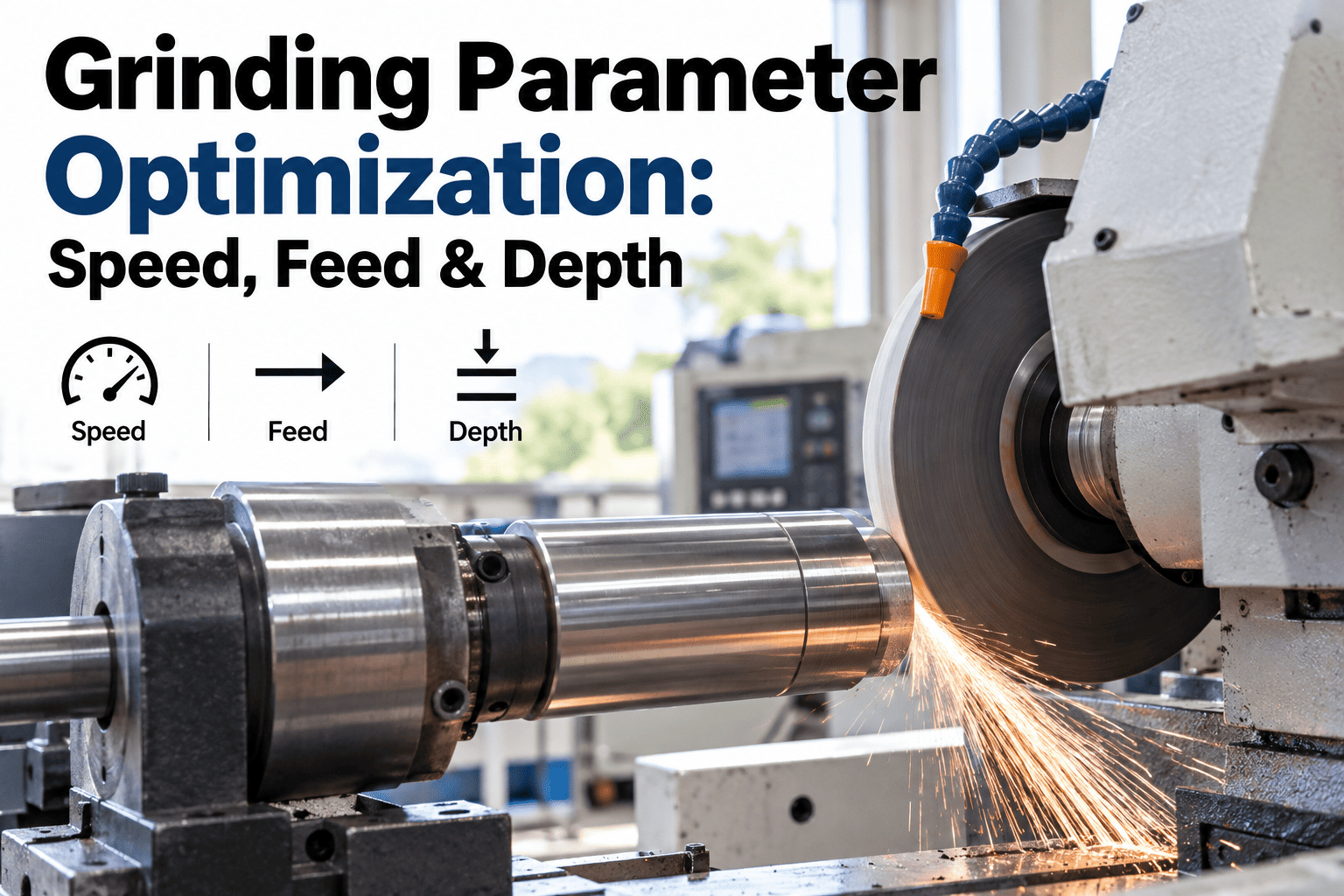
Wheel speed, traverse rate, depth of cut, and coolant flow do not operate independently on a roll grinder — they form a connected system where changing one without adjusting the others predictably degrades either surface finish or dimensional accuracy, and the "right" setting for each depends on the specific roll grade, hardness, and target finish rather than a single universal recipe a shop can apply across every job. Grinding parameter optimization is the discipline of matching these four settings to the job at hand deliberately, rather than defaulting to whatever setting was used last time regardless of whether the current roll grade actually matches. Shops looking to build this discipline into their process can start with a conversation with iFactory's support team about tracking parameter settings against surface finish outcomes by roll grade.
Four Settings, One Connected System — Change One Without the Others and Something Gives
Wheel speed, traverse rate, depth of cut, and coolant flow interact, and the right combination depends on roll grade and target finish, not a default carried over from the last job.
Why the Four Parameters Cannot Be Tuned in Isolation
Increasing traverse rate to speed up a grinding pass, for example, increases the load on each pass unless depth of cut is reduced to compensate, and that increased load raises heat generation at the wheel-workpiece interface unless coolant flow is also increased to carry the extra heat away. Adjusting one parameter while leaving the other three at their previous setting is one of the most common ways an otherwise well-intentioned attempt to improve throughput quietly degrades surface finish or introduces thermal damage risk instead.
How Each Parameter Actually Affects the Result
Understanding what each parameter individually controls is the foundation for adjusting them together as a coordinated system rather than one at a time in isolation.
Wheel Speed
Higher wheel speed generally improves surface finish but increases heat generation, requiring adequate coolant flow to manage the added thermal load without risking grinding burn.
Traverse Rate
Faster traverse rate increases throughput but coarsens surface finish unless depth of cut is reduced to compensate, trading cycle time against finish quality.
Depth of Cut
A deeper cut removes more material per pass but increases load on the wheel and workpiece, raising both heat generation and the risk of dimensional inaccuracy on harder roll grades.
Coolant Flow
Adequate coolant flow carries away the heat generated by the other three parameters, and under-delivering coolant for a given speed, traverse, and depth combination is what most often produces thermal damage.
Match Parameters to Roll Grade Every Time, Not by Memory
Book a 30-minute walkthrough of how iFactory tracks grinding parameter settings against surface finish outcomes by roll grade.
Parameter Starting Points by Roll Grade
Different roll grades and hardness levels call for different starting parameter combinations, and the table below outlines the general direction each grade tends to push the four settings.
| Roll Grade Characteristic | Typical Adjustment | Reason |
|---|---|---|
| Higher Hardness | Reduced depth of cut, increased coolant flow | Harder material generates more heat and load per pass |
| Fine Finish Requirement | Reduced traverse rate, increased wheel speed | Slower traverse with higher speed improves surface finish |
| High Throughput Priority | Increased traverse rate, reduced depth of cut per pass | Balances cycle time against finish and thermal risk |
| Thermally Sensitive Grade | Reduced wheel speed, maximized coolant flow | Minimizes heat generation for grades prone to thermal cracking |
A Staged Approach to Testing Parameter Changes
Rolling out a parameter change across an entire production batch, as happened in the scenario above, is the riskiest way to validate whether the change actually works. A staged approach catches problems on a much smaller scale.
Test on a Small Batch
A new parameter combination is applied to a handful of rolls first, with the remaining production continuing under the proven existing settings.
Inspect Thoroughly Before Scaling
Post-grind inspection specifically checks for thermal damage and surface finish deviation on the test batch before the new settings are applied more broadly.
Roll Out and Document
Once validated, the new coordinated parameter combination is documented as the new standard for that roll grade, preventing a future default back to the old settings.
A Composite Scenario: The Throughput Push That Introduced Thermal Damage
A roll shop under pressure to increase grinding throughput increased traverse rate across its standard grinding program without adjusting depth of cut or coolant flow to compensate, expecting a straightforward cycle time improvement. Within the first batch of rolls ground under the new settings, a noticeably higher rate of micro-cracking was found during post-grind inspection, a defect the shop had not seen at this frequency before.
Investigation found that the faster traverse rate, combined with unchanged depth of cut, had increased the load per pass beyond what the existing coolant flow could adequately manage, producing localized thermal damage at the wheel-workpiece interface that manifested as fine surface cracking. Reducing depth of cut to compensate for the faster traverse and increasing coolant flow to match the new heat load eliminated the cracking while still capturing a meaningful portion of the intended throughput gain, a much better outcome than the shop's initial instinct to simply revert the traverse rate change entirely.
Mistakes That Undermine Parameter Optimization
Adjusting One Parameter Without the Others
Changing traverse rate, wheel speed, or depth of cut in isolation, as happened in the scenario above, ignores the interaction between all four settings and risks introducing a defect that was not present before.
Reusing the Last Job's Settings Regardless of Roll Grade
Carrying over a parameter combination from a previous job without checking whether it actually suits the current roll grade's hardness and finish requirements is a common source of avoidable quality issues.
Reverting a Change Entirely Instead of Rebalancing It
The shop's initial instinct in the scenario above was to simply undo the traverse rate increase, which would have given up the entire throughput gain rather than finding the coordinated adjustment that preserved most of it.
Treating Coolant Flow as a Fixed Setting Independent of Other Parameters
Coolant flow needs to scale with the heat load generated by wheel speed, traverse rate, and depth of cut together, not stay fixed while the other three settings change.
Is Your Parameter Selection Process Actually Coordinated
Parameter changes are evaluated as a set, not one at a time
Reviewing all four parameters together before implementing a change avoids the kind of isolated adjustment that introduced thermal damage in the scenario above.
Starting parameters are documented by roll grade, not by memory
A documented starting point per grade removes the risk of carrying over an inappropriate setting from an unrelated previous job.
A throughput-driven change is rebalanced, not simply reverted, when a defect appears
Finding the coordinated adjustment that resolves a defect while preserving most of an intended improvement, as in the scenario above, captures more value than reverting the change outright.
Frequently Asked Questions
Why does increasing traverse rate sometimes cause thermal damage?
A faster traverse rate increases the material removal rate per pass if depth of cut is not reduced to compensate, and that increased load raises heat generation at the wheel-workpiece contact zone, exactly the mechanism that produced micro-cracking in the scenario above when coolant flow was not also increased to manage the added thermal load.
How should parameter settings differ between a rough grind and a finish pass?
Rough grinding typically favors higher depth of cut and traverse rate to maximize material removal, accepting a coarser interim surface finish, while a finish pass reduces depth of cut and traverse rate while often increasing wheel speed to achieve the target surface finish, with coolant flow adjusted to match the heat load of whichever combination is in use at each stage.
What is the safest way to test a new parameter combination before applying it broadly?
Testing a new combination on a small batch first, with thorough post-grind inspection for thermal damage and surface finish before rolling the change out broadly, would have caught the issue in the scenario above after a much smaller number of affected rolls rather than an entire production batch, making a staged rollout a much lower-risk way to validate a parameter change.
Should coolant flow always be maximized regardless of other parameter settings?
Not necessarily maximized, but coolant flow should be matched to the actual heat load generated by the current wheel speed, traverse rate, and depth of cut combination, since under-delivering coolant relative to that heat load is what caused the thermal damage in the scenario above, while excessive coolant flow beyond what is needed offers no additional benefit and simply adds unnecessary cost. Book a demo to see how iFactory correlates coolant flow against the other three parameters for a given roll grade.
What is the first step for a shop wanting to document standardized grinding parameters by grade?
The first step is reviewing historical grinding records to identify which parameter combinations have reliably produced acceptable surface finish and dimensional accuracy for each roll grade currently run, then documenting those combinations as a starting reference rather than leaving the decision to individual operator memory, which is exactly the kind of gap that let an uncoordinated parameter change reach a full production batch in the scenario above. Shops wanting help building this documentation can reach iFactory support.
Coordinate All Four Parameters Instead of Guessing at One
iFactory tracks wheel speed, traverse rate, depth of cut, and coolant flow together against surface finish outcomes by roll grade. Book a walkthrough to see it running on a live grinding operation.