Every reheating furnace loses heat somewhere it was never meant to go, through the refractory walls, out the charging and discharging openings, and up the flue stack with the exhaust gas. The question that actually matters for a retrofit budget is not whether these losses exist, it is how large each one is relative to the others, and which project pays back fastest once the real numbers are on the table. Without that quantification, retrofit spending tends to follow whichever loss is easiest to see rather than the one costing the most. Plant engineers building a retrofit case can see how iFactory AI quantifies wall, opening and flue gas losses on live furnace data before the next capital budget round.
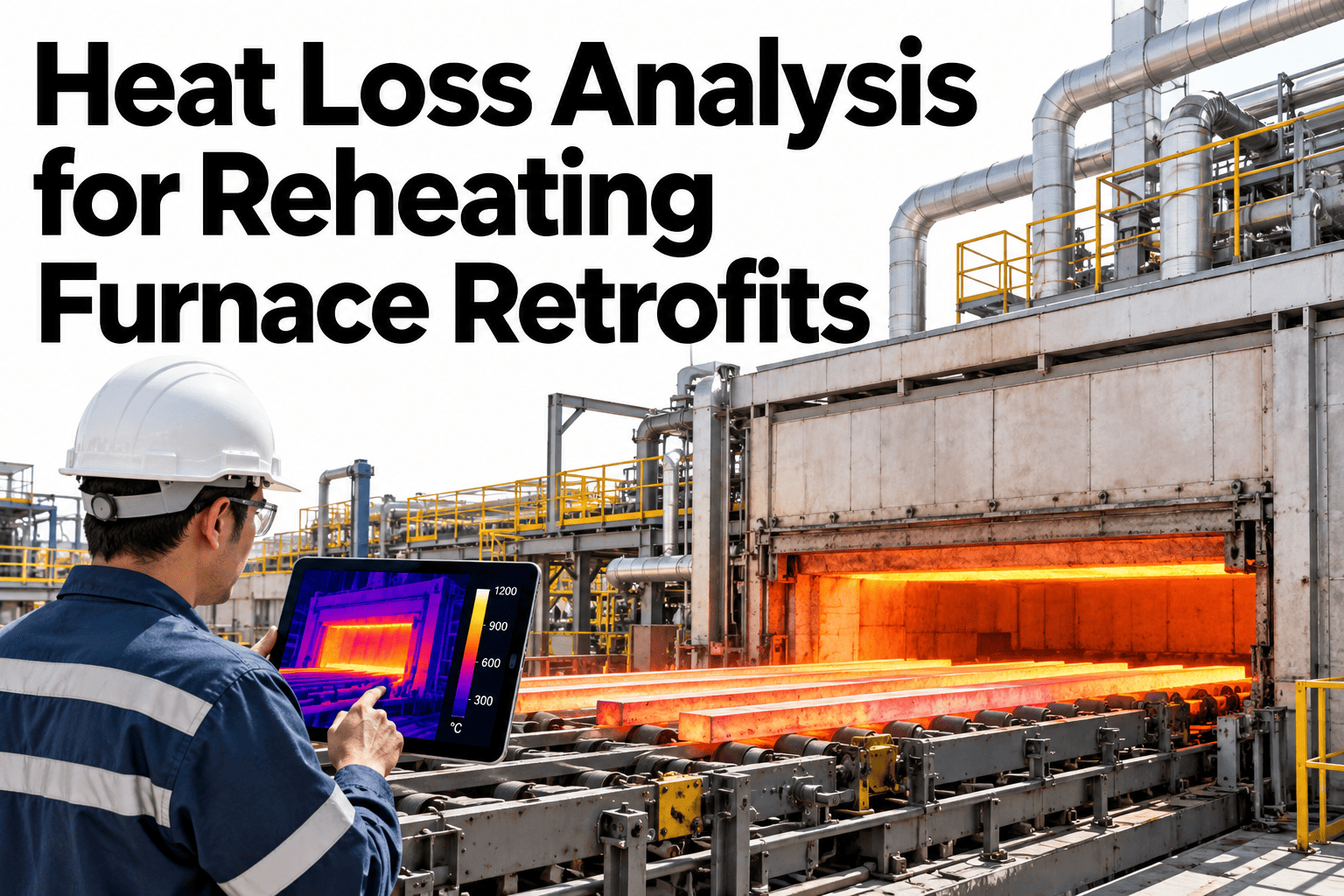
Heat Loss Analysis for Reheating Furnace Retrofits
Quantify wall, opening and flue gas losses separately, then rank retrofit projects by payback instead of by visibility.
Three Losses, Three Very Different Fixes
Each loss path has its own cause, its own measurement method and its own retrofit solution, which is why lumping them into one "furnace efficiency" number hides more than it reveals.
Heat conducted through refractory and shell, continuous and relatively steady over time.
Radiant heat escaping through charging doors, discharge openings and any gaps in the structure.
Heat carried away in the exhaust gas, driven by stack temperature and excess air.
On many furnaces flue gas loss is the largest single category, but the actual split varies with furnace age, design and operating practice, and should be measured rather than assumed.
How Each Loss Is Actually Quantified
Getting a usable number for each loss category requires a different measurement approach, not a single blanket efficiency test.
| Loss Category | Measurement Approach | Key Data Needed |
|---|---|---|
| Wall and structure | Surface temperature survey combined with known refractory properties | Shell surface temperatures, insulation condition, ambient conditions |
| Opening radiation | Radiant loss calculation based on opening size, temperature and duty cycle | Opening dimensions, furnace internal temperature, time open per cycle |
| Flue gas | Stack temperature and composition measurement against combustion air used | Flue gas temperature, oxygen content, fuel flow rate |
Get Your Own Furnace's Loss Breakdown Quantified
Book a 30-minute session and iFactory AI will walk through quantifying wall, opening and flue gas losses on your own furnace data before any retrofit spending is proposed.
Matching Each Loss to Its Retrofit Option
A retrofit project only makes sense against the specific loss it targets. Mismatching the two wastes capital on a fix that was never addressing the biggest problem.
Ranking Projects by Payback and Technical Difficulty
The largest loss is not automatically the easiest or cheapest to fix. A sound retrofit plan weighs both dimensions together.
Start here. These projects fund the harder ones that follow.
Worth planning for, but typically needs a larger capital commitment and longer lead time.
Reasonable to do opportunistically during other maintenance work.
Usually not worth pursuing unless driven by another requirement, such as safety or compliance.
A Four-Step Path From Measurement to Budget
A retrofit business case built in this order survives scrutiny better than one that starts from a vendor's proposal.
Measure each loss
Quantify wall, opening and flue gas loss separately on the actual furnace.
Match retrofit options
Identify which projects actually address each quantified loss.
Rank by payback
Size the expected savings and cost for each option, and rank them.
Sequence the budget
Fund high-payback, low-difficulty projects first to build momentum.
The retrofit programmes that deliver real payback are the ones built from measured loss data on the specific furnace in question, not from a generic industry assumption about where heat losses typically concentrate. A furnace with good wall insulation but poor combustion control will have a very different loss profile from one with the opposite problem, and proposing a wall upgrade on the second furnace, or a recuperator on the first, wastes capital addressing the smaller loss while the larger one continues unaddressed. Measure before proposing, and revisit the measurement after each retrofit phase, since fixing one loss path changes the relative size of the others.
Where iFactory AI Fits
iFactory AI quantifies wall, opening and flue gas losses from live furnace data, so retrofit budgets are built on measured numbers specific to each furnace.
Loss category breakdown
Wall, opening and flue gas losses are quantified separately using live temperature and combustion data.
Payback-ranked projects
Retrofit options are sized against the specific loss they address and ranked by payback and difficulty.
Before and after comparison
Loss profiles are re-measured after each retrofit phase to confirm the gain and guide the next step.
Ask in plain language
Ask which loss category is largest on a specific furnace right now and receive a direct answer.
Frequently Asked Questions
Which heat loss is usually largest on a reheating furnace?
Flue gas loss is often the largest single category on many furnaces, but the actual split between wall, opening and flue gas loss depends heavily on furnace age, insulation condition and combustion practice, so it needs to be measured on the specific furnace rather than assumed. You can watch a loss breakdown quantified on sample furnace data in a live session.
How do we measure flue gas loss accurately?
It requires stack temperature and gas composition measurement compared against fuel flow rate, since both temperature and excess air both drive the loss and need to be captured together rather than estimated from temperature alone. To set this up for your furnace, request a loss measurement review with the iFactory AI team, or ask support what instrumentation is needed.
Should we always fix the largest loss first?
Not necessarily. A project addressing a smaller loss but requiring far less capital and technical difficulty can deliver a better and faster payback than tackling the largest loss first, so both factors need to be weighed together. A short product tour of payback and difficulty ranking shows how this comparison is made.
Does fixing one loss path change the others?
Yes, often. Improving wall insulation can shift the relative share of flue gas loss, for example, so the loss profile should be re-measured after each retrofit phase rather than assumed to stay constant from the original analysis. See how before and after loss comparisons are tracked in a guided walkthrough.
What data do we need before approaching a retrofit vendor?
A quantified breakdown of wall, opening and flue gas loss on your own furnace gives you a far stronger negotiating position than a vendor's general efficiency claim, since it lets you evaluate their proposal against the loss it's actually meant to address. Schedule a walkthrough of building a retrofit business case to see what data supports it.
Spend Retrofit Capital Where the Loss Actually Is
iFactory AI quantifies wall, opening and flue gas losses on your own furnace, so retrofit projects are ranked by real payback. Book a walkthrough to see it built around your own furnace.