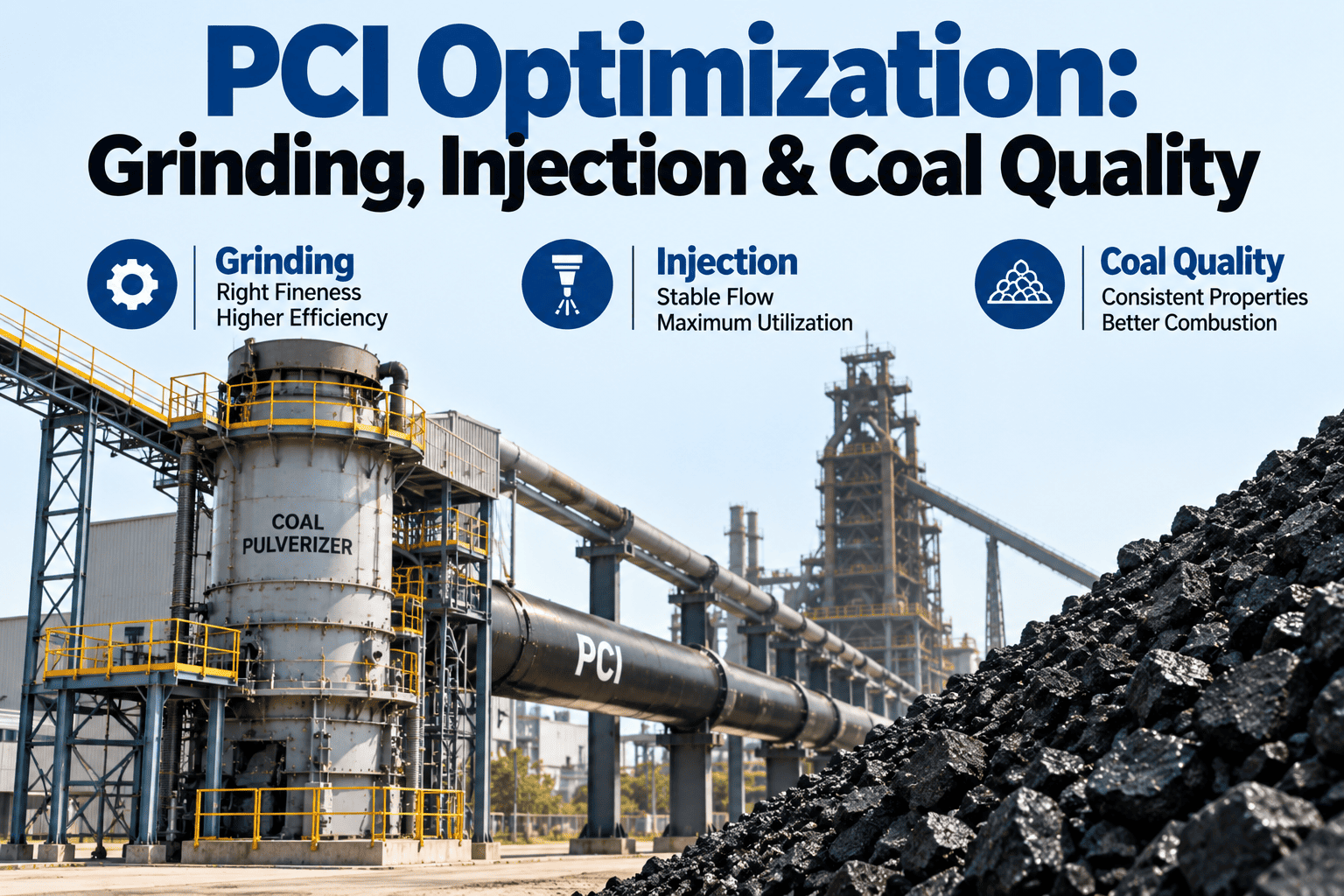
A blast furnace does not care how good yesterday's pulverized coal injection rate looked on the monthly report. It cares whether the coal reaching the tuyere right now is fine enough to burn completely in the few milliseconds it has inside the raceway, and whether the injection rate matches what the furnace's permeability can actually absorb. Most PCI programs stall not because the coal is wrong or the equipment is undersized, but because grinding fineness, injection rate, and coal quality are managed as three separate reports instead of one live system. iFactory's AI layer reads mill, injection, and hot-metal data together so operators can push PCI rate without pushing the furnace into instability.
BLAST FURNACE — PCI OPTIMIZATION
Turn Coal Grinding, Injection Rate, and Coal Quality Into One Optimization Loop
Most shops track PCI rate, mill fineness, and coal chemistry in three different systems, then wonder why coke rate will not come down further. iFactory connects the mill, the injection vessel, and the furnace so grinding quality, injection stability, and coal properties get optimized as one connected problem instead of three disconnected reports.
Why PCI Rate Plateaus Long Before the Theoretical Limit
Blast furnace operators know the textbook ceiling for pulverized coal injection sits somewhere between 200 kg and 270 kg of coal per ton of hot metal, depending on burden, oxygen enrichment, and hearth condition. Very few furnaces run anywhere close to that number, because the real ceiling shows up much earlier and is almost always operational rather than theoretical.
A mill grinding slightly coarse on a humid shift, a blend that shifts volatile matter unnoticed, or an injection line drifting unevenly between tuyeres will quietly cap the achievable rate long before the furnace itself becomes the constraint.
GRINDING DRIFT
Fineness falls below target for a few hours and unburnt char starts accumulating in the raceway and deadman, well before anyone reviews the shift's mill data.
TUYERE IMBALANCE
One or two tuyeres receive more coal than others because of line wear or blockage, so the average injection rate looks fine while local combustion efficiency does not.
COAL QUALITY SWING
A new coal shipment changes ash, moisture, or volatile matter, and the injection setpoint that worked for the last blend now runs the furnace closer to instability.
LAGGING FEEDBACK
By the time a coke rate report or a permeability alarm confirms something changed, the furnace has already absorbed hours of sub-optimal injection.
Grinding Fineness — The Quality Layer Most Shops Never Watch Live
Coal grinding fineness decides how much of the injected coal actually burns inside the raceway instead of leaving as unburnt char. Coal ground too coarse cannot combust fast enough in the short residence time at the tuyere, while coal ground too fine costs mill power without adding real combustion benefit.
Most operations set a single fineness target — commonly 70 to 80 percent passing 200 mesh, roughly 75 microns — and assume the mill holds it. In practice, fineness drifts with coal hardness, moisture, mill wear, and throughput, and drifts silently unless someone is watching the mill's live signature.
Target Fineness
70–80% passing 75 micron
Below this range, unburnt char rises and combustion efficiency drops sharply at the raceway.
Hardgrove Grindability Index
Typically 45–65 HGI
A harder coal (lower HGI) needs longer grinding time or coarser output for the same mill throughput.
Moisture at Mill Inlet
Shop-specific, tightly banded
Moisture swings change drying-air demand and can quietly push fineness outside target without a throughput change.
Mill Throughput
Set against coal hardness
Pushing throughput to meet an injection target on a harder coal batch is the most common cause of a fineness miss.
Injection Rate — Finding the Zone Between Under-Utilized and Unstable
Every furnace has an optimal injection band, not a single ideal number. Below that band, the furnace is leaving coke-replacement value on the table. Above it, permeability, deadman temperature, and raceway depth start moving in ways that erode the very productivity gains PCI is meant to deliver.
Under-Utilized
Below ~100 kg/tHM
Optimal Working Band
~140–180 kg/tHM for most shops
High-Risk Zone
Above ~200 kg/tHM without support
The high-risk zone is not off-limits — some of the world's largest furnaces run well past 200 kg/tHM with high oxygen enrichment, careful burden distribution, and coke of strong hot strength. The point is that moving into that zone without matching support on coal quality, burden, and blast conditions is what turns a coke-saving initiative into a permeability problem.
Coal Quality Parameters That Actually Move Coke Replacement
Not every coal quality number matters equally to PCI performance. The parameters below are the ones with the most direct, measurable effect on combustion efficiency and coke-coal replacement ratio, and the ones an AI-driven quality layer should be watching shipment to shipment.
| Parameter |
Effect on PCI Performance |
Practical Guidance |
| Volatile Matter (VM) |
Higher VM ignites faster and burns more completely in the raceway's short residence time |
Blend high-VM and low-VM coals to balance combustion speed against blast temperature needs |
| Ash Content |
Higher ash adds slag load and dilutes the coke-replacement value of every kilogram injected |
Track ash shipment to shipment; a small rise can quietly raise slag rate without any process change |
| Moisture |
Extra moisture consumes heat to evaporate and can destabilize both grinding and injection flow |
Hold inlet moisture inside a narrow band rather than reacting after a mill upset occurs |
| Hardgrove Grindability Index |
Lower HGI coal is harder to grind, directly limiting achievable fineness at a given throughput |
Adjust mill throughput proactively when a harder coal blend is scheduled, not after fineness drops |
| Sulfur Content |
Higher sulfur transfers into hot metal and can constrain how aggressively PCI rate is pushed |
Weigh sulfur alongside VM and ash when selecting a blend for a high-PCI operating window |
See Your Own Mill, Injection, and Coal Data in One View
iFactory can connect to your existing mill sensors, injection flow meters, and coal lab data to show live fineness, injection balance, and quality drift on your own furnace — before any new hardware is committed.
The iFactory Closed-Loop PCI Control Cycle
A grinding sensor or an injection flow meter that nobody acts on in real time is just another data point on a historian. iFactory's PCI layer is built as a closed loop, so every drift in fineness, injection balance, or coal chemistry becomes an operator action within minutes, not a line item in next month's review.
Sense
Mill power draw, particle size proxy, injection flow per tuyere, and coal lab results are streamed continuously instead of sampled periodically.
Compare
Each signal is compared against the target band for the current coal blend and current injection setpoint, not a single fixed threshold.
Alert
A fineness miss, a tuyere imbalance, or a quality shift generates a specific, categorized alert routed to the operator who owns that variable.
Adjust
The operator changes mill throughput, rebalances injection lines, or adjusts blend ratio with the exact reading in front of them.
Learn
The outcome of every adjustment feeds back into the model, sharpening the target bands for the next shift and the next coal blend.
What Changes Once Grinding, Injection, and Quality Are Watched Together
The value of connecting these three variables is not any single number moving in isolation — it is that a change in one no longer catches operators off guard on the other two. A coal quality shift shows up as a fineness recommendation before it shows up as a coke rate surprise.
Managed Separately
Fineness reviewed on a shift-end report, hours after any drift began
Injection setpoint held constant across coal blend changes
Tuyere-to-tuyere imbalance found only after a permeability event
Coal lab results reviewed for invoicing, not for injection tuning
Managed as One Loop
Fineness drift flagged within the same shift it begins
Injection setpoint adjusted proactively when blend quality shifts
Tuyere imbalance caught and corrected before it affects permeability
Coal lab results feed directly into the next injection recommendation
A Practical Path to a Higher, More Stable PCI Rate
Raising PCI rate safely is a sequence, not a single setpoint change. The stages below reflect how most successful programs move from a stable baseline to a genuinely higher operating rate without trading coke savings for permeability risk.
Stage 1
Establish the Live Baseline
Connect mill, injection, and lab data streams and let the model learn what a stable shift actually looks like for your current blend.
Stage 2
Close the Fineness Gap
Fix the grinding drift that is silently capping combustion efficiency before touching the injection setpoint at all.
Stage 3
Balance Tuyere-to-Tuyere Flow
Correct line-to-line injection variance so the average rate reflects what every tuyere is actually receiving, not a masked imbalance.
Stage 4
Step the Injection Rate Up
Raise the setpoint in small, monitored steps, watching permeability and deadman temperature at each step before moving further.
Frequently Asked Questions
How much coke can pulverized coal injection realistically replace?
Most operations see coke replacement in the range of 0.8 to 1.0 kilograms of coke per kilogram of coal injected, depending on coal quality and combustion efficiency at the raceway. Furnaces with well-controlled grinding and injection balance tend to sit at the higher end of that range consistently. You can
talk to our team about what replacement ratio is realistic for your current blend and equipment.
What happens if coal is ground too fine for injection?
Over-fine grinding does not damage combustion efficiency the way coarse grinding does, but it consumes more mill power, wears grinding media faster, and adds operating cost without a proportional improvement in coke replacement. The goal is to hit the target fineness band consistently, not to push fineness as high as possible.
Can we raise our PCI rate without buying new injection equipment?
In many cases yes, because the ceiling most furnaces hit first is operational rather than mechanical — grinding drift, tuyere imbalance, or a mismatched blend rather than injection vessel or line capacity. Correcting those variables often unlocks meaningful headroom before any capital equipment change is needed.
How does iFactory's system fit with our existing coal lab and mill instrumentation?
iFactory connects to the mill power and flow sensors, injection flow meters, and coal lab systems you already operate rather than replacing them. The assessment phase maps your current instrumentation against what live fineness and injection balance tracking need, and quotes only the supplemental sensing genuinely required.
How long does it take to see a measurable change in PCI rate or coke consumption?
Baseline data typically takes a few weeks to establish, and most operations see their first fineness and injection balance corrections land within a similar window. Coke rate movement usually follows within one to two months as corrected variables compound across shifts.
Book a demo to walk through a realistic timeline for your furnace and blend.
Push PCI Rate Higher Without Pushing Your Furnace Into Risk
Grinding fineness, injection balance, and coal quality decide how much coke your PCI program actually replaces. iFactory connects all three into one live view so your team can raise the rate with confidence instead of finding the limit the hard way.