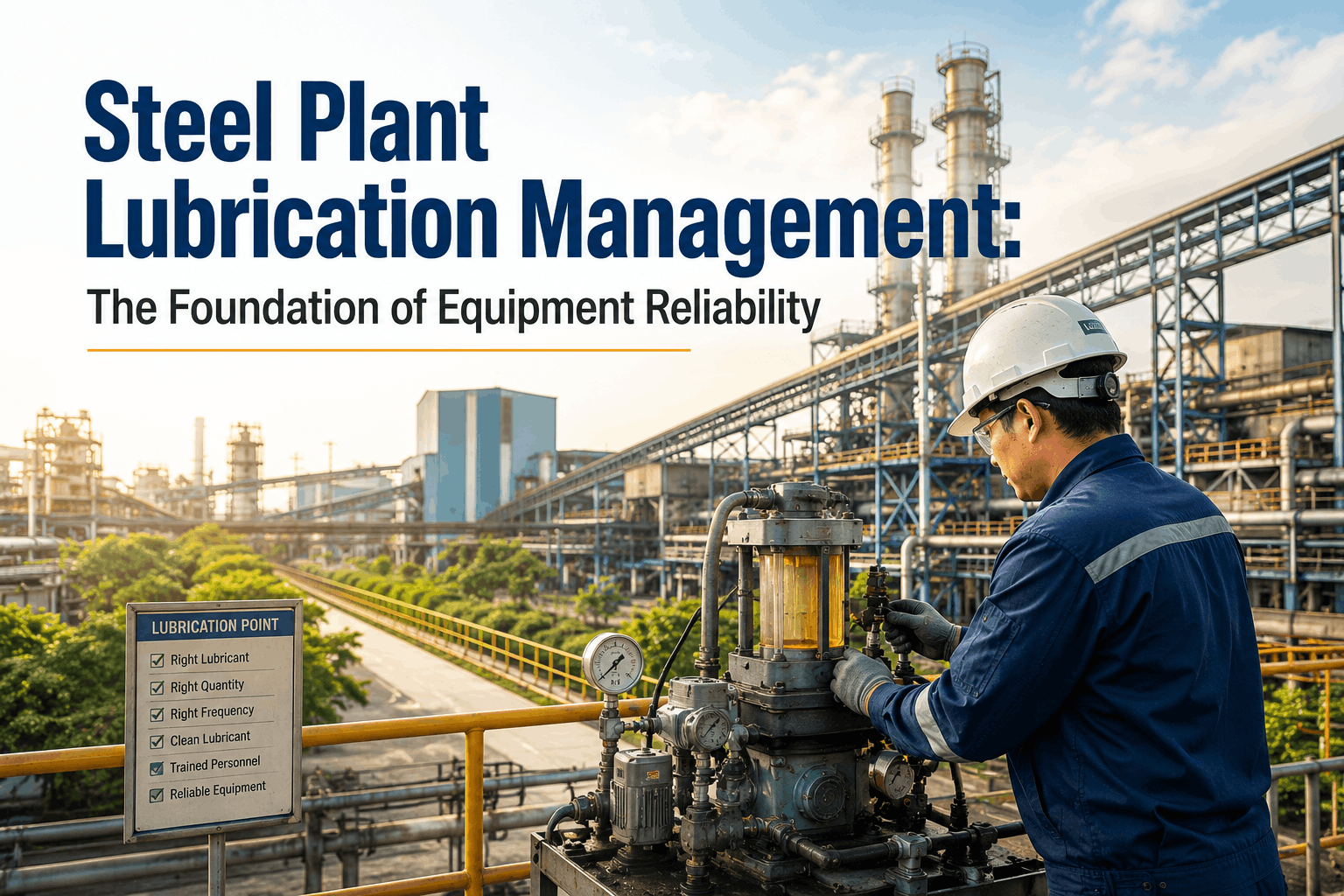
The industrial oil analysis program for steel plants is the most significant regulatory and reliability shift in heavy manufacturing in decades. Effective immediately, modern world-class standards mandate that steel plants, rolling mills, and casters handling high-value assets maintain detailed lubricant health records — down to the lot level — and produce them for reliability audits within 24 hours upon request. For Maintenance and Reliability Directors, the documentation window is no longer approaching. It is here. Understanding your obligations around Key Data Elements (KDEs), Critical Tracking Events (CTEs), and digital lubricant records is not optional — it is the operational baseline for continued asset life. This guide explores how AI-driven oil condition monitoring and real-time operational analytics combine to deliver measurable intelligence across every layer of steel plant lubrication. Facilities that move from paper-based sampling to AI-integrated platforms report up to a 45% reduction in catastrophic gearbox failures and a 30% extension in oil drain intervals. Book a demo to see how iFactory's digital twin connects your lubrication plan to live data.
What Is an AI-Driven Oil Analysis Program for Steel Plants?
The Steel Oil Analysis Rule establishes a new reliability recordkeeping framework for high-consequence assets. Unlike prior voluntary guidance, world-class reliability standards now define a mandatory, standardized approach to tracking lubricant health — from the first drum intake through to the final disposal or reclamation. The rule introduces a structured vocabulary of lubricant obligations built around two foundational concepts: Critical Tracking Events and Key Data Elements. Every maintenance team must understand these two constructs in operational, not just diagnostic, terms.
Traditional programs often fail because they treat oil analysis as a retrospective "report card" rather than a live operational signal. In the harsh environment of a steel mill — where high temperatures, water ingress, and metallic scale are constant — the data latency of a traditional 14-day lab cycle can be the difference between a routine filter change and a $500k gearbox rebuild. AI-driven programs close this loop by integrating live sensor data with spectral lab results, creating a continuous health model for every critical asset. Book a demo to see this transformation in action.
The Critical Asset List — the scope document for lubrication compliance — covers categories including main drive gearboxes, mill stand bearings, hydraulic systems, caster drives, fan bearings, and high-speed spindles. If your facility operates any of these assets at any point in the production chain, comprehensive oil analysis and KDE capture apply to your operations.
"Before iFactory, our oil analysis results were buried in PDFs that nobody read until something broke. Now, our lubrication program is an audit-ready digital system. We've cut gearbox downtime by 42% because we're acting on data, not just collecting it."
Understanding CTEs: Critical Tracking Events in Industrial Lubrication
Critical Tracking Events are the defined moments in the lubricant lifecycle where reliability records must be created and maintained. For steel plant maintenance teams, these moments represent the "chain of custody" for lubricant health. Any gap in this chain invalidates the predictive model. The most operationally significant CTEs are:
Lubricant Receiving and Batch Verification
The point at which fresh oil is received at the plant. Required KDEs include the brand, grade, quantity, unit of measure, receive date, and reference to the supplier's traceability lot code. AI integration ensures that "out-of-spec" fresh oil is detected before it enters the lube room.
Filtration and Bulk Storage Transfer
The initial pre-filtration step applied to lubricants before asset filling. Modern steel mills require pre-filtering fresh oil to ISO 16/14/11 levels. Required KDEs include ISO cleanliness code, filtration date, and storage location. This CTE prevents "built-in" contamination from day one.
Initial Asset Filling and Top-up
The first charging of a gearbox or hydraulic reservoir. This CTE is the most common compliance trigger. The traceability lot code assigned at filling must follow the asset through all subsequent samples — establishing the "Zero Hour" baseline for wear trending.
Route-Based Sampling and Lab Testing
The periodic collection of oil from an operating asset. KDEs include sample date, operating hours, sample location, and immediate visual inspection result. AI models analyze the rate of change between samples, not just the absolute values.
Oil Transformation and Reclamation
Every purification and additive reinforcement transaction must be documented with lot codes and results. This applies to every entity — maintenance, contractors, and oil suppliers. Book a demo to see automated sampling capture in action.
The Role of RDE-AES Spectroscopy and Particle Counting in Steel Mill Reliability
To achieve "lengthy" reliability targets, steel mills must move beyond simple viscosity testing. AI-driven platforms integrate Rotating Disc Electrode Atomic Emission Spectroscopy (RDE-AES) to identify elemental wear signatures at the parts-per-million level. This allows the system to distinguish between normal "break-in" wear and accelerated "fatigue" wear on specific gear teeth or bearing races.
Furthermore, ISO 4406 Particle Counting serves as the early-warning system for contamination. In high-pressure hydraulic systems used in continuous casters, a single shift at an ISO 22/20/18 level can cause more damage than three years at ISO 16/14/11. By capturing these KDEs at each sampling CTE, iFactory's AI engine calculates the Residual Useful Life (RUL) of both the lubricant and the asset, allowing for precision scheduling of filter changes and oil reclamation events. Book a demo to see how we manage these technical parameters.
Key Data Elements (KDEs): What Your Oil Records Must Capture
Key Data Elements are the specific data points that must be recorded at each Critical Tracking Event. The practical reliability challenge is not knowing what KDEs are required; it is building systems that capture them in a format that can be produced to auditors within 24 hours. Without a unified digital platform, this data is often lost in "lab portals" that do not communicate with your CMMS. Book a demo to see how iFactory maps KDE capture to your lubrication routes.
| CTE | Required KDEs | Traceability Lot Code Required? | Who Must Record |
|---|---|---|---|
| Sampling | Asset ID, Date, Hours, Location, Temp, Visual State | Yes — Link to Batch | Technicians, Route Leads |
| Filtration | Batch ID, ISO Code, Micron Rating, Filtration Date | Yes — Assign if New | Lube Room Staff |
| Top-up Event | Asset ID, Lot Code, Volume Added, Ref Document | Yes — Link to Tank | Area Maintenance |
| Transformation | Input Lot, Output Lot, Method, Date, Lab Result | Yes — New TLC for Output | Processors, Reclamation Team |
| Lab Testing | TLC, Viscosity, Particle Count, Wear Metals, TAN/TBN | Yes — Match Sample ID | Certified Laboratories |
| Disposal | TLC, Volume, Date, Receiver Identity, Manifest No | Yes — Record Final TLC | Waste Management |
Steel Plant Oil Analysis Record Retention Requirements
World-class reliability standards require covered entities to retain oil analysis records for a minimum of two years from the date of creation. Records must be maintained in a format that is producible to auditors within 24 hours. This requirement is the standard that exposes the most significant operational gaps in maintenance teams who rely on paper-based or siloed digital logs.
The rule does not mandate electronic records, but the 24-hour production window makes paper-only systems extremely high-risk. A maintenance lead with 18 months of paper reports cannot realistically produce a complete and accurate health chain for a specific gearbox within 24 hours. Book a demo to see how iFactory's system structures record retention to meet the 24-hour standard.
If an auditor or insurance lead submits a written request for health records related to a specific asset or batch, your facility must produce all relevant KDE records across every applicable CTE within 24 hours. This means your system must identify all lot codes, retrieve all CTEs and KDEs, trace backward to supplier batch records and forward to asset samples, and compile these records in a readable format. For facilities with thousands of assets, manual compilation is not viable without a purpose-built system.
AI-Driven Oil Analysis: How Technology Closes the Gap
Manual and spreadsheet-based systems fail reliability audits on three fronts: they cannot capture KDEs in real time, they cannot link input batches to output samples, and they cannot produce complete health chains within 24 hours. AI-driven oil analysis platforms address each of these points. Book a demo to see iFactory's AI-driven module in action.
Automated KDE Capture at CTEs
Integrated with lube room sensors, barcode scanners, and CMMS systems, AI-driven platforms capture Key Data Elements automatically at each Critical Tracking Event — eliminating manual entry delays and compliance gaps.
Wear Metal Linkage Through History
Intelligent diagnostic engines automatically link input lubricant batch codes to output wear metal results — maintaining the asset health integrity required for root-cause investigations without manual mapping.
24-Hour Health Report Compilation
On-demand reliability reports compile complete KDE histories across all CTEs for any asset or lot code — in minutes, not days. Records are formatted to ISO standards and can be transmitted electronically instantly.
Anomaly Simulation and Audit Readiness
Built-in simulation tools allow Maintenance Directors to run mock health exercises, identifying recordkeeping gaps before a major failure or audit. Audit-ready libraries reduce preparation time from weeks to hours.
Reliability Audit Gaps: Where Maintenance Teams Are Most at Risk
Based on industry analysis of steel plant reliability readiness assessments, the following gaps appear most frequently in facilities approaching their audit deadline.
Building a Reliability Audit Roadmap: A Step-by-Step Approach for Directors
For Maintenance and Reliability Directors leading their organization's audit readiness, the roadmap has five operational phases. Each phase feeds into the next, creating a structured pathway to excellence.
Scope Determination: Map Your Asset Health Exposure
Audit every gearbox, hydraulic system, and spindle handled at your facility against the Critical Asset List. Document where each CTE (Receiving, Sampling, Transformation) applies. Output: a facility-specific CTE map.
KDE Gap Analysis: Assess Current Data Capture
For each in-scope CTE, compare the KDEs your current systems capture against the required standards. Identify fields that are missing or recorded in formats that cannot be produced in 24 hours. Output: a KDE gap register.
Sampling System Design and Lot Code Strategy
Design a sampling structure that meets ISO requirements: unique asset identification, linkage to batch KDEs, and historical trending capability. Integrate assignment into route workflows. Output: a documented TLC schema.
Technology Platform Selection and Integration
Select and deploy an oil analysis platform capable of automated KDE capture, wear metal linkage, and 24-hour record production. Integrate with existing CMMS and ERP systems. Output: a deployed asset health system.
Mock Health Exercise and Audit Readiness Validation
Conduct a minimum of two mock health exercises — one forward trace from an oil batch to all assets, and one backward trace from an asset failure to all input batches. Output: validated audit-readiness certification.
Frequently Asked Questions: Steel Plant Oil Analysis & Health Reporting
What is the "Oil Analysis Rule" and who does it apply to?
World-class reliability standards now require steel plant maintenance teams handling critical assets to maintain lot-level lubricant health records at every Critical Tracking Event, from intake to disposal. It applies to all rotating and hydraulic assets.
What is a "Traceability Lot Code" for industrial lubricants?
A TLC is a unique identifier assigned to a lubricant batch at receiving and linked to all required KDEs. It must follow the product through every machine filling and sample transaction to maintain the health chain integrity.
How long does it take to implement a compliant oil analysis program?
Most mid-size steel plants achieve full digital compliance in 8–14 weeks, covering sensor integration, CTE mapping, lot code schema design, and mock health validation exercises. Existing digital logs can compress this to 6 weeks.
What happens if a facility cannot produce health records within 24 hours?
Failure to meet the 24-hour health report production window is a major reliability audit non-conformance, exposing your plant to insurance premium increases, operational risk alerts, and loss of certification status.
Does modern oil analysis require electronic records?
While not explicitly mandated, the 24-hour production requirement makes paper-only systems operationally unviable for most large plants. AI-driven platforms are the most reliable path to meeting the standard consistently and at scale.
Which lubricants are on the "Critical Asset List"?
The list covers gear oils for mill stands, hydraulic fluids for casters, spindle oils, and high-temperature greases. iFactory periodically updates this list based on industry reliability benchmarks and documented failure modes.
How does AI-driven analysis detect unbalance through oil samples?
While vibration analysis is primary, AI-driven oil analysis detects the resulting wear metal signatures (Fe/Cu) that occur when unbalance causes excessive bearing load, providing a secondary verification of asset stress.
Is the platform secure for sensitive reliability data?
Yes, iFactory uses enterprise-grade encryption and secure private cloud instances, ensuring that your sensitive operational and reliability data remains protected and under your exclusive control at all times.
Understanding CTEs: Critical Tracking Events in Industrial Lubrication
Critical Tracking Events are the defined moments in the lubricant lifecycle where reliability records must be created and maintained. For steel plant maintenance teams, the most operationally significant CTEs are:
Lubricant Receiving and Batch Verification
The point at which fresh oil is received at the plant. Required KDEs include the brand, grade, quantity, unit of measure, receive date, and reference to the supplier's traceability lot code.
Filtration and Bulk Storage Transfer
The initial pre-filtration step applied to lubricants before asset filling. A new traceability lot code must be assigned if none was assigned at receiving. Required KDEs include ISO cleanliness code, filtration date, and storage location.
Initial Asset Filling and Top-up
The first charging of a gearbox or hydraulic reservoir. This CTE is the most common compliance trigger. The traceability lot code assigned at filling must follow the asset through all subsequent samples.
Route-Based Sampling and Lab Testing
The periodic collection of oil from an operating asset. KDEs include sample date, operating hours, sample location, and immediate visual inspection result.
Oil Transformation and Reclamation
Every purification and additive reinforcement transaction must be documented with lot codes and results. This applies to every entity — maintenance, contractors, and oil suppliers. Book a demo to see automated sampling capture in action.
Key Data Elements (KDEs): What Your Oil Records Must Capture
Key Data Elements are the specific data points that must be recorded at each Critical Tracking Event. The practical reliability challenge is not knowing what KDEs are required; it is building systems that capture them in a format that can be produced to auditors within 24 hours. Book a demo to see how iFactory maps KDE capture to your lubrication routes.
| CTE | Required KDEs | Traceability Lot Code Required? | Who Must Record |
|---|---|---|---|
| Sampling | Asset ID, Date, Hours, Location, Temp, Visual State | Yes — Link to Batch | Technicians, Route Leads |
| Filtration | Batch ID, ISO Code, Micron Rating, Filtration Date | Yes — Assign if New | Lube Room Staff |
| Top-up Event | Asset ID, Lot Code, Volume Added, Ref Document | Yes — Link to Tank | Area Maintenance |
| Transformation | Input Lot, Output Lot, Method, Date, Lab Result | Yes — New TLC for Output | Processors, Reclamation Team |
| Lab Testing | TLC, Viscosity, Particle Count, Wear Metals, TAN/TBN | Yes — Match Sample ID | Certified Laboratories |
| Disposal | TLC, Volume, Date, Receiver Identity, Manifest No | Yes — Record Final TLC | Waste Management |
Steel Plant Oil Analysis Record Retention Requirements
World-class reliability standards require covered entities to retain oil analysis records for a minimum of two years from the date of creation. Records must be maintained in a format that is producible to auditors within 24 hours. This requirement is the standard that exposes the most significant operational gaps in maintenance teams who rely on paper-based or siloed digital logs.
The rule does not mandate electronic records, but the 24-hour production window makes paper-only systems extremely high-risk. A maintenance lead with 18 months of paper reports cannot realistically produce a complete and accurate health chain for a specific gearbox within 24 hours. Book a demo to see how iFactory's system structures record retention to meet the 24-hour standard.
If an auditor or insurance lead submits a written request for health records related to a specific asset or batch, your facility must produce all relevant KDE records across every applicable CTE within 24 hours. This means your system must identify all lot codes, retrieve all CTEs and KDEs, trace backward to supplier batch records and forward to asset samples, and compile these records in a readable format. For facilities with thousands of assets, manual compilation is not viable without a purpose-built system.
AI-Driven Oil Analysis: How Technology Closes the Gap
Manual and spreadsheet-based systems fail reliability audits on three fronts: they cannot capture KDEs in real time, they cannot link input batches to output samples, and they cannot produce complete health chains within 24 hours. AI-driven oil analysis platforms address each of these points. Book a demo to see iFactory's AI-driven module in action.
Automated KDE Capture at CTEs
Integrated with lube room sensors, barcode scanners, and CMMS systems, AI-driven platforms capture Key Data Elements automatically at each Critical Tracking Event — eliminating manual entry delays and compliance gaps.
Wear Metal Linkage Through History
Intelligent diagnostic engines automatically link input lubricant batch codes to output wear metal results — maintaining the asset health integrity required for root-cause investigations without manual mapping.
24-Hour Health Report Compilation
On-demand reliability reports compile complete KDE histories across all CTEs for any asset or lot code — in minutes, not days. Records are formatted to ISO standards and can be transmitted electronically instantly.
Anomaly Simulation and Audit Readiness
Built-in simulation tools allow Maintenance Directors to run mock health exercises, identifying recordkeeping gaps before a major failure or audit. Audit-ready libraries reduce preparation time from weeks to hours.
Reliability Audit Gaps: Where Maintenance Teams Are Most at Risk
Based on industry analysis of steel plant reliability readiness assessments, the following gaps appear most frequently in facilities approaching their audit deadline.
Building a Reliability Audit Roadmap: A Step-by-Step Approach for Directors
For Maintenance and Reliability Directors leading their organization's audit readiness, the roadmap has five operational phases. Each phase feeds into the next, creating a structured pathway to excellence.
Scope Determination: Map Your Asset Health Exposure
Audit every gearbox, hydraulic system, and spindle handled at your facility against the Critical Asset List. Document where each CTE (Receiving, Sampling, Transformation) applies. Output: a facility-specific CTE map.
KDE Gap Analysis: Assess Current Data Capture
For each in-scope CTE, compare the KDEs your current systems capture against the required standards. Identify fields that are missing or recorded in formats that cannot be produced in 24 hours. Output: a KDE gap register.
Sampling System Design and Lot Code Strategy
Design a sampling structure that meets ISO requirements: unique asset identification, linkage to batch KDEs, and historical trending capability. Integrate assignment into route workflows. Output: a documented TLC schema.
Technology Platform Selection and Integration
Select and deploy an oil analysis platform capable of automated KDE capture, wear metal linkage, and 24-hour record production. Integrate with existing CMMS and ERP systems. Output: a deployed asset health system.
Mock Health Exercise and Audit Readiness Validation
Conduct a minimum of two mock health exercises — one forward trace from an oil batch to all assets, and one backward trace from an asset failure to all input batches. Output: validated audit-readiness certification.
Frequently Asked Questions: Steel Plant Oil Analysis & Health Reporting
What is the "Oil Analysis Rule" and who does it apply to?
World-class reliability standards now require steel plant maintenance teams handling critical assets to maintain lot-level lubricant health records at every Critical Tracking Event, from intake to disposal.
What is a "Traceability Lot Code" for industrial lubricants?
A TLC is a unique identifier assigned to a lubricant batch at receiving and linked to all required KDEs. It must follow the product through every machine filling and sample transaction to maintain the health chain.
How long does it take to implement a compliant oil analysis program?
Most mid-size steel plants achieve full digital compliance in 8–14 weeks, covering sensor integration, CTE mapping, lot code schema design, and mock health validation exercises.
What happens if a facility cannot produce health records within 24 hours?
Failure to meet the 24-hour health report production window is a major reliability audit non-conformance, exposing your plant to insurance premium increases and operational risk alerts.
Does modern oil analysis require electronic records?
While not explicitly mandated, the 24-hour production requirement makes paper-only systems operationally unviable for most large plants. AI-driven platforms are the most reliable path to meeting the standard.
Which lubricants are on the "Critical Asset List"?
The list covers gear oils for mill stands, hydraulic fluids for casters, spindle oils, and high-temperature greases. iFactory periodically updates this list based on industry reliability benchmarks and failure modes.