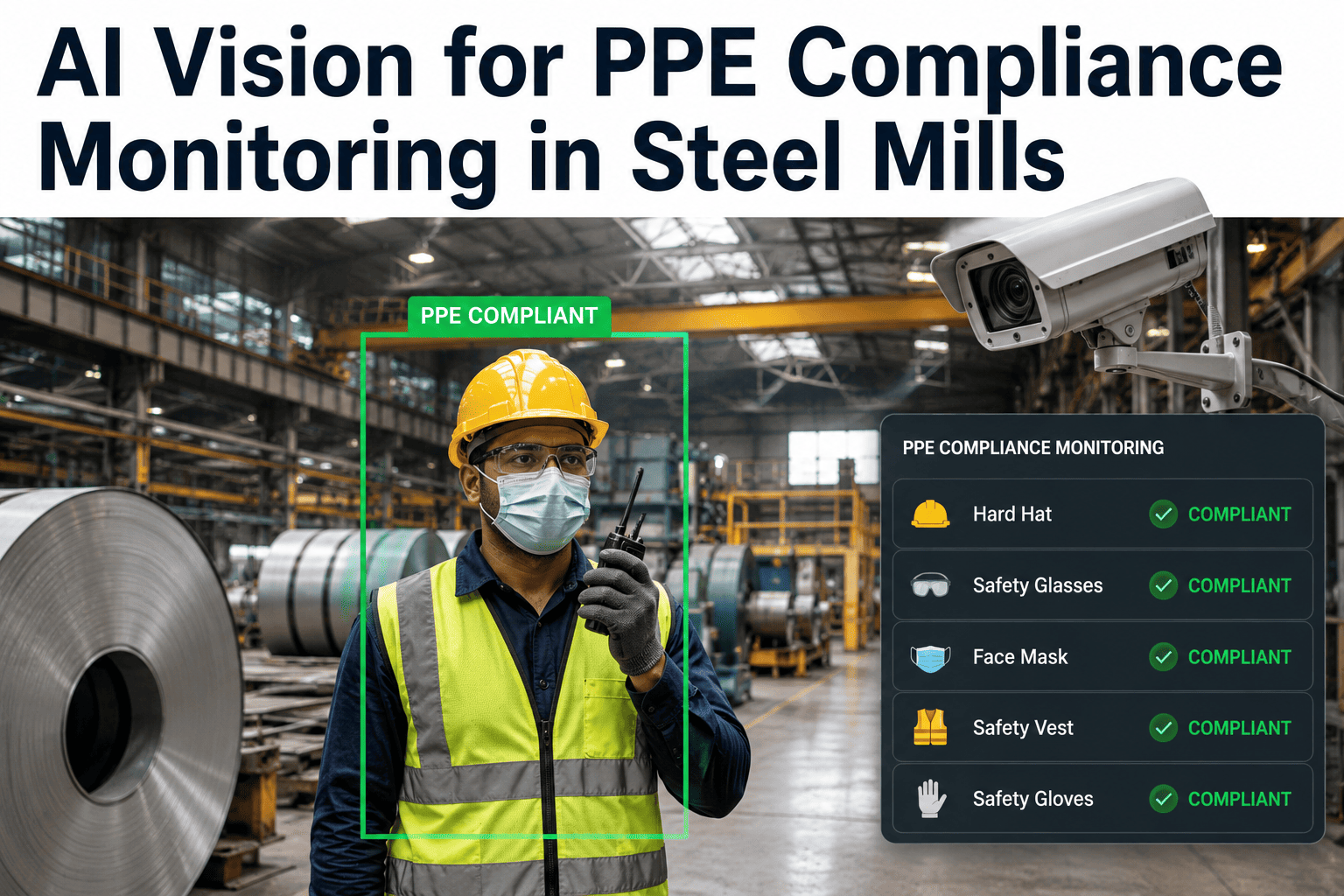
Steel mill PPE requirements go well beyond a standard hard hat and safety glasses — face shields near hot work, leather aprons around molten metal, and specific heat-resistant footwear all carry their own compliance rules, and each varies by zone. A walk-through audit once or twice a shift can only sample a fraction of the floor at any given moment, which means most PPE gaps are never actually observed by anyone. EHS directors looking for continuous coverage across every hot area can book a demo to see how AI vision tracks PPE compliance around the clock.
Track Every PPE Item, In Every Zone, On Every Shift
AI vision continuously checks face shields, aprons, footwear, and other zone-specific PPE against your plant's requirements, replacing spot-check audits with round-the-clock coverage.
Why Spot-Check Audits Undercount PPE Gaps
A scheduled walk-through audit captures a moment in time on a fixed route. It cannot see what happens in the zones the auditor isn't standing in, or the shift the auditor isn't working, which is exactly where most PPE gaps actually occur.
Zone-Specific PPE Requirements, Continuously Checked
Different areas of a steel mill call for different PPE combinations. AI vision is configured against each zone's specific requirement rather than a single plant-wide checklist.
| Zone | Required PPE Items | Monitoring Approach |
|---|---|---|
| Molten Metal / Pour Areas | Face shield, leather apron, heat-resistant boots | Continuous vision, zone-specific rule set |
| Rolling Mill Floor | Hard hat, safety glasses, hearing protection | Continuous vision, entry-point verification |
| Crane and Overhead Areas | Hard hat, high-visibility vest | Continuous vision, proximity-linked check |
| Maintenance Bays | Safety glasses, gloves, hard hat | Continuous vision, task-linked verification |
See What Continuous Coverage Would Show in Your Highest-Risk Zones
Share your zone-specific PPE requirements and camera coverage. iFactory engineers will show you what a pilot deployment could track from day one.
From Missed PPE Item to Corrective Action
Detecting a gap only matters if it leads to a timely correction. iFactory routes PPE compliance alerts to the right person, with the context needed to act quickly.
Built to Support Coaching, Not Just Catching Violations
The goal of continuous monitoring is a safer floor, not a punitive tracking system. Most plants deploying this technology use it to identify training gaps and reinforce good practice, not to single out individuals.
Rolling Out Vision-Based PPE Monitoring Without Disrupting the Floor
EHS directors evaluating this kind of system are often more concerned with how the rollout will land with the workforce than with the underlying technology itself, and that concern is worth taking seriously from the start. A rollout communicated clearly, with a stated purpose focused on safety rather than surveillance, tends to see far less friction than one that shows up on the floor unannounced.
Starting with a single high-risk zone, rather than attempting plant-wide coverage on day one, gives the EHS team a chance to validate that the zone-specific rules are configured correctly before expanding further. It also gives supervisors in that zone direct experience with how alerts work in practice, which makes them far more effective advocates when the programme extends to their colleagues in other areas of the plant.
Camera placement deserves more planning time than most rollouts initially budget for it. A camera angle that works well for general area monitoring may not reliably capture the specific PPE detail needed for accurate compliance checking, particularly for items like face shields that can be worn in a raised or lowered position. A site walk-through with both the EHS team and the vision engineering team, focused specifically on camera placement for each zone's PPE requirements, avoids a costly repositioning exercise after initial installation.
The first several weeks after go-live are usually the most important for building trust in the system's accuracy. Reviewing a sample of flagged alerts jointly with floor supervisors during this period, confirming whether each one was a genuine gap or a misread, gives the EHS team a clear picture of where the model needs further tuning before compliance data is used for any broader reporting or training decisions.
Once the model is validated in the first zone and the workforce has direct experience with how it works, expansion to additional zones typically moves much faster than the initial rollout, since much of the configuration work — defining zone rules, connecting to existing camera infrastructure, setting up alert routing — has already been proven out and can be reused with only zone-specific adjustments.
Measuring the Real Impact on Compliance Over Time
The most convincing case for continuous PPE monitoring is rarely made in the first week of deployment — it is made three to six months in, once enough trend data has accumulated to show a measurable shift in compliance patterns across zones and shifts. EHS directors evaluating whether a pilot is working should look past the raw count of alerts generated and focus instead on whether the underlying compliance rate in each monitored zone is actually improving over time.
A useful way to track this is comparing compliance rates across shifts before and after monitoring goes live in a given zone. Many plants find that compliance gaps concentrate more heavily on specific shifts or specific times within a shift, patterns that were previously invisible without continuous coverage. Once that pattern is visible, targeted coaching or a small procedural adjustment for that specific shift often closes the gap far more effectively than a general plant-wide reminder would have.
It is also worth tracking how quickly compliance gaps get corrected once flagged, not just how often they occur. A zone where alerts are frequent but consistently resolved within minutes reflects a workforce that responds well to real-time feedback, even if the raw alert count looks high on paper. A zone where the same type of gap recurs repeatedly despite alerts suggests either a training issue or a practical barrier — an uncomfortable piece of equipment, an access issue — that is worth investigating directly with the workforce in that area.
Over a longer time horizon, the trend data becomes useful well beyond individual zone compliance, informing broader decisions about equipment selection, training programme design, and even PPE procurement. If a specific PPE item is flagged as missing far more often than others across multiple zones, that pattern is worth investigating as a possible sign of a comfort or fit issue with the equipment itself, rather than assuming it reflects a workforce compliance problem alone.
Frequently Asked Questions
The questions EHS directors most often raise before adding AI vision PPE monitoring to an existing safety programme.
Book a PPE Compliance Walkthrough
Share your zone map and current PPE requirements. iFactory engineers will show you exactly how continuous monitoring would work across your specific floor layout.