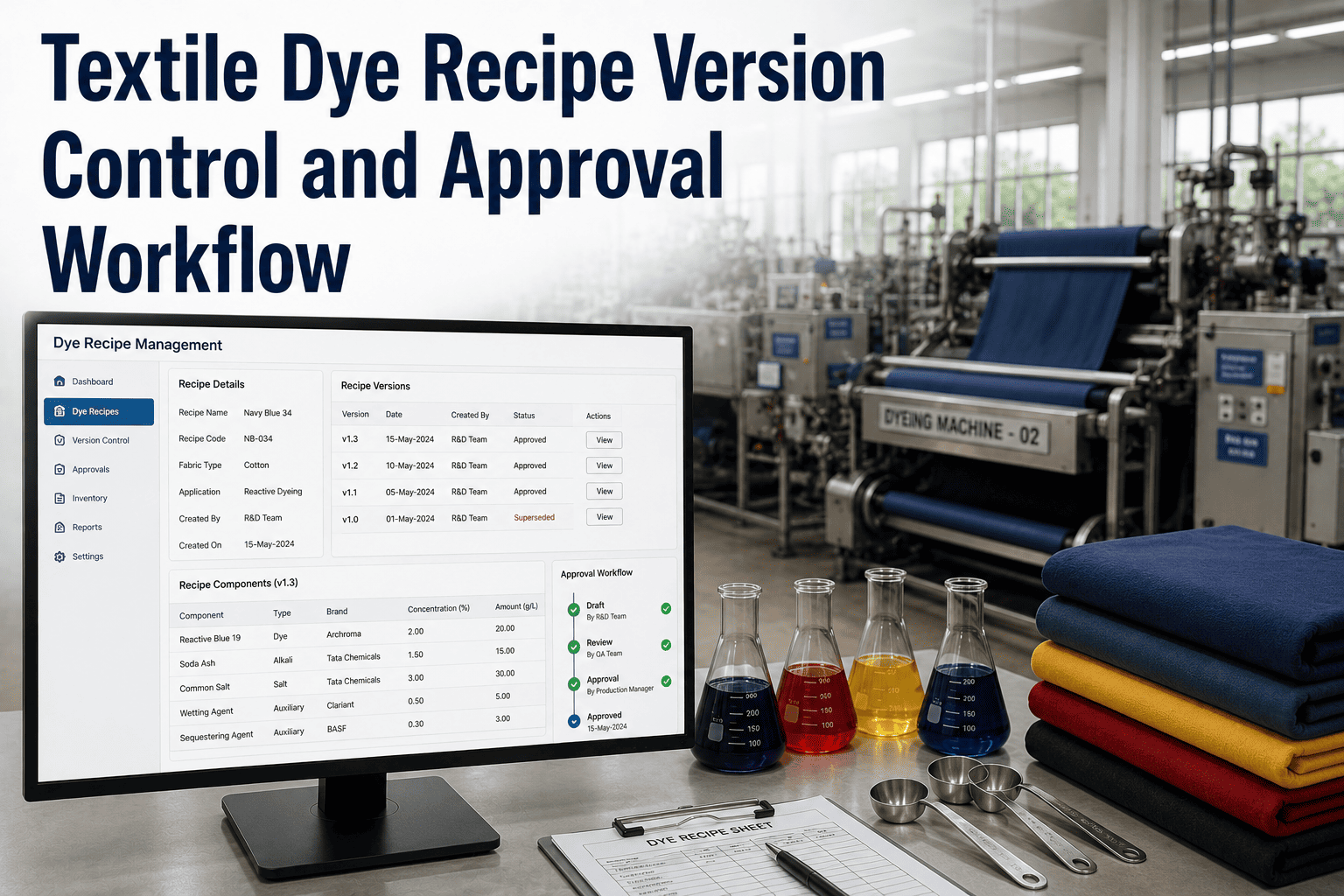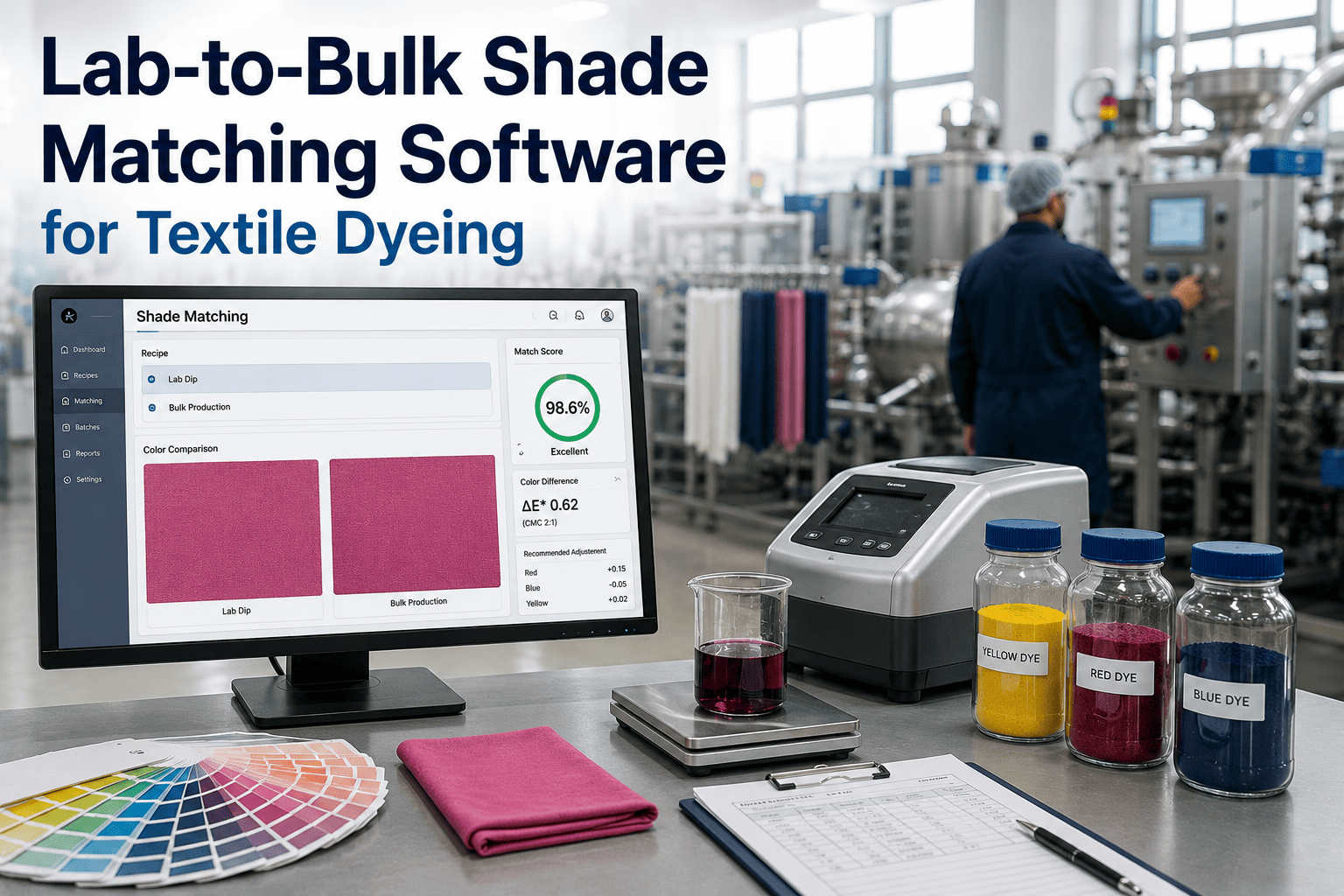
A textile brand ships a physical color standard to a supplier eight time zones away. The supplier dyes a lab dip, ships it back, and three weeks later a color manager holds it under a lightbox and says no — close, but not quite. That cycle repeats two or three times before approval, and each round costs a courier fee, dye lot, and roughly a week of calendar time that a digital color workflow eliminates almost entirely. The physical swatch that started the whole process was never actually a precise standard in the first place — it was a best approximation, subject to fading, lighting variation, and the simple reality that a supplier's available dyes may never have been capable of reproducing it exactly, no matter how carefully the dye house's colorist worked. iFactory's digital color communication module replaces the physical swatch relay with spectral data exchanged instantly between every actor in the color supply chain — cutting sample approval time by up to 50% according to industry benchmarks.
The Physical Swatch Was Never a Precise Color Standard — It Was a Best Guess in Fabric Form
Two identical-looking swatches can carry meaningfully different spectral data. Digital color communication replaces subjective visual matching with a number every actor in the supply chain can measure against.
Why a Physical Swatch Was Never a Reliable Standard
Traditional color communication in textile sourcing is built on physical samples: a brand's designer specifies a color, a physical swatch gets produced, and every supplier downstream must reproduce that exact shade using whatever dyes and chemicals they have available. Experience across the industry shows it's rarely possible to reproduce a color standard exactly from a physical sample alone — a supplier may simply lack the specific dye needed to hit the precise shade, and nobody discovers the mismatch until a lab dip ships back for visual comparison under a lightbox, days or weeks later. By the time that mismatch is discovered, an entire shipping and dyeing cycle has already been spent finding out something a spectral measurement could have flagged instantly.
The Physical Sample Problem
A fabric swatch degrades, fades, and varies subtly depending on how it was cut, stored, and lit during review — turning a supposedly fixed reference point into something that shifts slightly every time it changes hands.
The Digital Standard Alternative
A spectral data file measured from the original standard captures the exact color as a set of numeric reflectance values — a reference that doesn't fade, doesn't degrade in shipping, and reads identically on any calibrated instrument anywhere in the world.
Spectral Data: What Actually Gets Exchanged
A digital color standard is not simply a photograph or an RGB value pulled from a screen — those formats lose the precision needed for genuine textile color matching. What actually gets exchanged is spectral reflectance data: a measurement of how a surface reflects light across the visible spectrum, captured by a spectrophotometer and expressed as numeric values an instrument anywhere else can read and compare directly. This distinction matters more than it might first appear, because a screen's RGB display and a fabric's physical reflectance behave according to entirely different underlying physics, and no amount of screen calibration can substitute for an actual spectral measurement of the material itself.
| Component | What It Defines | Why It Matters |
|---|---|---|
| Spectral Reflectance Curve | How the material reflects light at each wavelength across the visible spectrum | The most precise, instrument-independent color description available |
| Tolerance | How much deviation from the target is acceptable before a match is rejected | Removes subjective judgment calls about whether a lab dip is "close enough" |
| Illuminant | The specific light source condition the color should be evaluated under | The same fabric can look different under different lighting — the illuminant fixes the evaluation condition |
| Inter-Instrument Agreement | How consistently different spectrophotometers read the same physical sample | Without it, data measured on one instrument doesn't reliably translate to another across the supply chain |
Inter-instrument agreement deserves particular attention, because it's the factor most often overlooked outside a color science team. With every actor in a global supply chain separated by oceans and time zones, measurement data has to be reliable and repeatable not only on the original instrument, but on every other instrument down the chain — a spectral file is only as useful as the confidence that a second spectrophotometer, thousands of miles away, will interpret it consistently. Without that confidence established and periodically re-verified, a digital workflow simply moves the same trust problem from physical samples to numeric data, without actually resolving it.
The Five Actors in a Digital Color Supply Chain
Color communication in textile sourcing typically involves five distinct parties, each with a different role and a different need for the same underlying spectral data. Internet-based technology exists specifically to support the accurate, real-time flow of that data between all five — replacing the old model where each handoff meant another physical sample in transit, and where a delay or error at any single link in the chain propagated forward into every subsequent step.
Brand / Designer
Originates the color specification and creates the initial digital color standard, defining the target shade, acceptable tolerance, and the illuminant condition suppliers must match against.
Sourcing / Merchandising Team
Routes the digital standard to selected suppliers and tracks approval status across every color and every vendor in a given production season, without waiting on physical samples to arrive before status is visible.
Dye House / Supplier
Receives the spectral data and formulates a dye recipe using color-matching software, comparing the formulated result against the digital tolerance before committing dye and fabric to a physical lab dip.
Quality / Color Manager
Reviews the submitted match against the approved tolerance digitally, approving or rejecting based on measured deviation rather than a subjective visual call under a lightbox.
Manufacturing / Production
Uses the approved digital standard as the production reference for bulk dyeing, with the same spectral data guiding batch-to-batch consistency checks throughout the full production run.
Formulation Software: Where the Actual Dye Recipe Gets Built
Receiving spectral data is only the first half of a digital color workflow — the dye house still has to convert that target into an actual, physical dye recipe, and this is where formulation software becomes the critical link between digital precision and physical production. Rather than a colorist manually adjusting a recipe by eye against a physical swatch, formulation software calculates a proposed dye combination mathematically from the spectral target, accounting for the specific dyes, fiber type, and process conditions available at that particular dye house. The output is a starting formulation grounded in measurement rather than a colorist's memory of similar past jobs, which matters enormously when the target shade has never actually been produced at that specific facility before.
Recipe Prediction
The software proposes a specific combination and concentration of dyes calculated to hit the target spectral curve, drawing on a database of how that dye house's available colorants behave on the specific substrate being dyed.
Pre-Dip Verification
Before committing fabric and dye to an actual physical lab dip, the predicted formulation is compared digitally against the tolerance — catching a formulation that won't hit the target before any material is actually consumed.
This pre-dip verification step is where a meaningful share of the efficiency gain actually comes from — a dye house achieving strong first-attempt accuracy isn't simply getting lucky more often, it's mathematically checking the formulation against the digital target before spending dye and fabric on a physical attempt that's already been calculated to miss the specified tolerance.
The Multi-Tier Supply Chain Problem: Digital Data Doesn't Always Reach Everyone
A brand's direct relationship is typically with a first-tier supplier — a garment manufacturer or a fabric mill — but the actual dyeing frequently happens further down the chain, at a second- or third-tier dye house the brand has no direct relationship with at all. Digital color communication that stops at the first tier, with the deeper supply chain still relying on physical samples passed hand to hand, preserves much of the delay and error the digital workflow was meant to eliminate — the bottleneck simply relocates to a part of the chain the brand can't see or influence directly.
Digital Standard Stops at Tier One
A brand sends spectral data to its direct garment supplier, who then reverts to a physical swatch when communicating with the actual dye house several tiers deeper — reintroducing the original delay at exactly the stage where the color is actually produced.
No Visibility Into Sub-Tier Instrument Quality
Even when a deeper-tier dye house does have a spectrophotometer, the brand often has no way to verify its calibration or inter-instrument agreement, undermining confidence in data that technically made it all the way down the chain.
Extending digital color communication genuinely end-to-end — reaching the actual dye house doing the physical work, not just the first-tier relationship a brand directly manages — is what determines whether the full benefit of the workflow is realized, or whether the gains simply shift the bottleneck one tier deeper into a supply chain the brand has less direct visibility into.
A Composite Scenario: Three Weeks Becomes Three Days
Consider a mid-size apparel brand sourcing a specific navy shade from a supplier in a different hemisphere, working under the traditional physical-sample model. The brand's designer specifies the color, a physical swatch is cut and shipped by courier, and roughly a week later the supplier's dye house receives it, attempts a match, and ships a lab dip back — another week in transit. The color manager reviews it under a lightbox, finds it slightly too cool, and rejects it. The cycle repeats: another swatch, another dye lot, another week each way. By the time an acceptable match is approved, three full cycles and nearly six weeks have passed, along with the courier costs and wasted dye lots from two rejected attempts — costs that never appear as a single obvious line item, but that accumulate quietly across every color, every season, and every supplier a brand works with.
Under a digital workflow, the same brand instead measures the target color once with a spectrophotometer and transmits the spectral data, tolerance, and illuminant specification to the same supplier electronically — arriving in seconds rather than a week. The dye house's formulation software builds a match against the digital target, evaluates it against the tolerance before any dye is committed to fabric, and submits the closest digital match for review the same day. The color manager evaluates the submission against the same numeric tolerance rather than a subjective visual impression, approves within the defined range, and the entire cycle — from specification to approval — compresses from nearly six weeks down to a matter of days, with far fewer wasted physical samples along the way.
What the Published Benchmarks Actually Show
The figures below come from independent industry surveys and platform performance data across brands that have made the shift from physical-sample to digital color workflows, and they consistently point in the same direction regardless of exact source.
Industry surveys of brands using electronic color management report roughly a 50% reduction in the number of days needed to obtain sample approval from overseas suppliers, compared to physical-sample workflows.
Cloud-based spectral data exchange platforms report first-attempt lab dip accuracy rates around 95% when suppliers formulate directly against digital tolerance data rather than visually matching a physical sample.
Brands adopting digital color specification and cloud-based approval workflows report time-to-market improvements in the range of 75% for the color approval stage specifically, compressing weeks into days.
Fewer rejected lab dips means fewer wasted dye lots, fewer courier shipments, and a measurably smaller carbon footprint tied to the sample approval process specifically.
Common Mistakes in Digital Color Adoption
The mistakes below show up repeatedly across brands transitioning from physical to digital color workflows, and most of them stem from treating the digital layer as a cosmetic addition rather than genuinely rebuilding the underlying process and organizational habits around it.
Skipping Inter-Instrument Calibration
Deploying spectrophotometers across multiple suppliers without verifying they agree with each other on the same physical samples produces a digital workflow that's precise on paper but inconsistent in practice.
Treating Digital Data as a Photo, Not Spectral Measurement
Sharing a photograph or a screen RGB value instead of genuine spectral reflectance data discards the precision that makes digital color communication valuable in the first place — screens and cameras are not color-accurate measurement instruments.
Setting Tolerances Too Loosely or Too Tightly
A tolerance set too loose approves visually unacceptable matches; one set too tight rejects commercially acceptable ones and drives unnecessary rework. Calibrating tolerance against what's genuinely achievable and acceptable takes deliberate testing, not a default setting.
Never Retiring the Physical Sample Entirely
Running a digital workflow in parallel with a still-mandatory physical confirmation sample for every approval preserves most of the original cycle time the digital process was meant to eliminate.
Every Rejected Lab Dip Is a Week and a Dye Lot You Didn't Need to Spend
iFactory routes digital color standards to every supplier instantly, with tolerance and illuminant data built in — so approval happens against a number, not a lightbox and a guess.
Who Owns Digital Color Adoption Inside a Brand
Rolling out digital color communication touches more departments than a typical software adoption — sourcing needs the workflow to actually speed up supplier relationships, quality needs confidence the digital tolerance genuinely reflects acceptable production output, and IT needs the data exchange to integrate cleanly with existing PLM and ERP systems already in place. A rollout owned entirely by any one of these functions in isolation tends to satisfy that function's priorities while leaving the others unconvinced, which is a common reason pilots stall before reaching full supplier-base adoption.
Color & Quality Team
Owns the tolerance and illuminant standards, verifies inter-instrument agreement across the supplier base, and ultimately signs off on whether the digital approval process is genuinely producing acceptable production results.
Sourcing & Merchandising
Drives supplier adoption and integrates the digital workflow into the broader development calendar, ensuring the faster approval cycle actually translates into a shorter overall time-to-market rather than getting absorbed elsewhere in the schedule.
Without clear ownership spanning both functions, a digital color pilot often stalls after initial rollout — the color team validates the technical accuracy but has no mandate to drive supplier adoption, while sourcing wants faster cycles but lacks the technical authority to set and enforce tolerance standards. Genuine adoption requires both functions moving together, with shared accountability for the program's success rather than each treating it as the other department's initiative to carry forward alone.
Frequently Asked Questions
The questions below reflect what sourcing and color teams most often ask as they move from a physical-sample workflow toward a genuinely digital color communication process.
Does digital color communication eliminate the need for physical samples entirely?
Not entirely, but it dramatically reduces reliance on them. Most mature digital workflows still use a final physical confirmation sample before bulk production begins, but the multiple rejected lab-dip cycles that used to consume weeks are replaced by digital comparison against spectral tolerance data — the physical sample becomes a final verification step rather than the primary matching mechanism. Visit support to see how a hybrid digital-physical workflow is typically structured.
What equipment does a supplier need to participate in a digital color workflow?
A calibrated spectrophotometer capable of measuring and communicating spectral reflectance data, along with color formulation software compatible with the brand's chosen data exchange format, is the baseline requirement. Many suppliers already own this equipment for internal quality control — the shift is in connecting it to a shared digital exchange rather than using it only for isolated internal checks. Book a demo to see typical supplier onboarding requirements.
How is a digital tolerance different from a visual "looks close enough" approval?
A digital tolerance defines a specific, numeric acceptable deviation from the target spectral data, evaluated the same way every time regardless of who is reviewing it or what lighting they're standing under. A visual approval depends on the individual reviewer's perception, the lighting condition in the room, and even how tired that reviewer happens to be that day — sources of inconsistency a numeric tolerance removes entirely.
Can digital color data be trusted across suppliers using different spectrophotometer brands?
Yes, provided inter-instrument agreement has been established and verified — the practice of confirming that different physical instruments produce consistent readings on the same physical sample. Without this verification step, spectral data measured on one brand of instrument may not translate reliably to another, undermining the consistency the digital workflow is meant to provide. Contact support for guidance on cross-brand instrument calibration.
How long does it take to roll out a digital color workflow across an existing supplier base?
Most brands start with a pilot group of key suppliers, verifying instrument calibration and workflow fit before expanding further. A realistic timeline for a meaningful portion of a supplier base to be fully onboarded, calibrated, and actively using digital color data runs several months to a season, depending on how many suppliers need new equipment versus simply connecting existing spectrophotometers to the shared workflow.
Stop Shipping Fabric to Find Out If the Color Is Right
iFactory connects every brand, sourcing team, dye house, and quality reviewer around a single spectral data standard — so color approval happens in days, not weeks, and against a measurement, not a guess.