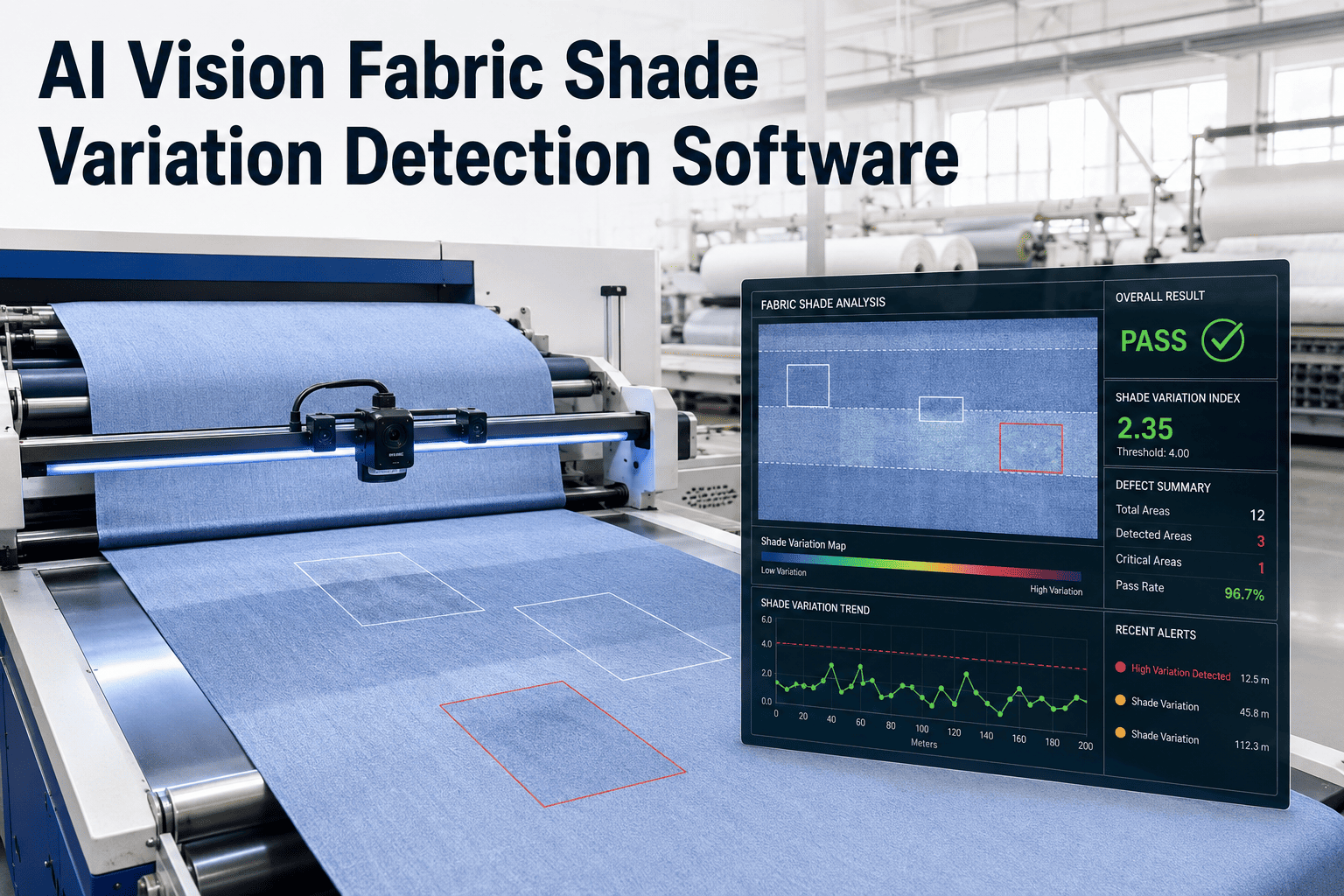
Double picks, kinky weft, and floats are the classical woven defects that grey inspection catches and buyers penalise — every one avoidable if the loom flagged them at insertion rather than the inspector finding them 12 hours later at the grey table. Under the American 4-Point System (ASTM D5430), each carries specific penalty points, holes and tears are automatic 4-point, and roll acceptance sits against the buyer's tolerance in points per 100 metres. Vision AI on the loom detects each defect at insertion, grades against the 4-Point System, and pushes the record to home-textile QC ahead of grey inspection.
iFactory / Loom-vision defect grading
Grade Every Loom Defect Live — Before Grey Inspection Catches It
Loom-vision defect classification and 4-Point System grading for double picks, kinky weft, floats, holes, and other woven defects — with defect data pushed to home-textile QC ahead of grey inspection for hold, cut-around, or route decision.
Double pick
2 pt
Loom 22 · pick 4,120
Kinky weft
1 pt
Loom 41 · pick 8,904
Hole / tear
4 pt
HOLD · roll 11-034
Loom vision
live at insertion
Home textile QC
push ahead of grey
The Problem in Grey Inspection Timing
A typical home-textile weaving mill runs looms 24 hours and grey-inspects the resulting rolls at a table with a QC inspector reading defects by eye at 12-25 m/min. Double picks, kinky weft, floats, and holes are the standard defect vocabulary — each with specific 4-Point System penalties under ASTM D5430, aggregated into points per 100 metres for acceptance. The problem is timing. The defect happened 8-12 hours ago on the loom; the inspector catches it now at the grey table. By then all rolls from that loom during the shift carry the same defect pattern, and the mill discovers a batch-level issue only after the batch is complete.
Where Home-Textile Defect Grading Actually Fails
Weaving defect grading failure modes are consistent across home-textile mills producing bed linen, curtains, towels, and utility fabrics. Each is a specific timing or attribution gap.
Discovery lag
Grey inspector catches the defect 8-12 hours after the loom created it. All rolls from that shift affected. Batch downgrade decisions expensive.
Inspector variance
Two inspectors grade the same roll differently — one at 24 points/100m, another at 31. Consistency across shifts a running problem. Buyer disputes follow.
4-Point misapplied
Inspector applies penalties inconsistently — a 4-inch defect gets 2 points from one inspector, 3 from another. ASTM D5430 rules are specific; application drifts.
QC hold delay
Home-textile QC waits for grey inspection to know which rolls need hold or cut-around. Delays the decision by shifts; by then some rolls have already shipped to finishing.
What Good Looks Like in Loom-Vision Grading
A working loom-vision grader holds four disciplines together — live detection at insertion, 4-Point System classification, home-textile QC push, and inspector-augmentation.
Live at Insertion
Vision at loom detects double pick, kinky weft, float, hole at the moment they occur. Defect type and severity captured; loom pick count records exact position.
Insertion, not table
4-Point Graded
Every defect graded against ASTM D5430 — 1/2/3/4 points by size, holes/tears automatic 4-point. Grading consistent because it's algorithmic, not per-inspector.
Algorithmic grading
Home Textile QC Push
Defect record pushed to home-textile QC system immediately. QC decision (hold, cut-around, route to lower-tolerance buyer) made before roll reaches grey table.
Decision before grey
Inspector Augment
Grey inspector no longer hunts for defects — the map is already there. Inspection becomes verification, not discovery. Throughput at the grey table doubles.
Verification, not hunt
How iFactory AI Fits
iFactory AI overlays your looms, grey inspection systems (Uster Fabriq, Elbit Vision, Barco Vision), and home-textile QMS — providing loom-vision defect capture, 4-Point grading, and the QC-push workflow that repositions grey inspection as verification rather than discovery.
Loom Vision
Vision Layer
Vision at loom port captures defects at insertion — double pick, kinky weft, float, hole, temple mark, reed mark. Loom pick count records exact position for downstream reference.
4-Point Grader
Vision + Standards
ASTM D5430 4-Point grading applied algorithmically. Consistent grade regardless of inspector. Per-buyer tolerance override for custom grading rules.
QC Push
Vision + QMS
Every defect record pushed to home-textile QC before roll reaches grey table. QC sees loom, pick position, defect type, and grade; makes hold/cut/route decision without waiting.
Grey Inspection
Vision + Grey
Grey inspection receives defect map at table. Inspector verifies (does not hunt). Throughput at grey table increases; inspector time returns to judgement calls.
Ask your weaving QA manager how many rolls get downgraded or disputed with buyers per month for defects that trace to loom conditions the shift knew about. If the number is more than a few, the loom-vision grader is where the recovery lives — because attribution and timing shift decisively toward the loom. Book a defect grading review.
10-Week Loom-Vision Grading Pilot on One Shed
One shed of home-textile looms (30-80), ten weeks. The pilot deploys loom-vision grading, activates 4-Point classification, pushes defect records to home-textile QC, and closes the first month of pre-grey QC decisions.
Weeks 1–2
Vision Mount
Loom-vision cameras mounted per port. Baseline current-state defect rates and inspector grading variance. Buyer tolerance profiles loaded.
Weeks 3–5
Grading Live
4-Point grading algorithmic per defect. Consistency against inspector benchmark measured. Model tuning against buyer-specific tolerance rules.
Weeks 6–8
QC Push
Defect push to home-textile QC live. Hold, cut-around, route decisions made pre-grey. QC decision cycle measured against previous post-grey cycle.
Weeks 9–10
Grey as Verification
Grey inspection repositioned as verification. Inspector throughput measured. Buyer disputes on defect grading measured against baseline.
Who Owns the KPI
Loom-vision grading crosses weaving, QA, home-textile QC, and buyer-facing account management. Each function owns a specific KPI or discovery stays post-shift.
Weaving QA Manager
Defect discovery cycle time
Owns the timing outcome — hours from defect occurrence to QC decision. Loom-vision cuts from 8-12 hours to minutes.
Home Textile QC Lead
Pre-grey hold decisions
Owns the decision velocity — hold, cut-around, and route decisions made before grey inspection. Post-grey decisions accumulate cost.
Grey Inspection
Inspector throughput at table
Owns the inspection efficiency — throughput at grey table with vision-augmented inspection. Verification faster than discovery.
Buyer Account Lead
Buyer disputes on 4-Point grading
Owns the customer-facing outcome — disputes tied to grading consistency or missed defects. Algorithmic grading and pre-shipment maps reduce both.
FAQ
How does 4-Point System grading actually apply to loom-vision data?
ASTM D5430 4-Point System assigns penalty points by defect size: defects under 3 inches = 1 point, 3-6 inches = 2 points, 6-9 inches = 3 points, over 9 inches = 3 points (or 4 depending on the variant applied); holes and tears are automatic 4 points regardless of size. Vision measures defect size directly from the image with sub-mm precision, so grading is algorithmic rather than eye-estimated. Roll acceptance sits at buyer-specific thresholds — many home-textile buyers accept up to 20-40 points per 100 linear metres for first quality, with tolerance rising for utility fabrics. The workflow applies each buyer's specific tolerance so the same defect might route to Buyer A as first quality and Buyer B as reject.
What if we use a different grading system — Graniteville, 10-Point, or European?
Multiple grading systems exist across the industry: American 4-Point (ASTM D5430, most common globally), Graniteville 78 (heavier penalties for large defects), 10-Point System (older US mill practice), European system (varies by country). The workflow supports each with configurable point-per-defect-size tables. Where a mill supplies buyers using different systems (common — one line to US buyers on 4-Point, another line to European buyers on their system), the same underlying defect data grades against multiple systems automatically. The physical measurement is one truth; the point calculation is per-system.
Book a demo to see multi-system grading.
How does this handle defects that appear only after finishing — dye variance, shrinkage effects?
Loom vision captures what happens at the loom — structural defects (double pick, kinky weft, float, hole), mechanical marks (reed, temple), yarn defects that survive weaving. Defects that appear only after finishing — dye variance, shrinkage misalignment, print registration issues, coating flaws — need vision at the specific finishing operation that induces them. The workflow supports finishing-stage vision alongside loom vision so the complete defect map for a roll includes both weaving-origin and finishing-origin defects. What loom vision doesn't do is predict finishing defects; what it does is provide the weaving-origin baseline against which finishing-added defects can be attributed correctly.
Stop letting grey inspection be the discovery step.
Grade Loom Defects Live on One Shed — 4-Point System
Bring one shed of home-textile looms, the last month of grey inspection findings, and buyer tolerance profiles for the top three customers. We'll walk what loom-vision grading would have caught pre-grey, and demonstrate the QC push workflow.