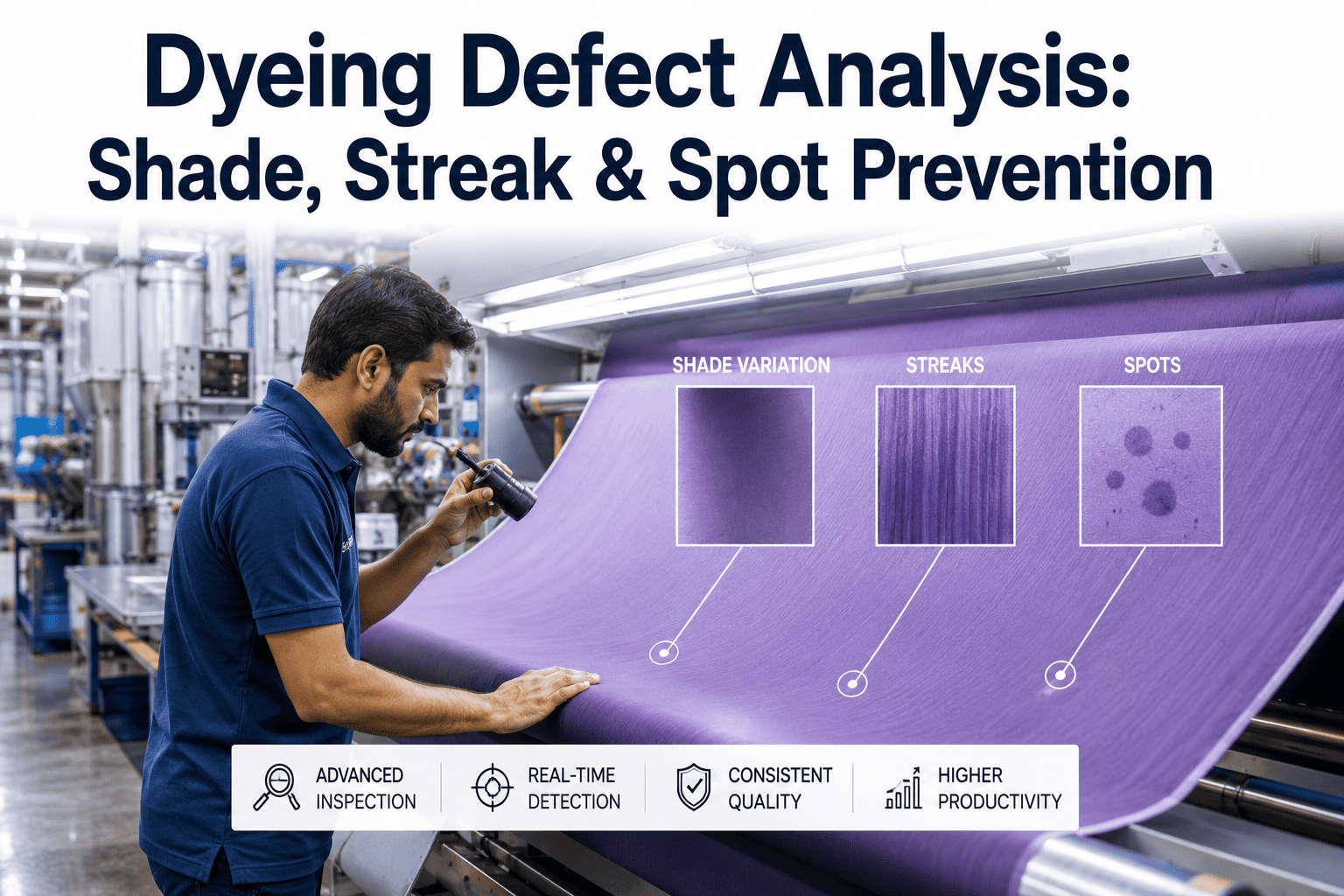
A streak running the length of a fabric roll looks like the same problem no matter what machine produced it, but the cause behind a streak on a jet dyeing machine is rarely the same cause behind one on a winch or a package dyeing unit. Treating streak investigation as one generic troubleshooting checklist, applied identically regardless of machine type, is why so many mills keep circling back to the same defect without ever landing on a fix that actually holds. The mechanics of fabric movement, liquor circulation, and pressure differ enough between machine types that the root cause list has to be built separately for each one.
The Streak Looks the Same. The Machine Behind It Rarely Causes It the Same Way.
Dye streaking is a broad defect category with fundamentally different root causes depending on machine type — jet, overflow, winch, and package dyeing each move fabric or liquor differently, and a fix that works on one often does nothing on another.
Why a Generic Streak Checklist Wastes Investigation Time
A common first response to a streak complaint is pulling out a generic troubleshooting checklist — check dye purity, check water quality, check the recipe, check the operator's log — and working through it top to bottom regardless of which machine produced the defect. This approach isn't wrong exactly, but it's inefficient in a way that costs real production time, because several of the most common streak causes are entirely mechanical and specific to how a particular machine moves fabric or liquor, and no amount of checking dye purity or water chemistry will ever surface a partially blocked jet nozzle or a worn winch guide roller. A generic checklist treats every streak as a chemistry or process problem first, when a meaningful share of streaking, particularly on jet and winch machines, originates from mechanical wear or misalignment that a chemistry-focused checklist was never designed to catch.
The more efficient approach starts with the machine type and the pattern shape, narrowing the investigation to the small set of causes actually plausible for that combination before broadening into chemistry or process variables only if the mechanical checks come back clean. This isn't just faster — it also prevents a common and costly mistake, where a mill responds to a streak by reformulating the dye recipe or adjusting a process parameter that had nothing to do with the actual cause, sometimes introducing a second, unrelated quality issue while chasing a fix for a problem that was mechanical all along.
Four Machine Types, Four Different Streak Mechanisms
Fabric Rope Turbulence Streaking
Fabric moves as a rope propelled by liquor jet force — uneven jet pressure or rope entanglement creates localized turbulence that produces streaking along the rope's contact points.
Liquor Flow Rate Streaking
Fabric moves via a gentler overflow liquor stream — inconsistent flow rate or an underfilled bath produces intermittent fabric-liquor contact and visible banding.
Fold-Line Contact Streaking
Fabric runs in open-width folds over a winch reel — a fold line that repeats in the same position cycle after cycle gets under-exposed to fresh liquor relative to the rest of the fabric.
Radial Penetration Streaking
Yarn wound on a package needs liquor to penetrate radially through the wind — uneven package density or channeling creates streaking that shows as rings once the yarn is later woven or knitted.
Jet Dyeing: Where the Turbulence Actually Comes From
Jet dyeing machines rely on a liquor jet to physically propel fabric through the machine as a continuous rope, and the streak patterns specific to this machine type trace almost entirely back to how evenly that propulsion force is applied. A nozzle with partial blockage, even a minor one from lint or dye residue buildup, creates asymmetric jet pressure that pushes one side of the fabric rope faster than the other, producing a twist that leads to uneven liquor contact and a streak that often runs at a slight diagonal rather than perfectly parallel to the fabric's length. Rope entanglement, where multiple fabric loops within the machine catch against each other rather than moving freely, creates a similar effect by holding sections of fabric in prolonged contact with each other rather than with fresh liquor.
Reel speed mismatch relative to jet pressure is a subtler jet-specific cause — if the reel that guides the fabric rope back into the jet chamber runs even slightly out of sync with the liquor propulsion rate, fabric can bunch at the reel exit point, creating a localized zone of extended, uneven liquor contact each time that section passes through. Because this defect repeats at a fixed interval tied to the rope's total cycle length, a jet dyeing streak that appears at regular intervals along the fabric roll is a strong diagnostic clue pointing toward reel-to-jet synchronization rather than a random contamination or chemistry issue.
Match the Investigation to the Machine, Not a Generic Checklist
iFactory logs jet pressure, liquor flow, and reel speed data per batch, so a recurring streak pattern can be traced to the specific mechanical driver rather than guessed at.
Overflow Machines: When Gentler Handling Still Streaks
Overflow dyeing machines were designed as a gentler alternative to jet systems, moving fabric via a liquor overflow stream rather than direct jet propulsion, which reduces mechanical stress on delicate fabrics but introduces its own streak mechanism tied to flow consistency rather than jet turbulence. An underfilled bath is the most common overflow-specific cause — if the liquor level drops below the machine's designed operating range, even briefly during a cycle, sections of fabric can pass through the overflow zone with reduced or inconsistent liquor contact, producing a band of lighter shade that reads as a streak once the fabric is inspected under full-width tension.
Pump flow rate fluctuation, often caused by a partially clogged filter or an aging pump losing consistent output pressure, produces a related but distinguishable pattern — rather than a single clean band, inconsistent flow tends to create a more irregular, wavering streak that varies in width along its length, reflecting the pump's fluctuating rather than fixed deficiency. Because overflow systems depend on maintaining a specific liquor-to-fabric ratio throughout the cycle, any component that disrupts steady flow — a partially blocked strainer, a valve not opening fully — tends to show up as streaking well before it would trigger any other alarm on the machine.
Winch Machines: The Fold Line That Keeps Repeating
Winch dyeing runs fabric in open-width folds draped over a rotating reel, and because the fabric's path through the machine is cyclical, any inconsistency in that path tends to repeat at the same physical location on the fabric with each pass — this is the defining characteristic of a winch-specific streak, and it's what separates it diagnostically from jet or overflow streaking, which tend to appear more continuously or diagonally rather than at a fixed repeating interval. A fold that consistently lands in the same position, often due to reel guide wear or an uneven reel surface, creates a section of fabric that spends more time folded against itself than exposed to open liquor circulation, and that section develops a visibly lighter, streaked appearance running the full length of the batch. The interval between repeats typically matches the fabric's total cycle length through the machine, which is itself a useful diagnostic number worth recording alongside the streak observation.
Guide roller wear compounds this problem over time — a roller with an uneven or grooved surface, developed gradually through months of fabric friction, can introduce a subtle but consistent fold bias that wasn't present when the machine was new. This is part of why a winch machine that produced consistent, streak-free fabric for years can begin showing a chronic streak pattern with no obvious single cause — the guide surface degraded slowly enough that no single maintenance inspection flagged it as the trigger.
Package Dyeing: Streaks You Only See After Weaving
Package dyeing presents a uniquely delayed diagnostic challenge, since the streaking defect — uneven radial penetration of liquor through a wound yarn package — often isn't visible on the package itself and only becomes apparent once the yarn is unwound and woven or knitted into fabric, at which point the streak appears as a repeating ring pattern that traces back to specific radial zones of the original package. Uneven package winding density is the most common driver, since a section wound tighter than the rest resists liquor penetration more than the surrounding looser-wound yarn, creating a corresponding zone of lighter dye uptake that maps directly to the winding inconsistency.
Channeling — liquor finding a low-resistance path through the package rather than penetrating evenly across its full radial cross-section — produces a related but mechanically distinct defect, often traceable to a package that was loaded with inconsistent tension or that developed a gap during the winding process. Because the consequence of package dyeing streaking only surfaces downstream in weaving or knitting, mills that dye yarn for their own subsequent fabric production have a real advantage over those selling dyed yarn directly, since in-house downstream inspection catches the defect while it can still be traced back to a specific package and dye lot rather than surfacing as an unexplained customer complaint months later.
Streak Diagnosis Quick-Reference by Pattern Shape
| Streak Pattern | Most Likely Machine Type | Primary Suspect |
|---|---|---|
| Diagonal, continuous | Jet dyeing | Nozzle blockage or asymmetric jet pressure |
| Irregular, wavering width | Overflow | Pump flow rate fluctuation |
| Fixed interval, repeating | Winch | Fold line or guide roller wear |
| Ring pattern, post-weaving | Package dyeing | Uneven winding density or channeling |
Streak Diagnosis Quick-Reference by Pattern Shape
Pattern shape alone doesn't guarantee a specific cause, but it reliably narrows the field of plausible candidates enough to make the physical inspection step far more targeted than starting from scratch. A quality inspector trained to read the shape of a streak before opening a work order — noting whether it's continuous or repeating, diagonal or straight, sharp-edged or gradual — hands the maintenance or process team a genuinely useful starting hypothesis rather than a vague "fabric came out streaky" report that leaves the entire machine open to suspicion. This small habit, essentially free to implement since it requires no new equipment or software, consistently cuts the time between a streak complaint and a confirmed root cause.
It's worth noting that pattern shape can blur when more than one cause is active simultaneously, which does happen — a jet machine with both a partially blocked nozzle and a mild reel synchronization drift can produce a streak that doesn't cleanly match either single-cause pattern described in the reference table. In these mixed cases, the pattern-shape method still earns its keep by narrowing the investigation to jet-specific mechanical causes broadly, even if it can't isolate the single dominant factor without a physical inspection to follow up.
A Composite Investigation: Solving a Jet Machine's Diagonal Streak
A knit fabric dyer running three jet dyeing machines noticed one specific machine producing a faint diagonal streak on roughly one in five batches, while the other two identical machines ran clean. Because the defect appeared on only one machine despite identical recipes and identical fabric types running across all three, the investigation focused immediately on machine-specific mechanical factors rather than process parameters shared across the fleet. A physical inspection of the affected machine's nozzle assembly, prompted by the diagonal pattern's known association with jet pressure asymmetry, found a partial lint accumulation inside one of the twin nozzles feeding the rope chamber.
Clearing the blockage and adding a nozzle inspection step to the machine's existing PM schedule resolved the streak entirely across the following forty batches. What made the case notable wasn't the mechanical fix itself, which was straightforward once identified, but how much time had been lost investigating dye chemistry and process parameters on this specific machine before anyone considered the nozzle, purely because the fabric type and recipe were identical to the two clean-running machines and nobody initially thought to check for a machine-specific mechanical difference between otherwise identical equipment.
The dyer's quality lead later estimated that roughly three weeks of investigation time, spread across several partial process trials, had gone into chasing recipe and chemistry explanations before the nozzle inspection finally happened — time that a pattern-shape-first approach, applied from the very first occurrence, would likely have cut to a matter of days.
Building a Machine-Specific Streak Investigation Checklist
Turning the machine-type distinctions covered above into a working investigation checklist is straightforward once the underlying mechanics are understood, but it requires the checklist itself to branch by machine type rather than presenting a single flat list — a jet machine's checklist should lead with nozzle and reel synchronization checks, an overflow machine's should lead with flow rate and bath level, a winch machine's should lead with guide roller and fold position, and a package machine's should lead with winding density and channeling risk. Building this branching structure once, and training quality and maintenance staff to select the correct branch based on the machine and pattern shape, turns what used to be an open-ended investigation into a much more predictable, repeatable process.
Identify the streak pattern shape before investigating causes
Diagonal, wavering, repeating, or ring-shaped patterns point toward different mechanical drivers, and misreading the shape wastes investigation time on the wrong machine component.
Compare against identical machines running the same recipe
A streak isolated to one machine among several identical units points strongly toward a machine-specific mechanical cause rather than a process or chemistry issue.
Add machine-specific streak checks to routine PM
Nozzle inspection for jet machines, flow rate verification for overflow, and guide roller condition for winch machines catch developing issues before they reach a full batch.
Frequently Asked Questions
Can the same streak pattern have different causes on the same machine type?
Yes, and this is one of the most common sources of a failed corrective action — two jet dyeing machines producing an apparently identical diagonal streak could trace back to nozzle blockage on one and reel-to-jet speed mismatch on the other, and applying the fix that worked on the first machine to the second often does nothing because the underlying mechanical driver is different. Confirming the specific cause on each individual machine, rather than assuming a pattern match implies an identical cause, prevents this wasted effort. Visit support to see how streak patterns are tracked per machine over time.
Why does package dyeing streaking often go undetected until weaving?
The wound package physically hides the radial penetration inconsistency from visual inspection, since the outer layers of yarn look uniform even when liquor didn't penetrate evenly through the package's internal structure. The defect only becomes visible once the yarn is unwound in a sequence that exposes the radial zones as a linear pattern during weaving or knitting, which is why package dyers benefit significantly from testing a sample unwind before releasing a full package lot to production.
How quickly does nozzle blockage typically develop on a jet dyeing machine?
This varies considerably based on fabric type and dye chemistry, but lint-heavy fabrics and dye classes prone to residue buildup can produce a meaningful partial blockage within a few weeks of continuous operation if nozzle cleaning isn't part of the routine PM schedule. Machines running a consistent nozzle inspection interval, rather than waiting for a visible streak to prompt inspection, catch this degradation well before it affects fabric quality.
Is winch dyeing more prone to streaking than jet or overflow machines?
Winch machines aren't inherently more streak-prone, but their specific failure mode — a repeating fold line — tends to be more visually obvious and more consistent once it develops, compared to the more variable patterns seen on jet or overflow equipment. This visibility is actually an advantage diagnostically, since a fixed-interval repeating streak on a winch machine narrows the investigation toward guide and reel components far faster than a more ambiguous pattern would on another machine type.
What's the fastest way to narrow down a streak's root cause across multiple identical machines?
Comparing the affected machine's operating parameters — jet pressure, liquor flow rate, reel speed, cycle timing — against the same readings from an identical, unaffected machine running the same recipe is usually the fastest diagnostic path, since any meaningful deviation between the two immediately narrows the investigation to a specific component rather than the entire machine. Book a demo to see how per-machine parameter comparison works across a dyeing fleet.
Stop Applying the Same Fix to Four Different Machines
iFactory tracks jet pressure, liquor flow, reel speed, and package winding data by machine, so a streak investigation starts with the mechanism that actually matches the pattern.