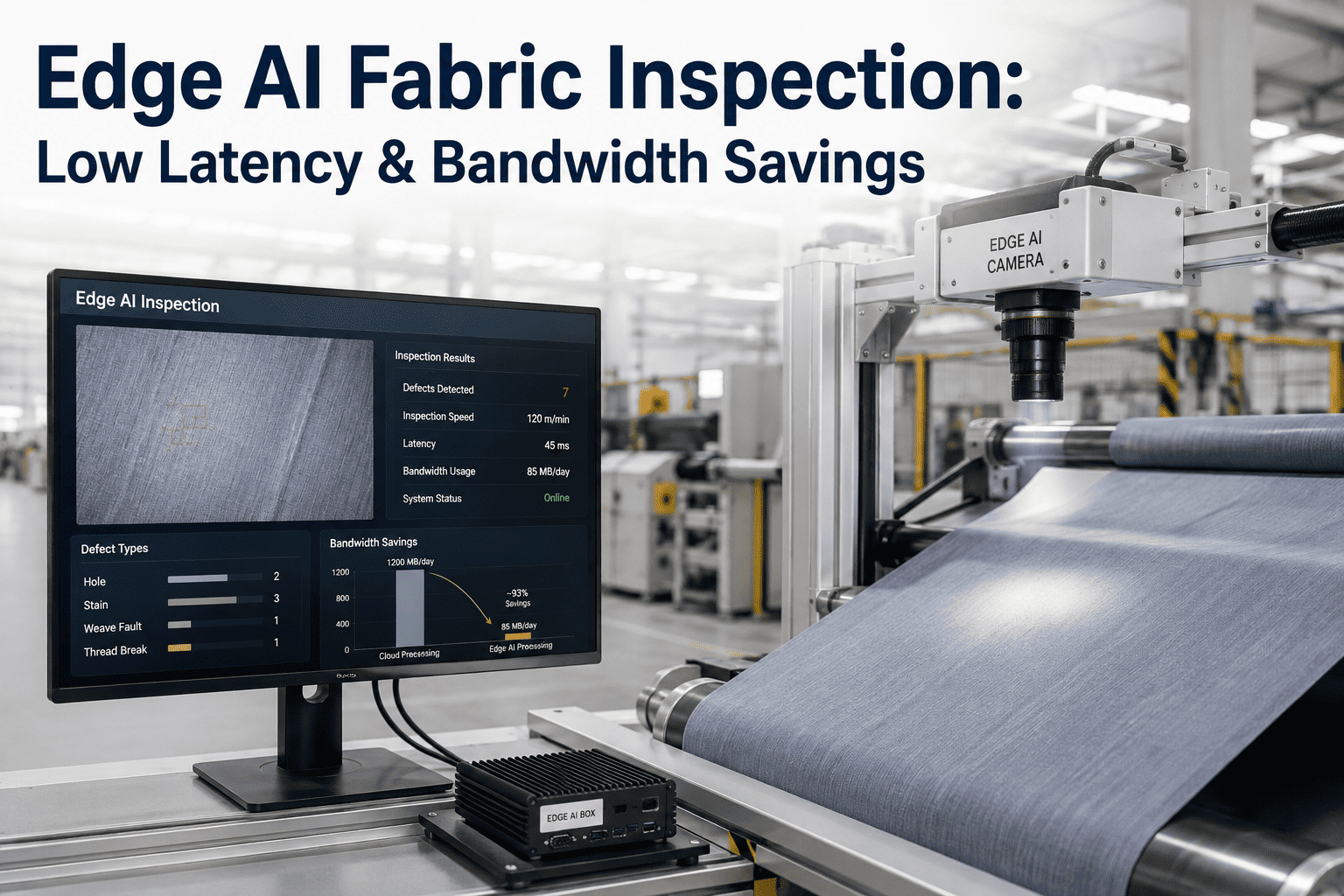
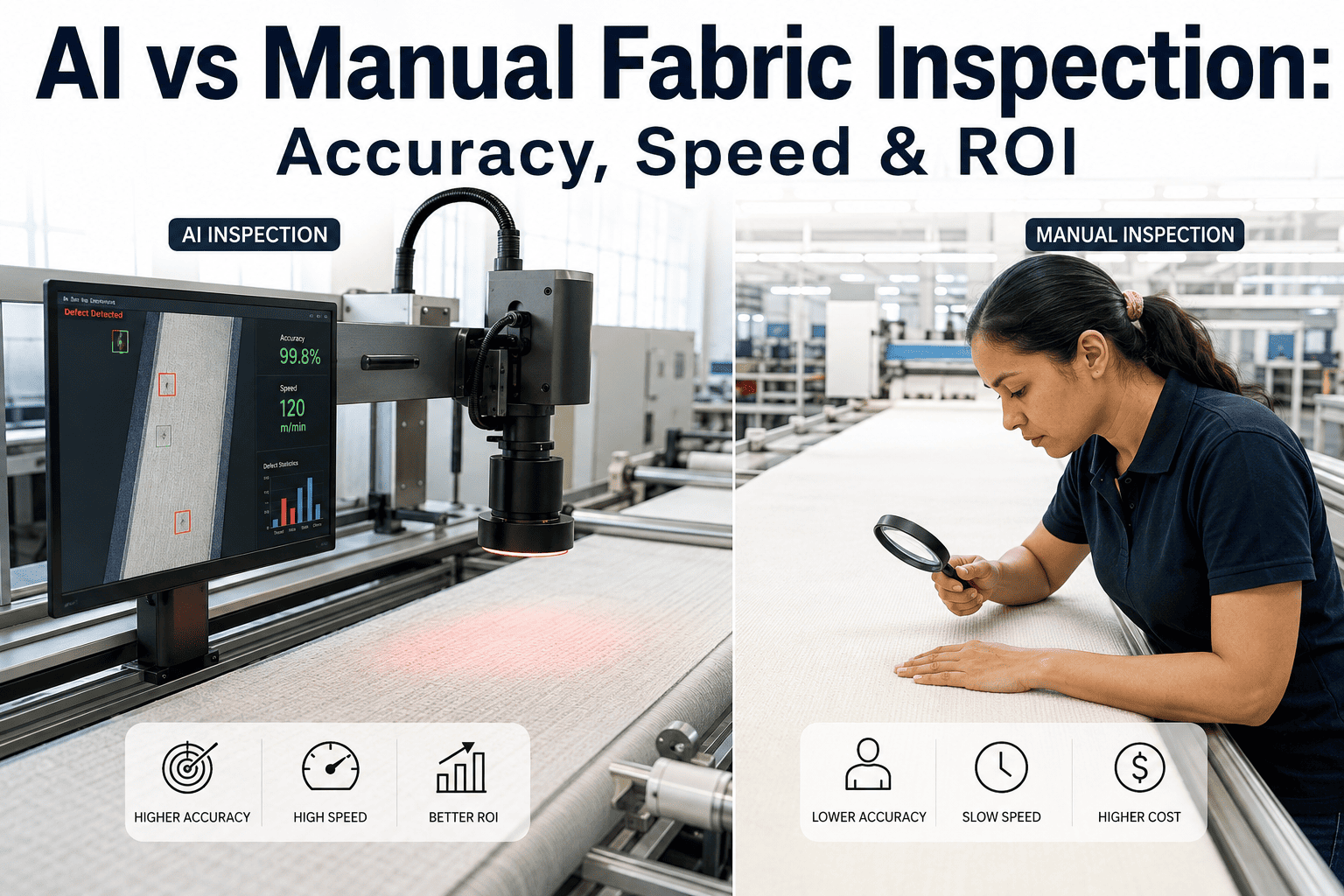
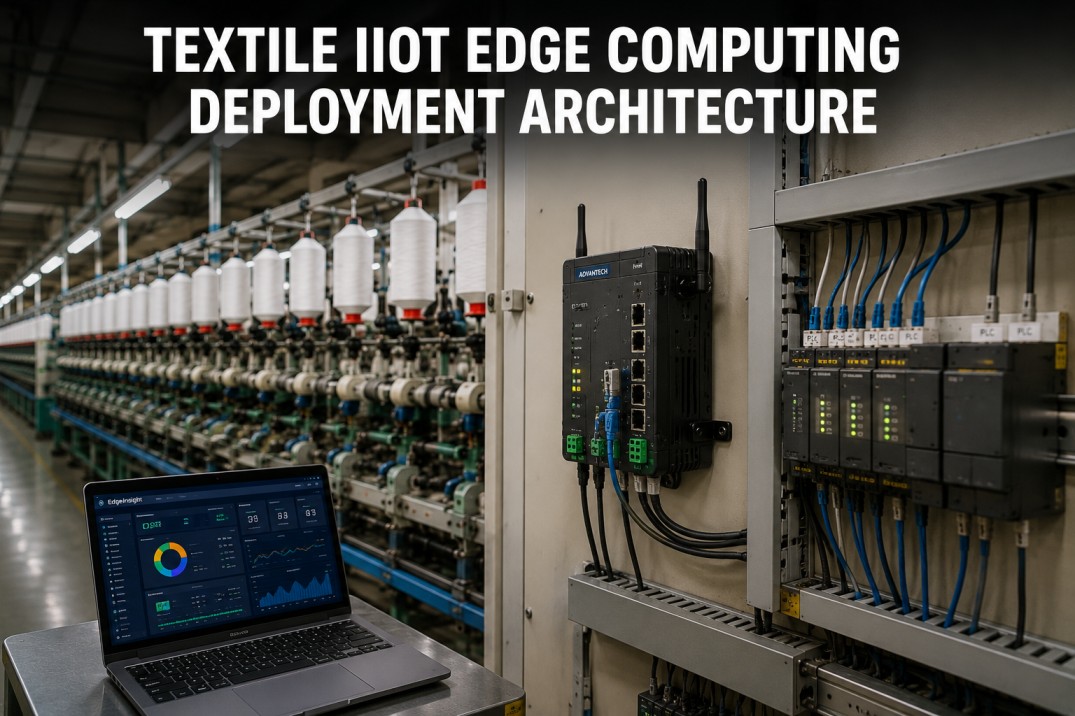
A single line-scan camera inspecting fabric at production speed generates more raw image data per hour than most plant networks were ever designed to move. Multiply that by the four, six, or ten cameras a wide-width finishing line actually needs for full-width coverage, and streaming raw video to a cloud server for inspection is not just slow, it can saturate the plant network before it saturates the cloud connection. Edge AI solves this by moving the inference decision onto hardware sitting at the camera, so only the result — a pass, a fail, a defect coordinate — needs to leave the line, not the image itself. iFactory designs edge-cloud architectures specifically for the bandwidth and latency constraints of multi-camera textile inspection. To see this architecture modeled against your own camera count and line speed, book a demo.
TEXTILE AI · EDGE DEPLOYMENT · LATENCY & BANDWIDTH
Keep the Decision at the Camera, Keep the Network From Drowning
iFactory architects fabric inspection AI so inference happens locally at sub-100ms latency, sending only defect results upstream instead of raw video, cutting bandwidth load by an order of magnitude while keeping every camera decision fast enough to matter.
What One Wide-Width Line's Cameras Actually Generate
1 Camera
Raw stream: manageable
4 Cameras
Raw stream: strains plant LAN
8 Cameras
Raw stream: exceeds most uplinks
8 Cams, Edge-Filtered
Only results + flagged frames upstream
Illustrative comparison of network load: raw video from every camera streamed continuously versus only inference results and occasional flagged frames sent upstream after edge processing.
WHY BANDWIDTH BECOMES THE BOTTLENECK FIRST
Full-Width Fabric Inspection Multiplies the Data Problem Fast
A single narrow-width camera on a slow line is rarely a bandwidth problem. The moment a mill scales to a wide-width finishing line needing multiple cameras for full coverage, or adds cameras across several lines feeding one network, the raw data volume compounds in a way that catches plant IT teams off guard, because the constraint was never obvious at a single-camera pilot scale.
01
Resolution Requirements Are Non-Negotiable
Catching sub-millimeter defects requires high-resolution line-scan capture, and resolution is exactly the dimension that inflates raw data volume the fastest per camera.
02
Camera Count Scales With Fabric Width
A wide-width line needs multiple cameras spanning the roll, and each one is a full independent data stream if all of them are sending raw video upstream.
03
Continuous Capture, Not Snapshots
Inspection cameras run continuously at line speed, unlike a security camera that can drop frame rate during quiet periods, so the data volume never has a lull.
04
Plant Networks Were Not Built for This
Most textile plant LANs were designed around MES and SCADA traffic patterns, not continuous high-resolution video from a growing bank of inspection cameras.
None of these four factors is a flaw in how a mill built its network, they are simply mismatched assumptions between what a plant network was designed to carry and what modern multi-camera inspection actually generates. Edge processing is the architectural fix, not a network upgrade that keeps chasing a growing camera count. A mill that tries to solve this purely by adding network capacity will find the target keeps moving, since every camera added or resolution increase requested pushes the requirement higher again, while an edge-first architecture keeps the upstream data volume roughly flat regardless of how many cameras are inspecting.
THE LATENCY BUDGET
Why Sub-100ms Isn't a Nice-to-Have on a Real Production Line
Latency and bandwidth are related but distinct problems. Bandwidth is about how much data can move; latency is about how fast a single decision comes back. On a fabric inspection line, the decision window is set by how much fabric passes under the camera before the reject or marking mechanism needs to act, and that window is often measured in tens of milliseconds, not seconds.
| Architecture |
Typical Round-Trip Latency |
Predictability |
Fits a Tight Decision Window? |
| Edge Inference at Camera |
Single-digit to a few tens of milliseconds |
Consistent, no network dependency |
Yes, by design |
| Local Server, LAN Round-Trip |
Tens of milliseconds |
Stable if LAN is uncongested |
Usually, with headroom to spare |
| Cloud Round-Trip |
Hundreds of milliseconds to a few seconds |
Highly variable with network conditions |
Rarely, for real-time reject decisions |
The variability row matters as much as the average figure. A cloud round-trip that averages acceptably but occasionally spikes under network load is, for a real-time reject decision, functionally the same as a round-trip that is always slow, because the press or reject mechanism still has to plan for the worst case, not the average case. Designing a reject system around an average latency figure while ignoring the tail is one of the more common ways a cloud-dependent inspection architecture passes a demo but fails intermittently in daily production, precisely because demo conditions rarely reproduce the network congestion a real plant experiences during a busy shift.
Model your own line's latency budget before choosing an architecture
iFactory calculates the actual decision window your line speed and reject mechanism require, then designs the edge-cloud split around that number instead of a generic recommendation.
THE HYBRID ARCHITECTURE
What Actually Runs at the Edge Versus What Belongs in the Cloud
Edge-first does not mean cloud-free. A well-designed textile inspection deployment splits work across three tiers deliberately, sending each type of task to the layer best suited for it rather than forcing every workload through a single architecture.
TIER 1 — AT THE CAMERA
Real-Time Defect Decisions
The pass/fail/flag call that must return before the fabric moves past the marking or reject point, running entirely on local edge hardware with no network dependency.
TIER 2 — LOCAL SERVER
Shift-Level Aggregation and Dashboards
Defect counts, roll-level quality summaries, and operator dashboards aggregated from multiple edge devices on the plant LAN, tolerant of slightly higher latency than the reject decision itself.
TIER 3 — CLOUD
Fleet-Wide Training and Analytics
Fleet-wide model training, drift detection across multiple plants, and long-term trend analytics, where latency tolerance is measured in hours or days rather than milliseconds.
This three-tier split is also what keeps the plant operating when connectivity drops. Since the real-time defect decision lives entirely at Tier 1, a mill's inspection line keeps running correctly through an internet outage that would completely stall a cloud-dependent architecture, with only the fleet-wide analytics layer temporarily falling behind until connectivity returns.
WHAT ACTUALLY TRAVELS UPSTREAM
Sending Results, Not Raw Video, Is the Bandwidth Fix
The core architectural decision that resolves the bandwidth problem is simple to state and easy to underestimate: once a frame has been inspected at the edge, the vast majority of frames do not need to travel anywhere at all. Only the exceptions do.
Defect Metadata
Defect type, location, size, and confidence score — a few bytes of structured data per detection, regardless of image resolution.
Flagged Frame Thumbnails
A compressed image of the specific frame where a defect was detected, sent for human review or audit trail purposes, not the entire continuous stream.
Periodic Health Snapshots
Low-frequency confidence and calibration health data supporting the drift monitoring covered separately in model maintenance practice, sent on a schedule rather than continuously.
Aggregated Shift Summaries
Roll-level and shift-level rollups for reporting and MES integration, batched rather than streamed frame by frame.
This shift, from streaming raw video continuously to streaming only structured results and occasional exception frames, is commonly reported to cut upstream bandwidth load by well over half in typical industrial vision deployments, and the reduction only grows as camera count and resolution increase, since the raw-video baseline scales with those two factors while the results-only traffic barely moves.
RESILIENCE BY DESIGN
What Happens to Inspection When the Network Actually Goes Down
Plant networks are not perfectly reliable, and any inspection architecture that depends on continuous connectivity to make its core decision inherits that unreliability directly. Edge-first architecture sidesteps this risk structurally rather than trying to engineer around it with redundant network links.
Inspection Continues Uninterrupted
Since the pass/fail decision runs entirely on local edge hardware, a network outage has no effect on the actual inspection function running at the camera.
Results Queue Locally
Structured results that would normally sync upstream are queued on the edge device during an outage, rather than being lost, and sync automatically once connectivity returns.
Only the Dashboards Fall Behind
Shift-level dashboards and cloud analytics show stale data during the outage window, a cosmetic gap rather than a functional one, since the underlying inspection data is preserved and catches up automatically.
This resilience is a direct structural consequence of where the decision-making logic lives, not an added feature bolted onto the architecture afterward. A cloud-dependent inspection system has no equivalent fallback, since the very system making the pass or fail call is the one that becomes unreachable during an outage.
FITTING THE MODEL TO THE HARDWARE
Why the Model Itself Has to Be Optimized for Edge Constraints
Edge hardware sitting at a camera has less raw compute than a data center GPU, which means the inference model deployed there needs to be deliberately optimized rather than simply shrunk down from a cloud-trained version and hoped to run fast enough. This optimization step is as important to hitting the latency budget as the hardware choice itself.
01
Quantization Reduces Compute Load
Converting a model to run at reduced numerical precision, commonly FP16 or INT8, cuts inference time meaningfully on the same edge silicon with minimal accuracy tradeoff when calibrated properly.
02
Architecture Choice Sets the Ceiling
A lightweight detection architecture designed for edge deployment starts from a fundamentally lower compute requirement than a large research-grade model, before optimization even enters the picture.
03
Pre-Processing Belongs on the Edge Device
Resize and normalization steps run locally on the edge hardware rather than requiring a round trip anywhere, since a correctly designed edge pipeline handles the full capture-to-decision loop on one device.
04
Validation Against the Deployed Version
Accuracy benchmarks should be measured against the actual quantized, optimized model running on the actual edge hardware, not the original full-precision model on a development workstation.
Skipping this optimization step is a common reason an edge deployment underperforms its latency target even on hardware that should be capable enough on paper. The fix is rarely a hardware upgrade at that point, it is properly optimizing the model that hardware is actually running.
TURNKEY DELIVERY
How iFactory Sizes and Deploys This Architecture for Your Line
Getting the edge-cloud split right requires knowing your actual camera count, line speed, and network topology before specifying hardware, not after. iFactory's deployment process starts with exactly that assessment.
What Gets Built
Edge inference hardware sized to your camera count and line speed
Local aggregation server for shift-level dashboards and MES integration
Structured results pipeline replacing raw video upload
Offline-tolerant operation that keeps inspecting through network outages
24×7 remote monitoring of edge device health and network load
Deployment Timeline
Weeks 1–4: Network and camera count audit, latency budget calculation, hardware sizing
Weeks 5–8: Edge hardware deployment, pipeline configuration, parallel validation
Weeks 9–12: Go-live, bandwidth load monitoring, operator training
FREQUENTLY ASKED QUESTIONS
What Textile Plants Ask Before Moving Inspection AI to the Edge
Does moving to edge inference mean we lose cloud-based analytics and reporting?
No, edge and cloud are not competing architectures in a well-designed deployment, they are two tiers doing different jobs. The real-time defect decision runs at the edge for latency reasons, while shift-level dashboards, fleet-wide analytics, and long-term trend reporting still run in the cloud, fed by the structured results the edge layer produces rather than raw video. You keep the reporting and analytics capability, it simply receives a much smaller, more efficient data stream than continuous video would require.
Book a demo to see the reporting layer running on top of an edge-first architecture.
What happens to inspection if our internet connection goes down?
Inspection keeps running normally, since the real-time defect decision lives entirely on local edge hardware with no dependency on external connectivity. Only the upstream reporting and fleet-wide analytics layer falls behind during an outage, catching up automatically once connectivity returns, rather than the inspection line itself stalling or falling back to manual grading. This offline tolerance is one of the more concrete practical benefits of an edge-first architecture beyond the latency numbers alone.
Contact our support team to review offline behavior for your specific network setup.
How many cameras can realistically run on our existing plant network before bandwidth becomes a problem?
It depends heavily on your camera resolution, line speed, and existing network traffic, which is exactly why a network audit is the first step of any deployment rather than a generic camera-count rule of thumb. As a general pattern, raw video from more than a handful of high-resolution inspection cameras tends to strain a typical plant LAN that was not specifically provisioned for continuous video traffic, while an edge-filtered architecture sending only structured results can support a much larger camera count on the same network.
Book a demo to get your specific network capacity evaluated.
Is edge hardware at every camera more expensive than one central server processing all the video?
The edge hardware itself does carry a per-camera cost, but that cost needs to be weighed against what a central-server architecture would actually require to keep pace: enough network bandwidth to carry every camera's raw stream, plus enough central compute to process all of it within the same tight latency window, both of which get expensive fast as camera count grows. In practice, distributing lightweight inference hardware to each camera and sending only results centrally is often the more cost-effective architecture once camera count exceeds a handful, not the more expensive one.
Contact our support team to compare total architecture cost for your specific camera count.
Can edge hardware handle model updates and retraining, or does that require sending data back to a central system?
Model updates are pushed down to edge devices from a central management layer once a retrained model has been validated, which is a much smaller data transfer than continuous video upload and can run on a low-frequency schedule rather than requiring constant connectivity. The retraining process itself, including drift monitoring and dataset curation, typically happens at the local server or cloud tier where more compute is available, then the resulting updated model is deployed back down to the edge devices running inference.
Book a demo to see the model update pipeline for edge-deployed inspection models.
DESIGN FOR YOUR ACTUAL NETWORK
Get an Edge-Cloud Architecture Sized to Your Cameras and Line Speed
iFactory audits your network, calculates your real latency budget, and builds an edge-first inspection architecture that keeps every decision fast and your bandwidth load under control as your camera count grows.