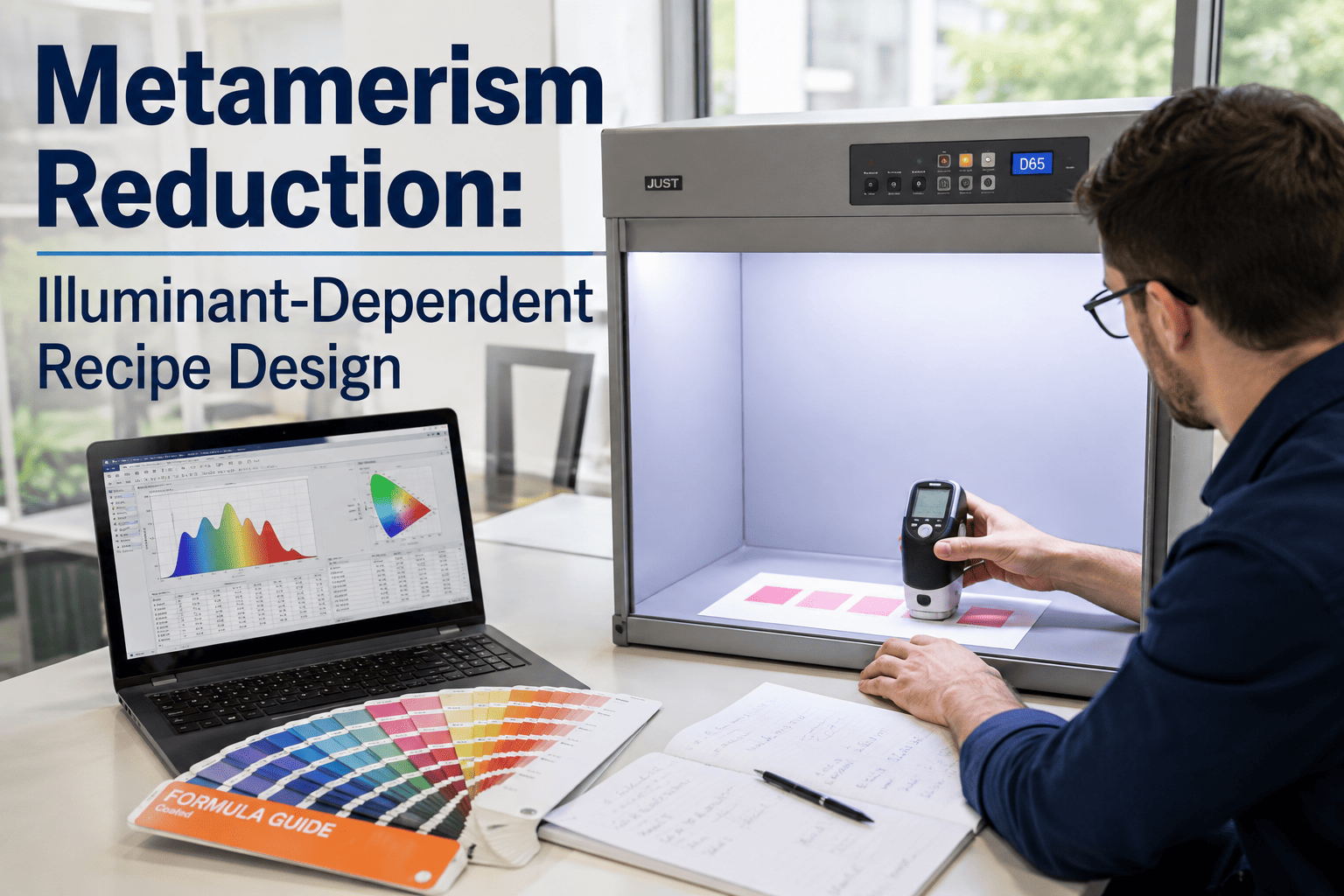
Two fabric swatches match perfectly under the showroom's D65 daylight lamp. The buyer approves the order. Three weeks later, a store manager unpacks the shipment under warm incandescent lighting and the two "matching" pieces look like they came from different dye lots entirely. Nothing changed about the fabric — what changed was the light, and the spectral reflectance curves behind that approved match were never actually the same to begin with. This is metamerism, and it is arguably the single most consequential phenomenon in color technology precisely because it hides behind a perfectly legitimate-looking approval, only to surface as a customer complaint weeks or months after the decision that let it through. iFactory's recipe formulation module flags metameric risk at the formulation stage, calculating a metamerism index across multiple illuminants before a recipe ever reaches an approval review.
Same Color, One Light. Different Color, the Next. That's Metamerism.
Two samples can share an identical CIELAB value under one illuminant and diverge sharply under another — because a matching color reading and a matching spectral curve are not the same thing.
What Metamerism Actually Is — And What It Isn't
Metamerism occurs when two samples, despite having genuinely different spectral reflectance curves, produce the same visual color sensation under one specific illuminant. Change the light source and the wavelengths available to be reflected shift — and because the two curves were never actually identical, they now reflect light differently, producing a visible mismatch that didn't exist a moment ago under the original light. This is a fundamentally different phenomenon from color inconstancy, and the two get confused constantly, even among people who work with color professionally on a daily basis.
Metamerism
A comparison between two different samples — they match under one light and diverge under another. The mismatch exists because each sample's dye recipe has a different underlying spectral curve, even though those curves converge to the same visual result under a specific illuminant, which is exactly what makes this phenomenon so easy to miss during a single-light approval check.
Color Inconstancy
A property of a single sample viewed under changing light — a red car that looks brown under sodium streetlight is exhibiting color inconstancy, not metamerism, because there's no second sample being compared against it.
The two concepts are closely related in practice, because metameric pairs typically have different color inconstancy indices — one sample in the pair tends to shift dramatically with the light change while the other stays relatively stable. Understanding which sample is the more color-inconstant one matters when choosing which recipe to actually commit to production, since the more stable of two visually matching options is generally the safer choice for a product that will travel through varied lighting environments after it leaves the factory.
Measuring It: Metamerism Index and Color Inconstancy Index
Metamerism can't be eliminated by eye alone — it has to be measured, and two distinct indices exist for two distinct questions. Confusing which index answers which question is a common and costly mistake in recipe approval, one that can quietly let a genuinely high-risk recipe through an approval process that appeared thorough on paper but never actually asked the right question of the data it had.
| Index | What It Measures | Typical Interpretation |
|---|---|---|
| Metamerism Index (MI) | Color difference between two samples under two different illuminants | Below 0.5: within tolerance. 0.5-1.0: requires closer examination. Above 1.0: not a suitable match. |
| Color Inconstancy Index (CII) | How much a single sample's own appearance shifts between illuminants | No universal pass/fail threshold — used to compare candidate recipes against each other, choosing the one with lower inconstancy |
MI alone is not sufficient for recipe approval, because a low MI only confirms two samples match reasonably well under the specific illuminant pair tested — it says nothing about how either sample behaves under a third lighting condition the buyer's retail environment might actually use. CII fills that gap by evaluating a candidate recipe's own stability across lighting changes, independent of what it's being compared against, giving a color team a way to choose between two visually equivalent recipes based on which one is genuinely more stable rather than which one happened to score better on a single comparison.
Observer Metamerism: The Variable That Isn't About Light At All
Illuminant metamerism gets most of the attention because it's the easier variable to test for — swap the light source, measure the shift. But a second, less discussed form exists: observer metamerism, where a color mismatch arises from a change in observer rather than a change in lighting. Two people with genuinely different color vision sensitivity can look at the identical pair of samples under the identical light and disagree about whether they match, a phenomenon that pure illuminant testing alone will never surface no matter how many light sources are added to the protocol.
Illuminant Metamerism
A color mismatch caused by a change in lighting — the type this article focuses on, and the type that dominates most textile color approval workflows.
Observer Metamerism
A color mismatch caused by a change in the observer's own color vision — one reason instrumental measurement, rather than relying purely on a single human reviewer's visual judgment, matters for consistent approval decisions.
Both forms trace back to the same underlying mechanism: each material's colorants have distinct spectral absorption and scattering properties, and a match that appears identical under one specific combination of light and observer sensitivity doesn't guarantee the same result under a different combination of either variable. Instrumental measurement doesn't eliminate observer metamerism entirely, since a spectrophotometer still has to be interpreted against a defined standard observer function, but it removes the variability that comes from different individual reviewers' color vision on a given approval decision.
Why Some Illuminant Pairs Are Far Worse Than Others
Metameric risk isn't uniform across every possible lighting change — some illuminant pairs consistently produce dramatically larger shifts than others, and knowing which pairs matter most for a given product's real-world viewing conditions focuses testing where it actually counts, rather than spreading limited testing time evenly across combinations that carry very different levels of practical risk.
| Illuminant Change | Typical CII Range | Real-World Relevance |
|---|---|---|
| D65 to D50 | Roughly 0.25-1.5 (narrower shift) | Both daylight-simulating sources — a relatively gentle test, common in print approval |
| D65 to Illuminant A | Roughly 1.7-3.5 (moderate shift) | Daylight to warm incandescent — the classic showroom-to-home lighting change |
| D65 to Fluorescent (F2) | Roughly 3.1-9.9 (severe shift) | The largest and most damaging shift among common comparisons — retail fluorescent lighting is a frequent real-world trigger |
The practical implication: a recipe approved only under a single daylight-to-daylight comparison may pass with a deceptively low index, while the same recipe's true metameric risk only becomes apparent when tested against the fluorescent lighting a retail floor actually uses. Approval testing that mirrors real end-use lighting conditions catches problems that daylight-only testing consistently misses — and given how much more severe the fluorescent-illuminant shift tends to be compared to other common comparisons, skipping it specifically represents one of the largest, most avoidable blind spots in a typical color approval workflow.
Dye Selection: The Only Real Lever for Prevention
Metamerism can only be minimized by selecting colorants with similar spectral properties — there is no formulation trick, software correction, or process adjustment that eliminates it after the fact if the underlying dyes were the wrong choice from the start. The choice of colorants is the single point of leverage that actually prevents metameric pairs from forming in the first place, which is precisely why dye selection deserves as much scrutiny as the visual color match itself during recipe development, not merely a passing consideration secondary to how close the final shade looks under a single reference light.
The Fix Is at Formulation, Not After Approval
iFactory's formulation engine prioritizes spectral curve similarity when proposing dye combinations — catching metameric risk before a recipe ever reaches the approval stage, not after a customer complaint.
A Composite Scenario: The Recipe That Passed Once and Failed Everywhere Else
Picture a textile mill formulating a navy shade to match a customer's approved physical standard. The colorist's first formulation attempt, using three dyes already stocked in-house, achieves an excellent visual and instrumental match under the mill's standard D65 lightbox — the color difference is well within tolerance, and the batch is approved for bulk dyeing on that basis alone. Nobody on the approval team asks what would happen under a different illuminant, because the D65 match already looks convincingly perfect and the production schedule is already under pressure to move forward.
The finished garments ship to a retail chain, where store lighting runs predominantly fluorescent rather than daylight-simulating. Under that lighting, the navy shade shifts noticeably greener than the approved standard, and stores across several locations begin flagging visible inconsistency between the new shipment and existing stock on the same rack. When the mill's color lab investigates, the spectral curves reveal the problem immediately: the three-dye recipe achieved its D65 match through a combination that happened to align at that specific illuminant, but the underlying reflectance curve diverged sharply from the standard's curve in the wavelength range fluorescent lighting emphasizes. A metamerism index calculated against D65-to-F2 would have flagged this recipe as high-risk before a single yard was dyed — but that comparison was never run, because the approval process only tested the one illuminant the mill's own lightbox used, and nobody had reason to question a match that already looked flawless under the conditions everyone was accustomed to trusting.
The corrective reformulation swapped one of the three dyes for a colorant with a spectral curve more closely tracking the standard across the visible range, sacrificing a marginal amount of match precision under D65 specifically in exchange for dramatically improved consistency under fluorescent and incandescent lighting alike. The lesson the mill's color team carried forward: an approval process that tests only the illuminant convenient to the lab, rather than the illuminants a garment will actually be viewed under after it leaves the mill, is testing the wrong thing entirely — and the cost of that oversight only shows up well after the batch has already shipped, when it's far more expensive to correct than it would have been at the formulation stage.
The Instrumentation Behind Reliable Metamerism Detection
None of the metamerism concepts discussed so far can be reliably applied without the right measurement tools. Relying on visual judgment alone, even from an experienced colorist, introduces exactly the observer-dependent variability that makes metameric matches so treacherous in the first place — a match that looks acceptable to one reviewer's eyes under the lab's particular lighting may not hold up to a different reviewer, let alone a different light source entirely, and the gap between those two failure modes is exactly what instrumentation is designed to close.
Spectrophotometer
Measures the full spectral reflectance curve of a sample across the visible wavelength range, providing the raw data both MI and CII calculations depend on — without it, spectral differences invisible to the eye under a single light source stay completely undetected.
Controlled Viewing Environment
A standardized lightbox with multiple selectable illuminants lets a color team confirm how a recipe behaves in real-world lighting conditions, rather than relying on ambient light that varies by time of day, weather, and location.
Testing under different lighting conditions before production, using a spectrophotometer and a controlled multi-illuminant viewing environment together, is what identifies metameric risk while a recipe is still cheap and easy to adjust — rather than after bulk dyeing has already committed material and time to a formulation nobody had confirmed would hold up beyond the one lighting condition it was originally approved under. The cost difference between catching this at the sampling stage versus discovering it after shipment is, in practice, the difference between a minor formulation adjustment and a full recall or rework cycle.
Building Metamerism Testing Into Standard Recipe Approval
Testing Under a Single Illuminant Only
Approving a match under whichever light source happens to be installed in the lab, without cross-checking at least one additional illuminant relevant to the product's actual end use, misses exactly the risk metamerism testing exists to catch.
Treating MI as a Complete Answer
A passing metamerism index between two tested illuminants says nothing about behavior under a third lighting condition — CII evaluation of the candidate recipe's own stability fills that gap.
Mixing Recycled or Unverified Colorant Sources
Combining dyes or inks from different batches or suppliers without verifying spectral consistency introduces metameric risk that a single visual check under one light will not reveal.
Skipping Consistent Viewing Angle and Conditions
Variations in viewing angle and surface texture introduce their own measurement noise on top of genuine metameric difference, muddying results and making a true metameric pair harder to distinguish from ordinary measurement variance.
Who Owns Metamerism Risk: Colorist, Quality, or Both?
Catching metameric risk before bulk production requires input from more than just the colorist who built the original recipe. The colorist has the technical formulation knowledge; the quality or approval team has visibility into which illuminants actually matter for a given customer's end-use environment — retail floor lighting, warehouse conditions, or point-of-sale display — knowledge that rarely sits with the person actually mixing the dyes.
Colorist / Color Lab
Owns dye selection and formulation, choosing colorants with spectral properties as close to the standard as cost and availability allow, and running the initial MI and CII calculations during recipe development.
Quality / Approval Team
Owns which illuminants get tested against for a given customer or product category, based on knowledge of that customer's actual retail or end-use lighting environment — information the color lab often doesn't have direct visibility into.
Without that second perspective feeding into the testing protocol, a color lab defaults to testing whatever illuminants happen to be built into its own lightbox, which may or may not reflect the lighting a specific customer's stores or facilities actually use. Coordinating the two functions — technical formulation knowledge paired with end-use lighting knowledge — is what prevents exactly the gap that surfaced in the navy shade scenario described earlier, where the mill's own lab equipment simply never included the fluorescent illuminant that mattered most for that particular retail customer, and nobody in the approval chain had the visibility to flag that gap before the batch shipped.
Frequently Asked Questions
The questions below reflect what colorists and quality teams most often ask as they build multi-illuminant testing into a recipe approval process that previously relied on a single lighting condition — a transition that changes how recipes get evaluated more than it changes how they get formulated in the first place.
How many illuminants should a recipe actually be tested against?
At minimum two, and preferably three or more standard illuminants relevant to the product's real-world viewing conditions — commonly D65 daylight, Illuminant A for incandescent, and a fluorescent source like F2 for retail environments. If a match holds under D65 but diverges under CWF or A, the pair is metameric and needs reformulation before approval. Visit support to see which illuminant sets are configured by default for different product categories.
Can a recipe with a passing MI still fail in the real world?
Yes — this is one of the most important, and most commonly missed, points in metamerism management. A metamerism index calculated between only two illuminants provides no guarantee about behavior under a third condition never tested. A recipe can pass one illuminant pair comfortably and still fail dramatically under a different lighting change the approval process simply never checked. Book a demo to see multi-illuminant testing configured for your product line.
Is metamerism always avoidable through better formulation?
Not entirely — some degree of metamerism is often unavoidable given real-world dye availability and cost constraints, but it can be measured, managed, and minimized. Selecting colorants with more similar spectral properties, even when a perfect spectral match isn't achievable, meaningfully reduces the severity of the mismatch across lighting changes even when it can't eliminate it completely.
Why does fluorescent lighting cause such severe metameric shifts compared to other illuminant changes?
Fluorescent light sources emit a narrower, more irregular spectral power distribution than daylight or incandescent sources, concentrated in specific wavelength bands rather than spread smoothly across the visible spectrum. Two dye recipes with different underlying reflectance curves are far more likely to diverge sharply under that irregular emission profile than under a smoother, more continuous light source. Contact support for guidance on testing specifically against fluorescent retail lighting.
Who should be responsible for catching metameric risk before bulk production?
Primary responsibility typically sits with the color lab or colorist formulating the recipe, but genuine prevention requires the approval process itself to mandate multi-illuminant testing rather than leaving it to individual discretion under production time pressure. A formulation workflow that calculates MI and CII automatically as part of standard recipe evaluation removes the dependency on any one person remembering to run the additional checks manually.
Stop Approving Matches That Only Hold Under One Light
iFactory calculates metamerism index and color inconstancy across every illuminant that matters to your buyers — so a recipe approved in the lab actually holds up on the retail floor.