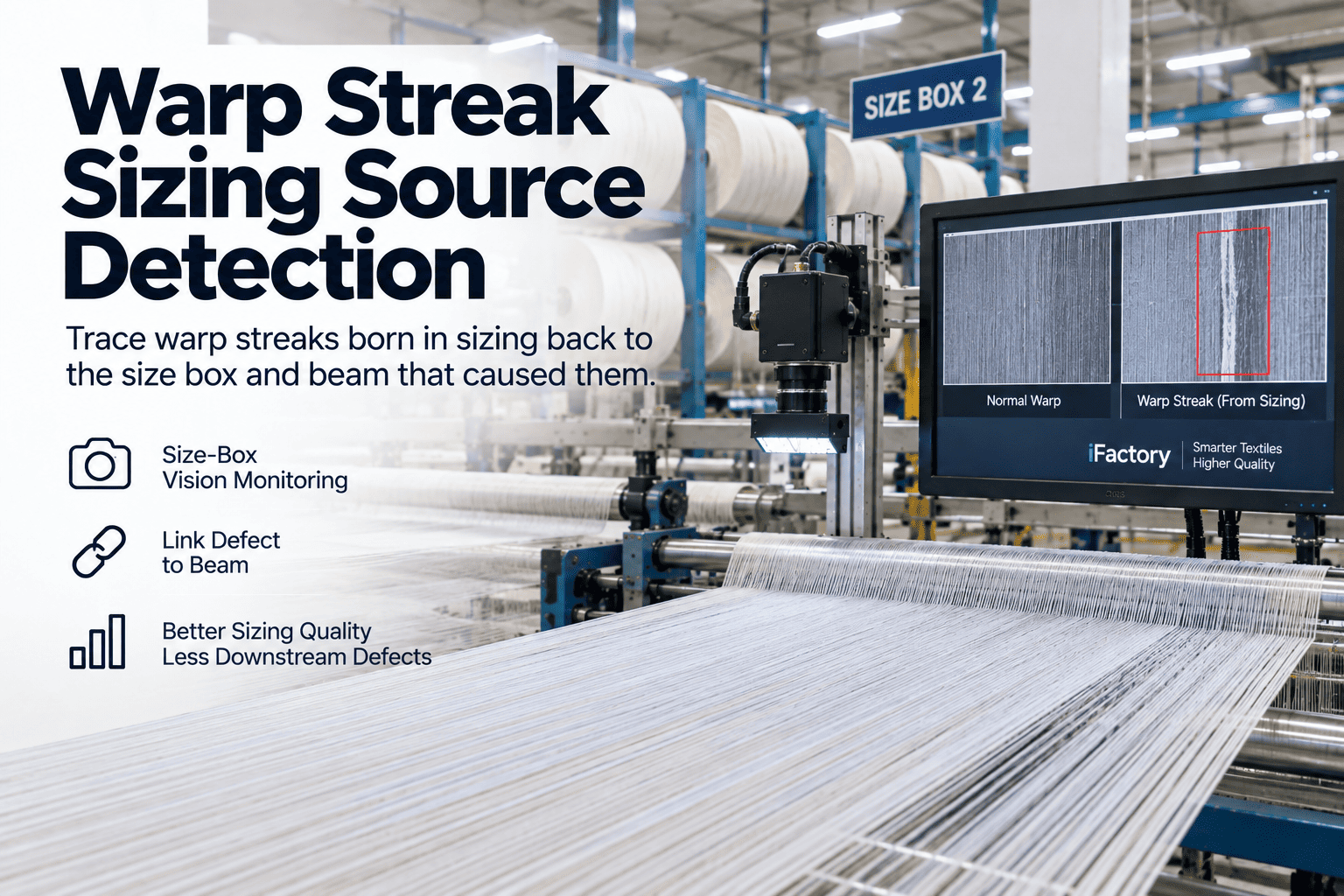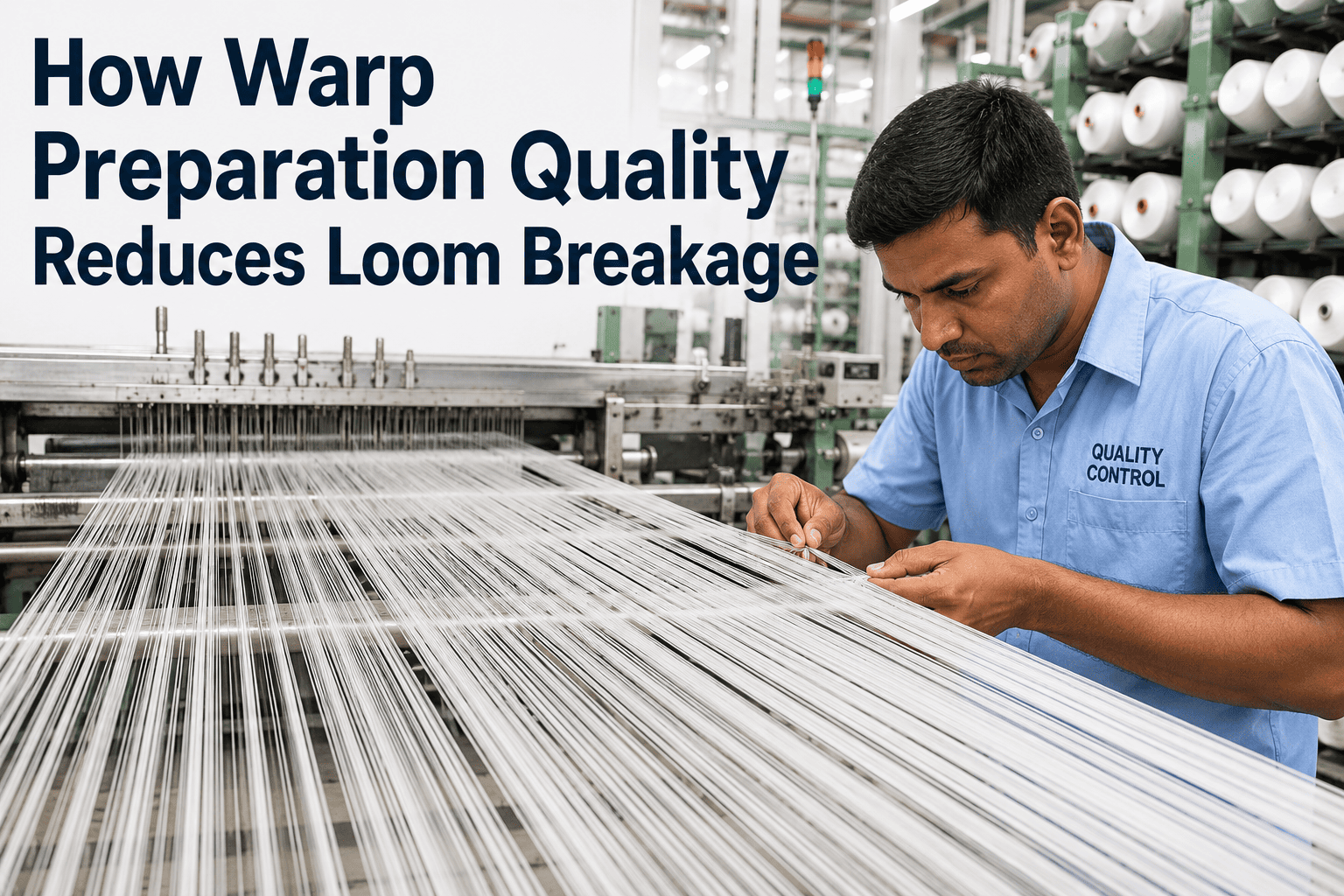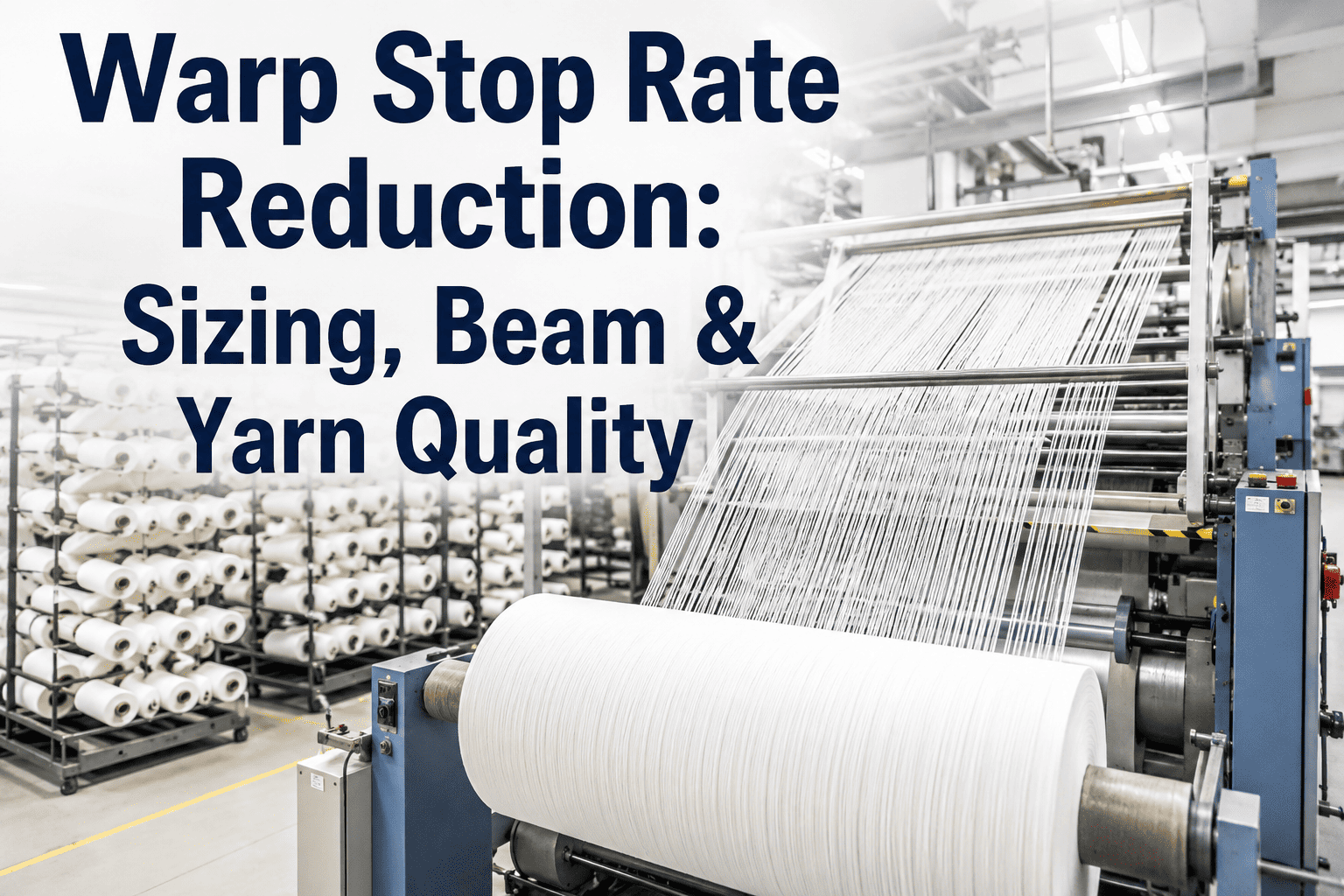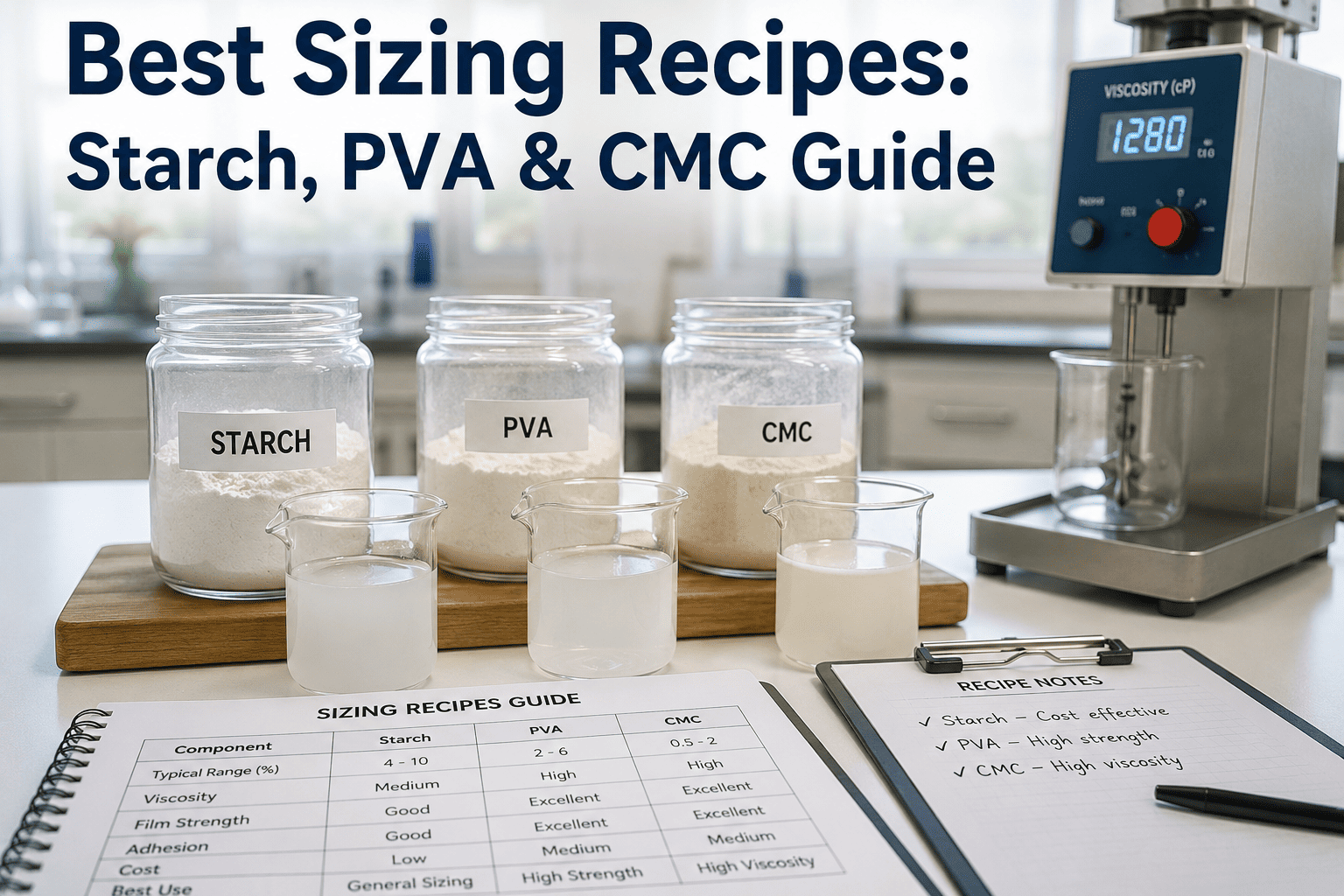
A weaving mill can own the best loom on the market and still bleed money on end breakage if the sizing recipe underneath the warp yarn is wrong for that yarn type — sizing is the unglamorous chemistry step that determines whether a warp survives the loom or snaps every few minutes. Sizing coats and binds warp yarn with a protective film before weaving, reducing hairiness, adding strength, and reducing friction against the reed and healds as the yarn is repeatedly abraded through thousands of picks. The right recipe depends on yarn type, count, weaving speed, and desizing requirements downstream — get any of those wrong and a mill either overspends on size add-on that slows desizing, or underspends and pays for it in end breaks and loom stops. This guide covers the major sizing agents — starch, PVA, CMC, and acrylic — their formulation logic, add-on percentage control, and how to match a recipe to yarn type and weaving conditions. Mills optimizing sizing cost against end-breakage rate can book a 30-minute demo to see how iFactory tracks size add-on and warp breakage together by yarn lot.
Sizing Recipe Optimization — Starch, PVA, and CMC Formulations
How each major sizing agent works, add-on percentage control by yarn type, sizing viscosity and temperature parameters, and desizing considerations that should shape a recipe before it ever reaches the size box.
Unsized warp yarn cannot survive the repeated abrasion of high-speed weaving — hairy fibers snag on the reed and healds, weak spots break under tension, and static builds up in synthetic yarns. Sizing applies a film-forming agent that binds loose fibers flat, adds tensile strength, and reduces surface friction, at an add-on percentage carefully controlled because too little leaves the yarn unprotected and too much slows desizing and raises chemical cost.
The Four Major Sizing Agent Families
Every sizing recipe is built around one or more of these base agents, usually blended together rather than used alone, since each brings a different strength and each has a limitation the others help offset.
Native and Modified Starch
The oldest and most widely used sizing agent for cotton and cotton-blend yarns, valued for low cost and strong film-forming ability on cellulose fibers. Modified starches (oxidized, enzyme-converted) offer better solubility and lower viscosity than native starch for easier application and desizing.
Polyvinyl Alcohol
A synthetic film-former with excellent strength and elasticity, especially effective on synthetic and blended yarns where starch adheres poorly. PVA produces a strong, flexible film but costs more than starch and requires specific desizing conditions since it does not break down with standard enzyme desizing alone.
Carboxymethyl Cellulose
Often used as a co-agent alongside starch or PVA rather than alone, CMC improves size paste stability, film flexibility, and easy desizing. It is valued for its clean wash-off characteristics and lower environmental load compared to full PVA-based recipes.
Acrylic Binders
Synthetic acrylic sizing agents provide strong adhesion and abrasion resistance on synthetic filament yarns where starch and even PVA can underperform, commonly used in polyester and polyester-blend warp preparation for high-speed weaving.
Matching Sizing Agent to Yarn Type
The single most consequential sizing decision is matching agent chemistry to fiber type — starch bonds well to cellulose but poorly to synthetic filament, while PVA and acrylic agents reverse that relationship, so the wrong pairing produces a film that flakes off rather than protecting the yarn through weaving.
These ranges are starting points, not fixed targets — actual optimal add-on within each range depends on final weaving speed, reed density, and how aggressively the fabric construction abrades the warp during shedding.
Add-On Percentage — Finding the Optimal Point
Size add-on percentage is the single number every sizing recipe optimization ultimately comes down to, and it behaves as a classic trade-off curve rather than a "more is always better" parameter.
Add-On Too Low
Insufficient film coverage leaves hairy fibers exposed. Weaving sees higher end breakage, more loom stops, and lower effective shed speed. Warp survives poorly under high-density or high-speed construction.
Optimal Range
Full fiber coverage with minimum excess chemical. End breakage rate drops to an acceptable operating level. Desizing removes the film cleanly without excessive time or chemical load.
Add-On Too High
Excess size stiffens the yarn beyond what's needed, increases desizing time and chemical/water consumption, raises cost per meter, and can cause size flaking that creates its own weaving fault.
Sizing Process Parameters That Control Recipe Performance
Even a well-chosen recipe underperforms if the process parameters applying it are out of tune — temperature, viscosity, and squeeze pressure all interact with the recipe's chemistry to determine actual film quality on the yarn.
Size Paste Viscosity
Controls how evenly the size penetrates and coats the yarn bundle. Too thin under-coats fiber ends; too thick over-adds and slows drying, risking uneven film thickness across the beam width.
Sizing Temperature
Affects paste viscosity and penetration rate — most starch-based pastes are applied in a specific warm temperature range to maintain workable viscosity without degrading the starch structure.
Squeeze Roller Pressure
Determines final wet pick-up and therefore add-on percentage directly — higher squeeze pressure removes more excess paste, lowering add-on for a given size box concentration.
Drying Cylinder Temperature
Must be controlled to fully cure the film without scorching the yarn or the size agent, since overheated size becomes brittle and prone to flaking during weaving.
Desizing Ease — Why Recipe Choice Matters After Weaving Too
A sizing recipe optimized purely for weaving performance can create an expensive downstream problem if desizing ease was not considered at the formulation stage, since the fabric cannot proceed to dyeing and finishing until the size film is fully removed.
Enzyme-Desizable Recipes
Starch-based sizing is broken down efficiently by standard amylase enzyme desizing, making it the lowest-cost and fastest desizing pathway — one reason starch remains dominant on cotton despite newer synthetic alternatives.
PVA and Synthetic Recipes
PVA does not respond to enzyme desizing and typically requires hot water wash-off or specific chemical desizing agents, adding process time and cost that must be weighed against PVA's weaving performance benefits on synthetic yarn.
Common Sizing Recipe Mistakes
Most sizing-related weaving losses trace back to a small number of recurring formulation or process errors that are straightforward to correct once identified.
Using a single fixed recipe across fine and coarse counts ignores that finer yarns need proportionally more surface coverage relative to their mass, leading to under-sizing on fine counts specifically.
A recipe adequate for a slower loom may under-protect the same yarn at higher picks-per-minute, where abrasion frequency against the reed rises with speed.
Choosing PVA purely for its strength without accounting for the added desizing time and chemical cost can make a "better" sizing recipe more expensive overall than a well-optimized starch blend.
Yarn hairiness and count can vary between lots from the same supplier — a recipe validated on one lot may need adjustment when the next lot arrives with different fiber characteristics.
The best sizing recipe is the one validated against your own end-breakage data — not a generic starting formula.
Starch, PVA, CMC, and acrylic each solve a different part of the sizing problem, and the right blend depends on yarn type, loom speed, and downstream desizing cost together. iFactory tracks size add-on percentage, end-breakage rate, and desizing time by yarn lot so a recipe adjustment can be validated with real production data before it's rolled out mill-wide.
Frequently Asked Questions
Why does the same starch-based recipe perform differently between two yarn lots from the same supplier?
Yarn hairiness, moisture content, and even minor count variation between lots change how much size film is actually needed for equivalent protection, even when the nominal count and fiber content are identical on paper. A lot with slightly higher hairiness needs a marginally higher add-on to achieve the same fiber-binding effect as a cleaner lot at the standard recipe concentration. This is why sizing recipes validated once and never revisited tend to drift out of optimal range over time as yarn sourcing shifts — periodic add-on and breakage-rate checks against current incoming yarn lots catch this drift before it shows up as a rising stop rate on the loom. Book a demo to see add-on and breakage tracking correlated by yarn lot automatically.
Can CMC replace starch entirely in a cotton sizing recipe?
Generally no — CMC is typically used as a co-agent alongside starch rather than a full replacement, because CMC alone does not provide the same bulk film-forming strength on cellulose fiber that starch delivers at comparable cost. CMC's main contribution is improving paste stability, film flexibility, and — critically — desizing ease, which is why blended starch-CMC recipes often outperform straight starch recipes on both weaving performance and downstream wash-off time. A full CMC-only recipe is more common on yarns like viscose or rayon where straight starch performs less predictably, but for standard cotton, blended starch-CMC remains the more cost-effective standard formulation.
Why does PVA require different desizing than starch, and does that make PVA not worth using?
PVA's chemical structure resists breakdown by the amylase enzymes that efficiently desize starch, so PVA-sized fabric typically needs hot water wash-off or a specific chemical desizing process instead, which adds time and cost to the desizing stage. This does not make PVA "not worth using" — on synthetic and blended yarns where starch adheres poorly and weaving performance would suffer without adequate sizing, PVA's superior film strength on those fiber types often justifies the added desizing cost through lower end-breakage and higher loom uptime. The right framing is a total cost comparison: PVA's weaving-stage savings from reduced stops versus its desizing-stage cost premium, evaluated for the specific yarn type in question rather than assumed universally in either direction. Contact iFactory Support for help modeling total sizing-to-desizing cost by recipe option.
How quickly should a sizing recipe be adjusted after a weaving speed increase?
Ideally before the speed increase goes into full production, not after — a recipe validated at a lower picks-per-minute rate may show acceptable end-breakage at that speed while being marginal, and pushing loom speed higher without revalidating the sizing recipe often reveals that marginal protection as a sharp rise in stops. The safer approach is running a trial batch at the target higher speed with the existing recipe, measuring end-breakage rate specifically, and adjusting add-on percentage or agent blend before committing the full warp beam inventory to the new speed setting. Skipping this validation step is one of the more common causes of a sudden, hard-to-diagnose breakage spike after a mill upgrades loom speed capability.
Does higher size add-on always mean lower end-breakage, so why not size heavily as a safety margin?
Add-on and end-breakage follow a curve, not a straight line — beyond the optimal coverage point, additional size does not meaningfully reduce breakage further because the fiber is already adequately protected, and the excess simply adds stiffness, cost, and desizing burden without a matching weaving benefit. In some cases, over-sizing actually increases problems by causing the film to flake under bending stress at the heald eyes, which itself becomes a new source of fiber shedding and breakage. The goal of sizing optimization is finding the minimum add-on that achieves acceptable breakage performance, not maximizing add-on as a blanket safety margin — the latter approach quietly inflates cost and desizing time without the protective benefit a mill assumes it's buying. Book a demo to find the optimal add-on point for your specific yarn and construction using real breakage data.
Optimize sizing cost against real end-breakage outcomes, not a generic industry starting recipe.
iFactory tracks size add-on percentage, warp breakage rate, and desizing time together by yarn lot and construction, so a sizing recipe change is validated with production data before it's applied mill-wide. A 30-minute demo builds this view against your current sizing program.