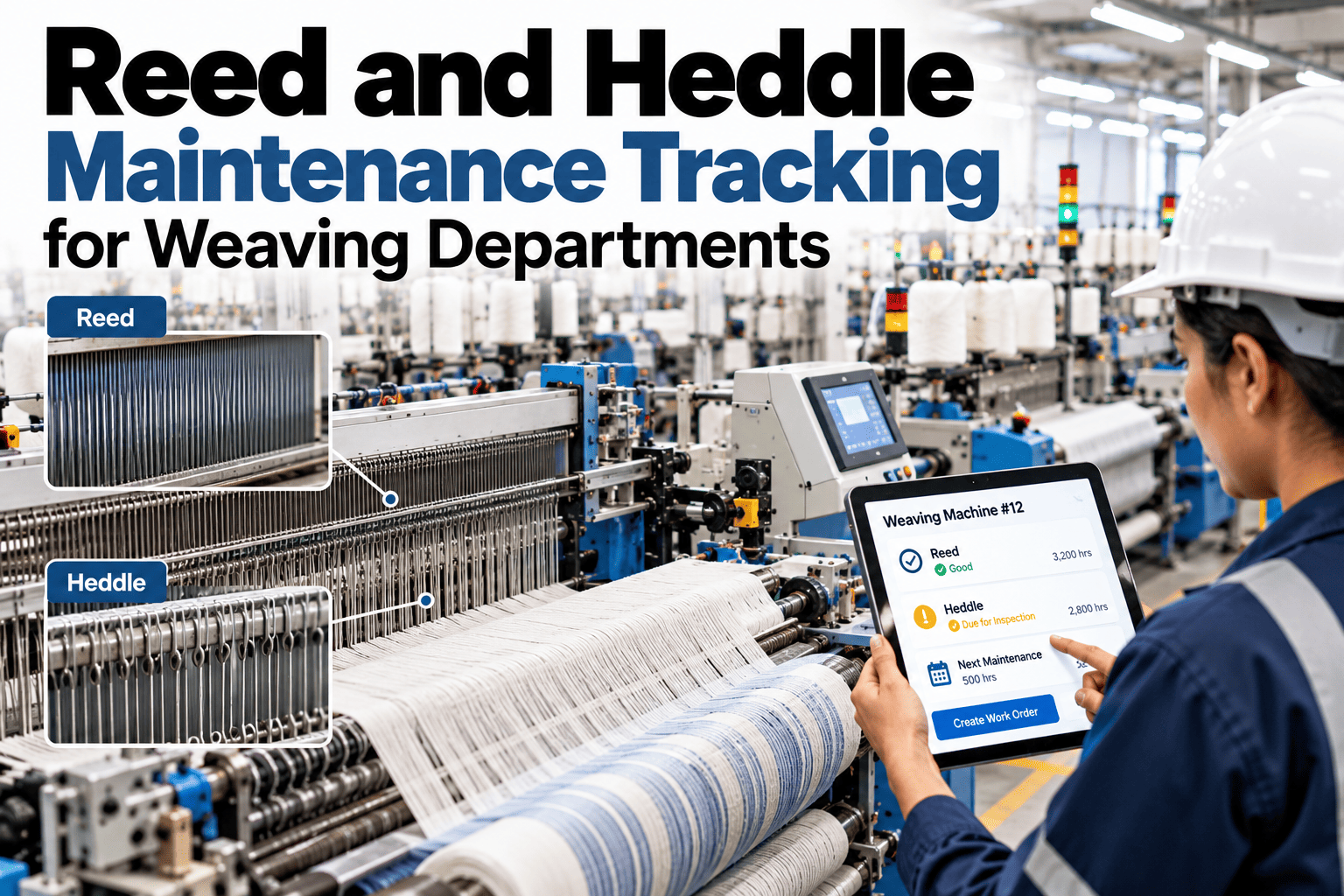
Reeds and heddles wear out quietly. A bent dent or a worn heddle eye barely changes how a loom runs, yet it chafes warp ends, raises breaks and leaves reed marks that show in the finished cloth. Because they are small, cheap and numerous, most sheds track them loosely, and then pay for it in quality. This checklist gives reeds and heddles a proper life record, and weaving departments can ask iFactory AI how each reed and heddle set is tracked from install to retirement.
The Reed and Heddle Maintenance Tracking Checklist
iFactory AI keeps a life record for every reed and heddle set, so inspection, repair and replacement happen on evidence instead of habit.
Where Each Checklist Fits in a Set's Life
Every reed and heddle set passes through the same stages. Each checklist below belongs to one of them.
Tick First: Wear Signs and Their Effect
Know what you are looking for before you start ticking. This table links each wear sign to what it does to the warp and the cloth.
| Wear Sign | Effect on Warp | Effect on Cloth |
|---|---|---|
| Burred or rough dents | Chafed and fuzzy ends | Reed marks and streaks |
| Bent dents | Uneven end spacing | Visible lines in the cloth |
| Grooved heddle eyes | More friction and breaks | Hairiness and snags |
| Rust or build-up | Sticking and uneven movement | Irregular cloth texture |
Checklist 0: Identify Every Set
A set with no identity has no history. Tick these boxes once, at the start, for every reed and heddle set.
Checklist 1: Incoming Inspection
Check every new or reconditioned set before it reaches the loom, because faults are cheapest to find on the bench.
Checklist 2: At Every Warp Change
This is the best moment to inspect, because the set is out and the loom is already stopped.
Give Every Reed and Heddle a Life Record
Book a 30-minute session and iFactory AI will show how reeds and heddles are logged, inspected and retired for your weaving department.
Checklist 3: While the Loom Is Running
Watch for early signs between warp changes. These boxes take a minute during each round.
Checklist 4: Repair, Recondition or Retire
Make the decision with evidence, not mood. Tick the boxes to see which way the set should go.
Checklist 5: Storage and Handling
Many sets are damaged between jobs, not on the loom. Good habits cost nothing.
Checklist 6: Weekly and Monthly Audit
A short audit keeps the whole system honest. Run it with the person who owns the warp store.
Mistakes to Avoid: The Do-Not-Tick List
If any of these describe your department, fix them before trusting your records.
What iFactory AI Ticks Off For You
iFactory AI is smart manufacturing and industrial software for textile operations. These items can run automatically once records are connected.
Score Your Department
Count the boxes you can honestly tick across Checklists 0 to 6, then read your result.
Under 15 ticked
Records are not yet reliable. Start with identity and incoming inspection.
15 to 30 ticked
The basics are in place. Focus on warp change inspection and defect matching.
30 to 40 ticked
A strong system. Automate counting and refine retirement rules.
Above 40 ticked
Excellent. Benchmark against other sheds and share the routine.
Review of Reed and Heddle Tracking
A practical review of what keeps reed and heddle records useful, written as editorial guidance rather than a named expert quote.
Identify every set
Without a unique identity, wear cannot be traced and the same fault recurs.
Track usage, not dates
Picks or metres since service reflect real wear better than calendar time.
Close the loop on defects
Each cloth defect should be checked against the set that wove it.
Frequently Asked Questions
How often should reeds and heddles be inspected?
At every warp change as a quick check, with deeper inspection set by picks or metres woven. The right interval depends on yarn, speed and style. Plan inspection intervals with the team in a live session using your own data. A usage-based interval also lets a rarely used set last longer, instead of replacing it by calendar date.
Is it worth tracking low-cost parts?
Yes, because their effect on quality and warp breaks is out of proportion to their price. A small tracking effort prevents costly rework on finished cloth. Over time the cost of tracking is small compared with the rework avoided on a single large order.
How are sets identified?
Usually with a tag or code linked to the record, so the set can be traced from loom to loom. Ask support what identification methods work best in your shed before you begin. Simple tags or stamped codes work well, as long as the same code is written into the record every time.
Can records show which set caused a defect?
Yes, when the set running on each loom is logged with the style and dates. A defect can then be matched back to the set quickly, often within minutes. Matching defects to sets also shows which sets deserve earlier retirement or reconditioning.
How do we start without disrupting production?
Begin with one style and its sets, adding the rest as habits form. Book a call to scope a light first rollout that fits around normal warp changes. Starting with one style keeps the effort small while the team learns what a good record looks like.
Stop Letting Small Parts Cause Big Defects
iFactory AI gives every reed and heddle set an inspection history and a retirement plan. Book a walkthrough to see it on your own weaving records.