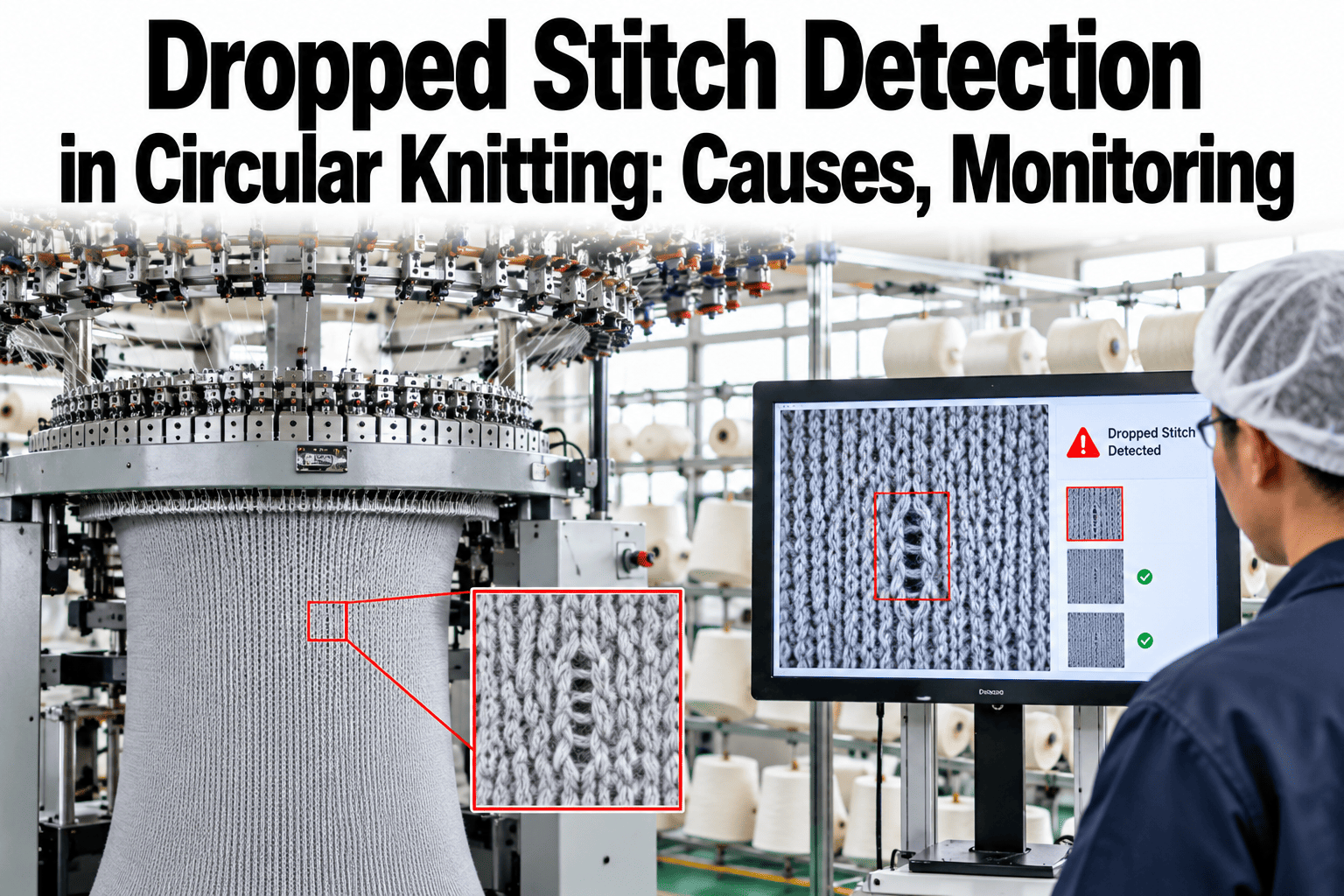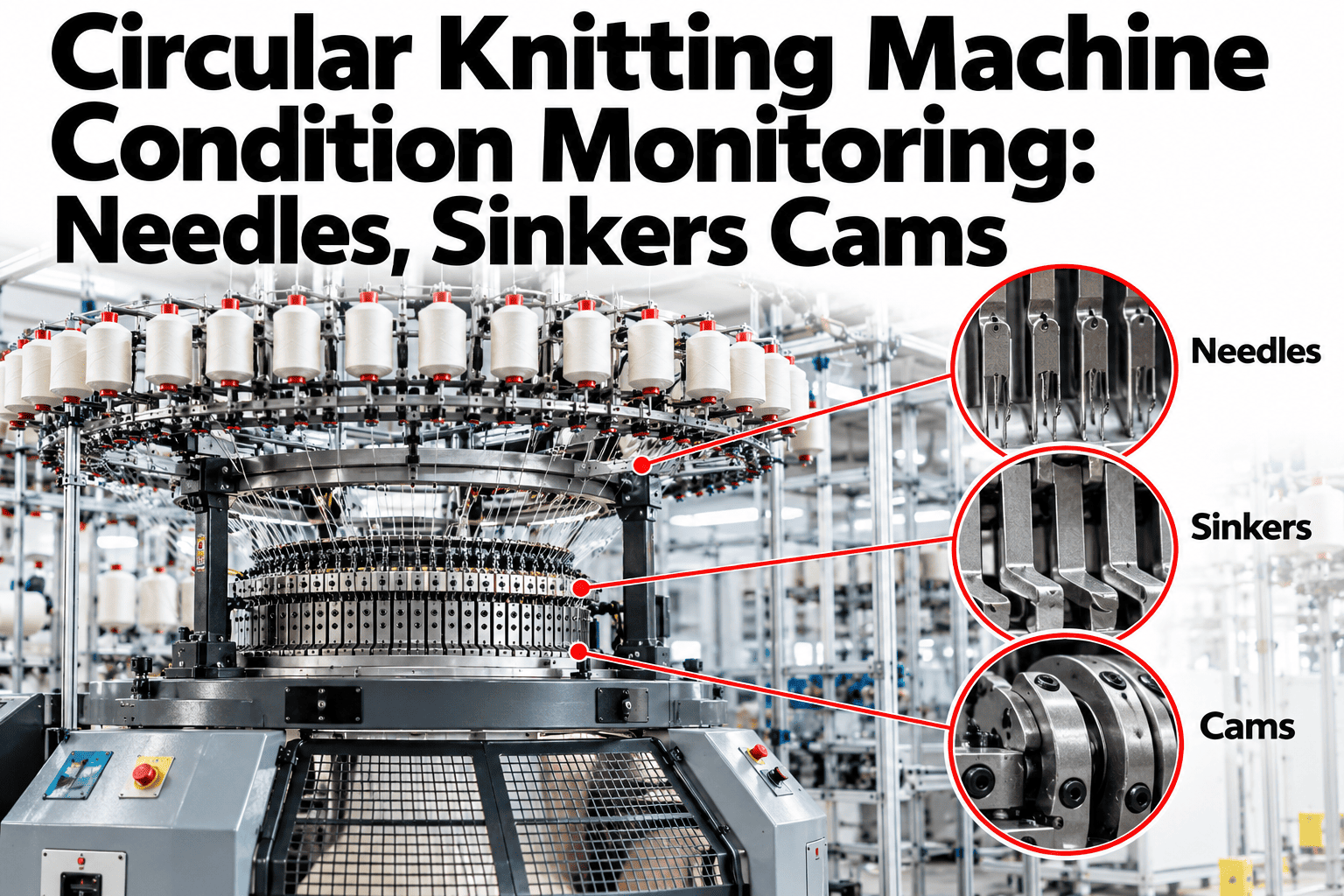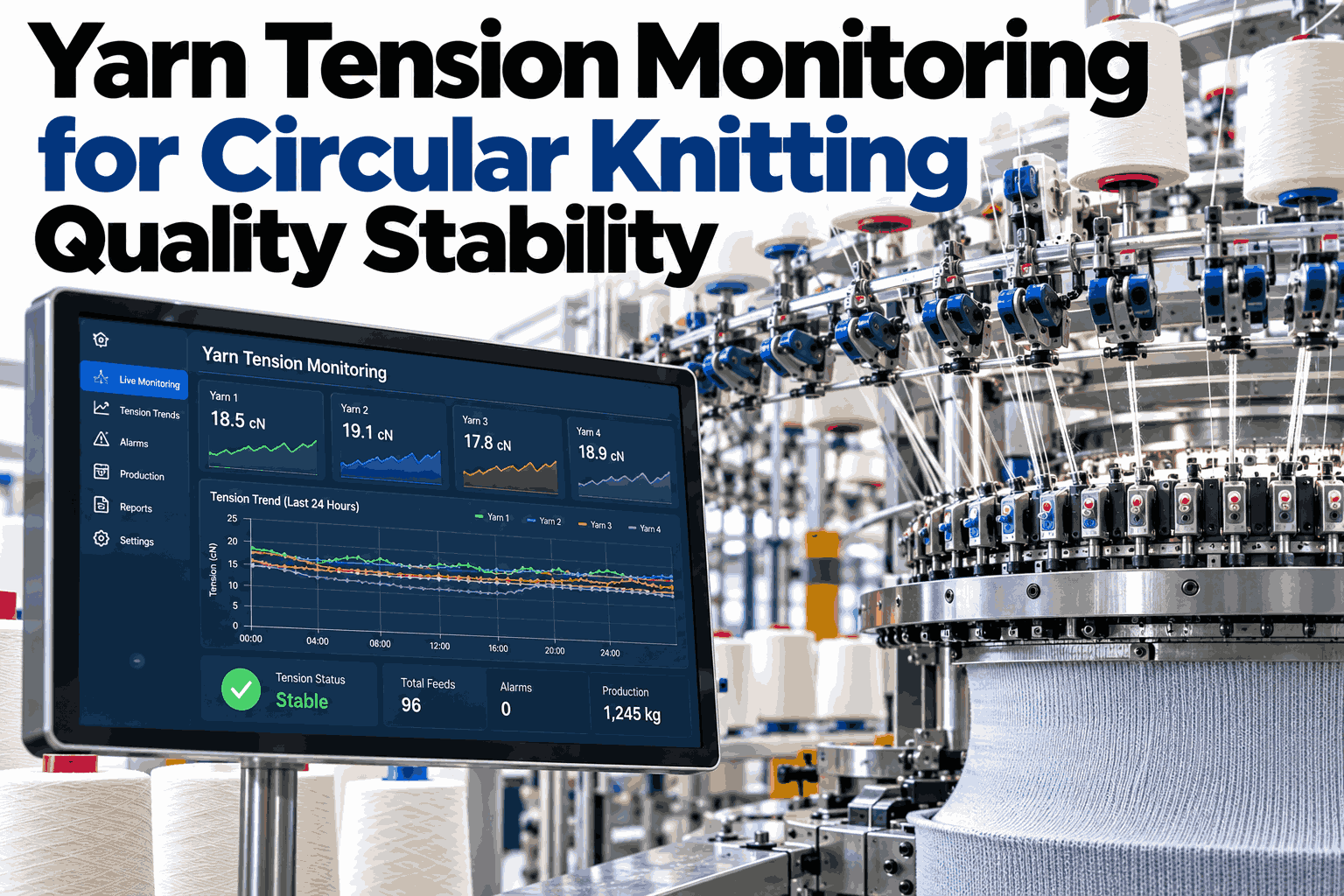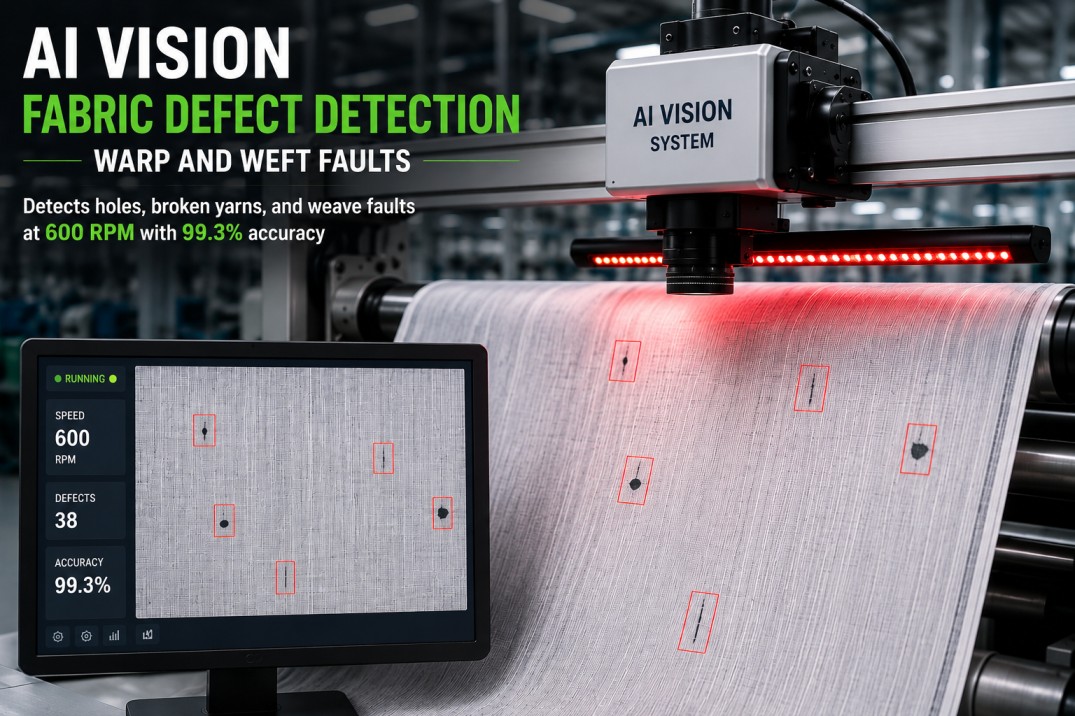
A 24-machine tricot facility running a mix of high-speed tricot and raschel warp knitting machines typically operates at 68 to 76 percent OEE — losing 24 to 32 percent of theoretical output to speed reductions, yarn breakage stoppages, guide-bar-related defects, and needle fatigue. Guide bar misalignment of just 0.3 millimeters produces visible barring defects that downgrade entire rolls. iFactory Real-Time Warp Knitting Monitoring Platform tracks guide bar pitch deviation, needle condition, yarn tension, and fabric structure at sub-millimeter resolution — detecting drift before it produces defective fabric and lifting OEE above 92 percent. Book a demo to see how mills using AI-based warp knitting monitoring reduce guide-bar-related seconds by 94 percent and recover 14 percentage points of OEE within 90 days.
Stop Guide Bar Drift From Becoming Roll-Wide Seconds Fabric.
iFactory's real-time monitoring catches guide bar pitch deviation, compound needle fatigue, and yarn tension variation at sub-millimeter precision — preventing defects before they accumulate. Deployed on tricot and raschel frames without machine modification.
Where Warp Knitting Machines Lose 24 to 32 Percent of Potential Output
Every warp knitting operation contends with the same six categories of production loss. The difference between mills running at 68 percent OEE and those above 92 percent lies in how each loss is detected — and how quickly the response is triggered. The breakdown below reflects measured data from 38 tricot and 22 raschel machines across 16 mills.
Speed Reduction Below Rated RPM
Tricot frames rated for 3,000+ rpm frequently run at 2,200 to 2,600 rpm due to yarn quality variation, tension fluctuation, and operator conservatism. Each 100 rpm below rated speed reduces output by 3.3 percent.
Yarn Breakage Stoppages
Warp yarn breaks account for the highest frequency of stoppages on both tricot and raschel machines. Average 3.4 breaks per 100,000 ends per hour on tricot, 5.8 on raschel due to higher tension variability in pattern bars.
Guide Bar Misalignment & Setup Changeovers
Pattern changes on raschel machines require guide bar re-pitching that averages 47 minutes per changeover. Misalignment of 0.3 mm or more produces visible barring defects until detected and corrected. Hidden drift goes unnoticed for hundreds of meters.
Compound Needle Fatigue & Breakage
Needle fatigue builds gradually over 4,000 to 6,000 operating hours. A single broken compound needle on a 200+ needle-per-inch tricot machine creates a vertical press-off that can propagate across the full fabric width before the operator responds.
Tension Variation & Yarn Quality Faults
Incoming yarn package quality variation, incorrect tension bar settings, and environmental humidity shifts cause intermittent tension spikes that produce streakiness and cloudiness in tricot fabric — often invisible until dyeing.
Planned Maintenance & Scheduling Inefficiency
Fixed-interval maintenance schedules replace needles and service guide bars on a calendar basis rather than actual condition — either wasting usable component life or running degraded components past optimal replacement point.
The Cost of 0.3 mm Guide Bar Drift: Measured Impact on Fabric Quality
Guide bar pitch deviation is the single largest preventable cause of downgraded fabric in warp knitting. Below a 0.3 mm threshold, barring defects are invisible to standard inspection. Above it, defect severity escalates rapidly with each additional 0.1 mm of drift — compounding across the full fabric width.
RPM vs. Defect Rate: Finding the Optimal Operating Point for Each Fabric Construction
Running a warp knitting machine at maximum rated speed does not maximize OEE. The optimal RPM varies by fabric construction, yarn count, and pattern complexity. Operating above the optimal point increases defect rate faster than it increases output — reducing net first-quality yield per hour. The data below represents measured performance across 38 tricot and raschel frames.
Plain Tricot — 40D Nylon
High-speed tricotTwo-Bar Tricot — 20D Polyester
Fine-gauge tricotRaschel — 100D Textured Polyester
Standard raschelRaschel Power Net — 40D Nylon / 20D Spandex
Elastic raschelKnow the Exact RPM That Maximizes First-Quality Output for Every Article.
iFactory's platform monitors guide bar pitch, needle condition, and yarn tension in real time — recommending optimal speed settings for each fabric construction and alerting the moment drift or fatigue exceeds tolerance. No modifications to your existing tricot or raschel frames.
From Guide Bar to Fabric Roll: The Four-Stage Warp Knitting Monitoring Pipeline
The iFactory platform monitors warp knitting machines through four integrated sensing and analysis stages — tracking mechanical condition, yarn behavior, and fabric quality simultaneously at full production speed. Each stage feeds into a unified dashboard that alerts operators and supervisors before defects propagate.
Guide Bar Pitch Sensing
MechanicalHigh-resolution linear encoders mounted on each guide bar measure pitch position at 0.05 mm resolution, 200 times per second. Deviation from the programmed pattern position triggers an alert at 0.15 mm — well before the 0.3 mm threshold where barring becomes visible. Pattern changeovers are verified automatically, eliminating setup errors that account for 23 percent of guide-bar-related defects.
Needle Condition Monitoring
Vibration + AcousticPiezoelectric vibration sensors and acoustic emission detectors mounted on the needle bar capture the signature frequency profile of each compound needle row. Fatigue progression shifts these frequencies by measurable amounts 6 to 8 weeks before needle breakage occurs. The platform predicts remaining useful life per needle row, enabling condition-based replacement instead of fixed-interval changes.
Yarn Tension & Break Detection
Real-TimeIndividual end tension sensors on each guide bar feed data at 50 ms intervals. Tension spikes above programmable thresholds trigger immediate machine stop — reducing yarn break propagation time from seconds to milliseconds. Historical tension data per yarn package enables upstream quality feedback to the winding department.
Fabric Structure AI Vision
Computer VisionA line-scan camera at the fabric take-down point captures the full fabric width at full production speed. A lightweight CNN trained on 78,000+ warp-knit fabric images detects barring, press-off, holes, miss-laps, and streakiness in real time — classifying each defect by type, severity, and across-machine coordinate. Combined with guide bar and needle data, the platform pinpoints the root cause of every defect that reaches the fabric.
Condition-Based Needle Replacement Saves $18,000 Per Machine Per Year
Fixed-interval compound needle replacement every 5,000 hours is standard practice — but actual needle wear varies by fabric type, yarn abrasiveness, and operating speed. Replacing on a fixed schedule wastes 30 to 40 percent of usable needle life on low-wear articles while risking breakage on high-wear articles. The table below shows the measured cost comparison between fixed-interval and condition-based replacement strategies across 22 machines.
| Metric | Fixed-Interval (5,000 hr) | Condition-Based (AI) | Difference |
|---|---|---|---|
| Needle replacements per year per machine | 2.4 | 1.8 | 25% fewer |
| Needle breakage stoppages per 1,000 hr | 3.7 | 1.2 | 68% reduction |
| Needle-related fabric defects per roll | 2.8 | 0.6 | 79% fewer defects |
| Replacement needle cost per machine per year | $4,800 | $3,600 | $1,200 savings |
| Downtime due to needle breakage (hr/yr) | 14.2 | 4.6 | 68% less downtime |
| Seconds fabric from needle defects (m/yr) | 1,240 | 260 | $14,700 savings |
| Total annual cost per machine | $22,400 | $4,400 | $18,000 savings |
Measured Outcomes Across 60 Warp Knitting Machines in 16 Mills
Mills deploying the iFactory warp knitting monitoring platform recorded consistent and compounding improvements across OEE, quality, and maintenance cost metrics within the first 120 days of operation.
Frequently Asked Questions
How does the platform differentiate between tricot and raschel machine monitoring requirements?
The platform is configurable per machine type. For tricot machines — which run at higher speeds (up to 3,000+ rpm) with simpler pattern structures — the emphasis is on guide bar pitch precision at 0.05 mm resolution and high-speed tension monitoring. For raschel machines — which run at lower speeds (600 to 1,200 rpm) but carry more guide bars and complex patterns — the platform adds multi-bar coordination monitoring, pattern changeover verification, and enhanced fabric structure AI trained on raschel-specific defect patterns (miss-laps, dropped stitches, pattern repeat errors). The same edge compute hardware supports both machine types; configuration is applied per machine during the one-day installation.
Can the system detect barring defects that are invisible to human inspectors?
Yes. Barring defects caused by guide bar pitch deviation of 0.3 to 0.5 mm are invisible to standard visual inspection and typically missed by off-line inspection frames. The line-scan camera and CNN-based fabric inspection model detect sub-visual pitch variation by analyzing periodic density variation across the fabric width at pixel-level resolution. In deployment, the system detects incipient barring at 0.2 mm drift — before any human-visible defect appears — and alerts the operator to adjust the affected guide bar during the next scheduled stoppage. Mills using this capability report eliminating 94 percent of barring-related downgrades.
How does condition-based needle replacement work compared to fixed-interval schedules?
Fixed-interval replacement changes needle rows every 5,000 operating hours regardless of actual wear. This approach wastes 30 to 40 percent of usable needle life on low-wear fabric styles while risking breakage on high-wear styles. Condition-based replacement uses piezoelectric vibration sensors and acoustic emission detectors mounted on the needle bar to measure the frequency signature of each needle row. As compound needles fatigue, the frequency profile shifts in measurable bands — typically beginning 6 to 8 weeks before breakage risk becomes significant. The platform predicts remaining useful life per needle row and generates a replacement recommendation when the probability of breakage exceeds 2 percent in the next 500 hours. This eliminates unexpected breakage stoppages while maximizing the service life of every needle row.
What sensors need to be installed on each machine, and does installation require production downtime?
Per machine, the installation includes: one linear encoder per guide bar (magnetic strip mounted on the guide bar frame, read head on the bar), two piezoelectric vibration sensors on the needle bar housing, one acoustic emission sensor, tension sensors on each guide bar yarn sheet (retrofit roller assembly), and one line-scan camera at the fabric take-down point. All sensors mount using existing bolt holes or magnetic bases — no drilling, welding, or machine modification required. Installation per machine takes 4 to 6 hours and can be performed during a scheduled maintenance window or changeover. For a 20-machine facility, full deployment is typically completed within 10 business days with no unplanned production downtime.
How does the platform handle pattern changeovers on raschel machines with multiple guide bars?
During a pattern changeover, the operator selects the new article from the platform's recipe library. The system provides a step-by-step guide bar pitch setup sequence on the operator's tablet, showing the target pitch for each bar. After manual setup is completed, the system runs an automated verification cycle — measuring actual pitch position for each bar and comparing it to the recipe. Any bar outside the 0.15 mm tolerance is flagged for re-pitching before production starts. This automated verification eliminates the most common source of pattern-change defects: undetected pitch errors that produce barring across the first 50 to 200 meters of fabric before an operator spots the problem. Mills using this feature report 89 percent fewer pattern-change-related defects.
What is the measurable ROI for a mid-size warp knitting facility with 20 machines?
Based on deployment data across 16 mills, a 20-machine facility with a 74 percent OEE baseline and 78 percent first-quality yield achieves the following annual improvements across three categories: $72,000 in recovered OEE (14 percentage point improvement representing 1,200 additional first-quality production hours), $31,000 in defect waste reduction (94 percent cut in guide-bar-related seconds plus 79 percent reduction in needle-defect fabric), and $25,000 in maintenance savings (condition-based needle replacement, fewer breakage stoppages, extended component life). Combined annual savings total approximately $128,000. At a typical deployment investment of $36,000 for 20 machines including all sensors, edge compute, and first-year platform fees, the payback period averages 3.4 months. These savings expand as the AI model accumulates mill-specific data and improves predictive accuracy over successive production cycles.
Lift Your Warp Knitting OEE Above 92% With Sub-Millimeter Precision Monitoring.
iFactory's platform detects guide bar drift at 0.05 mm, predicts needle fatigue 8 weeks before breakage, and catches fabric defects at full production speed. 94 percent fewer guide bar defects. 68 percent less needle breakage. 3.4 month ROI.