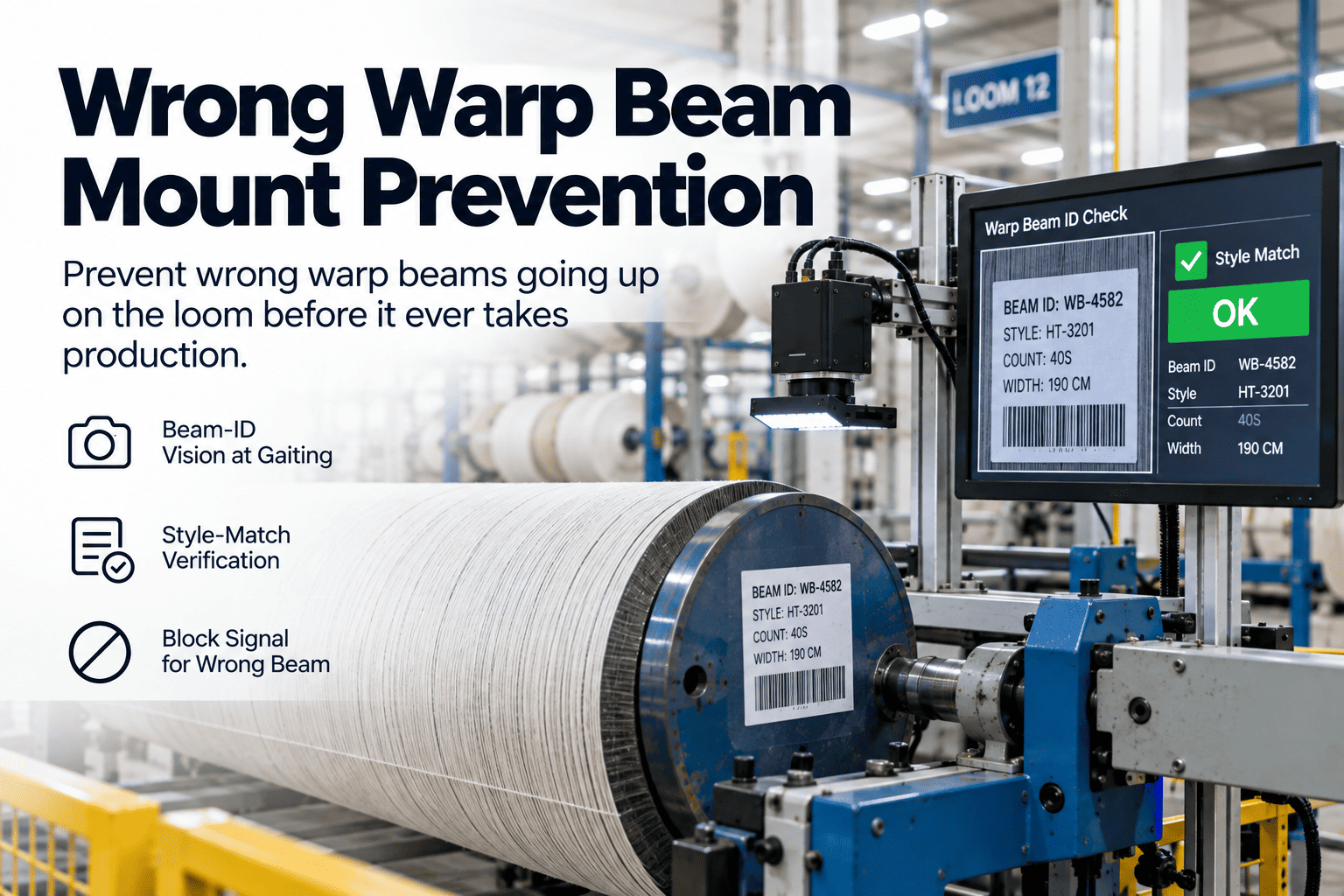
Wrong warp beams mounted on the wrong loom are one of the most expensive weaving prep errors — a beam intended for a bedsheet mounted on a loom set up for a curtain produces fabric that fails both intents, wastes the first 100-300 metres before someone catches it, and often requires the loom to be re-gaited entirely. Barcode systems help but require operator scanning discipline; loom controller integrations reach only some fleets. Vision AI at gaiting reads the beam ID at mount and checks it against the loom's scheduled style — blocking gaiting when the beam doesn't match.
iFactory / Wrong warp beam prevention
Block Wrong Warp Beams at Gaiting — Before the Loom Takes Production
Vision AI at loom gaiting station reading beam ID (OCR of beam label or barcode) and matching against the loom's scheduled style — mismatch blocks gaiting completion and alerts the weaving prep supervisor before the loom produces a single wrong-style pick.
2
Vision reads beam ID (barcode / OCR)
3
Match against loom's scheduled style
4
Mismatch → gaiting blocked · alert supervisor
Vision OCR
beam ID at gaiting
Style match
against schedule
The Problem in Warp Beam Mount Control
A typical weaving prep operation handles 40-120 beam changes per week across a shed of 200-500 looms. Beams sit in warp storage tagged with a beam identifier and a style code; prep pulls a beam per the day's schedule and delivers it to the loom for gaiting. When the wrong beam gets pulled — paperwork error, similar-looking style code, urgent request that jumps queue — the beam gets gaited before anyone catches it. First 100-300 metres come off the loom in the wrong style; grey inspection catches it; the loom is stopped; the correct beam has to be located; total cost runs into low thousands per event.
Where Wrong-Beam Mounts Actually Happen
Wrong warp beam mount failure modes are consistent across weaving prep operations. Each is a specific attention failure that vision-based gaiting-station check prevents.
Similar style codes
Two styles with codes differing by one character. Prep operator pulls the wrong beam in a rushed moment. Neither the tag nor the loom flag it.
Beam re-storage confusion
Beam pulled for one loom, plans change, beam returned to storage in wrong slot. Next pull operates on incorrect location assumption. Wrong beam delivered.
Verbal handoff error
Verbal beam-request-and-delivery between prep and weaving. Beam identifier read wrong or heard wrong. Wrong beam arrives at loom without either party catching it.
Rush override
Urgent production need drives prep to skip normal verification. Beam mounted without cross-check. First metres reveal the error at cost.
What Good Looks Like in Beam Mount Prevention
A working beam mount prevention holds four disciplines together — vision-based beam ID at gaiting, real-time style match against loom schedule, hard block on mismatch, and supervisor alert with resolution path.
Vision Beam ID
Vision camera at gaiting station reads beam identifier via barcode capture or OCR on beam label. Robust to worn, dusty, or partially visible tags. No operator scanning required.
No operator scan needed
Style Match
Beam ID checked against loom's scheduled style from weaving MES in real time. Match confirms gaiting can proceed. Mismatch triggers block workflow.
Real-time schedule check
Hard Block
Mismatch blocks gaiting completion — physically via gaiting station interlock where possible, procedurally via alert and supervisor sign-off where physical interlock unavailable.
Block, not warn
Supervisor Alert
Alert to weaving prep supervisor with beam ID, loom, expected style, delivered style, and resolution path (correct beam location, or re-schedule permission). Fast resolution, minimal loom downtime.
Fast resolution path
How iFactory AI Fits
iFactory AI overlays your loom gaiting stations, weaving MES, and warp beam tracking system — providing the vision-based beam ID capture and style-match logic that prevents wrong-beam mount without depending on operator scan discipline.
Gaiting Vision
Vision Layer
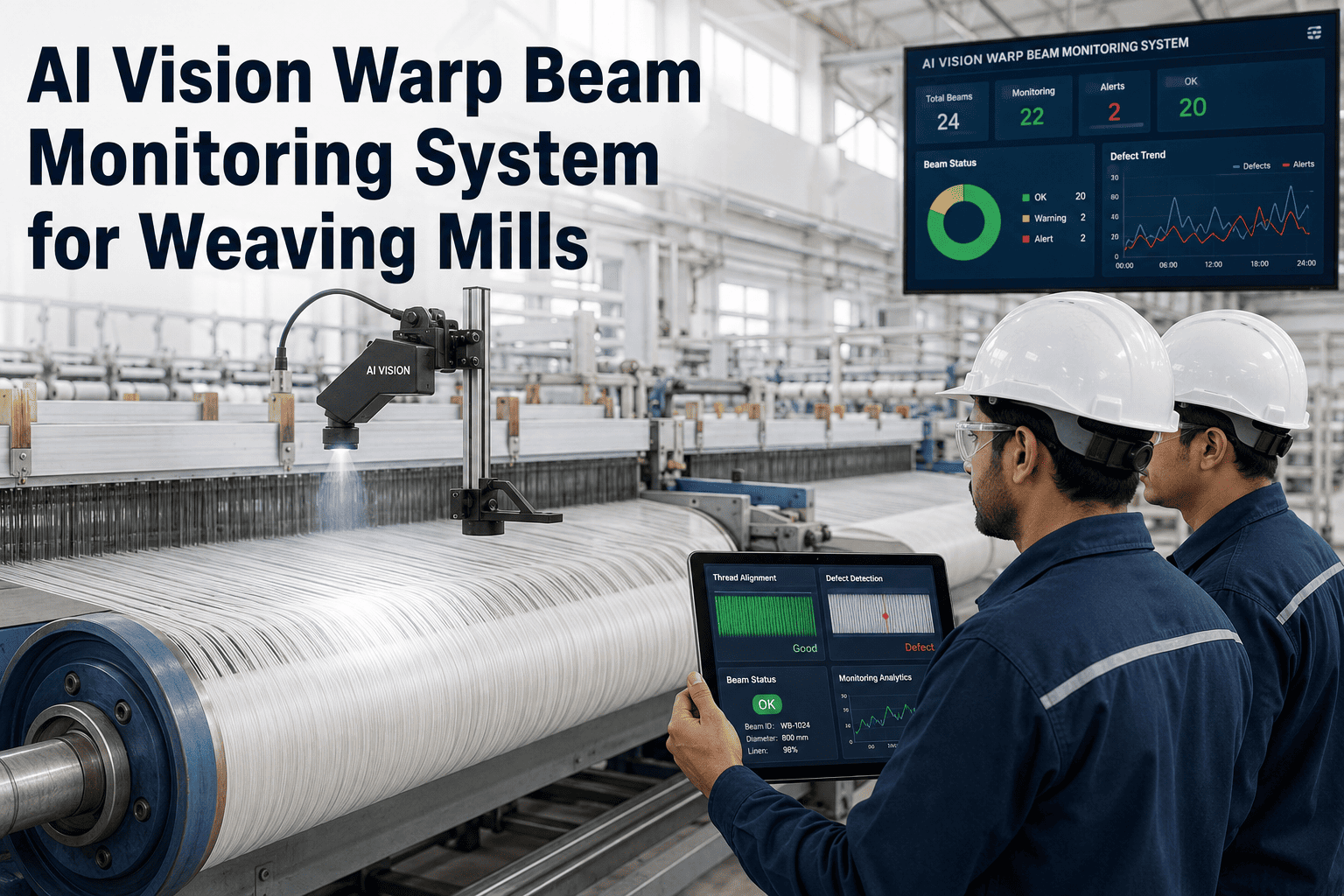
Vision camera at gaiting station reading beam identifier via barcode or OCR. Robust to real-world tag conditions (worn, dusty, angled). No operator scanning workflow required.
Style Matcher
Vision + MES
Beam ID checked against loom's scheduled style from weaving MES. Real-time match/mismatch response. Configurable per mill for style-code format and matching rules.
Block Controller
Vision + Loom
Mismatch blocks gaiting completion via physical interlock where available or procedural block via alert. Loom controller signal prevents production start.
Alert + Resolution
Vision + Mobile
Supervisor mobile alert with beam ID, loom, expected/delivered style, and correct-beam location. Resolution path visible; permission-to-proceed workflow for schedule-change cases.
Ask your weaving prep supervisor how many wrong-beam mount events last quarter cost more than an hour of loom time. If any occurred, gaiting-station vision is the specific prevention that closes the pattern — because dependence on human verification alone doesn't scale to 100+ beam changes per week. Book a beam mount prevention review.
8-Week Beam Mount Vision Pilot on One Shed
One shed section, eight weeks. The pilot mounts vision at gaiting stations, activates style-match logic against MES, tests the block workflow, and closes the first month of wrong-mount prevention.
Weeks 1–2
Vision Deploy
Gaiting-station vision cameras mounted. Beam ID reading calibrated against sample beams. Baseline current-state wrong-mount frequency and cost.
Weeks 3–4
MES Style Match
Style-match logic against weaving MES live. Match/mismatch response tested. Match accuracy verified against schedule ground truth.
Weeks 5–6
Block Live
Block workflow live — physical interlock or procedural block per station capability. First mismatch events blocked and resolved through supervisor workflow.
Weeks 7–8
Prevention Rate
Wrong-mount events prevented measured. Supervisor response time to block events measured. Rollout to remaining shed sections scoped.
Who Owns the KPI
Beam mount prevention crosses weaving prep, warp storage, MES scheduling, and loom operations. Each function owns a specific KPI or the vision layer becomes yet another warning that gets overridden.
Weaving Prep Supervisor
Wrong-mount events per month
Owns the prevention outcome — wrong-mount events reaching production. Zero is the requirement; every event carries hours of cost and shed disruption.
Warp Storage
Beam ID accuracy at storage
Owns the source data — beams stored with correct identifier and location. Vision at gaiting is downstream defense; upstream discipline is where it prevents best.
MES Scheduling
Schedule change communication cycle
Owns the schedule integrity — schedule changes reflected in MES before gaiting. Missing schedule updates cause false block events.
Weaving Operations
Loom start-to-production time
Owns the ramp — time from beam gaiting to production start. Fast block resolution keeps ramp times short.
FAQ
What happens when beam tags are damaged or unreadable — does the system just block everything?
Robust vision-based beam ID handles damaged, dusty, or partially visible tags substantially better than barcode scanners require. Vision reads the beam identifier through multiple pathways — barcode (1D or 2D), OCR of the printed identifier, and where beam production process supports it, engraved or laser-marked identifiers. When all pathways fail to read confidently, the workflow surfaces the issue to the supervisor with the beam image for manual verification rather than blocking silently. Supervisor confirms beam ID; workflow proceeds with the manually-confirmed identifier. Where the beam-tagging process itself is producing many unreadable tags, that surfaces as a specific upstream issue for warp storage to address.
How does this integrate with our existing barcode or RFID beam tracking?
The vision layer complements existing tracking rather than replacing it. Where beams already carry RFID tags, the vision provides visual verification that confirms the RFID reading matches the physical beam label (which prevents RFID-tag swap errors, occasionally seen in high-throughput operations). Where beams carry barcodes, the vision provides fallback for damaged barcodes that scanners fail on. Where beams have both, the vision adds the style-match logic that neither tracking method carries — beam ID plus loom schedule cross-check with block-on-mismatch. What the vision doesn't do is replace investment already made in beam tracking infrastructure; what it does is close the gap between beam tracking and correct mount.
Book a demo to see the multi-tag integration.
What if we need to change beam mid-shift for legitimate urgent reasons?
Legitimate schedule changes are supported by supervisor override workflow. When production requires a beam change that doesn't match the current MES schedule (customer priority change, quality hold on scheduled style, machine reassignment), supervisor updates the loom schedule in MES or approves a specific override that permits gaiting of the new beam. The override carries authorisation and reason for audit — because indiscriminate override capability defeats the block discipline. Frequent overrides on the same loom surface as a signal that schedule discipline upstream needs attention. The workflow protects legitimate operational flexibility while preventing the accidental wrong-mount that vision was designed to catch.
Stop losing hours to wrong beams at production start.
Block Wrong Beams at Gaiting — Live on One Shed
Bring one shed section's last quarter of wrong-mount incident history, current beam-tagging system, and MES style-schedule structure. We'll walk what vision at gaiting would have blocked, and demonstrate the supervisor override workflow for legitimate schedule changes.